Project Management: The Managerial Process
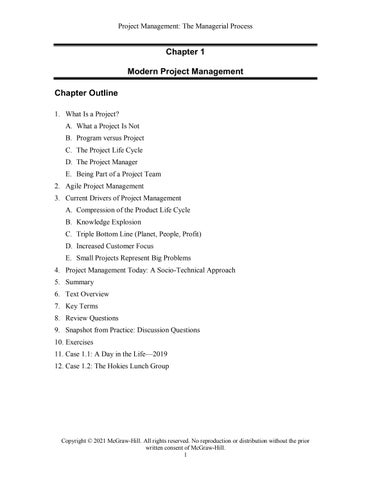
Chapter 1 Modern Project Management Chapter Outline 1. What Is a Project? A. What a Project Is Not B. Program versus Project C. The Project Life Cycle D. The Project Manager E. Being Part of a Project Team 2. Agile Project Management 3. Current Drivers of Project Management A. Compression of the Product Life Cycle B. Knowledge Explosion C. Triple Bottom Line (Planet, People, Profit) D. Increased Customer Focus E. Small Projects Represent Big Problems 4. Project Management Today: A Socio-Technical Approach 5. Summary 6. Text Overview 7. Key Terms 8. Review Questions 9. Snapshot from Practice: Discussion Questions 10. Exercises 11. Case 1.1: A Day in the Life—2019 12. Case 1.2: The Hokies Lunch Group
Copyright © 2021 McGraw-Hill. All rights reserved. No reproduction or distribution without the prior written consent of McGraw-Hill. 1
Project Management: The Managerial Process
Chapter Learning Objectives After reading this chapter you should be able to: LO 1-1
Understand why project management is crucial in today’s world.
LO 1-2
Distinguish a project from routine operations.
LO 1-3
Identify the different stages of a project life cycle.
LO 1-4
Describe how Agile PM is different from traditional PM.
LO 1-5
Understand that managing projects involves balancing the technical and sociocultural dimensions of the project.
Review Questions 1. Define a project. What are five characteristics which help differentiate projects from other functions carried out in the daily operations of the organization? A project is a complex, non-routine, one-time effort limited by time, budget, resource, and specifications. Differentiating characteristics of projects from routine, repetitive daily work are below: a. b. c. d. e.
A defined lifespan A well-defined objective Typically involves people from several disciplines A project life cycle Specific time, cost, and performance requirements.
2. What are some of the key environmental forces that have changed the way projects are managed? What has been the effect of these forces on the management of projects? Some environmental forces that have changed the way we manage projects are the product life cycle, knowledge growth, global competition, organization downsizing, technology changes, time-to-market. The impact of these forces is more projects per organization, project teams responsible for implementing projects, accountability, changing organization structures, need for rapid completion of projects, linking projects to organization strategy and customers, prioritizing projects to conserve organization resources, alliances with external organizations, and so on. 3. Describe the four phases of the traditional project life cycle. Which phase do you think would be most the difficult one to complete?
Copyright © 2021 McGraw-Hill. All rights reserved. No reproduction or distribution without the prior written consent of McGraw-Hill. 2
Project Management: The Managerial Process 1. Defining: Project specifications objectives are defined, and teams are formed with major responsibilities assigned. Much of this is referred to as defining the Scope of a project. 2. Planning: The creation of a comprehensive plan that includes schedules, budgets, staffing and risk assessment. 3. Executing: Work begins, deliverables are produced, and progress is monitored. 4. Closing: Putting the project to bed includes customer delivery, post project review or audit, and redeployment of project team. problematic. Disagreements at the customer acceptance can lead to rework, tension and in many cases litigation. Veteran project managers answer to this question would be ―It all depends‖. 4. What kinds of projects is Agile PM best suited for and why?
R&D work, technological breakthroughs, and creative endeavors.
5. The technical and sociocultural dimensions of project management are two sides to the same coin. Explain. The technical and sociocultural dimensions of project management are two sides of the same coin because successful project managers are skillful in both areas. The point is successful project managers need to be very comfortable and skillful in both areas.
Snapshot from Practice: Discussion Questions 1.1 The Project Management Institute 1. If you were a student interested in pursuing a career in project management how important do you think being CAPM would be? There is no data available on the value of the CAPM in the job market. Experts suggest at a minimum it demonstrates a strong interest in project management and a good understanding of the project management processes. Given the growing demand for people to work on projects, the CAPM may just separate you from other applicants. 2. How valuable do you think being a certified PMP is? Reliable data is hard to find. PMI reported that the median salary for a PMP is $108,200. Non-certified project managers, on the other hand, showed a median income of $91,000. According to a different survey, eighty percent of high-performing projects used PMP certified project managers. 1.3 London Calling: Seattle Seahawks versus Oakland Raiders Copyright © 2021 McGraw-Hill. All rights reserved. No reproduction or distribution without the prior written consent of McGraw-Hill. 3
Project Management: The Managerial Process 1. Why was it important to give players and staff a chance to explore London one evening? This will be a tough question for those not familiar with intense team sports. They will not be aware of the importance coaches devote to eliminating distractions that can disrupt team concentration and focus. Coach Carroll reportedly said, ―There was no avoiding the fact that we were in a foreign country. Players and staff were curious and excited, so we decided instead of denying it we would let them explore London‖. 2. What are one or two lessons you learned from this Snapshot? Several lessons can be gleaned from this Snapshot:
High performance projects need to devote significant attention to providing a work environment that supports high performance. The importance of interjecting fun on intense projects. The impact time zone changes can have on individual performance. The attention to detail exhibited in the project. The importance of managing the rhythm and pace of a group to accomplish project objectives.
Sports fans will draw attention to coach Carroll driving the players to the stadium the day before the game. This eliminated the distraction of not knowing what the field or locker room would be like. It answered the question of what kind of shoes the players would be wearing. Players like quarterback Russell Wilson like to form vivid, mental images of big plays the night before a big game. 1.4 Ron Parker 1. Do you agree with Ron Parker’s statement: ―To be successful, you must also be willing to run at problems/opportunities when everyone else is running away from them‖? This is somewhat of a philosophical question. While not the only way to become successful this is one path to success especially when other opportunities or advantages are not available. Tackling tough projects is a great way to gain visibility and establish a reputation. The flip side is that these projects are risky, and failure may damage one’s reputation. Organizations that excel at project management recognize that these projects often fail despite superior effort. They value experience and devote significant attention to improving future project performance by articulating lessons learned from current projects.
Copyright © 2021 McGraw-Hill. All rights reserved. No reproduction or distribution without the prior written consent of McGraw-Hill. 4
Project Management: The Managerial Process
Exercises 1. Review the front page of your local newspaper and try to identify all the projects contained in the articles. How many were you able to find? It is nearly impossible to open a newspaper and not find articles relating to projects. Sunday editions are especially good for this exercise. Even experienced project managers find the number of projects far greater than they would have predicted. Each one is managed by a project manager! This is a good illustration of the important role projects play in our daily lives. 2. Individually identify what you consider to be the greatest achievements accomplished by mankind in the last five decades. Now share your list with three to five other students in the class and come up with an expanded list. Review these accomplishments in terms of the definition of a project. What does your review suggest about the importance of project management? Typical responses center on technology, medical advances, space exploration—e.g., computer advances, laser operations and new drugs, building the space station. Often you have to point out that many of these projects are really programs. We usually select two or three student suggestions of projects (there will be plenty!) and ask the students to identify the kinds of problems the project manager of the project may have had to deal with. Again, once the students get into the exercise, the problems they can envision are many. These problems are placed on the board. After the board is nearly filled and most students have participated, we try to show or classify on the board the problems by the content of the text chapters. The intent is to demonstrate to the class the course and text will address many of the problems suggested by the students. 3. Individually identify projects assigned in previous terms. Were both sociocultural and technical elements factors in the success or difficulties in the projects? Students will naturally focus on sociocultural aspects in part because they are more familiar with concepts such as leadership, problem-solving, and teamwork than scope, WBS, and baseline budgets. Furthermore, interpersonal friction is often a source of consternation on student projects. The instructor may have to point out that interpersonal conflicts often arise from ill-defined scopes, uneven work schedules, and poor planning.
Copyright © 2021 McGraw-Hill. All rights reserved. No reproduction or distribution without the prior written consent of McGraw-Hill. 5