Instructor’s Resource
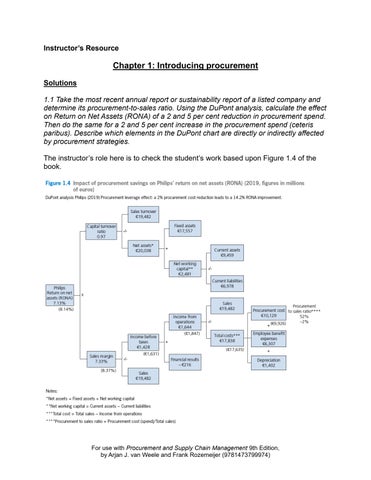
Chapter 1: Introducing procurement Solutions 1.1 Take the most recent annual report or sustainability report of a listed company and determine its procurement-to-sales ratio. Using the DuPont analysis, calculate the effect on Return on Net Assets (RONA) of a 2 and 5 per cent reduction in procurement spend. Then do the same for a 2 and 5 per cent increase in the procurement spend (ceteris paribus). Describe which elements in the DuPont chart are directly or indirectly affected by procurement strategies. The instructor’s role here is to check the student’s work based upon Figure 1.4 of the book.
For use with Procurement and Supply Chain Management 9th Edition, by Arjan J. van Weele and Frank Rozemeijer (9781473799974)
1.2 In your opinion, what constitutes procurement’s added value in a modern organization? Identify at least three areas where procurement contributes to competitiveness. What would you consider to be procurement’s core and non-core activities? Procurement policies can contribute to business success in three ways: 1. Policies can improve sales margins through realizing substantial cost savings (e.g. introducing new suppliers, competitive tendering, looking for substitute materials). A dollar saved in procurement is a dollar added to the bottom line. 2. Through better financial, quality and logistics arrangements with suppliers, procurement can contribute to a higher capital turnover ratio (e.g. longer payment terms, reduction of inventories through just-in-time (JIT) delivery agreements with suppliers, quality improvement which will lead to less buffer stock required and leasing instead of buying equipment). 3. Procurement can improve the company’s topline (i.e. sales turnover). Suppliers may contribute to the company’s innovation process, resulting in new products or solutions. Core versus non-core activities of the procurement function Procurement can be defined as: ‘Managing the company’s external resources in such a way that the supply of all goods, services, capabilities and knowledge which are necessary for running, maintaining and managing the company’s primary and support activities is secured at the most favourable conditions.’ From this definition it may be derived that the procurement function covers the following core activities: • Determining the specification • Selecting the most suitable supplier • Preparing and conducting negotiations with suppliers in order to establish an agreement • Placing orders by selected suppliers • Monitoring and controlling the orders (expediting) • Follow up and evaluation With regards to the last three activities: these may be delegated to the user (i.e. other departments), provided that the procurement organization has provided in an integrated order to pay system (i.e. solution). The procurement function does not include responsibility for, but needs to be synchronized with: • Materials requirement planning • Materials scheduling • Inventory management • Incoming inspection and quality control
For use with Procurement and Supply Chain Management 9th Edition, by Arjan J. van Weele and Frank Rozemeijer (9781473799974)
1.3 Discuss the major differences between procurement, sourcing and supply management as presented in this book. How do these concepts relate to supply chain management and value chain management? Would you consider procurement to be a subset of supply chain management, or should it be seen as the coordinating function that drives the entire supply chain? Discuss. • • • •
Procurement relates to determining specifications, selecting suppliers, negotiating contracts, ordering, expediting and follow up and evaluation. Supply: apart from procurement, it also includes the stores and receiving function of internally consumed items such as office supplies, cleaning materials, etc. Sourcing: relates to developing the most appropriate supplier strategy for a certain commodity or product category. Supply management relates to procurement activities but also to supplier qualification and selection, partnering and strategic alliances, monitoring of supply markets, strategic materials acquisition plans, and monitoring of supplier quality improvement.
Procurement manages the upstream part of the supply chain. Accordingly, procurement as a function is part of the broader range of functions that encompass supply chain management (SCM). SCM also encompasses elements such as production schedules, material planning, inventory management, distribution management, demand planning, and sales. Value Chain Management builds on SCM. Here the idea is that suppliers are challenged by the (larger) customer organization to improve its value proposition to its endcustomers. Value chain management focuses on value creation across the chain of supply. Through a value scope, each entity in the supply chain considers its core competence. This allows for a competitive advantage in the market. It creates a network of supply where each entity in the network is in charge of part of the value creation of the final product or service offered to consumers. Usually, the supplier works closely together with the customer’s technical and marketing staff to reduce the product’s overall costs, add new designs or features to the product which are attractive to the end-customer. 1.4 The chapter distinguishes between the procurement function and the procurement department. Explain the differences between the two and discuss why it is important to make this distinction in modern organizations, particularly in light of cross-functional collaboration, digital procurement tools and stakeholder involvement. Procurement function covers all activities for which the company receives an invoice from outside parties (e.g. specifying, selecting, contracting, ordering, expediting and evaluating). Many of these activities may be arranged for by the internal customers (e.g. marketing, IT and production departments) without interference from the procurement department. The scope of the procurement function is usually much broader than that of For use with Procurement and Supply Chain Management 9th Edition, by Arjan J. van Weele and Frank Rozemeijer (9781473799974)
the procurement department. Therefore, it is important to differentiate between the two. 1.5 Reflect on the new developments shaping procurement today. Describe at least three emerging digital technologies and discuss how they may impact the procurement function in general and the relationships with suppliers in particular. How do these technologies change the skills required of future procurement professionals? Procurement has developed greatly over the past three decades and it continues to evolve. A major driver for this development is digitalization. Existing technology and emerging digital technologies (e.g. e-sourcing, big data, blockchain, AI, robotic process automation) not only enable companies to improve their procurement process internally but also their relationships and collaboration with suppliers across their supply chains. Digitalization allows for stronger integration across supply chain functions, sales and operations planning, inventory control, quality inspection and procurement. This allows for improved productivity in procurement and across the supply chain as a whole. However, to achieve this system standardization across the different entities in the supply chain is a prerequisite. Suppliers need to be seamlessly integrated within these digital applications. This becomes a critical point of focus when considering new suppliers, to ensure that all selected suppliers can integrate with current digital systems already in place. It is also critical to consider the supplier’s potential in adapting new technologies which your own organization is considering as part of its procurement strategies.
For use with Procurement and Supply Chain Management 9th Edition, by Arjan J. van Weele and Frank Rozemeijer (9781473799974)
Instructor’s Resource
Chapter 2: The procurement process Solutions 2.1 To what extent do you consider the procurement process model presented in this chapter to be complete? Based on practical experience or specific industry needs, what would you like to add, remove or change? A model is always a simplified representation of the complex world. This means that not all variances that exist in reality can be captured. For example, the start of the purchasing process in the model is the definition of the specification; this should be preceded by an assessment and prioritization of business needs. It should also be considered whether this need can be insourced, or whether it should be outsourced. Therefore, some critics argue that make-or-buy should be included in the model. Next, some critics argue that the model should follow a circular model, as supplier performance should be used to qualify and select suppliers for future needs. Finally, critics argue that the repetitive character of most buying activities is not sufficiently reflected in the model. The model seems to illustrate only a one-time, new task buying situation. 2.2 What is meant by ‘procurement governance’? What rules, policies and procedures are required for a company to put proper ‘procurement governance’ in place? To prevent problems in the purchasing process, like poor administrative processes, personal relations or preferences, companies need clear rules and guidelines with regard to procurement governance. A professional administrative organization should be in place that ensures that no invoice is paid without a purchase order number. Another principle could be that, from a certain financial value, the organization commits itself to issuing three competitive bids before awarding a contract to a supplier. A third principle could be that the organization decides that a formal contract is needed before engaging in a formal relationship with a supplier and making any purchase order. These rules and guidelines should be communicated to the supplier community with the names of the persons who will have procurement authority. Procurement authority needs to be differentiated from budget authority. 2.3 Imagine you are a procurement manager at a consumer electronics manufacturer. Using the procurement process model as a guide, how would you work towards achieving zero-defects deliveries from the suppliers to your factory?
For use with Procurement and Supply Chain Management 9th Edition, by Arjan J. van Weele and Frank Rozemeijer (9781473799974)