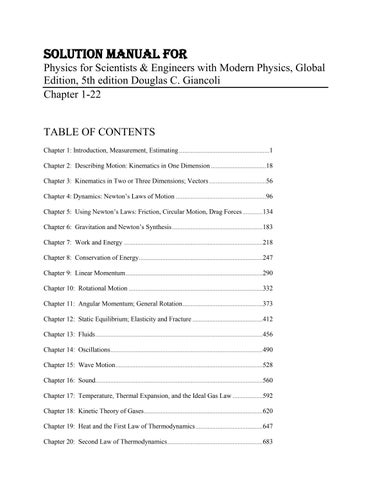
Solution Manual for Physics for Scientists & Engineers with Modern Physics, Global Edition, 5th edition Douglas C. Giancoli Chapter 1-22
TABLE OF CONTENTS Chapter 1: Introduction, Measurement, Estimating ......................................................1 Chapter 2: Describing Motion: Kinematics in One Dimension .................................18 Chapter 3: Kinematics in Two or Three Dimensions; Vectors ..................................56 Chapter 4: Dynamics: Newton’s Laws of Motion ......................................................96 Chapter 5: Using Newton’s Laws: Friction, Circular Motion, Drag Forces ............134 Chapter 6: Gravitation and Newton’s Synthesis ......................................................183 Chapter 7: Work and Energy ...................................................................................218 Chapter 8: Conservation of Energy ..........................................................................247 Chapter 9: Linear Momentum ..................................................................................290 Chapter 10: Rotational Motion ................................................................................332 Chapter 11: Angular Momentum; General Rotation ................................................373 Chapter 12: Static Equilibrium; Elasticity and Fracture ..........................................412 Chapter 13: Fluids ....................................................................................................456 Chapter 14: Oscillations ...........................................................................................490 Chapter 15: Wave Motion ........................................................................................528 Chapter 16: Sound....................................................................................................560 Chapter 17: Temperature, Thermal Expansion, and the Ideal Gas Law ..................592 Chapter 18: Kinetic Theory of Gases .......................................................................620 Chapter 19: Heat and the First Law of Thermodynamics ........................................647 Chapter 20: Second Law of Thermodynamics .........................................................683
Chapter 21: Electric Charge and Electric Field........................................................722 Chapter 22: Gauss’s Law .........................................................................................760 Chapter 23: Electric Potential ..................................................................................790 Chapter 24: Capacitance, Dielectrics, Electric Energy Storage ...............................827 Chapter 25: Electric Currents and Resistance ..........................................................861
Chapter 26: DC Circuits...........................................................................................887 Chapter 27: Magnetism ............................................................................................934 Chapter 28: Sources of Magnetic Field....................................................................960 Chapter 29: Electromagnetic Induction and Faraday’s Law ....................................994 Chapter 30: Inductance, Electromagnetic Oscillations, and AC Circuits ..............1021 Chapter 31: Maxwell’s Equations and Electromagnetic Waves ............................1056 Chapter 32: Light: Reflection and Refraction ........................................................1078 Chapter 33: Lenses and Optical Instruments .........................................................1114 Chapter 34: The Wave Nature of Light: Interference and Polarization .................1151 Chapter 35: Diffraction ..........................................................................................1184 Chapter 36: The Special Theory of Relativity .......................................................1209 Chapter 37: Early Quantum Theory and Models of the Atom ...............................1241 Chapter 38: Quantum Mechanics...........................................................................1270 Chapter 39: Quantum Mechanics of Atoms ...........................................................1301 Chapter 40: Molecules and Solids .........................................................................1329 Chapter 41: Nuclear Physics and Radioactivity .....................................................1358 Chapter 42: Nuclear Energy; Effects and Uses of Radiation .................................1389 Chapter 43: Elementary Particles ...........................................................................1420 Chapter 44: Astrophysics and Cosmology .............................................................1445
CHAPTER 1: Introduction, Measurement, Estimating Responses to Questions 1.
(a)A particular person’s foot. Merits: reproducible. Drawbacks: not accessible to the general public; not invariable (could change size with age, time of day, etc.); not indestructible. (b) Any person’s foot. Merits: accessible. Drawbacks: not reproducible (different people have different size feet); not invariable (could change size with age, time of day, etc.); not indestructible. Neither of these options would make a good standard.
2.
The distance in miles is given to one significant figure, and the distance in kilometers is given to five significant figures! The value in kilometers indicates more precision than really exists or than is meaningful. The last digit represents a distance on the same order of magnitude as a car’s length! The sign should perhaps read “7.0 mi (11 km),” where each value has the same number of significant figures, or “7 mi (11 km),” where each value has about the same % uncertainty.
3.
The number of digits you present in your answer should represent the precision with which you know a measurement; it says very little about the accuracy of the measurement. For example, if you measure the length of a table to great precision, but with a measuring instrument that is not calibrated correctly, you will not measure accurately. Accuracy is a measure of how close a measurement is to the true value.
4.
If you measure the length of an object and you report that it is “4,” you haven’t given enough information for your answer to be useful. There is a large difference between an object that is 4 meters long and one that is 4 km long. Units are necessary to give meaning to a numerical answer.
5.
You should report a result of 8.32 cm. Your measurement had three significant figures. When you multiply by 2, you are really multiplying by the integer 2, which is an exact value. The number of significant figures is determined by the measurement.
6.
The correct number of significant figures is three: sin 30.0º = 0.500.
7.
Useful assumptions include the population of the city, the fraction of people who own cars, the average number of visits to a mechanic that each car makes in a year, the average number of weeks a mechanic works in a year, and the average number of cars each mechanic can see in a week. (a) There are about 800,000 people in San Francisco. Assume that half of them have cars. If each of these 400,000 cars needs servicing twice a year, then there are 800,000 visits to mechanics in a year. If mechanics typically work 50 weeks a year, then about 16,000 cars would need to be seen each week. Assume that on average, a mechanic can work on 4 cars per day, or 20 cars a week. The final estimate, then, is 800 car mechanics in San Francisco. (b) Answers will vary. But following the same reasoning, the estimate is 1/1000 of the population.
Responses to MisConceptual Questions
1.
(c) As stated in the text, scientific laws are descriptive – they are meant to describe how nature behaves. Since our understanding of nature evolves, so do the laws of physics, when evidence can convince the community of physicists. The laws of physics are not permanent, and are not subject to political treaties. In fact, there have been major changes in the laws of physics since 1900 – particularly due to relativity and quantum mechanics. The laws of physics apply in chemistry and other scientific fields, since those areas of study are based on physics. Finally, the laws of physics are man-made, not a part of nature. They are our “best description” of nature as we currently understand it. As stated in the text, “Laws are not lying there in nature, waiting to be discovered.”
2.
(e) The first product is 142.08 m, which is only accurate to the 10’s place, since 37 m/s has only two significant figures. The second product is 74.73 m, which is only accurate to the 1’s place, since 5.3 s has only two significant figures. Thus the sum of the two terms can only be accurate to the 10’s place. 142.08 + 74.73 = 216.81, which to the 10’s place is 220 m.
3.
(a) The total number of digits present does not determine the precision, as the leading zeros in (c) and (d) are only place holders. Rewriting all the measurements in units of meters shows that (a) implies a precision of 0.0001m, (b) and (c) both imply a precision of 0.001 m, and (d) implies a precision of 0.01 m. Note that since the period is shown, the trailing zeros are significant. If all the measurements are expressed in meters, (a) has 4 significant figures, (b) and (c) each have 3 significant figures, and (d) has 2 significant figures.
4.
(b) The leading zeros are not significant. Rewriting this number in scientific notation, 7.8 103 , shows that it only has two significant digits.
5.
(b) When you add or subtract numbers, the final answer should contain no more decimal places than the number with the fewest decimal places. Since 25.2 has one decimal place, the answer must be rounded to one decimal place, or to 26.6. Thus the answer has 3 significant figures.
6.
(b) The word “accuracy” is often misused. If a student repeats a measurement multiple times and obtains the same answer each time, it is often assumed to be accurate. In fact, students are frequently given an “ideal” number of times to repeat the experiment for “accuracy.” However, systematic errors may cause each measurement to be inaccurate. A poorly working instrument may also limit the accuracy of your measurement.
7.
(a) Quoting the textbook, “precision” refers to the repeatability of the measurement using a given instrument. Precision and accuracy are often confused. “Accuracy” is defined by answer (b).
8.
(d) This addresses misconceptions about squared units and about which factor should be in the numerator of the conversion. This error can be avoided by treating the units as algebraic symbols that must be cancelled out.
9.
(e) When making estimates, the estimator may frequently believe that their answers are more significant than they actually are. This question helps the estimator realize what an order-ofmagnitude estimation is NOT supposed to accomplish.
10. (d) This addresses the fact that the generic unit symbol, like [L], does not indicate a specific system of units.
Solutions to Problems 1.
(a)
777
3 significant figures
2.
3.
(b)
81.60
4 significant figures
(c)
7.03
3 significant figures
(d)
0.03
1 significant figure
(e)
0.0086
2 significant figures
(f)
6465
4 significant figures
(g)
8700
2 significant figures
(a)
5.859 5.859 100
(b)
21.8 2.18 101
(c)
0.0068 6.8 10 3
(d)
328.65 3.2865 102
(e)
0.219 2.19 10 1
(f)
444 4.44 10 2
(a)
8.69 105 869, 000
(b)
9.1 103 9100
(c)
2.5 101 0.25
(d)
4.76 102 476
(e)
3.62 105 0.0000362
0.35 m
4.
% uncertainty
5.
(a)
% uncertainty
0.2 s
(b)
% uncertainty
0.2 s
(c)
6.
3.25 m
100% 11%
4.5s
100% 4.444% 4%
100% 0.4444% 0.4% 45s The time of 4.5 minutes is 270 seconds. 0.2 s % uncertainty 100% 0.0741% 0.07% 270 s
To add values with significant figures, adjust all values to be added so that their exponents are all the same. 9.2 103 s 6.3 104 s 0.008 106 s 9.2 103 s 63 103 s 8 103 s 9.2 63 8 103 s 80.2 103 s 8.0 104 s When adding, keep the least accurate value, and so keep to the “ones” place in the last set of parentheses.