Solution and Answer Guide: Abbaschian, Physical Metallurgy Principles, 5e, 2025, 9798214001661; Chapter 1: The Structure of Metals
Solution and Answer Guide
ABBASCHIAN, PHYSICAL METALLURGY PRINCIPLES, 5E, 2025, 9798214001661; CHAPTER 1: THE STRUCTURE OF METALS
PROBLEMS 1.1
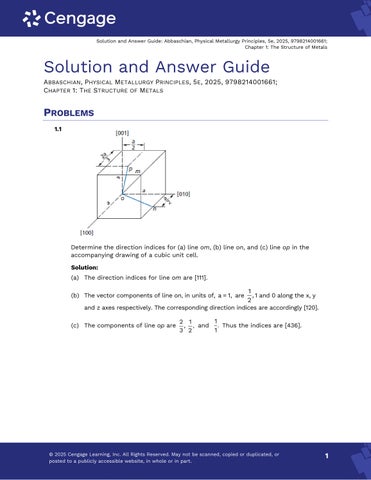
Determine the direction indices for (a) line om, (b) line on, and (c) line op in the accompanying drawing of a cubic unit cell. Solution: (a) The direction indices for line om are [111].
1 , 1 and 0 along the x, y 2 and z axes respectively. The corresponding direction indices are accordingly [120].
(b) The vector components of line on, in units of, a = 1, are
(c) The components of line op are
1 2 1 , , and . Thus the indices are [436]. 1 3 2
© 2025 Cengage Learning, Inc. All Rights Reserved. May not be scanned, copied or duplicated, or posted to a publicly accessible website, in whole or in part.
1
Solution and Answer Guide: Abbaschian, Physical Metallurgy Principles, 5e, 2025, 9798214001661; Chapter 1: The Structure of Metals
1.2
Determine direction indices for lines (a) qr, (b) qs, and (c) qt.
© 2025 Cengage Learning, Inc. All Rights Reserved. May not be scanned, copied or duplicated, or posted to a publicly accessible website, in whole or in part.
2
Solution and Answer Guide: Abbaschian, Physical Metallurgy Principles, 5e, 2025, 9798214001661; Chapter 1: The Structure of Metals
Solution: (a) The direction indices of line qr are [001]. (b) The direction indices of line qs are [101]. (c) The direction indices of line qt along the x, y and z axes are
1 1 1 , , and , 1 2 4
yielding the indices 2 1 4 .
1.3
In this figure, plane pqr intercepts the x, y, and z axes as indicated. What are the Miller indices of this plane? Solution: The intercepts of plane pqr with the three axes are reciprocals
1 3 2 , , and , with the 2 4 3
1 1 , , so that the Miller indices of the plane are (12 8 9). 1/ 2 3 / 4
© 2025 Cengage Learning, Inc. All Rights Reserved. May not be scanned, copied or duplicated, or posted to a publicly accessible website, in whole or in part.
3
Solution and Answer Guide: Abbaschian, Physical Metallurgy Principles, 5e, 2025, 9798214001661; Chapter 1: The Structure of Metals
1.4
What are the Miller indices of plane stu? Solution: This plane has intercepts
1 1 , –1 and , so that the Miller indices are 2 12 . 2 2
1.5
Write the Miller indices for plane vwx. Solution: On the assumption that parallel planes can be described by the same set of Miller indices, this plane should have the same indices as plane (C) of Fig. 1.16, which are (111).
© 2025 Cengage Learning, Inc. All Rights Reserved. May not be scanned, copied or duplicated, or posted to a publicly accessible website, in whole or in part.
4
Solution and Answer Guide: Abbaschian, Physical Metallurgy Principles, 5e, 2025, 9798214001661; Chapter 1: The Structure of Metals
1.6
Linear density in a given crystallographic direction represents the fraction of a line length that is occupied by atoms whereas linear mass density is mass per unit length. Similarly, planar density is the fraction of a crystallographic plane occupied by atoms. The fraction of the volume occupied in a unit cell, on the other hand, is called the atomic packing factor. The latter should not be confused with bulk density, which represents weight per unit volume. (a) Calculate the linear density in the [100], [110], and [111] directions in bodycentered cubic (BCC) and face-centered cubic (FCC) structures. (b) Calculate planar densities in (100) and (110) planes in bcc and fcc structures. (c) Show that atomic packing factors for BCC, FCC, and hexagonal close-packed (HCP) structures are 0.68, 0.74, and 0.74, respectively. Solution: (a) Referring to the hard ball model of BCC structure shown in Fig 1.1c, it can be seen that the atoms touch each other along the diagonal, [111] direction, of the unit cell. Taking R as radius of the atom, its length is equal to 4R. The lattice 4R . The edge of the unit cell, [100], is occupied by parameter, is therefore a = 3 two half atoms. The linear density in [100] direction is: LD[ 100] =
2R 4R
3
= 0.866
For the [110] direction, the length of the diagonal of the cube face is
2 a, which
is again occupied by two half atoms.
LD110 =
2R 2a
=
2R 2 × 4R
3
= 0.612
The linear density along [111] direction of BCC is obviously 1. For FCC unit cell, the atoms touch each other along [110] direction, as can be seen in Fig 1.2B. The lattice parameter is therefore a = 4R diagonal is
3a =
4 3R 2
2 , and the unit cell
. Therefore: LD[100] =
2R = 0.707 4R 2
LD[110] = 1 = LD[111]
2R = 0.408 4 3R 2
(b) The (100) face of the BCC unit cell, with an area of a2 , is occupied by 4 quarter circle areas. Therefore:
© 2025 Cengage Learning, Inc. All Rights Reserved. May not be scanned, copied or duplicated, or posted to a publicly accessible website, in whole or in part.
5