Chapter 1
Chapter 1: What Is Organizational Behavior?
1-1
Copyright © 2021 McGraw-Hill. All rights reserved. No reproduction or distribution without the prior written consent of McGraw-Hill.
Chapter 1
NOTE FROM THE AUTHOR My name is Jason Colquitt, and I‘m the lead author on the Colquitt-LePine-Wesson textbook, Organizational Behavior. I‘m also the author of this Instructor‘s Manual and I want to encourage adopters to reach out to me if I can help in any way with the book. I‘m happy to point you to video clips that complement our OB on Screen feature or to share the details of a research project on performance and commitment that I do with my students. I also created PowerPoints for earlier editions of the textbook that have extensive photos and vivid colors, along with narration notes from my own teaching. I‘m happy to share those PowerPoints with you, as the current PowerPoints are limited by new restrictions on photos and colors. I also have those files in Keynote form if you are a Mac user. In sum, I enjoy corresponding with adopters very much, so please do not hesitate to reach out to me. My email address is jason.colquitt@gmail.com.
1-2
Copyright © 2021 McGraw-Hill. All rights reserved. No reproduction or distribution without the prior written consent of McGraw-Hill.
Chapter 1
CHAPTER OVERVIEW Organizational behavior is a field of study devoted to understanding and explaining the attitudes and behaviors of individuals and groups in organizations. The two primary outcomes of organizational behavior are job performance and organizational commitment. This chapter explores the factors that affect these outcomes and shows how scientific studies provide evidence that good organizational behavior policies are linked to employee productivity, firm profitability, and even firm survival. This chapter also shows how we ―know what we know‖ about organizational behavior by describing the scientific research process. LEARNING GOALS After reading this chapter, you should be able to answer the following questions: 1.1 1.2 1.3 1.4 1.5 1.6
What is the definition of ―organizational behavior‖ (OB)? What are the two primary outcomes in studies of OB? What factors affect the two primary OB outcomes? Why might firms that are good at OB tend to be more profitable? What is the role of theory in the scientific method? How are correlations interpreted?
CONNECT EXERCISES The Resource Based View in Sports High Performance Work Practices at Netflix How Do We Know? How Do You Know? Types of Relationships in OB Flashlights and Pop Tarts—Correlation and Causation
Case Analysis Case Analysis Click and Drag* Self-Assessment Click and Drag* Case Analysis
*Note: An alternate version of each Click and Drag exercise is available in Connect for students with accessibility needs.
1-3
Copyright © 2021 McGraw-Hill. All rights reserved. No reproduction or distribution without the prior written consent of McGraw-Hill.
Chapter 1
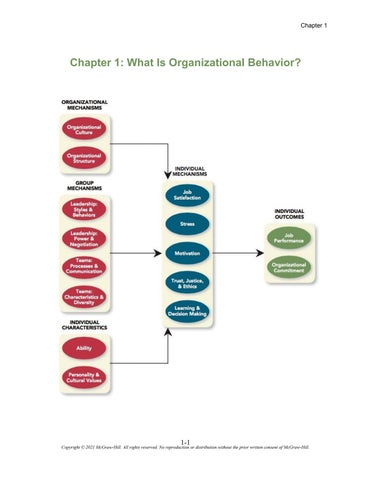
CHAPTER OUTLINE I. WHAT IS ORGANIZATIONAL BEHAVIOR? Try This!: Open the very first class by asking them to picture their worst coworker ever and to list the things that person did to earn ―worst coworker‖ status. Then have them do the same with the best coworker ever, listing the things that person did to earn ―best coworker‖ status. Both of these lists should be written on the board, a process that will result in a table similar to Table 1-1, The Best of Coworkers, the Worst of Coworkers. Then get them to understand the importance of explaining why the two people act so differently. That process of explanation is what OB is all about. A. Organizational Behavior Defined 1. Organizational behavior is a field of study devoted to understanding, explaining, and ultimately improving the attitudes and behaviors of individuals and groups in organizations B. An Integrative Model of OB 1. Provides a roadmap for the field of organizational behavior and shows how different chapters in the text are related 2. Individual Outcomes – These are the two primary goals of organizational behavior. a. Job performance (Chapter 2) – how well employees do on the job b. Organizational commitment (Chapter 3) – how likely employees are to remain with an organization 3. Individual Mechanisms – These directly affect job performance and organizational commitment. a. Job satisfaction (Chapter 4) – what employees feel about their work b. Stress (Chapter 5) – psychological responses to job demands that tax or exceed an employee‘s capabilities c. Motivation (Chapter 6) – energetic forces that drive an employee‘s work d. Trust, justice, and ethics (Chapter 7) – degree to which employees feel that their company does business with fairness, honesty, and integrity e. Learning and decision making (Chapter 8) – how employees gain job knowledge and use that knowledge to make decisions 4. Individual Characteristics – These affect individual mechanisms. a. Personality and cultural values (Chapter 9) – describe various individual traits and characteristics 1-4
Copyright © 2021 McGraw-Hill. All rights reserved. No reproduction or distribution without the prior written consent of McGraw-Hill.
Chapter 1
b. Ability (Chapter 10) – describes an individual‘s cognitive abilities, emotional skills, and physical abilities 5. Group Mechanisms – Also affect individual mechanisms, given that most employees do not work alone a. Team characteristics and diversity (Chapter 11) – the qualities that teams possess, including norms, roles, and the way team members depend on each other b. Team processes and communication (Chapter 12) – how teams behave with regard to communication, cooperation, and conflict c. Leader power and negotiation (Chapter 13) – the process by which individuals gain authority over other individuals d. Leader styles and behaviors (Chapter 14) – describes the specific actions leaders take to influence others at work 6. Organizational Mechanisms – These also affect individual mechanisms, because they influence the environment in which work is done. a. Organizational structure (Chapter 15) – shows how various units within an organization communicate b. Organization culture (Chapter 16) – describes the shared rules, norms, and values that shape behavior for organizational employees II. DOES ORGANIZATIONAL BEHAVIOR MATTER? OB Internationally. This feature is a valuable tool to help students understand how the relationships among OB concepts, and their applications, varies across cultures. A good way to begin discussing international issues in Chapter 1 is to ask students to describe their international experiences. How many students are international students? How many were born or raised in another country prior to moving to the United States? How many have lived or worked abroad? How many have gone abroad on study trips or vacations? Once you‘ve gotten a feel for the experience levels of the class, ask students if they believe that the importance of the concepts in the integrative model of OB will vary across cultures, or whether their importance will be universal. If they believe the importance varies, should multinational corporations design their OB policies to function differently at different branches? What are the pluses and minuses of such a strategy? A. Building a Conceptual Argument 1. Resource-based view of organizations – looks at what makes resources capable of creating long-term profits for a firm 2. Resources are considered to be more valuable when they are: 1-5
Copyright © 2021 McGraw-Hill. All rights reserved. No reproduction or distribution without the prior written consent of McGraw-Hill.