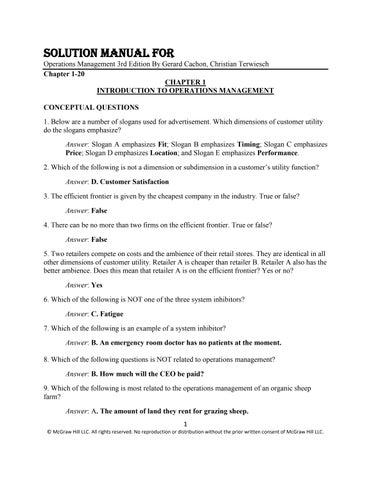
Solution Manual For Operations Management 3rd Edition By Gerard Cachon, Christian Terwiesch Chapter 1-20 CHAPTER 1 INTRODUCTION TO OPERATIONS MANAGEMENT CONCEPTUAL QUESTIONS 1. Below are a number of slogans used for advertisement. Which dimensions of customer utility do the slogans emphasize? Answer: Slogan A emphasizes Fit; Slogan B emphasizes Timing; Slogan C emphasizes Price; Slogan D emphasizes Location; and Slogan E emphasizes Performance. 2. Which of the following is not a dimension or subdimension in a customer’s utility function? Answer: D. Customer Satisfaction 3. The efficient frontier is given by the cheapest company in the industry. True or false? Answer: False 4. There can be no more than two firms on the efficient frontier. True or false? Answer: False 5. Two retailers compete on costs and the ambience of their retail stores. They are identical in all other dimensions of customer utility. Retailer A is cheaper than retailer B. Retailer A also has the better ambience. Does this mean that retailer A is on the efficient frontier? Yes or no? Answer: Yes 6. Which of the following is NOT one of the three system inhibitors? Answer: C. Fatigue 7. Which of the following is an example of a system inhibitor? Answer: B. An emergency room doctor has no patients at the moment. 8. Which of the following questions is NOT related to operations management? Answer: B. How much will the CEO be paid? 9. Which of the following is most related to the operations management of an organic sheep farm? Answer: A. The amount of land they rent for grazing sheep. 1 © McGraw Hill LLC. All rights reserved. No reproduction or distribution without the prior written consent of McGraw Hill LLC.
PROBLEMS AND APPLICATIONS 1. What are the subcomponents of inconvenience in a customer utility function? Answer: C. Location and Time Feedback: Location and timing are the two major subcomponents of inconvenience. 2. Which dimension of the customer utility function is particularly emphasized with the concept of ―custom built‖? Answer: B. Fit. Feedback: Fit is a subcomponent of the consumption utility that captures how well the product or service matches with the unique characteristics of a given consumer. 3. Which of the following characteristics is a subcomponent of the consumption utility in a customer utility function? Answer: A. Performance. Feedback: Performance is a subcomponent of the consumption utility that captures how much an average consumer desires a product or service. 4. Which dimension of the customer utility function is particularly emphasized with the ―to-go‖ section? Answer: D. Timing. Feedback: The "to-go" section is designed for customers to purchase food quickly and move on their way to their departure gate. The primary focus is on the speed of service, which addresses the timing element of the customer utility function. 5. Which dimension of the customer utility function is particularly emphasized with the special edition coupe? Answer: A. Performance. Feedback: The "special edition" coupe has features that give it a higher level of performance compared to the standard model. As a result, the "special edition" vehicle clearly emphasizes the performance dimension of the customer utility function. 6. Which of these hotels are on the efficient frontier? You may select more than one answer. Answer: Hotels B, C, and D. Feedback: The only hotel that is Pareto dominated is hotel A - all other are on the efficient frontier. Hotel A is Pareto dominated by hotel B, as B is both cheaper and better. 7. Which of these LTL carriers are on the efficient frontier? 2 © McGraw Hill LLC. All rights reserved. No reproduction or distribution without the prior written consent of McGraw Hill LLC.
Answer: Carriers A, B, and C. Feedback: Carrier D is the only one not on the efficient frontier because it is dominated by Carrier A on both measures. 8. Which of these dry cleaners are NOT on the efficient frontier? Answer: Dry Cleaner B. Feedback: Dry Cleaner B is the only one not on the efficient frontier because it is dominated by both Dry Cleaner A and C on both measures. 9. Which of the following items would be considered an input in the operations of a soft drink manufacturer? Answer: C. Empty bottles Feedback: Inputs are the things that a business purchases. Empty bottles would be part of the soft drink product. 10. Which of the following items would be considered a resource in the operations of a soft drink manufacturer? Answer: B. Bottling machines. Feedback: Resources are the things in a business that help transform input into output and thereby help provide supply for what customers demand. The bottling machine is a resource used to manufacture the soft drinks. The other items are inputs and are part of the product. 11. Which of the following items would be considered an input in the operations of a doctor’s office? Answer: C. Needle Feedback: The only item in the list that is a material used in the doctor's office operations is a needle. The rest of the items would be considered resources. 12. Which of the following items would be considered a resource in the operations of a movie theater? Answer: B. Projector Feedback: The only item in the list that is used to transform inputs to outputs is the projector. The rest of the items in the list would be classified as inputs because they are materials and supplies used in the operations. 13. Which of the following inefficiencies in a grocery store’s operations results from inflexibility? Answer: D. Employee work schedules set a week in advance Feedback: Inflexibility is the inability of an operation to quickly and cheaply change in response to new information. 3 © McGraw Hill LLC. All rights reserved. No reproduction or distribution without the prior written consent of McGraw Hill LLC.
14. Which of the following inefficiencies in a bank’s operations results from variability? Answer: C. Customers incorrectly listing information on forms Feedback: Variability corresponds to changes in either demand or supply over time. 15. Which of the following inefficiencies in a bank’s operations results from variability? Answer: A (When will the demand be fulfilled?) and D. Where will the demand be fulfilled? Feedback: Convenience refers to the questions of ―when‖ and ―where‖ the demand will be fulfilled. 16. Which of the following inefficiencies in a bank’s operations results from variability? Answer: B. What are the shipping charges to the customer? Feedback: The operational efficiency will affect the price that the firm is able to charge for its product and service to maximize its profitability. The shipping charges are part of the price component. 17. Which of the following operational decisions correspond(s) to the consumption utility component of the consumer utility function? Instructions: You may select more than one answer. Answer: C. What is the product or service to be delivered? Feedback: The product or service characteristics will affect how much each consumer will like the overall product or service, which is measured by consumption utility.
CASE There is no case for this chapter.
4 © McGraw Hill LLC. All rights reserved. No reproduction or distribution without the prior written consent of McGraw Hill LLC.
CHAPTER 2 INTRODUCTION TO PROCESSES
CONCEPTUAL QUESTIONS 1. From the perspective of process analysis, which of the following could be appropriate flow units for a hardware store? Answer: C. Number of customers. Feedback: The number of workers, cash registers, and suppliers are unlikely to change much over the course of a month and do not ―flow‖ through the process of the hardware store. 2. Over the course of a month, which of the following is most likely to describe an appropriate flow unit for a process analysis of a hospital? Answer: D. The number of patients. Feedback: Physicians, beds, and square footage are unlikely to change much over the course of a month and do not ―flow‖ through the process of a hospital. 3. At a cruise ship terminal, each day on average 1000 passengers embark on ships. On average, passengers spend 5 days on their cruise before returning to this terminal. If the flow unit is a passenger, then what are the flow rate and flow time of this process? Answer: The flow rate is 1,000 passengers per day and the flow time is 5 days. 4. It is election day and 1800 voters vote in their precinct’s library during the 10 hours the polls are open. On average, there are 15 voters in the library and they spend on average 5 minutes in the library to complete their voting. What is the inventory of voters, the flow rate, and the flow time for each voter? Answer: The inventory is 15 voters (this is given), the flow rate is 180 voters per hour or 3 voters per minute and the flow time is 5 minutes. 5. Over the course of a day, fans pour into a NASCAR venue at the rate of 8000 people per hour. The average rate at which fans leave the venue ______. Answer: B. must be exactly 8000 people per hour Feedback: The flow rate into a process must equal the flow rate out of a process (for the process to be stable). 6. A computer server experiences large fluctuations in the amount of data requests it receives throughout the day. Because of this variation, Little’s Law does not apply. True or false? Answer: False. 5 © McGraw Hill LLC. All rights reserved. No reproduction or distribution without the prior written consent of McGraw Hill LLC.