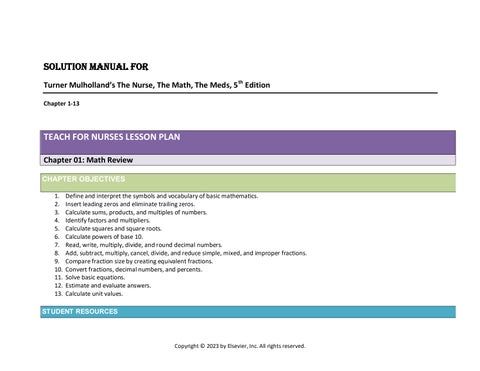
Solution Manual for Turner Mulholland’s The Nurse, The Math, The Meds, 5 th Edition Chapter 1-13
TEACH FOR NURSES LESSON PLAN Chapter 01: Math Review CHAPTER OBJECTIVES 1. Define and interpret the symbols and vocabulary of basic mathematics. 2. Insert leading zeros and eliminate trailing zeros. 3. Calculate sums, products, and multiples of numbers. 4. Identify factors and multipliers. 5. Calculate squares and square roots. 6. Calculate powers of base 10. 7. Read, write, multiply, divide, and round decimal numbers. 8. Add, subtract, multiply, cancel, divide, and reduce simple, mixed, and improper fractions. 9. Compare fraction size by creating equivalent fractions. 10. Convert fractions, decimal numbers, and percents. 11. Solve basic equations. 12. Estimate and evaluate answers. 13. Calculate unit values. STUDENT RESOURCES
Copyright © 2023 by Elsevier, Inc. All rights reserved.
understand
Textbook Chapter 01
apply
Elsevier’s Interactive Drug Calculation Application
INSTRUCTOR RESOURCES before class
Nursing Curriculum Standards (below)
in class
PowerPoint Presentations (Evolve) Image Collection (Evolve) Learning Activities (below) Discussion Topics (below)
after class
Test Bank (Evolve) Drug Label Glossary (Evolve)
TEACHING STRATEGIES Content Focus ESSENTIAL MATH VOCABULARY AND CONCEPTS
WHOLE NUMBERS Multiplying and Dividing Whole Numbers by the Number 1 IMPLIED DECIMAL POINTS AND TRAILING ZEROS
Content Highlights Review the essential math vocabulary. Make sure that the students are not confused about the symbols and understand that it is safer if most, if not all, of the symbols are not used and are written out in words instead. Provide the students with different types of handwriting that use both leading and trailing zeros and implied decimal points. Have them discuss which ones are difficult to decipher and how easily handwriting can be misread in the midst of a busy shift.
Learning Activities
Activity: Have the students bring their text to class. Divide the students up into groups of three and practice solving 10 practice questions from Chapter 01.
Activity: Make cards with individual Roman numerals (I, V, X, and so on) on each card. On other cards, write Arabic numbers (1, 5, 10, 14, 15, and so on). Divide the students into groups of three. Have the students match the Arabic numbers to Roman numerals using the cards. Have a set of cards for each student group.
Dividing a Number or Fraction By Itself
Copyright © 2023 by Elsevier, Inc. All rights reserved.
Resources PPT slide 3
PPT slides 4-6
TEACHING STRATEGIES Content Focus SUM PRODUCT
Content Highlights
Learning Activities
Discuss the different meanings of the word factor. Explain that many times familiar words can have meanings other than the one we typically associate to them.
Activity: Give the students several numbers and groups of numbers and have them write the factors and the common factors. Instruct them to exchange papers for grading and discussion.
Emphasize the difference between factors and multiples. Write several problems on the board: addition, multiplication, subtraction, and division. Label the parts of the problems, discussing that these labels learned in elementary school are even now important.
Examine the uses of squares and square roots in medication administration.
Give the students some examples of bases and exponents in both numerical form and in written form. Have them change them to the opposite form.
Online Activity: Go to https://www.ismp.org/tools/ errorpronea reviations p . Start an online journal by reviewing the symbols that may lead to medication errors, recording the symbols to avoid and identifying the alternatives to the symbols. Note: The journal will be ongoing with directions for entries for future chapters. Discussion Topic: Ask the students to share tips on how they remember terms and differentiate among mathematic processes. Do they use mnemonics, acronyms, songs, or other memory tricks? Activity: Have the students practice how to read the bases and exponents expressions in the book.
FACTOR
Resources
COMMON FACTORS Common Factors Other Than 1
MULTIPLE FACTORS VERSUS MULTIPLES MULTIPLIER DIVISOR, DIVIDEND, QUOTIENT, AND REMAINDER SQUARE SQUARE ROOT
BASES AND EXPONENTS POWERS OF 10 CALCULATIONS
Copyright © 2023 by Elsevier, Inc. All rights reserved.
PPT slide 7
PPT slides 8-9
TEACHING STRATEGIES Content Focus MULTIPLYING AND DIVIDING BY 10, 100, 1000 DECIMAL FRACTIONS READING NUMBERS AND DECIMALS DECIMAL POINT SPATIAL PLACEMENT WRITING DECIMALS AS FRACTIONS DECIMALS: WHICH IS LARGER? ROUNDING DECIMALS ADDING AND SUBTRACTING DECIMALS
Content Highlights
Explain that the number of digits to the right of the decimal point is the number of zeros in the denominator that is a power of 10 in a decimal fraction. Emphasize the importance of writing the decimal point neatly and clearly to avoid any confusion. Give the students numerous problems to work so they clearly understand how to identify the larger of a pair of decimals. Give examples of medications that should be rounded to either the nearest tenth or the nearest hundredth.
DIVIDING DECIMALS
Emphasize the importance of keeping the decimal points aligned when working problems (excluding multiplication). Many students have trouble with this, so allow time for plenty of practice.
Division of Decimals When the Divisor is a Whole Number
Review where to insert a decimal into a product that does not have enough digits in the answer.
Division of Decimals When the Divisor Contains Decimals
Work several division problems on the board, demonstrating clearly how to move the decimal point when necessary.
MULTIPLYING DECIMALS
Learning Activities
Activity: Bring different manikin wounds to class. Have the students measure the wound in inches. Convert the fractions to decimals (e.g., a wound that measures 4 ¼ inches would be converted to 4.25 inches). Small Group Activity: Group the students in such a way that each group has both strong and weak students in the area of math. Practice reading decimals aloud and writing properly and accurately what is spoken. Encourage students to provide feedback to each other.
Copyright © 2023 by Elsevier, Inc. All rights reserved.
Resources
PPT slides 10-14
TEACHING STRATEGIES Content Focus
FRACTIONS ALTERNATIVE FRACTION FORMS
Content Highlights Provide examples of medications that are supplied in decimal doses. Allow the students to work several problems converting mixed and improper fractions. It may have been several years since the students performed these processes, and review is necessary.
Learning Activities
Activity: Bring in some fun snacks for a discussion of fractions. Give the students the snacks and some scenarios they can work by separating or eating their items. Not all math is boring!
PPT slides 15-18
Small Group Activity: Break the students into two to four teams and have a contest to see which team can
PPT slides 19-20
MIXED FRACTIONS IMPROPER FRACTIONS
Resources
Discuss that knowing how to find common factors will assist the students in quickly reducing fractions.
CONVERTING MIXED AND IMPROPER FRACTIONS CONVERTING AN IMPROPER FRACTION TO A MIXED FRACTION REDUCING FRACTIONS COMMON (SAME) DENOMINATOR LOWEST COMMON DENOMINATOR Finding the Lowest Common Denominator EQUIVALENT FRACTIONS COMPARING FRACTIONS
Work several fraction comparison problems using cross multiplication.
Copyright © 2023 by Elsevier, Inc. All rights reserved.