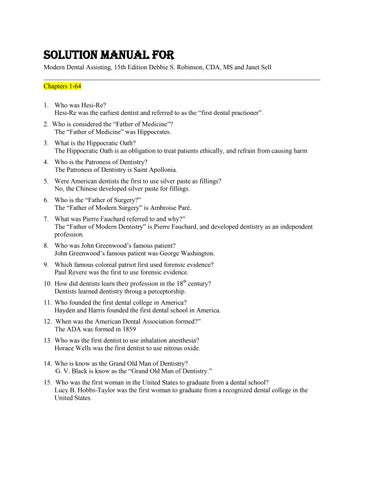
Solution Manual For Modern Dental Assisting, 15th Edition Debbie S. Robinson, CDA, MS and Janet Sell ___________________________________________________________________________________ Chapters 1-64 1. Who was Hesi-Re? Hesi-Re was the earliest dentist and referred to as the ―first dental practioner‖. 2. Who is considered the ―Father of Medicine‖? The ―Father of Medicine‖ was Hippocrates. 3. What is the Hippocratic Oath? The Hippocratic Oath is an obligation to treat patients ethically, and refrain from causing harm 4. Who is the Patroness of Dentistry? The Patroness of Dentistry is Saint Apollonia. 5. Were American dentists the first to use silver paste as fillings? No, the Chinese developed silver paste for fillings. 6. Who is the ―Father of Surgery?‖ The ―Father of Modern Surgery‖ is m roise Par . 7. What was Pierre Fauchard referred to and why?‖ The ―Father of Modern Dentistry‖ is Pierre Fauchard, and developed dentistry as an independent profession. 8. Who was John Greenwood’s famous patient? John Greenwood’s famous patient was George Washington. 9. Which famous colonial patriot first used forensic evidence? Paul Revere was the first to use forensic evidence. 10. How did dentists learn their profession in the 18th century? Dentists learned dentistry throug a perceptorship. 11. Who founded the first dental college in America? Hayden and Harris founded the first dental school in America. 12. When was the American Dental Association formed?‖ The ADA was formed in 1859 13. Who was the first dentist to use inhalation anesthesia? Horace Wells was the first dentist to use nitrous oxide. 14. Who is know as the Grand Old Man of Dentistry? G. V. Black is know as the ―Grand Old Man of Dentistry.‖ 15. Who was the first woman in the United States to graduate from a dental school? Lucy B. Hobbs-Taylor was the first woman to graduate from a recognized dental college in the United States.
16. Who was the women recognized worldwide on her research on HIV / AIDS Dr. Deborah Greenspan was know worldwide for her research on HIV/AIDS. 17. Who was the first African American to graduate from the dental school at Harvard University? Robert Tanner Freeman was the first African American to graduate from the Harvard School of Dental Medicine. 18. Who was the first African American female dentist in the United States? The first African American woman to practice dentistry in the United States was Ida Gray Rollins.
19.
Who was the first American Indian dentist in the United States? The first American Indian dentist in the United States was Dr. George Blue Spruce, Jr.
20. Who was the first dentist to use a dental assistant? C. Edmund Kells was the first dentist to use a dental assistant. . WORKBOOK ANSWER KEY Short-Answer Questions These questions reflect the Learning Outcomes listed at the beginning of this chapter in the textbook and can be used as class assignments. The answers can be found within the chapter and/or classroom discussion. Fill-in-the-Blank Statements 1. Malvina Cueria
5. Wilhelm Conrad Roentgen
2. preceptorship
6. Ida Gray-Rollins
3. Saint Apollonia 4. Paul Revere Multiple-Choice Questions 1. b
11. d
2. c
12. a
3. a
13. c
4. c
14. d
5. d
15. b
6. b
16. a
7. a
17. b
8. d
18. c
9. b
19. c
10. a
20. a
Activity This activity is designed to open discussion and solicit varying opinions in the classroom. Several responses could be correct. The course director will determine whether a student’s or a group’s response is correct according to the factors presented and what is required.
2 The Dental Healthcare Team TEXTBOOK ANSWER KEY Recall Questions and Answers 1. Name the members of the dental healthcare team. The members of the dental healthcare team are the dentist, dental hygienist, dental assistant, and laboratory technician. 2. Name the twelve dental specialties. The twelve dental specialties are dental anesthesiology, dental public health, endodontics, oral and maxillofacial pathology, oral and maxillofacial radiology, oral and maxillofacial surgery, oral medicine, oral facial pain, orthodontics, pediatric dentistry, periodontics, and prosthodontics. 3. What type of dental setting is a DSO? The type of setting is a dental management organization affiliated group practice where the dentists contract with a management agency to handle all the business side of a practice. 4. What is the minimal length of education for an ADA-accredited dental assisting program? The minimum length of an ADA-accredited dental assisting program is 1 academic year 5. What is the minimal length of education for dental hygiene licensure? The minimum length of education for dental hygiene licensure is 2 academic years. 6. What is the minimal length of education for an ADA-accredited dental laboratory technician program? The minimum length of an ADA-accredited dental laboratory technician program is 2 years. 7. What is required before a dental laboratory technician can fabricate a case? A dental laboratory technician must have a written prescription from a dentist before completing a task. WORKBOOK ANSWER KEY Short-Answer Questions These questions reflect the Learning Outcomes listed at the beginning of this chapter in the textbook and can be used as class assignments. The answers can be found within the chapter and/or classroom discussion. Fill-in-the-Blank Statements 1. dental assistant
8. oral pathology
2. periodontics
9. endodontist
3. oral and maxillofacial radiology
10. oral and maxillofacial surgery
4. dentist
11. orthodontics
5. dental laboratory technician
12. prosthodontics
6. dental hygienist
13. pediatric dentistry
7. dental public health
Multiple-Choice Questions 1. b
4. b
2. b
5. c
3. a
Case Study This case study is designed to open discussion and to solicit varying opinions in the classroom. Several responses may e correct. The course director will determine whether a student’s or a group’s response is correct according to the factors presented and the course requirements. 3 The Professional Dental Assistant TEXTBOOK ANSWER KEY Recall Questions and Answers 1. How can a dental assistant demonstrate ―professionalism‖? A dental assistant can demonstrate professionalism by having a positive approach towards the dental team and their patients. 2. How can a professional demonstrate they are a responsible person? You can demonstrate responsibility by arriving on time, staying for the full schedule, being a cooperative team member, and not asking to leave early. 3. What type of dentisty does the chairside assistant practice when assisting the dentist? The chairside assistant practices four-handed dentistry when working with the dentist 4. Name the three essential aspects of a professional appearance. The essentials of a professional appearance are good health, good grooming, and appropriate atire. 5. What type of credentials are issued by the DANB? The six national certifications issued by the DANB are certified dental assistant (CDA), national entry level dental assistant (NELDA), certified preventive functions dental assistant (CPFDA), certified orthodontic assistant (COA), and certified restorative functions dental assistant (CPFDA). certified in dental infection prevention and control (CDIPC), and one non clinical; dental industry specialist in Infection Prevention and control (DISIPC) 6. Where can you obtain additional information about the DANB examinations Visit their website at http://www.danb.org. 7. What is the purpose of the ADAA? The purpose or mission of the ADAA is to advance the careers of dental assistants and to promote the dental-assisting profession in matters of education, legislation, credentialing, and professional activities that enhance the delivery of quality dental healthcare to the public. 8. What are some benefits of being a member of the ADAA? Personal and professional growth, legislative issues and current information. Attend local, state, and national meetings, participate in workshops, earn continuing education credit, hear prominent speakers, and establish friendships with other dental assistants. Subscription to The Dental Assistant, the journal of the ADAA; professional liability, accidental death and dismemberment, and medical insurance options; awards and scholarship opportunities; a membership loan program; credit card options; and other discounts.