Solution Manual For Medical Insurance A Revenue Cycle Process Approach 9th Edition by Joanne Valeri
Solution Manual For
Medical Insurance A Revenue Cycle Process Approach 9th Edition by Joanne Valerius; Nenna Bayes; Cynthia Newby; Amy Blochowiak; Janet Seggern
Chapter 1-17
CONTENTS
INTRODUCTION
COURSE MANAGEMENT Available online at McGraw-Hill Connect ®
5-Week Syllabus
8-Week Syllabus
10-Week Syllabus
15-Week Syllabus
LESSON PLANS AND ANSWERS
Chapter 1 Introduction to the Revenue Cycle
Chapter 2 Electronic Health Records, HIPAA, and HITECH: Sharing and Protecting Patients’ Health Information
Chapter 3 Patient Encounters and Billing Information
Chapter 4 Diagnostic Coding: ICD-10-CM
Chapter 5 Procedural Coding: CPT and HCPCS
Chapter 6 Visit Charges and Compliant Billing
Chapter 7 Healthcare Claim Preparation and Transmission
Chapter 8 Private Payers/ACA Plans
Chapter 9 Medicare
Chapter 10 Medicaid
Chapter 11 TRICARE and CHAMPVA
Chapter 12 Workers’ Compensation and Disability/Automotive Insurance
Chapter 13 Payments (RAs), Appeals, and Secondary Claims
Chapter 14 Patient Billing and Collections
Chapter 15 Primary Case Studies
Chapter 16 RA/Secondary Case Studies
Chapter 17 Hospital Billing and Reimbursement
ANSWERS FOR CHAPTER SIMULATIONS Available online at McGraw-Hill Connect
CORRELATIONS Available online at McGraw-Hill Connect
ABHES, CAAHEP, CAHIIM, NHA
INTRODUCTION
Broad pressure to control costs in the healthcare industry creates a complex billing environment. Payment has shifted from straightforward fee-for-service insurance to a complex mixture of contracts with payers. Providers must ensure patient satisfaction and also use health information technology effectively and efficiently to receive maximum appropriate payment for their services. Additional pressure results from federal government prosecution of health care fraud and abuse as a top policy objective. HIPAA and HITECH have also created new privacy, security, transactions, and code sets laws, including the transition to ICD-10-CM/PCS, that must be implemented. Failure to comply with proper billing and coding procedures can have significant financial and legal consequences.
The ninth edition of Medical Insurance: A Revenue Cycle Process Approach continues to emphasize the medical revenue cycle ten steps that clearly identify all the components needed to successfully manage the medical insurance claims process. The cycle shows how medical professionals “follow the money.” The program assists instructors in presenting clear, up-to-date instruction to give students the skills and knowledge they will need to perform the current duties of medical insurance specialists and to succeed moving forward in a changing environment. Therefore, the text reflects judgments about what to emphasize, such as the increased use of health information technology, and then necessarily what to exclude, such as detailed histories of insurance programs.
In addition to current duties, the text covers trends, developments, and resources, so that students will be able to understand the inevitable changes as they occur. The text and the supplementary workbook and website reinforce problem analysis, critical thinking, effective use of resources, and communication, the capabilities that will underpin students’ future employment success as important members of the health care team.
KEY CHANGES FOR THE NINTH EDITION
Exercises
Starting in Chapter 8, in-chapter exercises give students the opportunity to get hands-on experience with claim completion through simulations of real software. Medical Insurance, 9e offers these options for completing these tasks:
Paper Claim Form: Students gaining experience by completing a paper CMS-1500 claim form use the blank form supplied (from the back of Medical Insurance, 9e) and follow the instructions in the text chapter that is appropriate for the particular payer to fill in the form by hand.
Connect Simulations: The ability to understand and to use Electronic Health Records (EHR) systems are critical job skills and competencies required for employment in a Medical Office or Hospital. In the past, teaching students the hows and whys of using an EHR has been challenging. Live software solutions require complex installation and support, and often don’t translate well into the classroom. Simulated educational solutions often fall short in giving students the realistic experience of working in real world scenarios.
McGraw-Hill Education is proud to offer EHRclinic, the educational EHR solution that provides the best of both worlds, both the experience of working in a live, modern EHR application, along with the convenience and reliability of simulated educational solutions.
EHRclinic is integrated into Connect, McGraw-Hill’s digital teaching and learning environment that saves students and instructors time while improving performance over a variety of critical outcomes.
For Medical Insurance, Connect provides simulated, auto-graded exercises in multiple modes to allow the student to use EHRclinic to complete the claims. If assigned this option, students should read the User Guide at www.mhhe.com/valerius9 as the first step, and then follow the instructions with each chapter’s case studies. Note: some data may be prepopulated to allow students to focus on the key tasks of each exercise.
Connect CMS-1500 Form Exercises: Another way to complete the claims exercises is by using the CMS-1500 form exercises in Connect if directed by your instructor. These exercises allow you to complete the necessary fields of the form in an autograded environment.
Please note that starting with this edition, we will no longer be offering live Medisoft® or Medisoft simulations as part of the options.
Changes to Content by Chapter
Chapter 1: Revised: Thinking It Through 1.8, item B, “female” deleted. Updated: statistics and data in Figures 1.1 and 1.4; web addresses for CMA, RMA, AHIMA, and AAPC organizations.
Chapter 2: New: Key Terms: 21st Century Cures Act, cybersecurity, False Claims Act, Stark Law; heading and description of 21st Century Cures Act with definition and new Table 2.2 listing the Cures Act Information Release Requirements; Revised: Section on HITECH; Internet Security heading updated to Cybersecurity; three paragraphs from Office of the Inspector General moved to Section 2.9; Updated: Questions and Answers on HIPAA Privacy Policies website; information under Breach Notification Procedures; CMS Administrative Simplification website; Table 2.3; list of HIPAA national identifiers and deletion of NPID; Deleted: as Key Terms: Health Care Fraud and Abuse Program, health information
exchange (HIE), Office of E-Health Standards and Services (OESS); Previous Table 2.2, Meaningful Use Objectives.
Chapter 3: New: Billing Tip on No Surprises Law, cross-referencing its introduction in Chapter 6; Updated: Figure 3.10, Evaluation and Management (E/M) office visit code ranges updated for CPT 2022; Deleted Key Term “portal” as now a familiar word.
Chapter 4: New: Coverage of new ICD-10-CM Chapter 22, Codes for Special Purposes, added to Table 4.1, Table 4.2, and text, including description of new Key Term social determinants of health (SODH); Revised: LO 4.8 in chapter-opening list and summary; also Matching replaced item 12 with social determinants of health and Applying Your Knowledge new items H, Q, and U; Updated: Figure 4.3, added “U-00 – U85” to item B, and a third guideline on the level of detail in coding (Item F) regarding level of specificity; Deleted: key term GEMs.
Chapter 5: New: Coverage of the CPT change to E/M code assignment for office/other outpatient services has resulted in many changes. First, LO 5.6 has been updated in the opening LO list and chapter summary. Two new sections in the text under the heading 5.6 Evaluation and Management Codes cover first E/M codes selection for office/other outpatient services and then for other E/M services. The description of outpatient vs inpatient services has been moved earlier.
This update includes two new Key Terms that are now most important for E/M coding of office visits, Medical Decision Making (MDM) and Time, are emphasized.
Tables 5.3, 5.4, and 5.5 are deleted and subsequent tables renumbered. Information on the difference between outpatient and inpatient services has been moved to follow the new sections. Figure 5.4 has been converted to a numbered list.
New copy has been added to describe the new care management services codes.
The previous information on the 1995 and 1997 Documentation Guidelines has been deleted as nonessential information for introductory students, because it focused on documenting examination requirements now replaced for outpatient office visits by medical decision making (MDM) or time as the determining factors for code assignment.
General Updates
LO 5.7 in the chapter-opening list and the chapter summary have been updated to clarify that text describes qualifying circumstances add-on codes.
The Category III example has been changed; Category I section code ranges are updated; Figure 5.1 has been updated; two new appendixes are added to the list of appendixes; in Thinking It Through 5.4, the code in question 1 has been updated to 3600. The examples under Reporting Surgical Codes have been replace with current codes. Under head 5.11 Medicine Codes, new copy explains the use of new codes for COVID vaccines, including a new Billing Tip.
Table 5.3 updated for two new sections.
Thinking It Through 5.6 is revised: Question 1, Cases and B have been deleted, previous Question 2 becomes Question 1, Cases A, B, and C, and previous Question 3 becomes Question 2.
Review Question 17 has been reworded to cover MDM. Review Question 25 is deleted.
Applying Your Knowledge, Case 5.1, Question A, has been revised to test for the newly defined E/M codes; the new answer is 99203.
Chapter 6 New: Add-on code (AOC) edits explained; No Surprises Act is a new Key Term; Updated: E/M office visit code descriptors for CPT 2022 throughout; Deleted: Figure 6.2.
Chapter 7 New: Billing Tip explaining the availability of a new Condition Code DR, meaning disasterrelated, referring to COVID claims; Updated: E/M office visit code descriptors for CPT 2022.
Chapter 8 New: Key terms concierge and direct primary care (DPC) with explanations; Revised: LO 8.3 and its item in the chapter summary; consistency for using term flexible spending account (rather than flexible savings account); Updated: CDHP annual deductibles for 2020; E/M office visit code descriptors for CPT 2022; major payers’ descriptions; Deleted: key term ‘carve out” to allow for addition of two new key terms
Chapter 9 New: Key terms Additional Document Request (ADR), telehealth/E-visit, and “Welcome to Medicare” preventive visit; Revised: Two Billing Tips added under Medicare Advantage explanation; Note that Medigap Plans C and F are not available to beneficiaries who join Medicare as of January 1, 20020; Updated: websites; Medicare premiums and deductibles; lists of Medicare services; roster billing to include COVID-19; E/M office visit code descriptors for CPT 2022; Deleted: Key term and text description of ZPIC as well as Review Question 8 , replaced with copy about the Supplemental Medical Review Contractor (SMRC) program; Figure 9.2 (following figures renumbered);
Chapter 10 Updated: Figure 10.1 updated with a new Texas Medicaid example; Figure 10.2 deleted and subsequent figures renumbered; E/M office visit code descriptors for CPT 2022.
Chapter 11: Revised: Section 11.1 statistic and added Group A and Group B Tricare beneficiary classifications; Section 11.2 language clarification; Figure 11.1; Figure 11.2; websites updated throughout the chapter; Review Questions section; Cases 11.1, 11.2 and 11.3 updated with new E/M visit code descriptors for CPT 2022.
Chapter 12 Revised: Figure 12.1; Cases 12.1 and 12.2 updated with new E/M office visit code descriptors for CPT 2022.
Chapter 13 New: WPC replaced by the X12 standards-development organization for electronic information exchange throughout (WPC no longer publishes the X12 standards); Updated: Figure 13.5 under Medicare Appeals, Medicare Request for Redetermination (Form 20027) and a new Billing Tip; Deleted: Figure 13.8.
Chapter 14 New: key term Regulation F; Revised:Figure 14.1; Section 14.2 to remove preventive office visit and labs and replace with a standard office visit and labs; Thinking It Through 14.4; Section 14.5 to include Regulation F definition and procedures; Thinking It Through 14.6; Thinking It Through 14.8; Applying Your Knowledge Case 14.1
Chapter 15 Updated: all CPT codes, conventions, and modifiers for 2023.
Chapter 16 Revised: Section 16.2 by adding an introduction with directions for completing Case Study exercises; Claim Case Study 16.15 for updated charge due CPT code update.
Chapter 17 New: Billing tip on the No Surprises Act.
STRUCTURE AND FEATURES OF THE TEXT/WORKBOOK
The text/workbook is divided into seventeen chapters. All seventeen chapters cover an important topic concerning insurance procedures.
The optimal course of study is to build knowledge and skills by following the order of the text presentation. However, since curriculum requirements vary, each chapter is complete, and includes its own learning objectives, key terms, and end-of-chapter material. Thus, the chapter order can be changed or material can be omitted to fit various instructional requirements. The text is designed for a one-semester medical insurance course, and covers medical insurance, medical coding basics, and a brief introduction to hospital billing. The text may be modified to suit the instructor’s curriculum requirements. Following are examples of possible modifications:
If students complete a HIPAA course in the curriculum, Chapter 2 of Medical Insurance may be omitted.
If students are knowledgeable regarding medical coding, Chapters 4 and 5 may be omitted.
Instructors who do not wish to present the topic of hospital billing may omit Chapter 17. When chapters are not presented as class work, it is suggested that they be assigned for independent study. In particular, Chapters 4 and 5 on medical coding provide an excellent review/refresher of basic coding procedures and guidelines.
Note that Chapter 6, Visit Charges and Compliant Billing, should not be omitted. It presents essential, timely material not covered in most law and ethics courses or in introductory coding classes regarding compliance.
Chapter Structure
Learning Outcomes describe the most important information the chapter contains.
Key Terms provide an alphabetic list of the most important vocabulary terms in the chapter. The key terms are printed in bold-faced type and defined when introduced. A complete glossary at the end of the book defines each key term as well as other important terms medical insurance specialists need to know.
Note that the key terms include healthcare vocabulary but not words that are in common general use, such as mortality and morbidity, which a student can readily research.
Chapter text provides essential background material and information on the procedures being taught.
Chapter Summary covers key topics in a tabular, step-by-step format with page references to help with review of the material.
Review questions and Applying Your Knowledge provide objective exercises and cases to test the students’ understanding of the chapter’s concepts and procedures. These exercises are tagged with the chapter's Learning Outcomes.
Pedagogy Reinforced
Learning Outcomes reflect the revised version of Bloom’s Taxonomy and the range of difficulty levels to teach and assess critical thinking about medical insurance and coding concepts.
Major chapter heads reflect the numbered Learning Outcomes.
In addition to the listing of learning outcomes and the listing of key terms, each chapter opener displays the Revenue Cycle, with the steps relevant to that chapter highlighted.
Key terms are defined in the margins for easy reference, tested at the end of the chapter, and listed in the Glossary toward the end of the book.
Billing Tips, Compliance Guidelines, and HIPAA/HITECH tips highlight key concepts or provide additional insights to help students navigate through the material.
“Thinking It Through” questions at the end of each section help assess each Learning Outcome.
STRUCTURE AND FEATURES OF THE INSTRUCTOR’S MATERIALS
Instructor Manual
Following this introduction, the instructor manual contains these sections:
Lesson plans, provided for each chapter, are intended to assist the instructor in preparing for class, presenting key concepts, and assessing student comprehension. Each lesson plan has these parts:
Class Preparation: The Teaching Focus and the Learning Outcomes
Class Presentation: The Lecture Outline
PowerPoint Range
Key Topics
Class Assessment: The Checklist
Thinking It Through
Review Questions
Applying Your Knowledge
Testbank
Connect
Answers
Thinking It Through
Review Questions
Applying Your Knowledge
Complete Answers for the Assisted Outlines and Review Questions, Workbook for Use with Medical Insurance 9e
Instructors’ Resources
Supplement Features
Instructor’s Manual (organized by Learning Outcomes)
PowerPoint Presentations (organized by Learning Outcomes)
Electronic Testbank
Tools to Plan Course
Lesson Plans
Answer Keys for all exercises
Key Concepts
Accessible
Computerized and Connect
Word version
Questions have tagging for Learning Outcomes, Level of Difficulty, Level of Bloom’s
Taxonomy, Feedback, ABHES, CAAHEP, CAHIIM, and Estimated Time of Completion
Correlations of the Learning Outcomes to Accrediting Bodies such as ABHES, CAHEP, CAHIIM, and NHA
Sample Syllabi
Conversion Guide Between seventh and eighth editions
Asset Map—recap of the key instructor resources, as well as information on the content available through Connect
Steps for students completing the simulated exercises in Connect
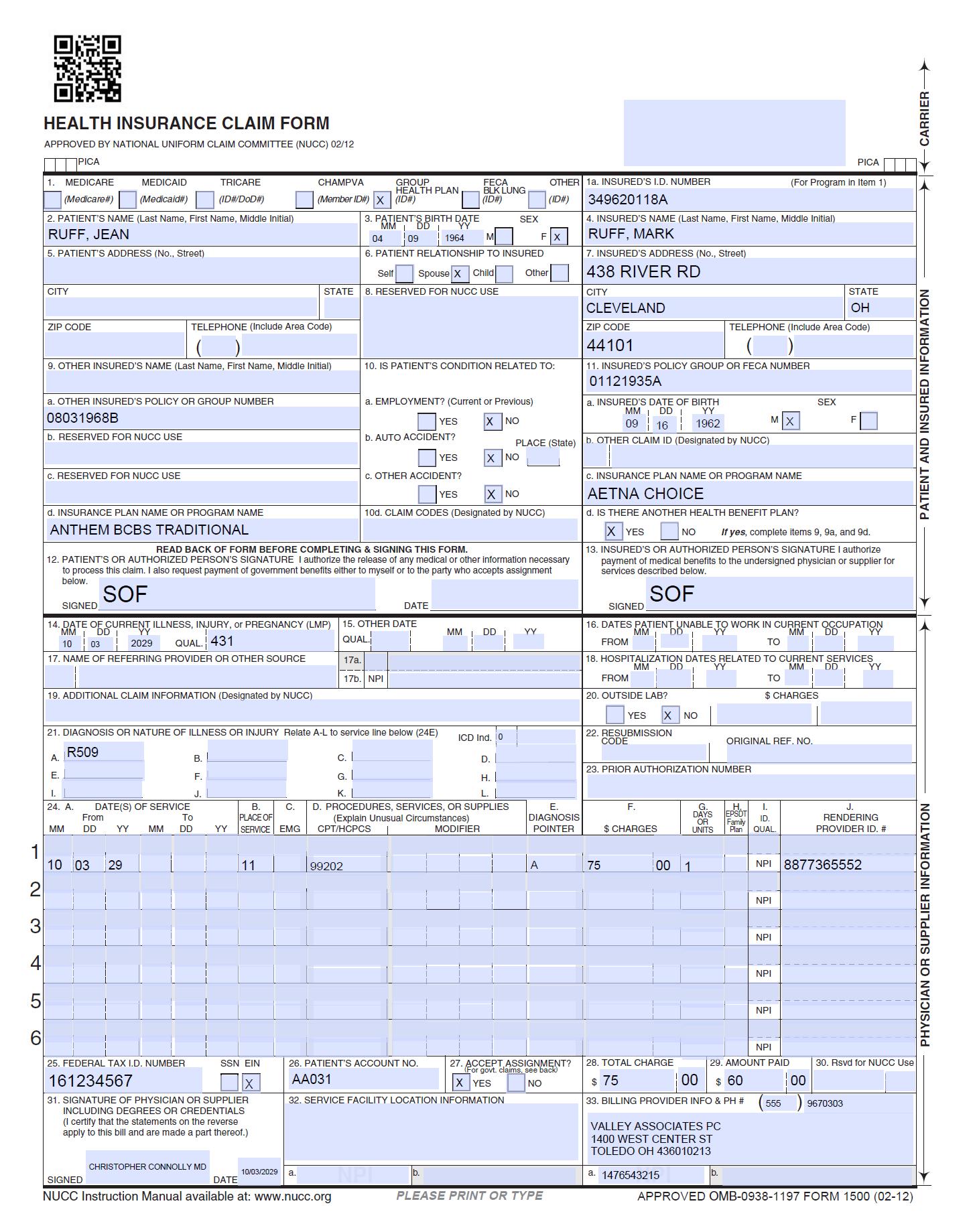
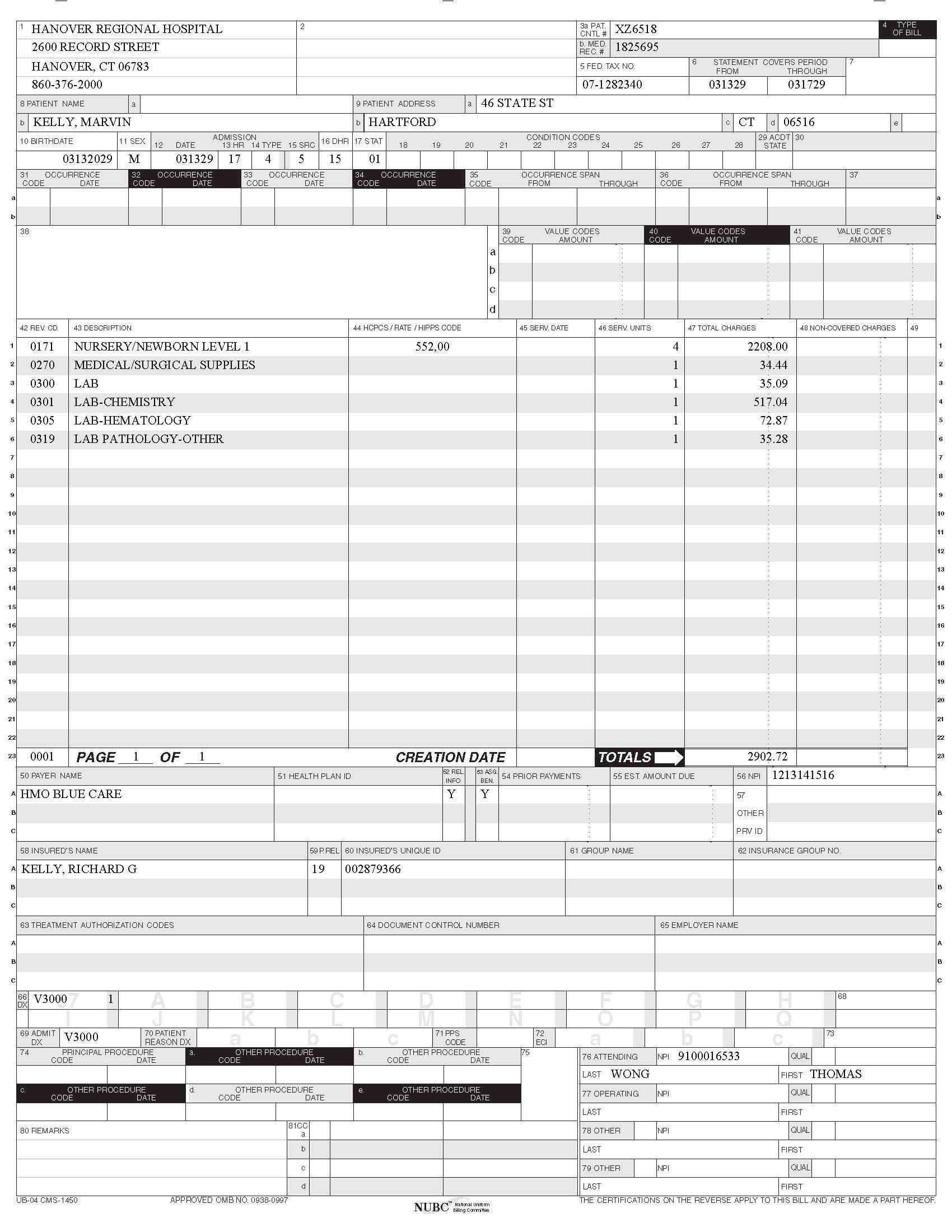
CMS-1500 and UB-04 Forms PDFs of both forms
Need help? Contact McGraw-Hill’s Customer Experience Group (CXG) at www.mhhe.com/support. Browse our FAQs (Frequently Asked Questions), product documentation, and/or contact a CXG representative.
Want to learn more about this product? Attend one of our online webinars. To learn more about the webinars, please contact your McGraw-Hill sales representative. To find your McGraw-Hill representative, go to www.mheducation.com and click “Support & Contact,” select “Higher Education,” and then click on “Find Your Higher Ed Sales Rep.”
ANCILLARY MATERIAL
Workbook for Use with Medical Insurance: A Revenue Cycle Process Approach, Ninth Edition
The workbook strengthens, reinforces, and expands student learning of the skills and concepts presented in the text. This workbook complements the text and follows the same learning outcomes.
Included is a brief review of the math skills necessary for processing medical insurance claims. Reinforcement of reading assignments (or note taking) is easy for students following the assisted outlining activity. The key term activities help strengthen students’ vocabulary for each chapter and the applying concepts activities provide additional hands-on practice with the concepts and skills presented in each chapter. Instructors can measure students’ progress in meeting learning outcomes with the short answer questions, or students can perform quick checks with the self-quiz questions. Instructors can expand on the Internet activities to deepen student understanding or to introduce new topics, for instance, when private and governmental third-party providers’ policies change.
For short programs, the workbook materials can be used as homework assignments for reinforcement, follow-up, or extra instruction. For longer programs, the workbook materials can be used in class as well as for homework assignments. Additional class time would also provide the opportunity to have students work in teams/groups on several of the Web exercises.
Instructors may choose to use sections of the workbook in class, for example, using the key terms section as a pretest. Instructors may select individual assignments for each chapter depending on the progress of the class or assign specific activities to students who might be having difficulty grasping certain themes. For example, the instructor might assign all students the assisted outlining activity to reinforce the reading of each chapter or the self quiz questions could be used by students individually or as a class as a pretest prior to chapter or unit tests.
Other students may need critical thinking skills sharpened or wish to focus on one of the Web activities. The additional activities could be used in their entirety or portions selected to highlight individual concepts from the text.
Keys to all workbook material are included in this instructor’s manual. Instructors may wish to provide students access to the answers to workbook exercises in order to monitor their progress.
LESSON PLANS HOW TO USE THE LESSON PLANS
Lesson plans, provided for each chapter, are intended to assist the instructor in preparing for class, presenting key concepts, and assessing student comprehension.
Each lesson plan has these parts:
Class Preparation: The Teaching Focus and the Learning Outcomes
Class Presentation: The Lecture Outline
PowerPoint Range
Key Topics
Class Assessment: The Checklist
Thinking It Through
Review Questions
Applying Your Knowledge
Workbook
Testbank
Connect
Answers to Thinking It Through Questions, Chapter Review Questions, and Applying Your Knowledge Cases
Chapter content is followed by the answers to the correlated workbook chapter.
Chapter 1 Introduction to the Revenue Cycle
TEACHING FOCUS AND LEARNING OUTCOMES
The current employment environment for administrative staff in physician practices reflects the pressures of decreasing provider compensation, rising costs for medical services and for employer and employee medical insurance, increased governmental regulation, increased public awareness of healthcare issues, and increased reimbursement complexity. These elements underpin the changes that occur almost daily in physician/patient relations and related billing/reimbursement issues, so students need to understand this background. They also need to develop the ability to analyze problems, identify the information that is required, research/abstract that information, determine the best course of action, and work in a team to communicate information and share results.
In Chapter 1, students begin their understanding of the work and the employment environment of medical insurance and billing. The chapter covers medical insurance and plans, reimbursement methods, and payers, concluding with the requirements for success as a medical insurance specialist. It provides the instructional material for accomplishing four goals:
1. Introduce the role, responsibilities, and employment opportunities of the medical insurance specialist.
2. Teach basic insurance terms and concepts.
3. Preview the revenue cycle.
4. Explain that the organization of Medical Insurance, 9e follows and reinforces the revenue cycle.
The order of presentation for this chapter is:
Present basic information on insurance terminology
Present basic information on healthcare plans and payers
Describe the duties of the medical insurance specialist in following the revenue cycle, and preview the text’s chapter structure in relation to the cycle
Briefly focus on the interplay among procedures, communication, and information technology in the revenue cycle
Present information on the medical insurance specialist’s skills, attitudes, possible certifications, and office ethics/etiquette that lead to successful employment
The learning outcomes for this chapter are:
LO 1.1 Identify three ways that medical insurance specialists help ensure the financial success of physician practices.
LO 1.2 Differentiate between covered and noncovered services under medical insurance policies.
LO 1.3 Compare indemnity and managed care approaches to health plan organization.
LO 1.4 Discuss three examples of cost containment employed by health maintenance organizations.
LO 1.5 Explain how a preferred provider organization works.
LO 1.6 Describe the two elements that are combined in a consumer-driven health plan.
LO 1.7 Define the three major types of medical insurance payers.
LO 1.8 Explain the ten steps in the revenue cycle.
LO 1.9 Analyze how professionalism, ethics, and etiquette contribute to career success.
LO 1.10 Evaluate the importance of professional certification for career advancement.
LECTURE OUTLINE
1.1 WORKING IN THE MEDICAL INSURANCE FIELD Slides Chapter 1: 5 – 7
1. Rising spending in the medical insurance field
2. Growing employment opportunities due to administrative complexity
3. Role of knowledgeable medical office administrative staff in practice profitability and patient satisfaction
4. Importance of following procedures
5. Need to communicate effectively both to patients and other staff members
6. Using health information technology practice management programs and electronic health records
1.2 MEDICAL INSURANCE BASICS Slides Chapter 1: 8 – 13
1. Medical insurance contract and benefits terms
2. Group versus individual policies
3. Disability/automotive insurance and workers' compensation
1.3 HEALTHCARE PLANS Slides Chapter 1: 14 – 17
1. Indemnity plans
a. Conditions for payment
b. Work through indemnity math example (text page 9)
2. Managed care plans
a. Health maintenance organizations (HMOs)
b. Point-of-service (POS) plans
c. Preferred provider organizations (PPOs)
d. Consumer-driven health plans
1.4 HEALTH MAINTENANCE ORGANIZATIONS Slides Chapter 1: 18 – 20
1.6 CONSUMER-DRIVEN HEALTH PLANS Slide Chapter 1: 22 – 23
1. Two elements
2. Cost containment
1.7 MEDICAL INSURANCE PAYERS Slide Chapter 1: 24 – 27
1. Private payers
2. Self-funded health plans
3. Government-sponsored healthcare programs
1.8 THE REVENUE CYCLE Slides Chapter 1: 28 – 29
1. Review of main job functions
2. Revenue cycle
Step 1 Preregister patients
Step 2 Establish financial responsibility
Step 3 Check in patients
Step 4 Review coding compliance
Step 5 Review billing compliance
Step 6 Check out patients
Step 7 Prepare and transmit claims
Step 8 Monitor payer adjudication
Step 9 Generate patient statements
Step 10 Follow up payments and collections
3. Explain the structure of Medical Insurance 9e, showing the relation of the text chapters to the revenue cycle
1.9 ACHIEVING SUCCESS Slides Chapter 1: 30 – 32
1. Work environments
2. Skills and attributes required for success
3. Medical ethics versus etiquette
1.10 MOVING AHEAD Slide Chapter 1: 33
1. Certification options
2. Continuing education
Option: Have students explore www.payscale.com (under your guidance, so they do not sign up for anything that has a charge) to look at pay ranges for job titles such as medical office assistant, medical coder, and other job titles.
CLASS ASSESSMENT CHECKLIST
Assessment Tool
Thinking It Through
Review Questions
Applying Your Knowledge
Workbook
Testbank
Connect ANSWERS
Instructor’s Notes
ANSWERS TO THINKING IT THROUGH
Thinking It Through 1.1
1. Students should expect that employment opportunities for medical insurance specialists in physician practices will continue to grow, primarily due to an aging population and the increases in health care spending.
Thinking It Through 1.2
1. Students may describe managed care or indemnity coverage. Ask students to locate the policies’ sections on benefits, exclusions, and financial responsibilities. In class, students should share their plan’s policy information or recount the coverage offered by Medicare. Use this conversation to introduce the next section, Health Care Plans, which will enable them to categorize plans and compare costs versus benefits.
Thinking It Through 1.3
1. Indemnity care health plans are more likely to offer a greater choice of physicians, as managed care offers a more restricted choice of (and access to) providers and treatments in exchange for lower premiums, deductibles, and other charges.
Thinking It Through 1.4
1. Use this exercise to point out how students need to learn to analyze information presented in chart or table format.
A. The health plan covers diabetic supplies and emergency services, but not dental exams.
B. PCP visits have a lower copayment than specialty visits.
Thinking It Through 1.5
1. Students should identify PPOs as the most popular type of insurance plan due to their extensive network of physicians and hospitals, their negotiated discounts from usual fees, and lack of a requirement for referrals.
Thinking It Through 1.6
1. Consumer-driven health plans combine a health plan, usually a PPO, that has a high deductible and low premiums, with a special "savings account" that is used to pay medical bills before the deductible has been met.
Thinking It Through 1.7
1. Student answers may vary greatly, and they should be prepared to explain their position.
Thinking It Through 1.8
1. A. Yes essential
B. Yes essential
C. No not essential
D. No detailed procedure not warranted by simple diagnosis
Thinking It Through 1.9
1. Purchasing supplies from a relative could raise the question of a conflict of interest and should be avoided.
2. Reporting overstated codes on insurance claims is not ethical.
Thinking It Through 1.10
1. Certification is important for administrative medical office employees as it demonstrates an advanced level of dedication and ambition on their part, and demonstrates that they are proficient in the field that they pursue. As far as personal goals are concerned, students should express some interest in obtaining a certification in a specialty that is relevant to the career they intend to pursue.
ANSWERS TO REVIEW QUESTIONS
Matching
1. H 2. F 3. A 4. G 5. E 6. I 7. D
8. B
9. C
10. J
11. L
12. M
13. K
14. C
15. A 16. B
17. A
18. B
19. B
20. A
21. D
22. D
23. D
Short Answer
24. (Step 1) Preregister patients, (Step 2) establish financial responsibility, (Step 3) check in patients, (Step 4) review coding compliance, (Step 5) review billing compliance, (Step 6) check out patients (Step 7) prepare and transmit claims, (Step 8) monitor payer adjudication (Step 9) generate patient statements, and (Step 10) follow up payments and collections.
25. Four of the following: medical terminology, anatomy and physiology, communication skills, attention to detail, flexibility, computer skills, honesty and integrity, ability to work as team member
ANSWERS TO APPLYING YOUR KNOWLEDGE
Case 1.1
A. $10
B. The patient is responsible for a deductible of $250. After that deductible is met, the patient is responsible for 20 percent of the fee.
C. The patient must receive approval in advance for hospital admission. This approval must be obtained at least seven days before a scheduled visit to the hospital and within forty-eight hours of an admission based on an emergency (or on the next business day after a weekend or holiday emergency admission).
Case 1.2
A. $95
B. $750, $250
C. $336, $84
D. $0
E. $535.50; $229.50
F. $1,055.60
G. The patient owes $1,890; the payer will not pay until the annual deductible has been met.
H. The patient owes $2,100; the payer owes $2,400.
Case 1.3
A. PPO
B. $5,659.92
C. $2,500
D. 0
E. $6,000
ANSWERS TO WORKBOOK
Chapter 1
ASSISTED OUTLINING
1. handling patients’ financial arrangements
2. billing insurance companies
3. processing payments
1.1 Working in the Medical Insurance Field
1. A shift of payment responsibility from employers and insurance companies to patients
2. Physicians must manage the business side of their practices in order to remain profitable
3. nearly 20
4. To make sure that sufficient monies flow into the practice from patient and insurance companies paying for medical services, and to pay the practice's operating expenses.
5. office manager, practice manager, or practice administrator
6. There are many possible student answers, including courteousness, empathy, attentiveness, helpfulness, etc.
7. (1) practice management program (PMP)
(2) electronic health record (EHR)
(3) PM/EHR
8. individual
1.2 Medical Insurance Terms
1. policyholder and health plan
2. necessary
3. preventive
4. Covered services will be reimbursed by a third party payer; noncovered services will not be reimbursed by a third party payer and are the responsibility of the patient.
5. (1) Most medical policies do not cover dental services, eye examinations or eyeglasses, employment-related injuries, cosmetic procedures, or experimental procedures.
(2) Policies may exclude specific items such as vocational rehabilitation or surgical treatment of obesity.
(3) Many policies do not have a prescription drug benefit.
6. group
7. work
8. job
1.3 Health Care Plans
1. indemnity
2. managed care
3. (1) The medical charge must be for medically necessary services and covered by the insured’s health plan.
(2) The patient’s payment of the policy’s premium must be up to date.
(3) If part of the policy, a deductible must have been met (paid).
(4) Any coinsurance must be taken into account.
4. after
5. (1) health maintenance organizations
(2) point-of-service plans
(3) preferred provider organizations
(4) consumer-directed health plans
1.4 Health Maintenance Organizations
1. networks
2. before
3. (1) Restricting patients’ choice of providers.
(2) Requiring preauthorization for services.
(3) Controlling the use of services.
(4) Controlling drug costs.
(5) Cost-sharing.
(6) Requiring referrals.
4. (1) preventive care and (2) pay-for-performance
(3) disease/case management
5. open
1.5
Preferred
Provider Organizations
1. PPOs
1.6 Consumer-Driven Health Plan
1. (1) The first element is a health plan, usually a PPO, that has a high deductible (such as $1000) and low premiums.
(2) The second element is a special “savings account” that is used to pay medical bills before the deductible has been met.
1.7 Medical Insurance Payers
1. private payers
2. self-funded health plans
3. government-sponsored health care programs
4. insurance
5. itself
6. Medicare is a 100 percent federally funded health plan that covers people who are sixty-five and over and, regardless of age, are disabled or have permanent kidney failure (end-stage renal disease, or ESRD).
7. Medicaid, a federal program that is jointly funded by federal and state governments, covers low-income people who cannot afford medical care. Medicaid is administered by each state, which determines the program’s qualifications and benefits under broad federal guidelines.
8. TRICARE, a Department of Defense program, covers medical expenses for active-duty members of the uniformed services and their spouses, children, and other dependents; retired military personnel and their dependents; and family members of deceased active-duty personnel. (This program replaced CHAMPUS, the Civilian Health and Medical Program of the Uniformed Services, in 1998.)
9. CHAMPVA, the Civilian Health and Medical Program of the Department of Veterans Affairs, covers veterans with permanent service-related disabilities and their spouses and dependents. It also covers surviving spouses and dependent children of veterans who died from service-related disabilities.
1.8 The Revenue Cycle
1. Verifying patient insurance information, eligibility, and authorization requirements before medical services are provided
2. Collecting payments up front, such as copayments or balances due
3. Maintaining up-to-date information about patients, private payers’ reimbursement guidelines, and government programs’ regulations
4. Following federal, state, and local legal guidelines and regulations on the confidentiality of all information about patients
5. Abstracting information from patients’ records to provide accurate billing information
6. Calculating provider reimbursement, billing health plans or patients, and maintaining effective communication to avoid problems or delayed payments
7. Assisting patients with insurance information and required documents
8. Processing payments and requests for further information about claims and bills
9. Maintaining financial records
10. Updating the forms the practice uses for patient information and health care claims processing
Revenue Cycle
Before the encounter
During the encounter
After the encounter
Step 1: Preregister patients
Step 2: Establish financial responsibility
Step 3: Check in patients
Step 4: Review coding compliance
Step 5: Review billing compliance
Step 6: Check out patients
Step 7: Prepare and transmit claims
Step 8: Monitor payer adjudication
Step 9: Generate patient statements
Step 10: Follow up payments and collections
1.9 Achieving Success
Answers 1–5 will include physicians’ practices, clinics, for hospitals or nursing homes, and in other health care settings such as insurance companies as claims examiners, provider relations representatives, or benefits analysts, in government and public health agencies, companies that offer billing or consulting services to health care providers is an option, as is self-employment as a claims assistance professional.
6. Knowledge of medical terminology, anatomy, physiology, and medical coding
7. Communication skills
8. Attention to detail
9. Flexibility
10. Health information technology (HIT) skills
11. Honesty and integrity
12. Ability to work as a team member
13. Appearance
14. Attendance
15. Initiative
16. Courtesy
17. Ethics are standards of behavior requiring truthfulness, honesty, and integrity. Ethics guide the behavior of physicians, who have the training, the primary responsibility, and the legal right to diagnose and treat human illness and injury. Professional etiquette is the correct behavior in a medical practice. It is generally covered in the practice’s employee policy and procedure manual, and typically includes respectful and courteous treatment of patients and all others who interact with the practice’s staff.
1.10 Moving Ahead
1–3 At least three of these options:
(1) Completed a medical insurance specialist program, coding specialist program, or medical assisting or health information technology
(2) Earn an associate degree or a certificate of proficiency by completing a program in a curriculum area such as health care business services.
(3) Further baccalaureate and graduate study enable advancement to managerial positions.
(4) Become a member of a medical insurance, medical billing, medical assisting, medical management, etc. organization.
(5) Obtain certification in coding, medical assisting, medical billing, medical office management, etc.
4. Certification by a professional organization provides evidence to prospective employers that the applicant has demonstrated a superior level of skill on a national test, and helps people to move ahead in their careers.
Chapter 1 Key
Terms
Choice
Self-Quiz
1. The patient is the first party; the physician is the second party; and the health plan is the third party, who agrees to carry the risk of paying for those services and is thus called the thirdparty payer.
2. A medically necessary service is reasonable and consistent with generally accepted professional medical standards for the diagnosis or treatment of illness or injury.
3. The payment is retroactive, the fee is paid after the patient receives services from the provider.
4. The payment is prospective, that is paid before the patient visit.
5. A policyholder and a health plan.
6. benefits
7. Payment for the cost of medically necessary medical services policyholders and their dependents receive.
8. The schedule of benefits of the insurance policy.
9. to manage care by establishing effective and efficient health care delivery systems that ensure quality and at the same time control health care costs.
10. from capit-, Latin for head
11. A fixed prepayment to a medical provider for all necessary, contracted services provided to each patient who is a plan member for a specific period of time.
12. The capitated rate payment system is a prospective payment it is paid before the patient visit.
13. to understand patients’ responsibilities for paying for medical services, to analyze charges and insurance coverage to prepare accurate, timely claims, and to collect payment for medical services from health plans and from patients
14. scheduling appointments, billing, and financial record keeping
15. physician offices, clearinghouses, insurance companies, billing services, hospitals, outpatient facilities, mental health care facilities, nursing homes, managed care organizations, government and/or public health agencies
Critical Thinking Questions
1. Both answers can be supported by arguments for covering excluded services as being the socially responsible thing to do. Upholding some excluded services helps keep costs down for insurance companies and subsequently lowers premiums.
2. This can be answered in many ways, depending upon the student.
3. Although this may be answered in many ways, perhaps the majority of students will choose a managed care plan that offers the most choice. This would mimic the general public’s preference.
4. Fee-for-service plans place fewer restrictions on the provider. Capitated plans allow for steady cash-flow each month.
5. Students may wish to create some type of listing of what skills/attributes they currently possess and those that need work. The instructor may also use this as an evaluation of a student’s soft skills or have students work together to identify one another’s skills/attributes or lack thereof.
Web Activities
Surfing the Net
1. Answers will vary according to state and insurer. For example, in Pennsylvania students might use the URL for Geisinger: www.geisinger.org/health-plan.
2. Answers will vary according to state and insurer.
3. Answers will vary according to state and insurer.
Using the Web Wisely
The website of the Medical Billing Advocates of America is: www.billadvocates.com/
4. Authority
Some information can be found by clicking on About - Contact Us. The site does not list any author names at this time; the corporate name (MBAA) is used.
5. Purpose and coverage
It is .com, a business site. By reading the Mission Statement, the student can learn about the purpose of the organization. Coverage of the topic appears to be of only one point-of-view. More than once, a home study course, for a fee, is offered to help persons become Medical Billing Advocates.
6. Accuracy
Whether the page is edited or reviewed by outside specialists is not apparent from viewing the site. Not enough specific are given in the narrative quoting outrageous medical bill charges to verify the facts. No references are used. This is a good critical thinking skills question for students. The author’s opinion is that this is simply a sales site targeting persons who wish to hold themselves out as specialists in saving money on medical bills.
7. Timeliness
No dates are given for creation or updating.
8. Integrity of the information
Again, no references sources are used. Pictures are general and probably simple down-loaded files.
9. Objectivity or point of view
The site seems to offer an “us against them” attitude, with us being the consumer and them being the third-payers, providers, hospitals, etc. The site definitely uses provocative language— and in bold for added emphasis. There are no ads on this page, although students may get popups or other ads depending on their computer’s settings.
Web Scavenger Hunt
This URL is for the American Medical Billing Association’s (AMBA) page for certified medical reimbursement specialist www.ambanet.net/cmrs.htm. The site lists the process for earning the Certified Medical Reimbursement Specialist designation through AMBA.
This URL is for the American Health Information Management Association’s (AHIMA) page for coding certification www.ahima.org/certification/. The site lists the various credentials and their requirements.
This URL is for the American Academy of Professional Coders’ page for coding certification www.aapc.com/certification/index.aspx. The site lists the various credentials and their requirements.
This URL is for the Professional Association of Health Care Office Management’s (PAHCOM) page for certification of office mangers specializing in physician practice management www.pahcom.com/cmm/overview.html. The site lists the requirements for the Certified Medical Manager designation.
Using Math in the Medical Office
Exercise 1
A. 75% 0.75
B. 25.3% 0.253
C. 47% 0.47
D. 88.5% 0.885
E. 07% 0.07
Exercise 2
A. 36% of 50 18
B. 73.5% of 425 312.375
C. 25% of 350 87.5
D. 10% of 650 65
E. 12.5% of 700 87.5
Exercise 3
A. 0.10 10%
B. 0.875 87.5% or 87½ %
C. 0.06 6%
D. 0.80 80%
E. 0.167 16.7%
Exercise 4
A. 32 out of 35 91%
B. 109 out of 125 87%
C. 43 out of 60 72%
D. 19 out of 25 76%
E. 385 out of 600 64%
Exercise 5
A. The insurance plan will be billed $255. The patient owes $85.
B. The insurance plan will cover $55.25. The patient will be billed $9.75.
Exercise 6
A. The insurance company will owe $620.10. The patient will pay the $1000 deductible as well as the 10 percent coinsurance of $68.90. for a total of $1068.90.
B. The patient owes a $20 copayment.
C. The patient will pay the $100 deductible plus her 45 percent coinsurance of $50.40, for a total of $150.40. The insurance company will reimburse $61.60.
Juanita Berrios Pt.
#483680
Primary ins. – Mgd. Care 721 Tamarack Street 610-555-3842
Secondary ins. – none Allentown, PA 18105
Date/Pro Charge Payment/Adj Balance
Or, students may also detail each step of the process.
Juanita Berrios Pt.
#483680
Primary ins. – Mgd. Care 721 Tamarack Street 610-555-3842
Secondary ins. – none
Allentown, PA 18105
5/3
Applying Concepts
1. For the first hospital visit, the patient will be billed/pay $612. The insurance plan will not yet pay as the patient has not yet met the deductible amount of $750.
$750 $612 = $138 remaining deductible
For the second hospital visit, the patient will be billed/pay $138, the remaining amount of the deductible. The insurance plan will reimburse $220, the charges left after the deductible has been met.
$358 $138 = $220
2. The patient will owe $45 (of the $100 deductible for office visits) to the office and $1000 (the full amount of the hospital deductible) to the hospital. (This is assuming the provider properly codes for the visit prior to admission.)
3. The patient will pay the $10 copayment and an additional $22.50 (30% of $75) in coinsurance for a total of $32.50.
4. Holly must pay the full amount, $1732, to the hospital in Maine as it is out of network. Holly will be reimbursed $1732 after submitting a claim to her HMO as this episode of care was for an emergency.
5. Insurer A will reimburse $676 which is 80 percent of $845. The amount remaining unpaid is $169. Insurer B will reimburse $135.20 which is 80 percent of $169. The amount remaining unpaid is $33.80. The patient will be billed for $33.80.
6. The patient’s insurance plan will cover 80% of the $95 complete eye exam, or $76. The patient must pay the 20% copayment of $19 and $65 for the refraction exam. Neither party will pay for the Glaucoma check as there was no charge.
7. Shane’s deductible will be $250. The health plan will reimburse $125; Sheena is responsible for paying the $250 deductible for Shane. Sharon’s deductible will be $250. The health plan will reimburse $725; Sheena is responsible for paying the $250 deductible for Sharon. Sheena will pay a total deductible of $500 plus 10% of the charges after the deductible is met, or $85.
8. The insurance plan will pay $255 ($265 minus the $10 co-pay). Mr. Anthony will pay a $10 copay.
9. The insurance plan will pay $12, which is 80 percent of the difference between the charges and the deductible ($15). Mr. Anthony owes $250 deductible plus $3 for coinsurance, for a total of $253.
Chapter 2 Electronic Health Records, HIPAA, and HITECH: Sharing and Protecting Patients’ Health Information
TEACHING FOCUS AND LEARNING OUTCOMES
Chapter 2 has three main sections: (1) medical records and documentation, (2) an overview of HIPAA/HITECH/ACA legislation, and (3) fraud, abuse, and compliance. Understanding patients’ records and proper documentation is necessary background for both coding and patient privacy compliance. HIPAA/HITECH rules permeate every aspect of the medical insurance specialist’s work, from handling patient information to filing healthcare claims. Avoiding fraudulent or abusive actions demands attention to compliance, most often as stated in the practice’s compliance plan.
The content of this chapter is necessarily theoretical; it sets the stage for the specific HIPAA/HITECH tips in all following chapters. The instructor may help students work with this conceptual material by asking them to think about HIPAA/HITECH/ACA protections both as employees and as consumers of healthcare.
Another interesting point may be made by the instructor. The HIPAA Privacy Law was proposed, as are all HIPAA regulations, and then subject to a period of public reaction which caused major revisions when the final law was enacted. A number of points changed, but many training documents released before the final rule were not likewise updated. For instance, patients do not have to authorize the release of their PHI for treatment, payment, and operations (TPO) purposes, although this was part of the original proposed rule. Best practice is to use primary sources, such as federal websites (HIPAA FAQs), rather than secondary sources to check questions in this dynamic environment.
Chapter 2 provides the instructional material for accomplishing these goals:
1. Introduce medical records and types of documentation, emphasizing EHRs and relationship between documentation and the revenue cycle.
2. Teach basic HIPAA concepts and terms
3. Introduce the HITECH Act and the Patient Protection and Affordable Care Act (ACA.
4. Explain the type of fraud and abuse regulation that applies to medical offices and compliance to avoid problems
The order of presentation is:
Present basic information on medical record documentation in physician practices, including coverage of the integrated medical documentation and revenue cycle that underpins PM/EHRs
Describe the three major HIPAA regulations: Privacy, Security, and Electronic Healthcare Transactions and Code Sets, and the HITECH Act and the ACA
Explain the ways in which compliance with HIPAA affects the revenue cycle
Briefly focus on government regulation of fraud and abuse
Cover the seven parts of a compliance plan and describe how these plans help avoid fraud and abuse
The learning outcomes for this chapter are:
LO 2.1 Explain the importance of accurate documentation when working with medical records.
LO 2.2 Compare the intent of HIPAA, HITECH, and ACA laws.
LO 2.3 Describe the relationship between covered entities and business associates.
LO 2.4 Explain the purpose of the HIPAA Privacy Rule.
LO 2.5 Briefly state the purpose of the HIPAA Security Rule.
LO 2.6 Explain the purpose of the HITECH Breach Notification Rule.
LO 2.7 Explain how the HIPAA Electronic Health Care Transactions and Code Sets standards influence the electronic exchange of health information.
LO 2.8 Describe the four final rules in the Omnibus Rule.
LO 2.9 Explain how to guard against potentially fraudulent situations.
LO 2.10 Assess the benefits of a compliance plan.
LECTURE OUTLINE
2.1 MEDICAL RECORD DOCUMENTATION: ELECTRONIC HEALTH RECORDS Slides Chapter 2: 5 – 11
1. Content and goals of medical records
2. Advantages of electronic health records
3. Information documented for each encounter
a. Documentation guidelines
b. Evaluation and management services documentation
4. 21st Century Cures Act
5. Integrated medical documentation and revenue cycle
6. “If a service is not documented, it cannot be billed.”
2. Briefly cover the code sets, noting that the major sets for physician practices will be covered in chapters 4 and 5
3. Cover current HIPAA National Identifiers:
a. Employer Identification Number (EIN)
b. National Provider Identifier (NPI)
2.8 OMNIBUS RULE AND ENFORCEMENT Slides Chapter 2: 25 – 27
1. Office for Civil Rights (OCR), Department of Justice (DOJ)
2. Fraud and abuse law enforced by the Office of Inspector General (OIG)
3. Penalties
2.9 FRAUD AND ABUSE REGULATIONS Slides Chapter 2: 28
1. Healthcare Fraud and Abuse Control Program
2. Federal False Claims Act
3. Fraudulent versus abusive actions
2.10 COMPLIANCE PLANS Slides Chapter 2: 29 – 32
1. Goals of compliance plans
2. Seven parts
3. Encourage ongoing training for professional and administrative staff
Note: Cover the Compliance Guideline on medical liability insurance
CLASS ASSESSMENT CHECKLIST
Assessment Tool Instructor’s Notes
Thinking It Through
Review Questions
Applying Your Knowledge
Workbook
Testbank
Connect ANSWERS
ANSWERS TO THINKING IT THROUGH
Thinking It Through 2.1
1. A. The letter is a consultation report; it reports the results of bronchoscopy, such as negative washings and absence of tumor.
B. The letter illustrates continuity of care in the use of a chest X-ray done by the primary care physician in the specialist’s diagnostic process; because this information was shared, the chest X-ray did not have to be repeated.
2. Students may indicate that having all the HER records will help ensure the continuity of care for patients by allowing all physicians to see their complete medical history and know what past conditions,
treatments, and procedures they have had. On the other hand, capturing all this data in one time period may be disruptive to regular operations such as billing and coding, due to the staff time required.
Thinking It Through 2.2
1. The HITECH Act is designed to promote the adoption and meaningful use of HIT, while addressing the privacy and security concerns that are associated with electronic transmission of health information. The law provides several provisions to strengthen the civil and criminal enforcement of HIPAA rules.
Thinking It Through 2.3
1. Although business associates are not directly accountable to the federal government, they are responsible for following HIPAA and HITECH rules as they are treated as covered entities under the HITECH Act.
Furthermore, the HITECH Act has expanded the definition of BAs to include vendors of personal health records.
Thinking It Through 2.4
Figure 2.2 shows a sample summary of Notice of Privacy Practices.
1. Permission is required for release of PHI to a patient’s life insurance company.
2. Written authorization is not required for emergency treatment.
3. Patients have the right to an accounting of disclosures, which states to whom information has been released.
Thinking It Through 2.5
1. Answers will vary; passwords should conform to the guidelines in the chapter.
2. Students should respond that they cannot permit the colleague to access their files but will be happy to assist by discussing the problem and their solution to it.
Thinking It Through 2.6
1. A business associate that discovers, or is responsible for, a breach, is required to notify the associated covered entity. The covered entity is then ultimately responsible for notifying the affected individual(s).
Thinking It Through 2.7
1. A. Marilyn did not follow release-of-information procedures to verify that Mr. Ramirez had authorized any information to be disclosed.
B. If Mr. Ramirez files a complaint with the federal Office of Civil Rights, she may be found in violation of the rights of Mr. Ramirez to have this information protected and be subject to penalties.
Thinking It Through 2.8
1. A. Mary is asking Kathleen to commit fraud on her behalf by deliberately falsifying the record.
B. Kathleen should explain that she cannot do as Mary asks, although she is sorry not to comply, because of her medical ethics and responsibility to observe the office’s policies and procedures.
Thinking It Through 2.9
1. Fraud is an intentional deceptive act to obtain a benefit, while abuse consists of actions that improperly use another’s resources. Punishments will vary based on the circumstances involved, but because fraud is always a deliberate act (while abuse is not always deliberate), it will more consistently create the most severe punishment.
Thinking It Through 2.10
1. Students answers should indicate that ongoing training would be important as it keeps medical insurance specialists sharp and up to date. Ongoing training ensures that they are aware of the most current updates, regulation changes, and developments in the field, and are best prepared to perform their jobs effectively.
ANSWERS TO REVIEW QUESTIONS
Matching
F
J
D
C
I
G
H
A
E
B
N
L
M
K
Multiple Choice 15. C
A
B 18. C 19. A 20. C 21. D
22. C
23. C 24. A
Short Answer
25. A. OCR: Office for Civil Rights
B. PHI: Protected Health Information
C. TCS: Transactions and Code Sets
D. DRS: Designated Record Set
E. EHR: Electronic Health Record
F. CC: Chief Complaint
G. NPI: National Provider Identifier
H. NPP: Notice of Privacy Practices
I. OIG: Office of Inspector General
ANSWERS TO APPLYING YOUR KNOWLEDGE
Case 2.1
All cases are HIPAA-compliant because PHI is being released either for treatment or payment purposes.
Case 2.2
Since Valley Associates, P.C., is HIPAA-compliant, the patient should have previously been notified of the privacy practices in writing. Rosalyn should refer to this document in answering the patient’s question, noting that her personal health information is disclosed only for treatment, payment, and health care operations. If possible, Rosalyn should give the patient examples. She can reassure the patient that only her health plan and any other provider involved with her health care will receive this information without her authorization.
Case 2.3
Based on the release form, the information about the treatment for alcohol abuse should not have been released without specific consent.
Case 2.4
A. yo: year old
B. hx: history
C. ca: cancer
D. bx: biopsy
E. Pt: patient
F. adm.: admitted
G. op: operative
H. Dx: diagnosis
ANSWERS TO WORKBOOK
Chapter 2
ASSISTED OUTLINING
1. prepare claims
2. prepare bills
3. (1) where, (2) why, (3) when, (4) how
4. Medical insurance specialists can share patients’ information for payment purposes if they observe the proper procedures to ensure the security of the data.
2.1 Medical Record Documentation
1. continuity; communication; physicians; other health care professionals
2. chronological; systematic; logical; consistent
3. Medical professional liability describes the responsibility of all licensed health care professionals to meet the medical standards of care that apply in their state.
4. malpractice
5. Medically necessary services are reasonable and necessary for the diagnosis or treatment of illness or injury, or to improve the functioning of a malformed body member. They are consistent with generally accepted standards of care.
6. An electronic health record is a computerized lifelong health care report for an individual that incorporates data from all sources that treat the individual.
7. (1) Immediate access to health information: The EHR is simultaneously accessible from computers in the office and other sites such as hospitals, all at the same time. Compared to sorting through papers in a paper folder, an EHR database can save time when vital patient information is needed. Once information is updated in a patient record, it is available to all who need access, whether across the hall, or across town.
(2) Computerized physician order management: Physicians can enter orders for prescriptions, tests, and other services at any time. This information is then transmitted to the staff for implementation or directly to pharmacies linked to the practice.
(3) Clinical decision support: An EHR system can provide access to the latest medical research on approved medical websites to help medical decision-making.
(4) Automated alerts and reminders: The system can provide medical alerts and reminders for office staff, to ensure that patients are scheduled for regular screenings and other preventive practices. Alerts can also be created to identify patient safety issues, such as possible drug interactions.
(5) Electronic communication and connectivity: An EHR system can provide a means of secure and easily accessible communication between physicians and staff, and in some offices, between physicians and patients.
(6) Patient support: Some EHR programs offer tools that allow patients access to their medical records and request appointments. The programs also offer patient education on health topics and instructions on preparing for common medical tests, such as an HDL cholesterol test.
(7) Administrative and reporting: The EHR may include administrative tools including reporting systems that enable medical practices to comply with federal and state reporting requirements.
(8) Error reduction: An EHR can decrease medical errors that are a result of illegible chart notes, since notes are no longer entered manually. The notes are entered electronically using a computer or a handheld device. However, the accuracy of the information in the EHR is only as good as the accuracy of the person entering the data into the computer device; it is still possible to click the wrong button or enter the wrong letter.
8. (1) Electronic medical record (EMR)
(2) Electronic health record (EHR)
(3) Personal health record (PHR)
9. The patient’s name
10. The encounter date and reason
11. Appropriate history and physical examination
12. Review of all tests that were ordered
13. The diagnosis
14. The plan of care, or notes on procedures /treatments that were given
15. The instructions or recommendations that were given to the patient
16. The signature of the provider who saw the patient
17. (1) Medicare expects the documentation to be generated during the time of service or shortly thereafter.
(2) Delayed entries within a reasonable time frame (24–48 hrs.) are acceptable for purposes of clarification, error correction, the addition of information not initially available, and if certain unusual circumstances prevented the generation of the note at the time of service.
(3) The medical record cannot be altered. Errors must be legibly corrected so that the reviewer can draw an inference as to their origin. These corrections or additions must be dated, preferably timed, and legibly signed or initialed.
(4) Every note stands alone, i.e., the performed services must be documented at the outset.
(5) Delayed written explanations will be considered for purposes of clarification only. They cannot be used to add and authenticate services billed and not documented at the time of service or to retrospectively substantiate medical necessity. For that, the medical record must stand on its own with the original entry corroborating that the service was rendered and was medically necessary.
(6) All entries must be legible to another reader to a degree that a meaningful review can be conducted.
(7) All notes should be dated, preferably timed, and signed by the author.
18. When providers evaluate a patient’s condition and decide on a course of treatment to manage it, the encounter is called evaluation and management (E/M).
19. (1) the chief complaint, or CC
(2) the history and physical examination
(3) the diagnosis
(4) the treatment plan
(5) HPI
(6) PMH
(7) family/social history
(8) ROS
20. Physicians discuss the assessment, risks, and recommendations with them, and document this conversation in the patient’s record. Usually, patients sign either a chart entry or a consent form to show they agree to the procedure.
21. (1) Comparisons of objective data with the patient’s statements
(2) Goals and progress toward the goals
(3) The patient’s current condition and prognosis
(4) Type of treatment still needed and for how long
22. (1) The final diagnosis
(2) Comparisons of objective data with the patient’s statements
(3) Whether goals were achieved
(4) Reason for and date of discharge
(5) The patient’s current condition, status, and final prognosis
(6) Instructions given to the patient at discharge, noting any special needs such as restrictions on activities and medications
23. (1) Procedure or operative reports for simple or complex surgery
(2) Laboratory reports for laboratory tests
(3) Radiology reports for the results of X-rays
(4) Forms for a specific purpose, such as immunization records, preemployment physicals, and disability reports
24. medical documentation and revenue cycle
25. chief complaint or CC
2.2 Health Care Regulation: HIPAA, HITECH, and ACA
1. The Centers for Medicare and Medicaid Services
2. The Health Care Financing Administration, or HCFA
3. Department of Health and Human Services (HHS)
4. (1) Regulating all laboratory testing, except research performed on humans
(2) Preventing discrimination based on health status for people buying health insurance
(3) Researching the effectiveness of various methods of health care management, treatment, and financing
(4) Evaluating the quality of health care facilities and services
5. (1) Protect peoples’ private health information
(2) Ensure health insurance coverage for workers and their families when they change or lose their jobs
(3) Uncover fraud and abuse
(4) Create standards for electronic transmission of healthcare transactions
6. The HITECH act guides the use of federal stimulus money to promote the adoption and meaningful use of health information technology, mainly using electronic health records (EHR).
7. State commissioners of insurance investigate consumer complaints about the quality and financial aspects of health care.
8. utilization of certified EHR technology to improve quality, efficiency, and patient safety in the health care system
9. 3
10. health information exchange (HIE)
11. doctors and hospitals
2.3 Covered Entities and Business Associates
1. the provider who created them
2. the patient
3. HIPAA Administrative Simplification provisions and their expansion under HITECH and the ACA.
4. standardizing the business transactions of health care are standardized and handling them electronically
5. EDI is the computer-to-computer exchange of routine business information using publicly available standards.
6. (1) HIPAA Privacy Rule: The privacy requirements cover patients’ health information.
(2) HIPAA Security Rule: The security requirements state the administrative, technical, and physical safeguards that are required to protect patients’ health information.
(3) HIPAA Electronic Transaction and Code Sets Standards: These standards require every provider who does business electronically to use the same health care transactions, code sets, and identifiers.
7. Health care organizations that are required by law to obey the HIPAA regulations are called covered entities A covered entity is an organization that electronically transmits any information that is protected under HIPAA. Other organizations that work for the covered entities must also agree to follow the HIPAA rules.
8. (1) Health plans the individual or group plan that provides or pays for the cost of medical care
(2) Health care clearinghouses companies that help providers handle electronic transactions such as submitting claims and manage electronic medical record systems
(3) Health care providers people or organizations that furnish, bill, or are paid for health care in the normal course of business
9. A practice is not a covered entity if it does not send any claims (or other HIPAA transactions) electronically and does not employ any other firm to send electronic claims for it.
10. Business Associates (BA) are organizations that work for covered entities but are not themselves CEs. Examples of BAs include law firms; outside medical billers, coders, and transcriptionists; accountants; and collection agencies; and vendors of personal health records (PHRs). BAs are as responsible as CEs for following HIPAA rules.
2.4 HIPAA Privacy Rule
1. The HIPAA Standards for Privacy of Individually Identifiable Health Information rule is known as the HIPAA Privacy Rule. It was the first comprehensive federal protection for the privacy of health information.
2. (1) Have a set of privacy practices that are appropriate for its health care services
(2) Notify patients about their privacy rights and how their information can be used or disclosed
(3) Train employees so that they understand the privacy practices
(4) Appoint a privacy official responsible for seeing that the privacy practices are adopted and followed
(5) Safeguard patients’ records
3. PHI is defined as individually identifiable health information that is transmitted or maintained by electronic media, such as over the Internet or by computer modem, including information sent to "the cloud" or remote servers, or on magnetic tape or compact disks.
4. PHI includes:
(1) Name
(2) Address (including street address, city, county, Zip code)
(3) Names of relatives and employers
(4) Birth date
(5) Telephone numbers
(6) Fax number
(7) E-mail address
(8) Social Security number
(9) Medical record number
(10) Health plan beneficiary number
(11) Account number
(12) Certificate or license number
(13) Serial number of any vehicle or other device
(14) Website address
(15) Fingerprints or voiceprints
(16) Photographic images
(17) Genetic information
5. Use of PHI means sharing or analysis within the entity that holds the information. Disclosure of PHI means the release, transfer, provision of access to, or divulging of PHI outside the entity holding the information.
6. treatment, payment, or health care operations (TPO)
7. The designated record set (DRS) for a provider does not include appointment and surgery schedules, requests for lab tests, and birth and death records. It also does not include mental health information, psychotherapy notes, and genetic information.
8. For a health plan, the designated record set includes enrollment, payment, claims decisions, and medical management systems of the plan.
9. (1) Access, copy, and inspect their PHI
(2) Request an amendment to their health information
(3) Obtain an accounting of most disclosures of their health information
(4) Receive communications from providers via other means, such as in Braille or in foreign languages
(5) Complain about alleged violations of the regulations and the provider’s own information policies
10. Covered entities must give each patient a notice of privacy practice at their first contact or encounter.
11. (1) A description of the information to be used or disclosed
(2) The name or other specific identification of the person(s) authorized to use or disclose the information
(3) The name of the person(s) or group of people to whom the covered entity may make the use or disclosure
(4) A description of each purpose of the requested use or disclosure
(5) An expiration date
(6) Signature of the individual (or authorized representative) and date
(7) A statement of the individual’s right to revoke the authorization in writing
(8) A statement about whether the covered entity is able to base treatment, payment, enrollment, or eligibility for benefits on the authorization
(9) A statement that information used or disclosed after the authorization may be disclosed again by the recipient and may no longer be protected by the rule
12. (1) Emergencies
(2) Court orders
(3) Workers’ compensation cases
(4) Statutory reports
(5) Research
(6) Self-pay (patient rather than the insurance pays for the service) requests for restrictions
13. De-identified health information neither identifies nor provides a reasonable basis to identify an individual.
14. Psychotherapy notes are treated differently as they contain particularly sensitive information and are not typically useful for treatment, payment, or health care operations purposes.
15. the more stringent state law
2.5 HIPAA Security Rule
1. The HIPAA Security Rule requires covered entities to establish safeguards to protect PHI. The security rule specifies how to secure such protected health information on computer networks, the Internet ("cloud storage"), and storage disks such as floppy disks or CDs.
2. encryption
3. (1) Secure Internet connections
(2) Access control, passwords, and log files to keep intruders out
(3) Backups to replace items after damage
(4) Security policies to handle violations that do occur
2.6 Breach Notification Rule
1. A breach is an impermissible use or disclosure under the Privacy Rule that compromises the security or privacy of PHI.
2. Following the discovery of a breach of unsecured PHI, a covered entity must notify each individual whose unsecured PHI has been, or is reasonably believed to have been, inappropriately accessed, acquired, or disclosed in the breach.
3. breach notification
4. (1) A brief description of what happened, including the date of the breach and the date of the discovery of the breach, if known
(2) A description of the types of unsecured PHI that were involved in the breach (such as full name, Social Security number, date of birth, home address, account number, or disability code)
(3) The steps individuals should take to protect themselves from potential harm resulting from the breach
(4) A Brief description of what the covered entity involved is doing to investigate the breach, to mitigate losses, and to protect against any further breaches
(5) Contact procedures for individuals to ask questions or learn additional information, which include a toll-free telephone number, an e-mail address, website, or postal address
2.7 HIPAA Electronic Health Care Transactions and Code Sets
1. a number; a name
2. (1) X12 837 Health care claims or equivalent encounter information/coordination of benefits, as well as coordination of benefits (COB) an exchange of information between payers when a patient has more than one health plan
(2) X12 276/277 Health care claim status inquiry/response
(3) X12 270/271 Eligibility for a health plan inquiry/response
(4) X12 278 Referral certification and authorization
(5) X12 835 Health care payment and remittance advice
(6) X12 820 Health plan premium payments
(7) X12 834 Health plan enrollment and disenrollment
3. (1) ICD-9-CM and/or ICD-10-CM
(2) CPT
(3) CDT-4
(4) HCPCS
4. (1) EIN;
(2) NPI
5. The NPI has replaced other identifying numbers that had been in use, such as the UPIN for Medicare and the numbers that had been assigned by each payer to the provider.
2.8 Omnibus Rule and Enforcement
1. The Omnibus Rule contains regulations that enhance patients' privacy protections, provide individuals new rights to their health information, and strengthen the government's ability to enforce HIPAA in an increasingly digital period. In addition, it includes the four final rules:
(1) Strengthening previous HIPAA/HITECH rules, such as making BAs directly liable for compliance with privacy and security law
(2) Increasing the civil monetary penalties for violations
(3) Restating the standard that determines when to report breaches with more objective measures
(4) Prohibiting health plans from using or disclosing genetic information for determining insurance coverage
2. In an audit, which is a methodical examination, investigators review selected medical records to see whether the documentation matches the billing.
2.9 Fraud and Abuse Regulations
1. (1) The Office of Inspector General (OIG) has the task of detecting health care fraud and abuse and enforcing all laws relating to them.
(2) The Department of Justice (DOJ)
(3) Federal Bureau of Investigation (FBI). The DOJ and FBI work under the direction of the U.S. Attorney General to prosecute those suspected of medical fraud and abuse.
2. Submitting a fraudulent claim or making a false statement or representation in connection with a claim.
3. It encourages reporting suspected fraud and abuse against the government by protecting and rewarding people involved in qui tam, or whistle-blower, cases.
4. (1) An antikickback statute that makes it illegal to knowingly offer incentives to induce referrals for services that are paid by government health care programs. Many financial actions are considered to be incentives, including illegal direct payments to other physicians and routine waivers of coinsurance and deductibles.
(2) Self-referral prohibitions (called Stark rules) that make it illegal for physicians (or members of their immediate families) to have a financial relationship with clinics to which they refer their patients, such as radiology service clinics and clinical laboratory services. (Note, however, that there are many legal exceptions to this prohibition under various business structures.)
(3) The Sarbanes-Oxley Act of 2002 requires publicly traded corporations to attest that their financial management is sound. These provisions apply to for-profit health care companies. The
act includes whistle-blower protection so that employees can report wrongdoing without fear of retaliation.
5. Fraud is an act of deception used to take advantage of another and is done deliberately. In federal law, abuse means an action that misuses the money that the government has allocated, such as Medicare funds. Abuse is not necessarily intentional. It may be the result of ignorance of a billing rule or of inaccurate coding.
2.10 Compliance Plans
1. The law of respondeat superior states that an employer is responsible for an employee’s actions.
2. (1) audit and monitor compliance with government regulations, especially in the area of coding and billing
(2) have policies and procedures that are consistent (3) provide for ongoing staff training and communication
(4) respond to and correct errors.
3. (1) Prevent fraud and abuse through a formal process to identify, investigate, fix, and prevent repeat violations relating to reimbursement for health care services provided
(2) Ensure compliance with applicable federal, state, and local laws, including employment laws and environmental laws as well as antifraud law
(3) Help defend the practice if it is investigated or prosecuted for fraud by substantiating the desire to behave compliantly and thus reduce any fines or criminal prosecution
4. (1) Consistent written policies and procedures
(2) Appointment of a compliance officer and committee
(3) Training
(4) Communication
(5) Disciplinary systems
(6) Auditing and monitoring
(7) Responding to and correcting errors
5. compliance officer
6. (1) Procedures for ensuring compliance with laws relating to referral arrangements.
(2) Provisions for discussing compliance during employees’ performance reviews and for disciplinary action against employees, if needed.
(3) Mechanisms to encourage employees to report compliance concerns directly to the compliance officer.
7. Train medical office staff members who are involved with coding and billing.
Chapter 2 Key
Key Terms
Defining
Abuse: Actions that improperly use another’s resources.
Audit: Methodical review; in medical insurance, a formal examination of a physician’s accounting or patient medical records.
Breach: An impermissible use or disclosure under the Privacy Rule that compromises the security or privacy of PHI and also that could pose significant risk of financial, reputational, or other harm to the affected person.
Compliance plan: A medical practice’s written plan for (a) the appointment of a compliance officer and committee, (b) a code of conduct for physicians’ business arrangements and employees’ compliance, (c) training plans, (d) properly prepared and updated coding tools such as job reference aids, encounter forms, and documentation templates, (e) rules for prompt identification and refunding of overpayments, and (f) ongoing monitoring and auditing of claim preparation.
Covered entity: Under HIPAA, a health plan, clearinghouse, or provider that transmits any health information in electronic form in connection with a HIPAA transaction. In the law, “health plan” does not specifically include workers’ compensation programs, property and casualty programs, or disability insurance programs.
De-identified health information: Medical data from which individual identifiers have been removed; also known as a redacted or blinded record.
Fraud: Intentional deceptive act to obtain a benefit.
HIPAA Privacy Rule: Law that regulates the use and disclosure of patients’ protected health information (PHI).
HIPAA Security Rule: Law that requires covered entities to establish administrative, physical, and technical safeguards to protect the confidentiality, integrity and availability of health information.
Malpractice: Failure to use an acceptable level of professional skill when giving medical services that results in injury or harm to a patient.
Medical records: A file that contains the documentation of a patient’s medical history, record of care, progress notes, and correspondence.
Medical standards of care: State-specified performance measures for the delivery of health care by medical professionals.
National Provider Identifier: Under HIPAA, unique 10-digit identifier assigned to each provider by the National Provider System.
Protected health information: Individually identifiable health information that is transmitted or maintained by electronic media.
TPO: Health care treatment, payment, and operations; under HIPAA, patients’ protected health information may be shared for TPO.
Self Quiz
1. There are several clues. The website’s URL may begin with https, denoting that it is a secure site. The user may also note the padlock in the tray locking as the information is sent.
2. Common words such as a pet’s name, a spouse’s name, or a street name would be poor choices. Common numbers such as telephone numbers, social security numbers, or ZIP codes would be poor choices.
3. The patient owns the information in the medical record; the provider owns the paper record.
4. This use of PHI is considered necessary for TPO and is appropriate under HIPAA.
Critical Thinking Questions
1. Students should note advantages related to ease of access to records, the ability to search for information, the ability to instantly create patient records using voice or computer technology instead of waiting for transcription services. Disadvantages relate to the need for security of these records and the possibility of persons not authorized to do so viewing the records. Other disadvantages could be computer malfunctions, power failures, etc.
2. Yes.
3. Students should be able to cite both pros and cons on this topic. The pros would revolve around the marital relationship giving a spouse the right to this information, especially perhaps in instances regarding family planning, and might include the concept that a spouse provides the health insurance coverage. The cons would revolve around the HIPAA statute and the right of one person to determine his or her own medical care.
4. Persons employed in these businesses may not be as aware of the HIPAA legislation and would benefit from training to assure compliance. For the provider, it would help to prevent unauthorized release of PHI once information leaves the provider’s office.
5. Effective passwords should contain both letters and numbers; if possible, symbols and capitalization should also be used. Passwords should not be real words or obvious strings of numbers. Passwords should not mimic a user ID as this may be seen by many others. Passwords should be changed frequently.
Web Activities
Surfing the Net
1. The four core elements of this framework are:
(1) Electronic health records for all Americans that provide every patient and his or her caregivers the necessary information required for optimal care while reducing costs and administrative overhead.
(2) Computer-assisted clinical decision support to increase the ability of health care providers to take advantage of state-of-the-art medical knowledge as they make treatment decisions (enabling the practice of evidence-based medicine).
(3) Computerized provider order entry—such as for tests, medicine, and procedures—both for outpatient care and within the hospital environment.
(4) Secure, private, interoperable, electronic health information exchange, including both highly specific standards for capturing new data and tools for capturing non-standards-compliant electronic information from legacy systems.
Applying Concepts
1. This type of activity may violate HIPAA as PHI may not be able to be protected outside the office setting. The employee may also be considered to have stolen the documents by taking them out of the office. The practice may suffer consequences if information is conveyed to unauthorized persons. Ethically, this person is not fairly completing her job duties. She is using extra hours to get the work done, when, in fact, there is too much to be done by one person or this particular employee is not able to adequately do the job.
2. You may be able to ask for a specific item of information, such as mother’s maiden name, that only that person would know. You also could return the phone call to a number listed in
this patient’s chart. While many practices are now using photos of patients as part of the medical record, that would require the patient being present in the office.
3. The authorization document must be in plain language and include the following:
• A description of the information to be used or disclosed
• The name or other specific identification of the person(s) authorized to use or disclose the information
• The name of the person(s) or group of people to whom the covered entity may make the use or disclosure
• A description of each purpose of the requested use or disclosure
• An expiration date
• Signature of the individual (or authorized representative) and date
In addition, the rule states that a valid authorization must include:
• A statement of the individual's right to revoke the authorization in writing
• A statement about whether the covered entity is able to base treatment, payment, enrollment, or eligibility for benefits on the authorization
• A statement that information used or disclosed after the authorization may be disclosed again by the recipient and may no longer be protected by the rule
Specific types of releases to be covered include identifying those persons permitted to receive information and those person not permitted to receive information, leaving phone messages with another person, leaving a message on an answering machine, speaking on a speakerphone, etc.
4. The patient’s full name is not included. The exact date, and perhaps time, of visit is not recorded. The correction is done correctly the incorrect information has only one line drawn through it, the correction is written directly above, the initial of the person making the correction are in place, as is the date of the correction. In paragraph two, sentence two, there are errors 525% is incorrect and the next phrase “are inflamed show inflammatory reaction,” needs revised. The physician’s signature or initials is missing in the signature line.
Chapter 3 Patient Encounters and Billing Information
TEACHING FOCUS AND LEARNING OUTCOMES
Chapter 3 provides a detailed instruction on Steps 1, 2, 3, and 4 of the 10-step revenue cycle. It is vital that students comprehend the tasks done by the medical insurance specialist in each step.
Another theme that students need communications skills, an understanding of the applicable health information technology, and procedural knowledge for success as medical insurance specialists is reinforced in Chapter 3. Chapter illustrations show the related use of the practice management program (PMP) for these tasks.
The order of presentation is:
Refer to the revenue cycle and preview Steps 1, 2, 3, and 4
Cover the information gathered from new and established patients before encounters
Explain the procedures followed to verify insurance coverage and determine the primary payer
Briefly describe encounter form layout and content
Detail the types of charges that may be collected at the time of service
Reinforce the interplay among procedures, communication, and health information technology in the revenue cycle
The learning outcomes for this chapter are:
LO 3.1 Explain the method used to classify patients as new or established.
LO 3.2 Discuss the five categories of information required of new patients.
LO 3.3 Explain how information for established patients is updated.
LO 3.4 Verify patients’ eligibility for insurance benefits.
LO 3.5 Discuss the importance of requesting referral or preauthorization approval.
LO 3.6 Determine primary insurance for patients who have more than one health plan.
LO 3.7 Summarize the use of encounter forms.
LO 3.8 Identify the eight types of charges that may be collected from patients at the time of service.
LO 3.9 Explain the use of real-time adjudication tools in calculating time-of-service payments.
LECTURE OUTLINE
3.1 NEW VERSUS ESTABLISHED PATIENTS Slide Chapter 3: 6
1. Cash flow and revenue cycle management
2. Determining patient classification as new or established
3. Established-patient information update
4. Practice management programs (PMPs) capture/store patient data
3.2 INFORMATION FOR NEW PATIENTS Slides Chapter 3: 7 – 12
1. Five types of information gathered for new patients
a. Preregistration and scheduling information
b. Medical history
c. Patient/guarantor and insurance data (point out these areas on the patient information form)
d. Assignment of benefits
e. Acknowledgment of Receipt of Notice of Privacy Practices
Note: Per the updated patient information form, practices must gather data on patients’ race, ethnicity, and preferred language for financial incentives under Meaningful Use provisions, as explained in Chapter 2.
3.3 INFORMATION FOR ESTABLISHED PATIENTS Slide Chapter 3: 13 14
1. Established-patient information update
2. Effective communications with patients during the intake process
3.9 CALCULATING TOS PAYMENTS Slide Chapter 3: 29 – 31
1. Financial policy
2. Estimating patient payments
3. Real-time adjudication
Applying Your Knowledge
Testbank
Connect
ANSWERS
ANSWERS TO THINKING IT THROUGH
Thinking It Through 3.1
1. It is important to determine if patients are new or established in the practice, so that patient information will be gathered accurately and efficiently.
Thinking It Through 3.2
1. Patients’ insurance coverage should always be verified prior to their office visit to best protect the practice from the possibility of nonpayment.
Thinking It Through 3.3
1. “Ralph Plane Smith” is used, because the patient’s name in the PMP database should match the payer’s records.
2. The policyholder is Arnold Kopelman; the patient is his spouse.
Thinking It Through 3.4
1. Electronic transactions are the fastest and most efficient method for verifying a patient's eligibility for benefits. In addition, they offer extra benefits, such as trace numbers, more-detailed information, and can be sent automatically.
Thinking It Through 3.5
1. A referral is a document that may be required by a health plan for a patient to be seen by a physician other than the primary care physician for further evaluation and/or treatment. Preauthorization is a prior approval that may be required by a health plan before a patient sees a specialist, is admitted to the hospital, or has a particular procedure.
Thinking It Through 3.6
1. The secondary payer needs to know what the primary payer paid on the claim. The basic information that is provided is patient identification, diagnosis and procedure information, charges billed, and amount paid.
Thinking It Through 3.7
1. Age range = 40-64
2. New patient.
3. Procedures: ECG, injection.
4. Lab: Urinalysis.
Thinking It Through 3.8
1. Collecting balances from patients at the time of service is an excellent way for medical practices to increase their cash flow, limit their later collection efforts, and maximize the likelihood of getting paid in full.
Thinking It Through 3.9
1. According to the financial policy in Figure 3.11, payment is expected at the time of the patient’s visit for services that are not covered by an insurance plan. The practice does not accept assignment for health plans that it does not contract with directly; patients are responsible for securing payment from their insurance plan in these circumstances.
ANSWERS TO REVIEW QUESTIONS
Matching
1. E
2. C
3. I
4. D
5. A
6. G
7. B
8. F
9. J
10. H
11. L
12. K
13. M
14. N
Multiple Choice
15. B 16. B 17. A 18. C 19. D 20. C 21. A
22. D
23. B
24. A
Completion
25. A. nonPAR nonparticipating
B. COB coordination of benefits
C. PAR participating
D. NP new patient
E. EP established patient
ANSWERS TO APPLYING YOUR KNOWLEDGE
Case 3.1
new patient
Case 3.2
Patient Name: Harry Cornprost
Date of Call: 10/25/2029
Topic: Reschedule appointment with Dr. Connelley Outcome: Appointment rescheduled for 12/4/2029
Case 3.3
A. New York Health
B. Gloria’s plan
C. Karen’s plan
D. Bernard’s plan (or Orion’s plan)
E. Jim’s employer’s plan
Case 3.4
A. 30% of $80, or $24
B. The discounted rate the physician receives is $480 – 15%, or $408; patient pays $10, HMO $398
C. The discounted rate the physician receives is $210 – 20%, or $168; patient pays $25.20 and the PPO pays $142.80
ANSWERS TO WORKBOOK
Chapter 3
ASSISTED OUTLINING
1. (1) First, information about patients and their insurance coverage is gathered and verified. (2) Then, data about the diagnoses and procedures are documented by the provider and used by the medical insurance specialist to update the patient’s account. (3) Finally, time-of-service charges are collected from patients.
3.1 New Versus Established Patients
1. A new patient (NP) has not received any services from the provider (or another provider of the same specialty/subspecialty who is a member of the same practice) within the past three years. A returning patient is called an established patient (EP). This patient has seen the provider (or another provider in the practice who has the same specialty/subspecialty) within the past three years.
3.2 Information for New Patients
1. (1) Preregistration and scheduling information (2) Medical history
(3) Patient/guarantor and insurance data
(4) Assignment of benefits
(5) Acknowledgement of Receipt of Notice of Privacy Practices
2. (1) Full name
(2) Telephone number
(3) Address
(4) Date of birth
(5) Gender
(6) Reason for call or nature of complaint, including information about previous treatment
(7) If insured, the name of the health plan and whether a copay is required
(8) If referred, the name of the referring physician
3. provider who agrees to provide medical services to a payer's policyholders according to a contract
4. The form asks for information about the patient’s personal medical history, the family’s medical history, and the social history. Social history covers lifestyle factors such as smoking, exercise, and alcohol use. Less detailed forms are used by many specialists that cover the histories needed for treatment. The information on the medical history form is reviewed by the physician with the patient during the visit. The patient’s answers and the physician’s notes are documented in the medical record.
5. (1) First name, middle initial, and last name
(2) Gender (F for female or M for male)
(3) Race
(4) Ethnicity
(5) Primary language
(6) Marital status (S for single, M for married, D for divorced, W for widowed)
(7) Birth date, using four digits for the year
(8) Home address and telephone number (area code with seven-digit number)
(9) Email address
(10) Employer’s name, address, and telephone number
(11) For a married patient, the name and employer of the spouse
(12) A contact person for the patient in case of a medical emergency
(13) If the patient is a minor (under the age of majority according to state law) or has a medical power of attorney in place (such as a person who is handling the medical decisions of another person), the responsible person’s name, gender, marital status, birth date, address, email address, telephone number, and employer information. If a minor, the child’s status if a fulltime or part-time student. In most cases, the responsible person is a parent, guardian, adult child, or other person acting with legal authority to make health care decisions on behalf of the patient.
(14) The name of the patient’s health plan.
(15) The health plan’s policyholder’s name (the policyholder may be a spouse, divorced spouse, guardian, or other relation), birth date, plan type, Social Security number, policy number/group number, telephone number, and employer.
(16) If the patient is covered by another health plan, the name and policyholder information for that plan.
6. (1) Group identification number
(2) Date on which the member’s coverage became effective
(3) Member name
(4) Member identification number
(5) The health plan’s name, type of coverage, copayment/coinsurance requirements, frequency limits or annual maximums for services; sometimes the annual deductible
(6) Optional items, such as prescription drugs that are covered, with the copayment requirements
7. The ID is photocopied or scanned and placed in the patient’s chart.
8. Physicians usually submit claims for patients and receive payments directly from the payers. The policyholder must authorize this procedure by signing and dating an assignment of benefits statement.
9. Treatment, Payment, and Healthcare Operations
10. (1) Treatment: This purpose primarily consists of discussion of the patient’s case with other providers. For example, the physician may document what each member of the health care team is expected to do in providing care. Each team member then records actions and observations, so that the ordering physician knows how the patient is responding to treatment.
(2) Payment: Practices usually submit claims on behalf of patients, which involves sending demographic and diagnostic information.
(3) Healthcare Operations: This purpose includes activities such as staff training and quality improvement.
11. The most common method is to give the patient a copy of the medical office’s privacy practices to read, and then have the patient sign a separate form called an Acknowledgment of Receipt of Notice of Privacy Practices (see Figure 3.6). Only direct providers, those who directly treat the patient, are required to have patients sign an acknowledgment. An indirect provider, such as a pathologist, must have a privacy notice, but does not have to secure additional acknowledgments.
3.3 Information for Established Patients
1. When established patients present for appointments, the front desk asks if any pertinent personal or insurance information has changed. This update process is important because different employment, marital status, dependent status, or a new plan may affect patients’ coverage. Patients may also phone in changes, such as new addresses or employers. To doublecheck that information is current, most practices periodically ask established patients to review and sign off on their patient information form when they come in. This review should be done at least once a year, such as when established patients have their first appointment in a new year. The file is also checked to be sure that the patient has been given a current Notice of Privacy Practices.
2. (1) provider database
(2) patient database
3. good problem solvers, willing to listen to and empathize with the patient while sorting out emotions from facts to get accurate information
3.4 Verifying Patient Eligibility for Insurance Benefits
1. (1) Verify the patient’s eligibility for insurance benefits
(2) Determine preauthorization and referral requirements
(3) Determine the primary payer if more than one insurance plan is in effect
2. (1) Patients’ general eligibility for benefits
(2) The amount of the copayment or coinsurance required at the time of service
(3) Whether the planned encounter is for a covered service that is medically necessary under the payer’s rules
3. Premiums paid on time, employment status, dependents’ age for eligibility; for HMOs, must verify that
(1) the provider is a plan participant,
(2) the patient is listed on the plan’s enrollment master list,
(3) the patient is assigned to the PCP as of the date of service
4. X12 270/271 Eligibility for a Health Plan Inquiry/Response
The HIPAA Eligibility for a Health Plan transaction is also called the X12 270/271. The “270” refers to the inquiry that is sent, and the “271” to the answer returned by the payer.
5. the entire bill
6. because the copay on the insurance card may be out of date
7. so the patients can be made aware of their financial responsibility in advance
8. (1) The trace number, as a double-check on the inquiry
(2) Benefit information, such as whether the insurance coverage is active
(3) Covered period the period of dates that the coverage is active
(4) Benefit units, such as how many physical therapy visits
(5) Coverage level that is, who is covered, such as spouse and family or individual
(6) The copay amount
(7) The yearly deductible amount and payment status
(8) The out-of-pocket expenses
(9) The health plan’s information on the insured’s/patient’s first and last names, dates of birth, and identification numbers
(10) Primary care provider
(11) Premium amount and status
9. Patients are informed that the payer does not pay for the service, and that they are responsible for the charges.
3.5 Determining Preauthorization and Referral Requirements
1. The medical insurance specialist may request preauthorization over the phone, by e-mail or fax, or by an electronic transaction.
2. If an electronic transaction is used for referrals and preauthorizations, it must be the HIPAA Referral Certification and Authorization transaction, also called the X12 278.
3. (1) Check that the patient has a referral number
(2) Verify patient enrollment in the plan
(3) Understand restrictions to services, such as regulations that require the patient to visit a specialist in a specific period of time after receiving the referral or that limit the number of times the patient can receive services from the specialist
3.6 Determining the Primary Insurance
1. Primary insurance is the plan that pays first when more than one plan is in effect and secondary insurance is an additional policy that provides benefits.
2. Tertiary insurance, a third payer, is possible. Some patients have supplemental insurance, a “fill-the-gap” insurance plan that covers parts of expenses, such as coinsurance, that they must otherwise pay under the primary plan.
3. The coordination of benefits guidelines ensure that when a patient has more than one policy, maximum appropriate benefits are paid, but without duplication. Under the law, to protect the insurance companies, if the patient has signed an assignment of benefits statement, the provider is responsible for reporting any additional insurance coverage to the primary payer.
4. The HIPAA Coordination of Benefits transaction is used to send the necessary data to payers. This transaction is also called the X12 837 – the same transaction used to send health care claims electronically because it goes along with the claim.
5. (1) If the patient has only one policy, it is primary.
(2) If the patient has coverage under two group plans, the plan that has been in effect for the patient for the longest period of time is primary. However, if an active employee has a plan with the present employer and is still covered by a former employer’s plan as a retiree or a laid off employee, the current employer’s plan is primary.
(3) If the patient is also covered as a dependent under another insurance policy, the patient’s plan is primary.
(4) If an employed patient has coverage under the employer’s plan and additional coverage under a government-sponsored plan, the employer’s plan is primary. For example, if a patient is enrolled in a PPO through employment and is also on Medicare, the PPO is primary.
(5) If a retired patient is covered by a spouse’s employer’s plan, and the spouse is still employed, the spouse’s plan is primary, even if the retired person has Medicare.
(6) If the patient is a dependent child covered by both parents’ plans, and the parents are not separated or divorced (or if the parents have joint custody of the child), the primary plan is determined by the birthday rule.
(7) If two or more plans cover dependent children of separated or divorced parents who do not have joint custody of their children, the children’s primary plan is determined in this order:
(a) The plan of the custodial parent
(b) The plan of the spouse of the custodial parent if remarried
(c) The plan of the parent without custody
(8) If the patient has coverage under both a group and an individual plan, the group plan is primary.
(9) Dependent coverage can be determined by a court decision, which overrules these guidelines.
6. The birthday rule states that the parent whose day of birth is earlier in the calendar year is primary. Note that if a dependent child’s primary insurance does not provide for the complete reimbursement of a bill, the balance may usually be submitted to the other parent’s plan for consideration.
7. The insurance policy also covers which parent’s plan is primary for dependent children of separated or divorced parents. If the parents have joint custody, usually the birthday rule applies.
8. If the parents do not have joint custody of the child, unless otherwise directed by a court order, usually the primary benefits are determined in this order:
(1) The plan of the custodial parent
(2) The plan of the spouse of the custodial parent, if the parent has remarried
(3) The plan of the parent without custody
9. insurance coverage
10. (1) Learn the name, telephone number/extension, and e-mail address of the appropriate representative at each payer. If possible, invite the representative to visit the office and meet the staff.
(2) Use a professional, courteous telephone manner or writing style to help build good relationships.
(3) Keep current with changing reimbursement policies and utilization guidelines by regularly reviewing information from payers. Usually, the medical practice receives Internet or printed bulletins or newsletters from health plans and government-sponsored programs that contain up-to-date information.
3.7 Working with Encounter Forms
1. The encounter form lists the medical practice’s most frequently performed procedures and their procedure codes. Other information often included on the form:
• A checklist of managed care plans under contract, and their utilization guidelines
• The patient’s prior balance due, if any
• Check-off boxes to indicate the timing and need for a follow-up appointment to be scheduled for the patient during checkout
2. A summary of the diagnoses and procedures provided as well as charges/billing information for a patient’s visit.
3. The encounter form is also called a superbill, charge slip, or routing slip
4. Encounter forms should be prenumbered to make sure that all the days’ appointments tie out with the day’s encounter forms. This provides a check that all visits have been entered in the practice management program for accurate charge capture.
5. Medical insurance specialists limit questions to physicians to those that are essential.
3.8 Understanding Time-of-Service (TOS) Payments
1. (1) Previous balances
(2) Copayments
(3) Coinsurance
(4) Noncovered or overlimit fees
(5) Charges of nonparticipating providers
(6) Charges for self-pay patients
(7) Deductibles for patients with consumer-driven health plans (CDHP)
(8) Charges for supplies and copies of medical records
2. yes
3. As health insurance costs have risen, employers have shifted from copayments to coinsurance to save money.
4. Payers require patients to pay for noncovered (excluded) services under their policies, and do not have any say about what the providers charge for the excluded services.
5. To accept assignment for the patients: that is, to accept the allowed charge as full payment.
6. PAR means participating provider and nonPAR mean nonparticipating provider. A PAR accepts assignment; a nonPAR usually does not accept assignment. The patient usually must pay the difference between what the health plan reimburses and the amount billed.
7. Patients who do not have insurance coverage are called self-pay patients.
8. A practice may decide to collect patients' unmet deductibles or to adopt the policy of estimating the amount the patient will owe and collecting a partial payment during the checkout process.
3.9 Calculating TOS Payments
1. The practice’s financial policy explains what is required of patients and when payment for services is due. It is usually either displayed on the wall of the reception area or included in a new patient information packet.
2. To estimate these charges, the medical insurance specialist verifies:
• The patient’s deductible amount and whether it has been paid in full, the covered benefits, and coinsurance or other patient financial obligations
• The payer’s allowed charges for the planned or provided services
Based on these facts, the specialist calculates the probable bill for the patient.
3. (1) Create the claim while the patient is being checked out.
(2) Transmit the claim electronically to the payer.
(3) Receive an immediate (“real-time”) response from the payer.
4. Practices implement a credit card on file (CCOF) policy as protection in the event of delays in payment or failures to pay.
5. series
Chapter 3 Key
B
Critical Thinking Questions
1. Those favoring the gender rule might refer to a father’s responsibility for his children’s welfare. It might also be noted that men may have positions that offer better health benefits or less costly health benefits due to their employment status. Those favoring the birthday rule would consider the gender rule to be discriminatory and sexist. They would argue that the birthday rule provides equal opportunity for parents to be responsible for their children’s welfare.
2. This is a relatively new issue in many offices; obviously, in emergency conditions, the patient must be treated without concern for payment. In non-emergency condition, students could argue that the patients are trying to “scam” the provider by not paying, that knowingly seeing a patient without first receiving the copay could be construed as fraud or abuse in billing, and that these patients are expecting something not afforded to all patients. Students could also argue that some patients cannot even afford the amount of the copay and still should be seen.
3. Asking for the CC allows the scheduler to apportion the appropriate amount of time for patient care; it allows the medical assistant to properly prepare the examination room for the patient visit. This also allows for quicker, more efficient care of the patient once he or she arrives at the office.
4. The patient/guarantor is ultimately responsible for paying his/her debts, including those for medical services.
5. Answers will vary here. Types of information would be name and address, insurance plan name and ID number, previous illnesses, current medications, etc.
Web Activities
Surfing the Net
1. Answers will vary according to state and insurer. For example, students may visit http://chipcoverspakids.com/ for Pennsylvanians.
2. (a) Here students will find various articles. The article should be from a known publication. (b) Students will abstract the article. This is a good opportunity to reinforce the correct use of reference citations.
Web Scavenger Hunt
3. (a) A Regional Health Information Organization
(b) RHIOs will transform how health care information is delivered. Providers will have almost instant access to medical records, tests, without regard to geography. Patients will also have access to information, thereby reducing time spent in telephone calls, appointments, etc. RHIOs should also improve patient safety as a patient’s medical record will be available literally anywhere, anytime.
(c) As with any electronic system, security issues must be addressed. Cost will also be a factor. (d) Here students will need to search for information on RHIOs, or other terms such as electronic health networks, in their specific geographical area.
Applying Concepts
1. The patient must pay the $15 copay at the time of service, either before or after the encounter with the provider. The PPO must pay $100, or the allowed amount, when the claim is submitted.
2. The HMO will pay for 18 sessions at $48.15, for a total of $866.70. The patient is responsible for the $10 copay for each visit, or $180, plus 10% of the balance on the 18 visits. The 5 additional visits are also the responsibility of the patient, 5 sessions at $63.50 per session. The patient owes $593.80.
3. The discounted rate is $292.40, or $365.50 less 20%. The HMO will pay $272.40; Mr. Moroni will pay $20 in copayment.
4.
5.
Lisa Perez Universal Health
478 Third Street Chart #753159
Allentown, PA 18102
610-555-1937
Harold Rubright MetropolisCare
67 Blue Barn Road Chart #852753
Allentown, PA 18105
610-555-1048
Chapter 4 Diagnostic Coding: ICD-10-CM
TEACHING FOCUS AND LEARNING OUTCOMES
Chapter 4 is the first of three coding chapters. According to a survey conducted by Medical Office Biller, in response to the question “What other tasks do billers work on besides billing?”, over 50 percent answered that medical billers are responsible for coding. The purpose of these chapters is to provide a basic introduction to ICD-10-CM (Chapter 4) and CPT/HCPCS coding and coding compliance (Chapter 5). Students who master the material gain sufficient understanding of coding for entry-level medical insurance specialists positions.
It is critical for instructors to use current reference materials ICD, CPT, and HCPCS in the classroom and to emphasize to students the importance of always having current materials when employed. For outpatient coding, HIPAA requires the code set that is applicable as of the date of service. The material in Chapter 4 is divided into small sections so that it can be covered at a comfortable pace for the class. Reassure students that coding work is always done using the references and the documentation, not from memory. The coding cases at the end of the chapter are to be completed using the ICD-10-CM that is available for class use.
The learning outcomes for this chapter are:
LO 4.1 Discuss the purpose of ICD-10-CM.
LO 4.2 Describe the organization of ICD-10-CM.
LO 4.3 Summarize the structure, content, and key conventions of the Alphabetic Index.
LO 4.4 Summarize the structure, content, and key conventions of the Tabular List.
LO 4.5 Apply the rules for outpatient coding that are provided in the ICD-10-CM Official Guidelines for Coding and Reporting
LO 4.6 Briefly describe the content of Chapters 1 through 22 of the Tabular List.
LO 4.7 Assign correct ICD-10-CM diagnosis codes.
LO 4.8 Discuss the process of researching ICD-9-CM codes when necessary.
LECTURE OUTLINE
4.1 ICD-10-CM Slides Chapter 4: 5 – 6
1. Code makeup
2. Updates
4.2 ORGANIZATION OF ICD-10-CM Slides Chapter 4: 7 – 9
4.3 THE ALPHABETIC INDEX Slides Chapter 4: 10 – 13
1. Main Terms, subterms, and nonessential modifiers
2. Common terms
3. Eponyms
4. Indention: turnover lines
5. Cross-references
6. The abbreviations NEC and NOS
7. Multiple codes, connecting words, and combination codes
4.4 THE TABULAR LIST Slides Chapter 4: 14 – 19
1. Categories, subcategories, and codes
2. Inclusion notes
3. Exclusion notes
4. Punctuation
5. Etiology/manifestation coding
6. Laterality
Note: On text page 106, update the number of chapters from 21 to 22, per section 4.6.
4.5 ICD-10-CM OFFICIAL GUIDELINES FOR CODING AND REPORTING Slides Chapter 4: 20 – 23
1. Code the primary diagnosis first followed by current coexisting conditions
Note: Mention new chapter 22, codes for special purposes, holds Covid-related codes.
4.7 CODING STEPS Slide Chapter 4: 27
Step 1 Review complete medical documentation
Step 2: Abstract the medical conditions from the visit documentation
Step 3: Identify the main term for each condition
Step 4: Locate the main term in the alphabetic index
Step 5: Verify the code in the tabular list
Step 6: Check compliance with any applicable official guidelines and list codes in appropriate order
4.8 ICD-10-CM AND ICD-9-CM Slides Chapter 4: 28 – 29
1. Differences and similarities between ICD-9 and ICD-10-CM
2. GEMS
CLASS ASSESSMENT CHECKLIST
Assessment Tool Instructor’s Notes
Thinking It Through
Review Questions
Applying Your Knowledge
Workbook
Testbank Connect
Optional Medical Coding Workbook Part II
ANSWERS
ANSWERS TO THINKING IT THROUGH
Thinking It Through 4.1
1. Possible answers include Swine flu (H1N1), Bird Flu (also called avian flu/H5N1), West Nile virus, SARS, human Creutzfeldt-Jakob disease, and Lyme disease.
Thinking It Through 4.2
1. It is important to use current ICD codes so that the diagnosis is properly and accurately communicated, and to ensure that the maximum possible benefit is received.
Thinking It Through 4.3
1. A. Eponym
B. Supplementary
2. Stieda’s disease: see Bursitis, tibial collateral─the coder must turn to Bursitis; tibial collateral in the Alphabetic Index.
Atrophia: see also Atrophy─the coder should also review the entry or entries under Atrophy, atrophic (of)
Branchial: see condition─the coder must turn to the specific condition that has affected the respiration.
3. See cross-references are not followed by codes, since the coder must turn to the referenced main term to further research the condition.
2. J44.0, Chronic obstructive pulmonary disease with acute lower respiratory infection, is followed by the phrase “Code also: to identify the infection,” meaning that the infectious organism, if known, should also be coded.
3. The note that follows category S80, Superficial injury of knee and lower leg, indicates that a seventh character must be reported with all codes in this category.
4. Category E11, Type 2 diabetes mellitus, includes diabetes (mellitus) due to insulin secretory defect, diabetes NOS, and insulin resistant diabetes (mellitus).
5. Because the instruction is to “Code first underlying disease…”, these codes are manifestation codes and may not be primary.
Thinking It Through 4.5
1. Z00.01, N63.21
Examination; medical (adult)
Mass; breast
Guideline: Code the primary diagnosis first, followed by current coexisting conditions.
Note: The lump is specified to be in the upper outer quadrant of the left breast.
2. R51
Headache
Guideline: Code to the highest level of certainty (do no code rule-outs).
Guideline: Code chronic condition when treatment is provided.
4. M62.81, B91
Weak, weakening, weakness; muscle
Syndrome; postpolio (myelitic)
Guideline: Code late effects.
5. M19.90
Osteoarthritis
Guideline: Code to the highest level of specificity.
Thinking It Through 4.6
1. External cause codes are not reportable as primary codes, because they code for supplementary information rather than primary conditions.
Thinking It Through 4.7
1. It is important to find the appropriate listing in the Alphabetic Index to be directed to the correct code in the Tabular List. The Tabular List must always be checked to verify the code, as it contains additional information and notes.
A. patient complains of abdominal cramps
B. Pain(s); abdominal
Note: In the Alphabetic Index, the main term and subterm “Cramp(s); abdominal,” contains a note that states “see Pain, abdominal.”
C. R10.9
D. Yes, the listing in the Tabular List matches the Alphabetic Index, because both represent unspecified abdominal pain.
2. A. cerebral atherosclerosis
I67.2
Arteriosclerosis, arteriosclerotic; cerebral
Note: The main term Atherosclerosis has a note that directs the user to the main term Arteriosclerosis
Note: The fifth digit character indicates the condition is on the right ankle, and the sixth digit character indicates it is a stage 2 pressure ulcer.
K. J11.82
Influenza; with; myocarditis
Note: The influenza virus is not identified.
L. H66.93
Otitis (acute); media
Note: The fifth digit character indicates a bilateral condition.
M. A78, I39
Endocarditis; due to; Q fever
Note: The Alphabetic Index lists both codes and the notes specify to code first the underlying disease.
N. Z23
Vaccination; encounter for
O. A93.8
Heartland virus disease
P. D64.81, T45.1X5A
Anemia; due to; antineoplastic chemotherapy
Q. M62.838
Spasm; muscle; thigh
Note: The sixth digit character indicates the condition is in the right thigh.
R. J11.1
Influenza; with; respiratory manifestations NEC
Note: This condition is not otherwise specified.
S. J15.3
Pneumonia; in (due to); Streptococcus; group B
T. M31.8
Vasculitis; systemic
Case 4.2
A. The first code is correct. The second code, for seborrheic dermatitis, requires another character, L21.9. (Code to the highest level of specificity.)
L40.1, L21.9
Psoriasis; pustular (generalized)
Dermatitis; sebhorric
Note: The dermatitis is an unspecified condition.
B. The coding is incomplete. Code N40.1 has the instruction, “Use additional code for associated symptoms, when specified.” Code R32 should be listed as the secondary code to identify urinary incontinence NOS.
(Code the primary and coexisting conditions.)
N40.1, R32
Enlargement, enlarged; prostate; with lower urinary tract symptoms
Incontinence
Note: This is an unspecified condition.
C. The code for arthritis cannot be assigned, since the arthritis was not confirmed. Only code M25.562 should be listed. (Code only to the highest level of certainty.)
M25.562
Pain(s); joint; knee
Note: The sixth digit character indicates the pain is in the left knee.
ANSWERS TO WORKBOOK
Chapter 4
ASSISTED OUTLINING
1. A coding system provides an accurate way to collect statistics to keep people healthy and to plan for needed health care resources, as well as to record morbidity (disease) and mortality (death) data.
2. Physician
3. Physician, medical coder, insurance or billing specialist, or medical assistant.
4.1 ICD-10-CM
1. A listing of diseases and codes according to a system created by the World Health Organization of the United Nations.
2. World Health Organization of the United Nations.
3. International Classification of Diseases (ICD), Tenth Revision, Clinical Modification
4. Codes in the ICD-10-CM describe conditions and illnesses more precisely than does the World Health Organization’s ICD-10 because the codes are intended to provide a more complete picture of patients’ conditions.
5. It is used to code and classify morbidity data from patient medical records, physician offices, and surveys conducted by the National Center for Health Statistics.
6. three- to seven-character alphanumeric representation of a disease or condition
7. valid codes are either three, four, five, six, or seven characters in length
8. yes
9. addenda
10. as of the date they go into effect
4.2 Organization of ICD-10-CM
1. (1) ICD-10-CM Index to Diseases and Injuries: The major section of this part, known as the Alphabetic Index, provides an index of the disease descriptions in the second major part, the Tabular List. Many descriptions are listed in more than one manner.
(2) ICD-10-CM Tabular List of Diseases and Injuries: The Tabular List is made up of twenty-one chapters of disease descriptions and their codes.
2. (1) ICD-10-CM Neoplasm Table: The Neoplasm Table provides code numbers for neoplasms by anatomical site and divided by the description of the neoplasm.
(2) ICD-10-CM Table of Drugs and Chemicals: The Table of Drugs and Chemicals provides an index in table format of drugs and chemicals that are listed in the Tabular List.
(3) ICD-10-CM Index to External Causes: The Index to External Causes provides an index of all the external causes of diseases and injuries that are listed in the related chapter of the Tabular List.
3. diagnostic statement
4. conventions
4.3 The Alphabetic Index
1. The index is organized by the condition, not by the body part (anatomical site) in which it occurs.
2. The word that identifies a disease or condition in the ICD-10-CM Alphabetic Index. Each main term appears in boldface type and is followed by its default code.
3. Subterms are essential in the selection of correct codes. They may show the etiology of the disease its cause or origin or describe a particular type or body site for the main term.
4. in parentheses on the same line
5. flu
6. An eponym is a condition (or a procedure) named for a person, such as the physician who discovered or invented it; some are named for patients. For example, Morvan’s disease appears as a subterm under disease and as a key term.
7. If the main term or subterm is too long to fit on one line, as is often the case when many nonessential modifiers appear, turnover (or carryover) lines are used. Turnover lines are always indented farther to the right than are subterms. It is important to read carefully to distinguish a turnover line from a subterm line.
8. If the cross-reference see appears after a main term, the coder must look up the term that follows the word see in the index. The see reference means that the main term the coder first looked up is not correct; another category must be used. See also, another type of
crossreference, points the coder to additional, related index entries. See also category indicates that the coder should review the additional categories that are mentioned
9. Not elsewhere classifiable, or NEC, appears with a term when there is no code that is specific for the condition. This abbreviation means that no code matches the exact situation.
10. Not otherwise specified, or NOS, means unspecified. This term or abbreviation indicates that the code to be located in the Tabular List should be used when a condition is not completely described in the medical record.
11. A disease's typical signs, symptoms, or secondary processes.
12. That the code cannot be the first-listed code in coding this diagnostic statement; these codes are listed after the codes for the etiology.
13. A single code that classifies both the etiology and the manifestation of an illness or injury.
4.4 The Tabular List
1. The diseases and injuries in the Tabular List are organized into chapters according to etiology, body system, or purpose.
2. (1) Certain infectious and parasitic diseases
(2) Neoplasms
(3) Diseases of the blood and blood-forming organs and certain disorders involving the immune mechanism
(4) Endocrine, nutritional, and metabolic diseases
(5) Mental, Behavioral and Neurodevelopmental disorders
(6) Diseases of the nervous system
(7) Diseases of the eye and adnexa
(8) Diseases of the ear and mastoid process
(9) Diseases of the circulatory system
(10) Diseases of the respiratory system
(11) Diseases of the digestive system
(12) Diseases of the skin and subcutaneous tissue
(13) Diseases of the musculoskeletal system and connective tissue
(14) Diseases of the genitourinary system
(15) Pregnancy, childbirth, and the puerperium
(16) Certain conditions originating in the perinatal period
(17) Congenital malformations, deformations, and chromosomal abnormalities
(18) Symptoms, signs, and abnormal clinical and laboratory findings, not elsewhere classified
(19) Injury, poisoning, and certain other consequences of external causes
(20) External causes of morbidity
(21) Factors influencing health status and contact with health services
3. as "x"
4. in a note at the start of the code it covers
5. (1) A category is a three-character alphanumeric code that covers a single disease or related condition.
(2) A subcategory is a four- or five-character alphanumeric subdivision of a category. It provides a further breakdown of the disease to show its etiology, site, or manifestation.
6. a letter
7. Inclusion notes are headed by the word includes and refine the content of the category appearing above them.
8. Exclusion notes are headed by the word excludes and indicate conditions that are not classifiable to the code above.
9. Excludes 1 is used when two conditions could not exist together, such as an acquired and a congenital condition; it means “not coded here.” Excludes 2 means “not included here,” but a patient could have both conditions at the same time.
10. (1) A colon (:) indicates an incomplete term.
(2) Parentheses ( ) are used around descriptions that do not affect the code that is, nonessential, supplementary terms.
(3) Brackets [ ] are used around synonyms, alternative wordings, or explanations.
11. "due to" or "associated with"
12. Etiology codes may be followed by the instruction use an additional code or a note saying the same thing. The order of the codes must be the same as shown in the Alphabetic Index: the etiology comes first, followed by the manifestation code.
13. The instruction code first underlying disease (or similar wording) appears below a manifestation code that must not be used as a first-listed code.
14. In ICD-10-CM, the concept of laterality is the idea that the classification system should capture the side of the body that is documented for a particular condition.
4.5 ICD-10-CM Official Guidelines for Coding and Reporting
1. (1) CMS advisers
(2) Participants from the American Hospital Association (AHA), (3) American Health Information Management Association (AHIMA)
(4) National Center for Health Statistics (NCHS).
2. Adherence to the Official Guidelines when assigning diagnosis codes is required under HIPAA.
3. (1) Code the primary diagnosis first, which is the first-listed diagnosis, followed by current coexisting conditions.
(2) Code to the highest level of certainty.
(3) Code to the highest level of specificity.
4. The ICD-10-CM code for the primary diagnosis is listed first. After the first-listed diagnosis, additional codes may be used to describe all current documented coexisting conditions that must be actively managed because they affect patient treatment or require treatment during the encounter. Coexisting conditions may be related to the primary diagnosis, or they may involve a separate illness that the physician diagnoses and treats during the encounter.
5. Acute conditions are generally, relatively sudden or severe problems that are coded with the specific code that is designated acute, if listed. Many patients, however, receive ongoing treatment for chronic conditions those that continue over a long period of time or recur frequently.
6. conditions that remain after a patient's acute illness or injury has ended
7. no
8. A sign is an objective indication that can be evaluated by the physician, such as weight loss. A symptom is a subjective statement by the patient that cannot be confirmed during an examination, such as pain.
9. principal diagnosis
10. Surgery is coded according to the diagnosis that is listed as the reason for the procedure. In some cases, the postoperative diagnosis is available and is different from the physician’s primary diagnosis before the surgery. If so, the postoperative diagnosis is coded because it is the highest level of certainty available.
11. The more characters a code has, the more specific it becomes; the additional characters add to the clinical picture of the patient.
4. M codes are used by pathologists to report on and study the prevalence of various types of neoplasms.
5. anemias and coagulation defects
6. diabetes mellitus
7. drug and alcohol
8. central; peripheral
9. eye and adnexa
10. ear and mastoid process
11. code also
12. chronic obstructive pulmonary disease
13. oral cavity
14. skin infections, inflammations, and other diseases
15. site and laterality
16. male and female
17. the six-week period following delivery
18. a newborn infant, up to 28 days after birth
19. either hereditary or due to influencing factors during gestation
20. definitive diagnosis
21. Chapter 20
22. External cause codes report the cause of injuries from various environmental events, such as transportation accidents, falls, and fires.
23. External cause codes are located by first using the third section of the Alphabetic Index, Index to External Causes.
24. Z codes are used to report encounters for circumstances other than a disease or injury, such as factors influencing health status, and to describe the nature of a patient’s contact with health services.
25. (1) Reporting visits with healthy (or ill) patients who receive services other than treatments, such as annual checkups, immunizations, and normal childbirth
(2) Reporting encounters in which a problem not currently affecting the patient’s health status needs to be noted, such as personal and family history.
26. U codes are assigned for special purposes, often for new and emerging diagnoses such as Covid-19 related conditions.
4.7 Coding Steps
1. (1) Step 1. Review complete medical documentation.
(2) Step 2. Abstract the medical conditions from the visit documentation.
(3) Step 3. Identify the main term for each condition.
(4) Step 4. Locate the main term in the Alphabetic Index.
(5) Step 5. Verify the code in the Tabular List.
(6) Step 6. Check compliance with any applicable Official Guidelines and list codes in appropriate order.
2. The chief complaint is the medical reason that the patient presents for the particular visit care on this encounter. The physician then examines the patient and evaluates the condition or complaint, documenting the diagnosis, condition, problem, or other reason that the documentation shows as being chiefly responsible for the services that are provided. This primary diagnosis provides the main term to be coded first.
3. physician's diagnosis or diagnoses
4. Conditions can be found in either of two ways; by looking up the main term or the specific name of the condition.
5. (1) Use any supplementary terms in the diagnostic statement to help locate the main term.
(2) Read and follow any notes below the main term.
(3) Review the subterms to find the most specific match to the diagnosis.
(4) Read and follow any cross-references.
(5) Make note of a two-code (etiology and/or manifestation) indication.
6. (1) Read include or excludes notes, checking back to see if any apply to the code’s category, section, or chapter.
(2) Be alert for and follow instructions for additional digit requirements.
(3) Follow any instructions requiring the selection of additional codes (such as “code also” or “code first underlying disease”).
(4) List multiple codes in the correct order.
7. Coders should be sure not to include suspected conditions (for outpatient settings) and to report the primary diagnosis as the first-listed code, followed by any coexisting conditions and external source codes.
4.8 ICD-10-CM and ICD-9-CM
1. (1) ICD-10-CM provides many more categories for diseases and other health-related conditions and
(2) much greater flexibility for adding new codes in the future.
2. (1) ICD-10-CM contains 21 chapters versus ICD-9-CM’s 17 chapters and two supplemental classifications, V codes, and E codes.
(2) ICD-9-CM has a single chapter Diseases and Disorders of the Nervous System and Sense Organs whereas ICD-10-CM places these conditions in three separate chapters.
(3) In ICD-10-CM, injuries are grouped by anatomical site rather than injury category.
(4) Postoperative complications in ICD-10-CM are found in procedure-specific body system chapters.
(5) Disorders of the immune mechanism are included with diseases of the blood and bloodforming organs, whereas the immunity disorders are found in the ICD-9-CM chapter for endocrine, nutritional, and metabolic diseases.
(6) There are differences in the order of chapters.
3. (1) The two major sections of the ICD-9-CM and the ICD-10-CM code sets are the Alphabetic Index and the Tabular List, and
(2) the same steps covered earlier in this chapter apply to ICD-9-CM.
4. general equivalence mappings
5. the federal government
Chapter 4 Key Key Terms
Matching
1. I 2. B 3. D 4. F 5. E
6. H
7. C
8. A
9. G
10. J
Self Quiz
1. (1) A00–B99 Certain Infectious and Parasitic Diseases
(2) C00–D49 Neoplasms
(3) D50–D89 Diseases of the Blood and Blood-forming Organs and Certain Disorders involving the Immune Mechanism
(4) E00–E89 Endocrine, Nutritional, and Metabolic Diseases
(5) F01–F99 Mental, Behavioral, and Neurodevelopmental Disorders
(6) G00–G99 Diseases of the Nervous System
(7) H00–H59 Diseases of the Eye and Adnexa
(8) H60–H95 Diseases of the Ear and Mastoid Process
(9) I00–I99 Diseases of the Circulatory System
(10) J00–J99 Diseases of the Respiratory System
(11) K00–K95 Diseases of the Digestive System
(12) L00–L99 Diseases of the Skin and Subcutaneous Tissue
(13) M00–M99 Diseases of the Musculoskeletal System and Connective Tissue
(14) N00–N99 Diseases of the Genitourinary System
(15) O00–O9A Pregnancy, Childbirth, and the Puerperium
(16) P00–P96 Certain Conditions Originating in the Perinatal Period
(17) Q00–Q99 Congenital Malformations, Deformations, and Chromosomal Abnormalities
(18) R00–R99 Symptoms, Signs, and Abnormal Clinical and Laboratory Findings, Not Elsewhere Classified
(19) S00–T88 Injury, Poisoning, and Certain Other Consequences of External Causes
(20) V00–Y99 External Causes of Morbidity
(21) Z00–Z99 Factors Influencing Health Status and Contact with Health Services
2. See also, another type of cross-reference, points the coder to additional, related index entries.
3. (1)
(2)
(3)
Here the student may locate eponyms by paging through the Alphabetical Index. Some better known terms would include Parkinson's disease, Pap smear, Tay-Sachs disease, etc.
4. Each main term appears in boldface type and is followed by its default code, the one most frequently associated with it.
5. The index is organized by the condition, not by the body part (anatomical site) in which it occurs.
6. 1) Incomplete bundle branch heart block
2) Cerebral atherosclerosis
3) Acute bacterial food poisoning
4) Skin test for hypersensitivity
5) Spasmodic asthma with status asthmaticus
Critical Thinking Questions
1. Medical insurance specialists may need to use GEMs in order to research old codes, update records, and for support in filing insurance claims that are not required to use ICD-10-CM.
2. The codes are intended to provide a more complete picture of patients’ conditions. This helps eliminate discrepancies caused by language barriers or translation.
3. New developments happen every day in the medical fields. Codes may change as new information about the illness, disease, or injury is learned/discovered. Using an older code book may lead to incomplete coding or not coding to the highest level of specificity.
4. The entry in the Alphabetical Index may not be detailed enough for proper coding. The coder needs to see any notes to code to the highest level of specificity.
Web Activities
Surfing the Net
1. Currently a Yahoo search revealed over 30 booksellers for the ICD.
(a) The current price on Amazon.com ranges from about $75 to o $100 depending on the binding, number of volumes, tabs, etc.
2. Optum sells online coding software.
(a) There are many companies that offer this software; few list prices on the web. Most ask the inquirer to call or e-mail for a quote. However, at www.optum360coding.com the company does list some products for sale.
(b) Free online coding software can be found at many sites, for example, http://www.eicd10.com/ or http://www.icd10data.com/
These sites are not always as easy to use as an on-site program, but they do tend to have accurate data.
Using the Web Wisely
3. These answers will vary depending upon the site located in the previous question. Students should be using the criteria in Chapter 1’s Using the Web Wisely to evaluate these sites.
Web Scavenger Hunt
4. (1)Yes, the ICD-10-CM Guidelines are listed on the page, and can be downloaded as a PDF file.
(2) Yes, addenda are listed on the page as downloadable files.
5. (1) Yes, they are listed for sale on Amazon.com.
Applying Concepts
1. E78.3
Hyperchylomicronemia
Note: This condition includes the hyperlipidema, group D condition.
2. R42, X52.xxxA
Dizziness
Weightlessness (effects of) (in spacecraft, real or simulated)
Note: This condition is found in the Table of Drugs and Chemicals and is for an accidental (unintentional) subsequent encounter toxic effect of venom of bees, accidental (unintentional), subsequent encounter.
Note: This condition is found in the Table of Drugs and Chemicals and is for an accidental (unintentional) first encounter.
14. Z04.9
Observation
Note: This condition is not otherwise specified.
15. Q53.23
High; scrotal testes; bilateral
Chapter 5 Procedural Coding: CPT and HCPCS
TEACHING FOCUS AND LEARNING OUTCOMES
Chapter 5 presents the basic information medical insurance specialists will need to know about CPT/HCPCS coding. The beginning of the chapter describes the overall structure and use of CPT, including modifiers. Table 5.2 summarizes the accepted modifiers. Each CPT section is covered in the same way: the purpose, terminology, and key guidelines for its codes, its structure for locating codes, its modifiers, and notes on correct reporting. In the E/M, anesthesiology, and surgery sections, the modifiers are listed and explained; in the following three sections radiology, pathology/laboratory, and medicine codes the respective modifiers are listed but not defined, as their meanings should now be familiar to the student.
The last section of Chapter 5 presents the HCPCS code set, which provides HIPAA-mandated codes for products, supplies, and other services not included in CPT. An overview of the history and purpose is followed by an explanation of the structure of the code set and its modifiers. The chapter then outlines the basic steps for assigning correct HCPCS codes and verifying billing rules.
A difficult topic, procedural coding can at first overwhelm even determined students. The instructor should again reinforce the point that, like ICD-10-CM, memorization is not required to use CPT. Instead, the best tool is an understanding of the conventions and the building blocks that are used. These must be well understood before students begin to work with the codes themselves.
The learning outcomes for this chapter are:
LO 5.1 Explain the CPT code set.
LO 5.2 Describe the organization of CPT.
LO 5.3 Summarize the use of format and symbols in CPT.
LO 5.4 Assign modifiers to CPT codes.
LO 5.5 Apply the six steps for selecting CPT procedure codes to patient scenarios.
LO 5.6 Explain how to select CPT Evaluation and Management codes for office visits and for other types of E/M services.
LO 5.7 Explain the physical status modifiers and qualifying circumstances add-on codes used in the Anesthesia section of CPT Category I codes.
LO 5.8 Differentiate between surgical packages and separate procedures in the Surgery section of CPT Category I codes.
LO 5.9 State the purpose of the Radiology section of CPT Category I codes.
LO 5.10 Code for laboratory panels in the Pathology and Laboratory section of CPT Category I codes.
LO 5.11 Code for immunizations using Medicine section CPT Category I codes.
LO 5.12 Contrast Category II and Category III codes.
LO 5.13 Discuss the purpose of the HCPCS code set and its modifiers.
2. Types of CPT codes, Category I, II, and III: Note that although the majority of the codes are Category I, they are not often referred to that way rather, just as CPT codes.
3. Updates from the American Medical Association (AMA)
4. Emphasize the HIPAA/HITECH Tip: use CPT codes that are in effect on the date of service (DOS)
5.2 ORGANIZATION Slides Chapter 5: 7 – 11
1. Six sections of Category I codes
2. The index
a. Main terms and modifying terms
b. Code ranges
c. Cross-references and conventions
3. The main text
a. Guidelines
Note: CPT added two appendixes, S AI Terminology and T Audio-Only Telemedicine Service Codes.
5.3 FORMAT AND SYMBOLS Slides Chapter 5: 12 – 15
1. Format
a. Semicolons and indentions
b. Cross-references
2. Symbols
a. Bullet for new code
b. Triangle for changed descriptor
c. Facing triangles for changed text
d. Plus sign for add-on code
e. Star for telemedicine
f. Lightning bolt for vaccine code pending FDA approval
g. Resequenced codes
5.4 CPT MODIFIERS Slide Chapter 5: 16
1. What Do Modifiers Mean?
2. Assigning Modifiers
5.5 CODING STEPS Slide Chapter 5: 17
Step 1 Review complete medical documentation
Step 2 Abstract the medical procedures from the visit documentation
Step 3 Identify the main term for each procedure
Step 4 Locate the main terms in the CPT index
Step 5 Verify the code in the CPT main text
Step 6 Determine the need for modifiers
5.6 EVALUATION AND MANAGEMENT CODES Slides Chapter 5: 18 –22
1. Used by all physicians
2. Structure by
a. Place or type of service
b. New or established patient
c. Outpatient or inpatient services
d. Consultation versus referral
3. E/M code selection for office or other outpatient services
a. Medical decision making (MDM)
b. Time
4. Selecting E/M codes for other types of E/M services
a. Step 1 Determine the category and subcategory of service based on the place of service and the patient’s status
b. Step 2 Determine the extent of the history that is documented
c. Step 3 Determine the extent of the examination that is documented
d. Step 4 Determine the complexity of medical decision making that is documented
e. Step 5 Analyze the requirements to report the service level
f. Step 6 Verify the service level based on the nature of the presenting problem, time, counseling, and care coordination
g. Step 7 Verify that the documentation is complete
h. Step 8 Assign the code.
i. Preventive medicine services
j. Care management services
5.7 ANESTHESIA CODES Slides Chapter 5: 23 – 24
1. Structure
2. Physical status modifiers
3. Add-on codes for qualifying circumstances
4. Reporting anesthesia codes
5.8 SURGERY CODES Slides Chapter 5: 25 – 26
1. Surgical package versus separate procedure
a. Global periods (0, 10, or 90 days)
b. Services not included in a surgical period
2. Structure of section
3. Typical modifiers
4. Reporting sequence
5.9 RADIOLOGY CODES Slide Chapter 5: 27
1. Technical component versus professional component
2. Unlisted radiology procedures and special reports
3. Contrast material
4. Structure of section/typical modifiers
5.10 PATHOLOGY AND LABORATORY CODES Slide Chapter 5: 28
1. Complete procedure includes four elements
2. Concept of panels
3. Unlisted procedures and special reports
4. Structure of section/typical modifiers
5.11 MEDICINE CODES Slide Chapter 5: 29
1. Structure and modifiers
2. Reporting medicine codes
5.12 CATEGORY II AND III CODES Slide Chapter 5: 30
1. Category II codes
a. Four digits and an alpha character
b. Track treatment measures
c. Do not affect payment
2. Category III codes
a. Four digits and an alpha character
b. Temporary codes for new technologies, services, and procedures
c. Are reimbursed by payers under correct payment conditions
3. Updates released biannually
5.13 HCPCS Slides Chapter 5: 31 – 34
1. Level II codes
2. Permanent versus temporary codes
3. HCPCS updates
4. HCPCS coding procedures and steps
5. HCPCS modifiers
6. HCPCS billing procedures
Applying Your Knowledge
Workbook
Testbank Connect
Optional Medical Coding Workbook Part III
ANSWERS
ANSWERS TO THINKING IT THROUGH
Thinking It Through 5.1
1. The American Medical Association (AMA) owns and maintains the CPT code set.
Thinking It Through 5.2
1. Surgery Section 10021–69990
2. Medicine Section 90281–99607
3. Radiology Section 70010–79999
4. Evaluation and Management Section 99201–99499
5. Pathology and Laboratory Section 80047–89398
6. Anesthesia Section 00100–01999
Thinking It Through 5.3
A. Removal 66920
Removal; Lens
Note: The coder must select the appropriate code from the range given in the CPT index (66920-66940).
B. Coombs 86880
Coombs Test; Direct
Note: CPT codes 86885 and 86886 only apply if an “indirect” test is specified.
C. X-ray 74260
X-ray; Duodenum
D. Unlisted 21089
Unlisted Services and Procedures; Maxillofacial Prosthetics
E. DTAP 90700
DTaP Immunization
2. The symbol • indicates a new procedure code. Students should select five that are new in the version of CPT used in the class.
3. The symbol + indicates an add-on code, a procedure commonly carried out in addition to a primary procedure. Code 33228 is an add-on code for a dual lead system pacemaker pulse generator.
4. The symbol ▲ indicates that the code’s description has been changed. Students should select five that are changed in the CPT used in the class.
5. The symbols ►◄ enclose new or revised text other than the procedure’s description. Students should select five codes with new or revised text in the CPT used in the class.
6. The symbol next to a code indicates that it is a telemedicine code. Students should select an appropriate code from CPT’s evaluation and management section.
7. The symbol # indicates a resequenced code. Students should select an appropriate code with this symbol from the CPT.
Thinking It Through 5.4
1. The symbol a circle with a backslash in front of code 93503, insertion and placement of flow directed catheter, means that the modifier 51, Multiple Procedures, cannot be used with this code.
2. A. Case 1 Modifier 22: increased procedural services, means service provided was greater than typically represented by the CPT code
B. Case 2 Modifier 47: anesthesia by surgeon
C. Case 3 Modifier 53: discontinued procedure
D. Case 4 Modifier 50: bilateral procedure
E. Case 5 Modifier 62: two surgeons
Thinking It Through 5.5
1. 26160
Excision; Cyst; Finger
Note: The correct code must be selected by reviewing the choices in the Surgery section from the code range given in the CPT Index (26160, 26210, 26215).
2. 31237
Biopsy; Nose; Endoscopic
3. 29881
Arthroscopy; Surgical; Knee
Note: The correct code must be selected by reviewing the choices in the Surgery section from the code range given in the CPT Index (29866-29868, 29871-29889).
4. 42310
Salivary Glands; Abscess; Incision and Drainage; Submaxillary
Note: The correct code must be selected by reviewing the choices in the Surgery section from the code range given in the CPT Index (42310-42320).
5. 52325
Cystourethroscopy; Removal; Calculus
Note: The correct code must be selected by reviewing the choices in the Surgery section from the code range given in the CPT Index (52310, 52315, 52320, 52325, 52352).
Thinking It Through 5.6
1. A. Case A. 99212
Evaluation and Management; Office and Other Outpatient
Note: The presenting problem is self limited or minor and for an established patient.
B. Case B. 99205
Evaluation and Management; Office and Other Outpatient
Note: The presenting problem is of moderate to high severity and for a new patient.
C. Case C 99211
Evaluation and Management; Office and Other Outpatient
Note: The presenting problem is minimal and for an established patient.
2. Established patient (EP)
Thinking It Through 5.7
1. The modifier P3 refers to a “Patient with severe systemic disease” when it appears with an anesthesia CPT code.
Thinking It Through 5.8
1. In order of likely highest to lowest rate of reimbursement, code 44950 (appendectomy):
59 Distinct procedural service
51 Multiple procedures
53 Discontinued procedure
Rationale should point out that separate surgeries should be a greater value than multiple surgeries done in the same system or site; discontinued procedure is lower because presumably less time is spent.
2. As the notes at the beginning of the Laparoscopy section containing CPT code 44180 state, surgical laparoscopy always includes diagnostic laparoscopy. Therefore, 49320 would not be reported in conjunction with 44180.
Thinking It Through 5.9
1. Special reports are frequently used when filing radiology claims because unlisted codes are often reported, and the special report provides the necessary information about the nature, extent, and need for the procedures and describes the time, effort, and equipment necessary to provide it.
Thinking It Through 5.10
1. Both are reportable.
2. No, only the comprehensive metabolic panel would be reported (80053), as it includes all of the tests in the electrolyte panel (80051).
Thinking It Through 5.11
1. 93005 Electrocardiogram, routine ECG with at least 12 leads; tracing only, without interpretation and report; this code does not include the professional component.
Thinking It Through 5.12
1. The American Medical Association (AMA) offers a listing of Category II and III codes, and can be used as a source for verification purposes. The website from the AMA for updates: www.ama-assn.org/go/cpt
Thinking It Through 5.13
1. F8
2. TA
3. QN
4. A0428
Ambulance
Note: The correct code must be selected by reviewing the choices in the code range given in the HCPCS Index (A0021-A0999).
5. E0602
Pump; breast
Note: The correct code must be selected by reviewing the choices in the code range given in the HCPCS Index (E0602-E0604).
6. J3485
Zidovudine; 10 MG; IV
Note: Use the Table of Drugs and Biologicals to find the drug name and HCPCS code.
7. Q0111
Wet mount
8. E0265
Bed; hospital
Note: The correct code must be selected by reviewing the choices in the code range given in the HCPCS Index (E0250-E0270, E0300-E0304, E0328-E0329).
ANSWERS TO REVIEW QUESTIONS
Matching
G
A
H
B
E
C
F
I
D
J
L
M
K
Multiple Choice
14. D 15. C 16. A 17. B
18. D
19. B
20. A
21. C
22. C
23. A
Completion
24. Step 1 Review Complete Medical Documentation.
Step 2 Abstract the Medical Procedures from the Visit Documentation.
Step 3 Identify the Main Term for Each Procedure.
Step 4 Locate the Main Terms in the CPT Index.
Step 5 Verify the Code in the CPT Main Text.
Step 6 Determine the Need for Modifiers.
25. History: problem-focused, expanded problem-focused, detailed, or comprehensive Examination: problem-focused, expanded problem-focused, detailed, or comprehensive Medical decision making: straightforward, low complexity, moderate complexity, or high complexity
ANSWERS TO APPLYING YOUR KNOWLEDGE
Case 5.1
A. 99203
Evaluation and Management; Office and Other Outpatient
Note: The presenting problem is of moderate severity and for a new patient.
B. 99223
Evaluation and Management; Hospital
Note: This visit is initial hospital care of high severity.
C. 99244
Evaluation and Management; Consultation
Note: The office consultation is of moderate to high severity.
D. 99386
Preventive Medicine; New Patient
Note: The new patient is between 40 and 64 years old.
E. 99455
Disability Evaluation Services; Examination
Note: The examination was performed by the treating physician.
F. 99492
Evaluation and Management; Care Management; Psychiatric Collaborative Care
Note: This service is noted to be initial psychiatric collaborative care management. G. 99284
Evaluation and Management; Emergency Department
Note: The presenting problem for this emergency service is of high severity.
H. 99307
Evaluation and Management; Nursing Facility; Subsequent Care
Note: This nursing facility care is for a patient in stable condition.
I. 99341
Evaluation and Management; Home Services
Note: The home services are of low severity and for a new patient.
J. 99441
Evaluation and Management; Telephone Services
Note: The service was within 5-10 minutes of medical discussion.
Case 5.2
A. 00731
Anesthesia; Gastrointestinal Endoscopy
Note: The procedure is only for the upper gastrointestinal region and is not otherwise specified.
B. 01830 P1, 99100
Anesthesia; Wrist
Anesthesia; Special Circumstances; Extreme Age
Note: The correct code must be selected by reviewing the choices given in the Anesthesia section from the CPT Index (00400, 01810-01860); this is an open procedure for a healthy patient older than 70.
C. 10180
Incision and Drainage; Wound Infection; Skin
D. 17110
Destruction; Warts; Flat
Note: The correct code must be selected by reviewing the choices given in the Surgery section from the CPT Index (17110-17111).
Note: The correct code must be selected by reviewing the choices given in the Surgery section from the CPT Index (23540, 23545).
F. 15730
Skin Graft and Flap; Zygomaticofacial Flap
G. 11056
Lesion; Skin; Paring or Curettement
Note: The correct code must be selected by reviewing the choices given in the Surgery section from the CPT Index (11055-11057); the paring falls in the 2 to 4 lesions range.
H. 59160
Curettage; Uterus; Postpartum
I. 19260
Excision; Chest Wall; Tumor
Note: The correct code must be selected by reviewing the choices given in the Surgery section from the CPT Index (19260-19272); the ribs are included in the excision.
J. 52601 P2
Prostatectomy; Transurethral
Note: This patient has mild systemic disease, requiring a modifier.
K. 59000
Aminocentesis; Diagnostic
L. 50630
Ureterolithotomy
Note: The correct code must be selected by reviewing the choices given in the Surgery section from the CPT Index (50610-50630); the procedure is on the lower one-third of the ureter.
M. 42821
Tonsillectomy
Note: The correct code must be selected by reviewing the choices given in the Surgery section from the CPT Index (42820-42826); the patient is over age 12.
N. 45330
Sigmoidoscopy; Exploration
Note: The correct code must be selected by reviewing the choices given in the Surgery section from the CPT Index (45330, 45335); this procedure is diagnostic.
O. 38222
Biopsy; Bone Marrow
Note: The procedure is specified to include a biopsy and an aspiration.
P. 29515
Splint; Leg; Short
Q. 31075
Sinusotomy; Frontal Sinus; Exploratory
Note: The correct code must be selected by reviewing the choices given in the Surgery section from the CPT Index (31070-31075).
R. 19000, 19001 X 2
Puncture Aspiration; Cyst; Breast
Note: Each additional cyst must be reported separately.
Note: The correct code must be selected by reviewing the choices given in the Surgery section from the CPT Index (22800-22804); this procedure is in the range of 7 to 12 vertebral segments.
T. 59400
Vaginal Delivery; Routine Care
Case 5.3
A. 96401
Chemotherapy; Subcutaneous
Note: The correct code must be selected by reviewing the choices given in the Medicine section from the CPT Index (96401-96402); the procedure is not specified as hormonal.
B. 99070
Supply; Materials
C. 93010
Electrocardiography; Evaluation
Note: The service only includes the interpretation and report.
Note: The correct code must be selected by reviewing the choices given in the Pathology and Laboratory section from the CPT Index (81001, 81003); the procedure is without microscopy.
F. 75600
Aortography; Aorta Imaging
Note: The correct code must be selected by reviewing the choices given in the Radiology section from the CPT Index (75600-75630, 93567); the procedure is without serialography.
G. 74021
X-ray; Abdomen
Note: The procedure is specified to include four views.
Note: The procedure is specified to include a full gene sequence.
J. 95829
Electrocorticogram; Intraoperative
Note: The procedure is noted to be separate.
Case 5.4
A. 1. 99 multiple modifiers
2. 66 surgical team
3. 51 multiple procedures (knee, pelvis, left wrist repair)
4. 50 bilateral procedure (knee surgery, both knees)
B. 25260 47
Repair; Arm; Lower
The correct code must be selected by reviewing the choices in the Surgery section from the code range given in the CPT Index (25620-25263, 25270).
C. 71046 77
X-ray; Chest
Note: The correct code must be selected by reviewing the choices in the Radiology section from the code range given in the CPT Index (71045-71048); the procedure is a repeat procedure by another physician.
D. 78
Case 5.5
A. G0010
Vaccination, administration; hepatitis B
B. A6206
Contact layer
Note: The correct code must be selected by reviewing the choices in the code range given in the HCPCS Index (A6206-A6208).
C. L3300
Shoes; lift
Note: The correct code must be selected by reviewing the choices in the code range given in the HCPCS Index (L3300-L3334).
D. P3000
Papanicolaou (Pap) smear
Note: The correct code must be selected by reviewing the choices given in the HCPCS Index (P3000, P3001, Q0091).
E. E0210
Electric; heat pad; standard
F. E0305
Rail; bed
Note: The correct code must be selected by reviewing the choices given in the HCPCS Index (E0305, E0310).
G. J9035
Bevacizumab; 10 MG; IV
Note: Use the Table of Drugs and Biologicals to find the drug name and HCPCS code.
H. A9285
Device; inversion/eversion correction
I. B9002
Pump; enteral infusion
J. J7030
Saline; normal
Note: The saline solution is 1000 cc and described as normal.
K. J2650
Prednisolone Acetate; up to 1 ML; IM
Note: Use the Table of Drugs and Biologicals to find the drug name and HCPCS code.
L. A4772
Glucose; test strips
Note: The correct code must be selected by reviewing the choices given in the HCPCS Index (A4253, A4772); the test strips are used for dialysis.
M. G9902
Screening; tobacco use
Note: The correct code must be selected by reviewing the choices given in the HCPCS Index (G9458G9460, G9902-G9905); the patient is identified as a tobacco user.
N. A7018
Water; distilled, for nebulizer
O. E0113
Crutches; underarm, wood; single
P. E0147
Walker; heavy-duty; with multiple braking system
Q. B9006
Parenteral nutrition; infusion pump
Note: The correct code must be selected by reviewing the choices given in the HCPCS Index (B9004, B9006, E0791); the pump is stationary.
R. H0001
Alcohol; abuse, assessment
Note: The correct code must be selected by reviewing the choices given in the HCPCS Index (G0396G0397, H0001); the test is not specified to be a structured assessment.
S. J9023 X4
Avelumab; 10 MG; IV
Note: A total of 40 mg is injected, requiring four separate HCPCS codes.
T. C1889
Device; implantable/insertable device
Note: The device is not specified or otherwise classified.
Case 5.6
A. TA
B. TC
C. GA
ANSWERS TO WORKBOOK
Chapter 5
ASSISTED OUTLINING
1. (1) Standard procedure codes are used by physicians in medical practices to report the medical, surgical, and diagnostic services they provide. These codes are used by payers to determine payments. Accurate procedural coding ensures that providers receive the maximum appropriate reimbursement for services.
(2) Procedure codes are also used to establish guidelines for the delivery of the best possible care for patients.
(3) Medical researchers track various treatment plans for patients with similar diagnoses and evaluate patients’ outcomes. The results are shared with physicians and payers so that best practices can be implemented.
5.1 Current Procedural Terminology, Fourth Edition (CPT)
1. The AMA (American Medical Association) owns and maintains the CPT.
2. CPT was first produced by the AMA in 1966. Its wide use began in 1983, when the Health Care Financing Administration (now named the Centers for Medicare and Medicaid, CMS) decided that the CPT codes would be the standard codes for physician procedures paid by Medicare, Medicaid, and other government medical insurance programs.
3. Officially, CPT is the first part (called Level I) of the Healthcare Common Procedure Coding System, referred to as HCPCS, and the supply codes are the second part (Level II). Most people, though, call the codes in the CPT book CPT codes, and the Level II codes HCPCS codes.
4. (1) CPT is the mandated code set for physician procedures under HIPAA’s Electronic Health Care Transactions and Code Sets.
(2) CPT codes must be used on all claims for Medicare, Medicaid, and other government insurance programs.
(3) Codes must be current as of the date of service.
5. (1) Category I codes
(2) Category II codes
(3) Category III codes
6. CPT Category I codes which are the most numerous have five digits (with no decimals).
7. They have an alphabetic character for the fifth digit.
8. Category II codes are used to track performance measures for a medical goal such as reducing tobacco use. These codes are optional; they are not paid by insurance carriers. They help in the development of best practice care and improve documentation.
9. Category III codes are temporary codes for emerging technology, services, and procedures. A temporary code may become permanent and part of the regular Category I codes if the service it identifies proves effective and is widely performed.
10. These codes also have an alphabetic character for the fifth digit.
11. During the year, practicing physicians, medical specialty societies and state medical associations send their suggestions for revision to the AMA. This input is reviewed by the AMA’s Editorial Panel, which includes physicians as well as representatives from the Health Insurance Association of America, CMS, the American Health Information Management Association (AHIMA), the American Hospital Association (AHA), and BlueCross BlueShield. The panel decides what changes will be made in the annual revision.
12. The annual changes for Category I codes are released by the AMA on October 1 and are in effect for procedures and services provided after January 1 of the following year.
13. Both vaccine product codes and Category III codes are released twice a year and have a 6month period for implementation. Offices billing these services should check for updates at the CPT Website.
14. Physician practices must use new CPT codes on their effective date. Preparations include updating the codes on encounter forms/templates and practice management programs. HIPAA requires claims to report the procedure codes that are current as of the date of service, so there is no “grace period” or overlapping use of old and new codes.
5.2 Organization
1. (1) Evaluation and Management Codes 99201–99499
(2) Anesthesia Codes 00100–01999
(3) Surgery Codes 10021–69990
(4) Radiology
(5) Pathology and Laboratory
(6) Medicine
Codes 70010–79999
Codes 80047–89398
Codes 90281–99607
2. The assignment of a correct procedure code begins by reviewing the physician’s statements in the patient’s medical record to determine the service, procedure, or treatment that was performed. Then the index entry is located, which provides a pointer to the correct code range in the main text. Using the CPT index makes the process of selecting procedural codes more efficient. The index contains the descriptive terms that are listed in the sections within the CPT.
3. (1) The name of the procedure or service, such as echocardiography, extraction, and cast
(2) The name of the organ or other anatomical site, such as stomach, wrist, and salivary gland
(3) The name of the condition, such as abscess, wound, and postpartum care
(4) A synonym or an eponym for the term, such as Noble Procedure, Ramstedt operation, and Fowler-Stephens orchiopexy
(5) The abbreviation for the term, such as CAT scan and ECMO
4. The main terms in the index are printed in boldface type. Many terms are listed more than one way. A main term may be followed by subterms that further describe the entry. These additional indented terms help in the selection process.
5. A range of codes is shown when more than one code applies to an entry. Two codes, either sequential or not, are separated by a comma.
6. See is a mandatory instruction. It tells the coder to refer to the term that follows it to find the code. It is used mainly for synonyms, eponyms, and abbreviations.
7. A code is never selected on the basis of only the index entry, because often the main text contains additional entries and important guidelines that alter the selection.
8. Section headings, subsection headings, and procedures, system or site subgroups.
9. Each of the six sections of the main text lists procedure codes and descriptions under subsection headings. These headings group procedures or services, such as Therapeutic or Diagnostic Injections or Psychoanalysis; body systems, such as Digestive System; anatomical sites, such as Abdomen; and tests and examinations, such as Complete Blood Count (CBC). Following these headings are additional subgroups of procedures, systems, or sites.
10. Each section begins with section guidelines for the use of its codes. The guidelines cover definitions and items unique to the section. They also include special notes about the structure of the section or the rules for its use. The guidelines must be carefully studied and followed in order to correctly use the codes in the section. Some notes apply only to specific subsections. The guidelines list the subsections in which these notes occur, and the notes themselves begin those subsections.
11. An unlisted procedure is one not completely described by any code in the section.
12. Unlisted procedure codes are used for new services or procedures that have not yet been assigned codes in CPT, either Category I or III codes. When an unlisted code is reported to a payer, documentation of the procedure should accompany the claim. Often the operative report or a letter from the physician describing the procedure meets this need.
13. Special reports are used for rare or new procedures, especially unlisted procedures. These reports, which are mandatory, permit the payer to assess the medical appropriateness of the procedure. The guidelines cover the information that should be in the report, such as a
description of the nature, extent, and need for the procedure, plus additional notes on the symptoms or findings.
14. The first appendix, Appendix A Modifiers, has a complete listing of all modifiers used within the CPT with descriptions and, in some cases, examples of usage.
5.3 Format and Symbols
1. To conserve space in the printed reference, CPT uses a semicolon and indentions when a common part of a main entry applies to all the indented entries that follow. Note that the common descriptor begins with a capital letter, but the unique descriptors after the semicolon do not.
2. Some codes and descriptors are followed by indented see or use entries in parentheses, which refer the coder to other codes.
3. (1) • A bullet (a solid circle) indicates a new procedure code. The symbol appears next to the code only the year that it is added.
(2) ↑ A ((solid) triangle facing up indicates that the code’s descriptor has changed. It, too, appears in only the year the descriptor is revised.
(3) ►◄ Facing triangles (two triangles that face each other) enclose new or revised text other than the code’s descriptor.
4. A plus sign (+) next to a code in the main text indicates an add-on code. Add-on codes describe secondary procedures that are commonly carried out in addition to a primary procedure.
5. A (star) is used for telemedicine.
6. A lightning bolt symbol is used to designate a vaccine pending approval for use by the FDA.
7. The codes that are resequenced are listed two times in CPT. First, they are listed in their original numeric position with the note that the code is now out of numerical sequence and referring the user to the code range containing the resequenced code and description. Second, the code and its descriptor appear in the group of codes to which it is related.
5.4 CPT Modifiers
1. A CPT modifier is a two-digit number that may be attached to most five-digit procedure codes. Modifiers are used to communicate special circumstances involved with a procedure that has been performed. A modifier indicates to private and government payers that the physician considers the procedure to have been altered in some way. A modifier usually affects the normal level of reimbursement for the code to which it is attached.
2. Modifiers can be used in all six sections; however, not all modifiers are available for use with every section’s codes. Three examples are:
(1) Some modifiers apply only to certain sections. For example, the modifier 23, Unusual Anesthesia, is used only with codes that are located in the Anesthesia section, as its descriptor implies.
(2) Add-on codes cannot be modified with 51, Multiple Procedures, because the add-on code is used to add increments to a primary procedure, so the need for multiple procedures is replaced by procedures added on.
(3) Codes that begin with (a circle with a backslash) also cannot be modified with 51, Multiple Procedures.
3. The use of a modifier means that a procedure was different from the description in CPT, but not in a way that changed the definition or required a different code.
4. (1) A procedure has two parts a technical component performed by a technician, such as a radiologist, and a professional component that the physician performed, usually the interpretation and reporting of the results
(2) A service or procedure was performed more than once, by more than one physician, and/or in more than one location
(3) A service or procedure has been increased or reduced
(4) Only part of a procedure was done
(5) A bilateral or multiple procedure was performed
(6) Unusual difficulties occurred during the procedure
5. Modifiers are shown by adding a space and the two-digit code to the CPT code.
6. Two or more modifiers may be used with one code to give the most accurate description possible. The use of two or more modifiers is shown by reporting 99, Multiple Modifiers, followed by the other modifiers, with the most essential modifier listed first.
5.5 Coding Steps
1. (1) Step 1. Review complete medical documentation.
(2) Step 2. Abstract the medical procedures from the visit documentation.
(3) Step 3. Identify the main term for each procedure.
(4) Step 4. Locate the main terms in the CPT Index.
(5) Step 5. Verify the code in the CPT Main text.
(6) Step 6. Determine the need for modifiers.
2. The first step is to review the documentation of the patient’s visit and decide which procedures and/or services were performed and where the service took place (the place of service, which may be an office, a facility, or another health care setting).
3. Based on knowledge of CPT and of the payer’s policies, a decision is made about which services can be charged and are to be reported.
4. Main terms may be based on the:
• Procedure or service (such as repair, biopsy, evaluation and management, or extraction)
• Organ or body part (such as chest wall, prostate, or bladder)
• Condition or disease being treated (such as facial nerve paralysis)
• Common abbreviation (such as ECG or CT)
• Eponym (such as Cotte operation)
• Symptom (for example, fracture)
5. Procedures are located in the index at the back of CPT. For each term a listing of a code or a code range identifies the appropriate heading and procedure code(s) in CPT. When a code range is listed, read the code descriptors for all codes within the range indicated in the index in order to select the most specific code. If the main term cannot be located in the index, the medical insurance specialist reviews the main term selection with the physician for clarification. In some cases, there is a better or more common term that can be used.
6. First, check section guidelines and any notes directly under the code, within the code descriptor, or after the code descriptor. Items cannot be billed separately because they are covered under another, broader code. The codes to be reported for each day’s services are ranked in order of highest to lowest rate of reimbursement. The actual order in which they were performed on a particular day is not important. When reporting, the earliest date of service is listed first, followed by subsequent dates of service.
7. The patient’s diagnosis may affect this determination.
5.6 Evaluation and Management Codes
1. The codes in the Evaluation and Management section (E/M codes) cover physicians’ services that are performed to determine the best course for patient care. Often called the cognitive codes, E/M codes cover the complex process a physician uses to gather and analyze information about a patient’s illness and to make decisions about the patient’s condition and the best treatment or course of management.
2. The E/M codes are listed first in CPT because they are used so often by all types of physicians.
3. Although CPT was first published in 1966, the Evaluation and Management section was introduced much later, in 1992. The E/M coding method came from a joint effort by CMS and the AMA to define ranges of services from simple to very complicated.
4. Code range 99381 - 99429
5. NP; EP
6. A new patient (NP) has not received any professional services from the physician (or from another physician of the same specialty/subspecialty in the same group practice) within the past three years. An established patient (EP) has received professional services under those conditions.
7. The term any professional services in the definitions of new and established patients means that if a patient had a face-to-face encounter with a physician, the established category is used. The same rule applies to a patient of a physician who moves to another group practice. If the patient then sees the physician (or another of the same specialty) in the new practice, the patient is established. In other words, the patient is new to the practice, but established to the provider.
8. A consultation occurs when a second physician, at the request of the patient’s primary physician, examines the patient. On the other hand, when the patient is given a referral, either the total care or a specific portion of care is transferred to another physician. The patient becomes a new patient of that doctor and may not return to the care of the referring physician until the completion of a course of treatment. Referrals require use of the regular office visit E/M service codes. This distinction is important to medical insurance specialists, because the amounts that can be charged for the two types of service are different. Under a referral, the PCP or other provider is sending the patient to another physician for specialized care. If the sending provider requests a consultation, this is asking for the opinion of another physician regarding the patient’s care. The patient will be returned to the care of the original primary care provider with the specialist’s written consultation report containing an evaluation of the patient’s condition/care.
9. 99202-99205 and 99211-99215
10. and 11. MDM: straightforward, low complexity, moderate complexity, and high complexity; yes
11. (1) Step 1 Determine the Type of Service Based on the Place of Service and the Patient’s Status
(2) Step 2 Determine the Extent of the History That Is Documented
(3) Step 3 Determine the Extent of the Examination That Is Documented
(4) Step 4 Determine the Complexity of Medical Decision Making That Is Documented
(5) Step 5 Analyze the Requirements to Report the Service Level
(6) Step 6 Verify the Service Level Based on the Nature of the Presenting Problem, Time, Counseling, and Care Coordination
(7) Step 7 Verify That the Documentation Is Complete
(8) Step 8 Assign the Code
12. (1) the history the physician documented (2) the examination that was documented
(3) the medical decisions the physician documented.
13. The exception to this guideline is selecting a code for counseling or coordination of care, where the amount of time the physician spends may be the only key component in some situations.
14. History of Present Illness (HPI)
System Review (Review of Systems [ROS])
Past History
Family History (FH)
Social History (SH)
15. The history of present illness is a description of the development of the illness from the first sign or symptom that the patient experienced to the present time.
17. The past history of the patient’s experiences with illnesses, injuries, and treatments contains data about other major illnesses and injuries, operations, and hospitalizations. It also covers current medications the patient is taking, allergies, immunization status, and diet.
18. The family history reviews the medical events in the patient’s family. It includes the health status or cause of death of parents, brothers and sisters, and children; specific diseases that are
related to the patient’s chief complaint or the patient’s diagnosis; and the presence of any known hereditary diseases.
19. The facts gathered in the social history, which depend on the patient’s age, include marital status, employment, and other factors.
20. The histories documented after the HPI are sometimes referred to as PFSH, for past, family, and social history. This history is then categorized as one of four types on a scale from lesser to greater extent of amount of history obtained:
(1) Problem-focused: Determining the patient’s chief complaint and obtaining a brief history of the present illness
(2) Expanded problem-focused: Determining the patient’s chief complaint and obtaining a brief history of the present illness, plus a problem-pertinent system review of the particular body system that is involved
(3) Detailed: Determining the chief complaint; obtaining an extended history of the present illness; reviewing both the problem-pertinent system and additional systems; and taking pertinent past, family, and/or social history
(4) Comprehensive: Determining the chief complaint and taking an extended history of the present illness, a complete review of systems, and a complete past, family, and social history
21. (1) Problem-focused: A limited examination of the affected body area or system
(2) Expanded problem-focused: A limited examination of the affected body area or system and other related areas
(3) Detailed: An extended examination of the affected body area or system and other related areas
(4) Comprehensive: A general multisystem examination or a complete examination of a single organ system
22. (1) Straightforward: Minimal diagnoses options, a minimal amount of data, and minimum risk
(2) Low complexity: Limited diagnoses options, a low amount of data, and low risk
(3) Moderate complexity: Multiple diagnoses options, a moderate amount of data, and moderate risk
(4) High complexity: Extensive diagnoses options, an extensive amount of data, and high risk
23. (1) History
(2) Examination
(3) Medical decision making
24. (1) how severe the patient’s condition is, referred to as the nature of the presenting problem
(2) how much time the physician typically spends directly treating the patient.
25. (1) medical necessity
(2) appropriateness of the service
Previous questions 26 and 27 on Documentation Guidelines should be deleted; not covered in Medical Insurance 9e.
5.7 Anesthesia Codes
1. The Anesthesia section’s subsections are organized by body site. Under each subsection, the codes are arranged by procedures. The body-site subsections are followed by two other
subsections: (1) radiological procedures that is, anesthesia services for patients receiving diagnostic or therapeutic radiology and (2) other or unlisted procedures.
2. (1) a modifier that describes the patient’s health status and (2) the standard modifiers.
3. (1) P1 Normal healthy patient
(2) P2 Patient with mild systemic disease
(3) P3 Patient with severe systemic disease
(4) P4 Patient with severe systemic disease that is a constant threat to life
(5) P5 Moribund patient who is not expected to survive without the operation
(6) P6 Declared brain-dead patient whose organs are being removed for donor purposes
5.8 Surgery Codes
1. (1) Evaluation and Management (E/M) service(s) subsequent to the decision for surgery on the day before and/or day of surgery (including history and physical)
(2) Local infiltration, metacarpal/metatarsal/digital block or topical anesthesia
(3) Immediate postoperative care, including dictating operative notes, talking with the family and other physicians and other qualified health care professionals
(4) Writing orders
(5) Evaluating the patient in the post-anesthesia recovery area
(6) Typical postoperative follow-up care
2. In the Surgery section, the grouping of related work under a single procedure code is called a surgical package or global surgery rule.
3. The period of time that is covered for follow-up care is referred to as the global period.
4. (1) Complications or recurrences that arise after therapeutic surgical procedures.
(2) Care for the condition for which a diagnostic surgical procedure is performed. Routine follow-up care included in the code refers only to care related to recovery from the diagnostic procedure itself, not the condition.
5. Separate procedure means that the procedure is usually done as an integral part of a surgical package—usually a larger procedure—but that in some situations it is not. If a separate procedure is performed alone or along with other procedures but for a separate purpose, it may be reported separately.
6. Most of the Surgery section’s subsections are organized by body system and then divided by body site; procedures are grouped next; followed by specific procedures.
7. (1) Modifier 22, Increased procedural services: Used with rare, unusual, or variable surgery services; requires documentation.
(2) Modifier 26, Professional component: Used to report the professional components when a procedure has both professional and technical components.
(3) Modifier 32, Mandated services: Used when the procedure is required by a payer or is a government, legislative, or regulatory requirement.
(4) Modifier 33, Preventive services: Used to indicate that the primary purpose of a service is the delivery of an evidence-based preventive services.
(5) Modifier 47, Anesthesia by surgeon: Used when the surgeon (rather than an anesthesiologist) administers regional or general anesthesia (local/topical anesthesia is bundled in the surgical code).
(6) Modifier 50, Bilateral procedure: Used when identical bilateral procedures were performed during the same operation, either through the same incision or on separate body parts, such as left and right bunion correction. Attach the bilateral modifier to the code for the first procedure to indicate that the procedure was done bilaterally.
8. Bundling is using a single payment for two or more related procedure codes. Fragmented billing is an incorrect practice in which procedures covered under a single bundled code are unbundled and separately reported.
9. When payers reimburse multiple surgical procedures performed on the same day for the same patient, they pay the full amount of the first listed surgical procedure, but they often pay reduced percentages of the subsequent procedures. For maximum payment when multiple procedures are reported, the most complex or highest-level code the procedure with the highest reimbursement value should be listed first. The subsequent procedures are listed with the modifier 51 (indicating multiple procedures).
5.9 Radiology Codes
1. (1) The technical component: The technologist, the equipment, and processing, including preinjection and postinjection services such as local anesthesia, placement of needle or catheter, and injection of contrast material
(2) The professional component: The reading of the radiological examination and the written report of interpretation by the physician
2. When unlisted codes are reported, a special report must be attached that defines the nature, extent, and need for the procedure and describes the time, effort, and equipment necessary to provide it.
3. For some radiological procedures, contrast materials provide different types of information about body parts.
4. Contrast materials administered in veins or arteries are coded as with contrast; contrast materials administered orally or rectally are coded as without contrast
5. The diagnostic radiology, diagnostic ultrasound, and nuclear medicine subsections of the Radiology section are structured by type of procedure, followed by body sites and then specific procedures. The radiation oncology subsection is organized somewhat differently. The first group of codes covers the planning services oncologists perform to set up a patient’s radiation therapy treatment for cancer.
6. Most radiology services are performed and billed by radiologists working in hospital or clinic settings.
5.10 Pathology and Laboratory Codes
1. (1) Ordering the test
(2) Taking and handling the sample
(3) Performing the actual test
(4) Analyzing and reporting on the test results.
2. A single code grouping laboratory tests that are frequently done together. When a panel code is reported, all the listed tests must have been performed.
3. Any unlisted code must be submitted with a special report that defines the nature, extent, and need for the procedure and describes the time, effort, and equipment necessary to provide it.
4. (1) Name of the test, such as urinalysis, HIV, skin test (2) Procedure, such as hormone assay (3) Abbreviation, such as TLC screen (4) Panel of tests, such as Complete Blood Count
5. (1) OSHA (the Occupational Safety and Health Administration) (2) CLIA (the Clinical Laboratory Improvement Amendment of 1988)
5.11 Medicine Codes
1. The subsections are organized by type of service. Many subsections have notes containing usage guidelines and definitions.
2. Immunizations require two codes, one for administering the immunization and the other for the particular vaccine or toxoid that is given. The descriptors for injection codes also require two codes, one for administering the injection and one for the substance that is injected (the exception is allergy shots, which have their own codes in the Allergy and Clinical Immunology subsection).
5.12 Category II and III Codes
1. optional
2. four/alphabetical
3. Category I unlisted code
5.13 HCPCS
1. The Healthcare Common Procedure Coding System, referred to as HCPCS, was set up to give healthcare providers a coding system that describes specific products, supplies, and services that patients receive, and is used to report these items and services. HCPCS codes permit physician practices to bill for items provided to patients in Medicare, Medicaid, and many private payers’ plans.
2. The Level I section of HCPCS codes is the portion which contains the Current Procedural Terminology (CPT) code set.
3. The second section is the HCPCS Level II codes that identify supplies, products, and services not in Level I. The Centers for Medicare and Medicaid Services (CMS) is responsible for maintaining the HCPCS code set.
4. A Level II code is made up of five characters that begin with a letter followed by four numbers, such as J7631.
5. Durable medical equipment (DME) is reusable medical equipment ordered by physicians for patients’ use at home, such as walkers and wheelchairs.
6. The E section contains the codes for durable medical equipment (DME).
7. HCPCS is the mandated code set for reporting supplies, orthotic and prosthetic devices, and durable medical equipment under HIPAA Electronic Health Care Transactions and Code Sets.
8. CMS has a code advisory committee made up of representatives from CMS and other government agencies, called the CMS HCPCS Workgroup. Its role is to identify services for which new codes are needed.
9. The CMS HCPCS Workgroup maintains the permanent national codes that are available for use by all government and private payers. No code changes can be made unless all panel members agree. Advisers from private payers are seated on the Workgroup to provide their input.
10. Before using a miscellaneous code on a claim form, the medical insurance specialist should check with the payer to determine whether there is a specific code that should instead be used. For Medicare claims sent to one of the DME MACs, the medical insurance specialist should check with the Pricing, Coding Analysis, and Coding (PDAC) contractors under contract to CMS. The PDAC is responsible for providing assistance in determining which HCPCS codes describe DMEPOS items for Medicare billing purposes.
11. The temporary national codes may also be used by all payers. When temporary codes become permanent national HCPCS Level II codes, the coding reference indicates the change.
12. (1) C Codes: Valid only on Medicare claims and used specifically for the hospital outpatient prospective payment system.
(2) G Codes: For the professional component of services and procedures not found in the CPT.
(3) Q Codes: For drugs, medical equipment, and services that have not been given CPT codes and are not identifiable in the Level II codes, but are needed to process a billing claim.
(4) K Codes: Developed to assist DME MACs when no permanent national codes exist for the product or supply.
(5) S Codes: For private insurers to identify drugs, services, supplies and procedures; used by the Medicaid program but not reimbursable under Medicare.
(6) H Codes: For state Medicaid agencies to identify mental health services (alcohol and drug treatment). These agencies are mandated by law to establish separate codes for these services.
(7) T Codes: For state Medicaid agencies when there are not permanent national codes; not to be used by Medicare, but can be used by private insurers.
13. HCPCS Level II permanent national codes are released on January 1 of each year and are reviewed continuously throughout the year. Any supplier or manufacturer can ask CMS to make changes. Requests must be submitted in writing and must describe the reason for the proposed changes. CMS must receive requests by January 3 of the current year for the changes to be considered for the next January 1 release. Revisions received after the deadline are considered for the next annual update.
14. Temporary national codes are updated quarterly. Once established, temporary codes are usually implemented within 90 days, the time needed to inform physician practices and suppliers via bulletins and newsletters.
15. The HCPCS website lists current HCPCS codes, has an alphabetical index of HCPCS codes by type of service or product, and also has an alphabetical table of drugs for which there are Level II codes. The newly established temporary codes and effective dates for their use are also posted, and may be purchased along with HCPCS as well.
16. To assign HCPCS Level II codes, first look up the name of the supply or item in the index. The index is arranged alphabetically, with the main term in bold print followed by the HCPCS Level II
code. Verify the code selection in the appropriate Tabular List section of the HCPCS Level II code book.
17. The Table of Drugs that appears in the HCPCS code books presents drugs in alphabetical order, followed by the dosage, the way the drug is administered (such as intravenously), and the HCPCS code.
18. The particular symbols vary by the publisher of the HCPCS code book, but their meaning is always explained in the legend on the bottom of each page.
19. The coder should carefully review the description of quantities associated with HCPCS codes. Drug descriptions should be carefully checked to note the method of administration and the dosage. The selected code must match the administration method and dose that are documented in the medical record or on the encounter form. For example, as seen in the text, some books use a pair of triangles facing away from each other to highlight new codes.
20. Level II Modifiers are used to provide additional information about services, supplies, and procedures. Use of modifiers with HCPCS Level II codes can be made at the request of the payer.
21. HCPCS Level II modifiers are made up of either two letters or one letter and one number.
22. (1) The correct procedure but on the wrong body part
(2) The correct procedure but on the wrong patient
(3) The wrong procedure on the patient
23. When medical insurance specialists are processing claims for patients who have Medicaid or Medicare, they should consult HCPCS code books to identify services reimbursable under HCPCS Level II. There are important symbols to direct the biller or coder to Medicare billing rules. These rules are reprinted in the appendixes of HCPCS code books.
24. When commercial payers want participating practices to use HCPCS codes instead of the corresponding CPT codes, they inform the practices. However, not all private payers use HCPCS codes, and they are not required to use all the codes.
Chapter 5 Key
13. A 14. O
15. I
Self Quiz
1. (1) Evaluation and Management codes define the physicians’ services that are performed to determine the best course of treatment for patient care.
(2) Anesthesia codes identify services performed or supervised by a physician, and includes general, regional, and local anesthesia.
(3) Surgery codes identify surgical procedures performed by physicians.
(4) Radiology codes identify radiological services performed by or supervised by a physician.
(5) Pathology and Laboratory codes identify services performed by physician or by physiciansupervised technicians.
(6) Medicine codes identify the evaluation, therapeutic, and diagnostic procedures done or supervised by a physician.
2. Evaluation and Management codes are organized by place and/or type of service. Anesthesia codes are organized by body site. Surgery codes are organized by body system and then body site, followed by procedural groups. Radiology codes are organized by type of procedure followed by body site. Pathology and Laboratory codes are organized by type of procedure. Medicine codes are organized by type of service or procedure.
3. Evaluation and Management guidelines include determining if the patient is a new or established patient, selecting the E/M service level, special reports, unlisted services, and other definitions. Anesthesia codes’ guidelines include time-based, services covered in bundled codes, unlisted services or special reports, and qualifying circumstances codes. Surgery codes’ key guidelines include surgical package definitions, follow-up care definitions, add-on codes, separate procedures, subsection notes, unlisted services or special reports, and starred procedures. Radiology codes’ guidelines for radiology codes include unlisted services or special reports, supervision and interpretation (the technical and professional components of these codes). Pathology and Laboratory codes’ guidelines include complete procedures, panels, and unlisted services or special reports. Medicine codes’ guidelines for Medicine codes include subsection notes, multiple procedures reported separately, add-on codes, separate procedures, and unlisted services or special reports.
4. E/M codes are listed in the front of the CPT because they are the most frequently used codes.
5. No single modifier is available for use with codes from all six sections of the CPT.
6. A bullet indicates a new procedure code; it only appears in the year the new code is added.
7. Physical status modifiers are used because the patient’s health has a large effect on the level of difficulty of anesthesia services. Therefore, anesthesia codes must be assigned a physical status modifier. The patient’s physical status is selected from this list:
P1. Normal healthy patient
P2. Patient with mild systemic disease
P3. Patient with severe systemic disease
P4. Patient with severe systemic disease that is a constant threat to life
P5. Moribund patient who is not expected to survive without the operation
P6. Declared brain-dead patient whose organs are being removed for donor purposes
8. (1) Step 1. Review complete medical documentation.
(2) Step 2. Abstract the medical procedures from the visit documentation.
(3) Step 3. Identify the main term for each procedure.
(4) Step 4. Locate the main terms in the CPT Index.
(5) Step 5. Verify the code in the CPT main text.
(6) Step 6. Determine the need for modifiers.
9. A service that is not listed in CPT; it is reported with an unlisted procedure code and requires a special report when used.
10. The ranges of codes is shown when more than one code applies to an entry. Two codes, either sequential or not, are separated by a comma.
11. Medical equipment such as wheelchairs, walkers, canes, hospital beds, and oxygen that are prescribed for the patient and usually used in the home.
12. Each code begins with a letter followed by 4 digits.
13. CMS
14. Quarterly by CMS.
15. The CMS HCPCS Workgroup maintains the permanent national codes that are available for use by all government and private payers. No code changes can be made unless all panel members agree. There are also the temporary national codes that may also be used by all payers. These temporary codes can become part of the permanent national HCPCS Level II codes. When that happens reference is made in the coding text for the medical insurance specialist to see. The permanent national codes are released on January 1 of each year. Temporary national codes, though, are updated quarterly. Once established, temporary codes are usually implemented within 90 days, the time needed to inform physician practices and suppliers via bulletins and newsletters regarding the implementation of temporary CMS codes.
Critical Thinking Questions
1. The entry in the index may not be detailed enough for proper coding; many entries list ranges of codes, not one specific code. The coder needs to read through the entire entry in the Tabular List to code explicitly what transpired.
2. This is considered a bilateral procedure. This modifier must be used to show that this was not two separate operations. The patient was prepped only once, the equipment/room/supplies were prepared only once.
3. Because 99211 does not necessarily require the presence of a physician, whereas new patient visits do.
4. In this instance, neither provider would use a bundled code as neither provider provided the complete package of care. The providers can only charge for the actual services provided.
5. The ease or difficulty of performing anesthesia can be affected by the age and/or physical status of the patient. While anesthesia services codes the minutes of anesthesia, the level of difficulty also needs to be included to reflect the true actions of the anesthesiologist/doctor.
6. The purpose of the workgroup is to identify codes required for services not found in the CPT or HCPCS Level II codes.
7. HCPCS codes can identify products, drugs, interventions, etc. necessary for medical treatment but that are not considered procedures. The HCPCS standardizes the way these items are named much like the ICD and CPT standardized diagnosis and procedural coding.
8. Most insurers accept HCPCS codes to identify DME, etc. Therefore, even though the claim is not going to Medicare, a HCPCS codes would be used.
9. The Center for Medicaid and Medicare Services (CMS) has a code advisory committee made up of representatives from CMS and other government agencies, called the CMS HCPCS Workgroup. The purpose of the workgroup is to identify codes required for services not found in the CPT or HCPCS Level II codes.
HCPCS Level II codes are reviewed continuously throughout the year. Changes to HCPCS Level II can be requested to CMS by any supplier or manufacturer. These requests must be submitted in writing, describing the reason for the change. Submission of such material must be received by January 3 of the current year to be considered for the next January 1 update of the HCPCS Level II codes. Revisions received after the stated deadline will be considered and/or included in the next annual update.
Web Activities
Surfing the Net
1. (A) Under the Certification tab on the website, the list includes RHIA, RHIT, CCA, CCS, CCS-P, CHDA, CHPS, CHTS, CPHI, and CDIP.
(B) CCA
(C) Applicants must have a high school diploma or an equivalent degree and should have six months experience in a health care setting doing coding or have taken an AHIMA-approved coding program or other formal training. Applicants must then register for and sit for the exam and score within the passing criteria.
2. (A) Under Certification the list includes CPC, COC, CIC, CRC, and CPC + CPB; many types of specialty credentials, and an Instructor certification.
(B) In order to earn the CPC credential, the examinee must:
(1) Have an associate’s degree (though this is currently only recommended, not required).
(2) Pay examination fee at the time of application submission.
(3) Maintain current membership with the AAPC.
(4) Have at least two years coding work experience. Coding work experience is defined as onthe-job experience that includes working with CPT, ICD-10-CM, or HCPCS code sets.
(5) Achieve a passing score in each section of the examination. If a passing score in each section is not achieved each time the examination is taken, the entire examination must be retaken.
3. (A) For example, at the website for Yale NewHaven Health, the Careers tab, job postings vary but usually have openings for coders.
(B) There are many entries at the current website for staff in HIM.
(C) Medical Transcriptionist, intake clerk, registrar, medical biller, office coordinator, etc.
4. (A) Answers will vary by student location.
5. (A) Electronic Data Interchange.
(B) EDI allows for seamless electronic transmission of claims. This is more efficient than submitting paper claims.
(C) A practice can purchase a PMP software or use software provided by third-party payers for claims submission. The practice must have the basic computing and communications technology in place to use EDI.
Using the Web Wisely
6. (A) Answers will vary by location; however, coding-type positions are available nationwide.
(B) Again, answers will vary by location.
(C) Most listings are employment opportunities; occasionally, a school/training program will create a listing seeking students.
Web Scavenger Hunt
7. (A) (1) The CPT Editorial Panel of the AMA maintains and updates the CPT.
(2) “Specific procedures exist for addressing suggestions to revise CPT, adding or deleting a code, or modifying existing nomenclature.”
(3) “CPT’s effectiveness depends on constant updating to reflect changes in medical practice. Suggestions of physicians, medical specialty societies, state medical associations, and those who deal regularly with health care information are the only way to ensure that CPT reflects current practice. Accordingly, the AMA welcomes correspondence, inquiries, and suggestions concerning old and new procedures. Coding change request forms are available through the AMA and are required to initiate a review of a proposed coding change by the CPT Advisory Committee. These forms play a vital role in maintaining and increasing the efficiency of the CPT process.”
8. (A) The current release and implementation date is listed at the top of the file.
(B) This is dependent on the document accessed. For 2018 the changes are mostly for code descriptor changes and editions.
(C) Again, this will vary with the document accessed and the date.
Applying Concepts
1. 99211
Evaluation and Management; Office and Other Outpatient
2. 00103 53
Anesthesia; Eyelid
Note: The use of modifier 53 indicates a discontinued procedure.
3. 43020
Esophagectomy; Total
Note: The procedure is specified to feature laparoscopic mobilization of the abdominal and mediastinal esophagus.
4. 99397
Evaluation and Management: Preventive
5. 65093 62
Evisceration; Ocular Contents; with Implant
Note: The use of modifier 62 indicates the work of two surgeons.
6. 64912, 64913
Repair; Nerve; Graft
Note: Both the original code and the add-one code are required to indicate the additional strand.
7. 71046
X-ray; Chest
Note: The x-ray included two views, front and lateral.
8. 33406
Replacement; Aortic Valve
Note: This procedure is with an allograft valve (freehand).
Note: The Table of Drugs and Biologicals is used to find this code.
17. A4570
Splint; toad finger
18. T1013
Sign language or oral interpreter services
19. Q0035
Cardiokymography
20. H1011, T1014
Assessment; family
Telehealth; transmission
21. J0760
Colchicine; 1 MG; IV
Injection, colchicine, per 1 mg
Note: The Table of Drugs and Biologicals is used to find this code.
Chapter 6 Visit Charges and Compliant Billing
TEACHING FOCUS AND LEARNING OUTCOMES
Chapter 6, the last chapter in Part 2, Claim Coding, covers two steps of the revenue cycle:
Step 4 Review Coding Compliance
Step 5 Review Billing Compliance
The chapter first emphasizes that diagnosis and procedure codes must be linked in order to correctly report services. Federal programs that affect billing and compliance, such as the Medicare Correct Coding Initiative (CCI) edits, are briefly covered, as are coding and billing compliance strategies. The topic of auditing of coding and billing, which is increasingly important, is introduced next. Students should know that such tools are used in conducting audits, and that entry-level work as a medical insurance specialist may involve discussions of audits of claims.
Chapter 6 then provides background for understanding how various payers reimburse physician charges. Types of fee structures usual fees, RVS, and RBRVS are covered, with emphasis on calculating RBRVS payments. Payment methods allowed charges, fee schedule, and capitation are then discussed.
If the chapters are taught in the text order, students will benefit from a refresher in basic insurance terminology due to their intervening work on coding in Chapters 4 and 5. Introduce this chapter by reviewing the revenue cycle and the key terms from Chapters 1 and 3. It is important for students to work through the text’s exercises and to know the math needed to perform the RBRVS calculations. Figure 6.3 is a useful discussion aid. Note that this topic is included here, rather than in Chapter 9, Medicare, because (1) students need to understand these payments to logically follow the claim submission, adjudication, and reimbursement follow-up process and (2) because other Medicare topics add up to an already large chapter. Also note that the term “malpractice expense” is often referred to as “professional liability insurance” by the medical profession.
The learning outcomes for this chapter are:
LO 6.1 Explain the importance of code linkage on health care claims.
LO 6.2 Describe the use and format of Medicare’s Correct Coding Initiative (CCI) edits and medically unlikely edits (MUEs).
LO 6.3 Discuss types of coding and billing errors.
LO 6.4 Appraise major strategies that help ensure compliant billing.
LO 6.5 Discuss the use of audit tools to verify code selection.
LO 6.6 Describe the fee schedules that physicians create for their services.
LO 6.7 Compare the methods for setting payer fee schedules.
LO 6.8 Calculate RBRVS payments under the Medicare Fee Schedule.
LO 6.9 Compare the calculation of payments for participating and nonparticipating providers, and
describe how balance billing regulations affect the charges that are due from patients.
LO 6.10 Differentiate between billing for covered versus noncovered services under a capitation schedule.
LO 6.11 Outline the process of patient checkout.
LECTURE OUTLINE
6.1 COMPLIANT BILLING Slide Chapter 6: 6
1. Definition of code linkage
2. Review linkage as pointed out on the CMS-1500 (02/12) claim form
6.2 KNOWLEDGE OF BILLING RULES Slides Chapter 6: 7 10
1. Importance of knowing billing rules of payers
2. Use and format of the three types of Medicare CCI Edits
a. Column 1/Column 2 code pair edits
b. Mutually exclusive code edits
c. Modifier indicators
3. Medically unlikely edits
4. Add-on code edits
5. Government/private payer enforcement of billing rules
6.3 COMPLIANCE ERRORS Slides Chapter 6: 11
1. Errors relating to code linkage lack of medical necessity
2. Coding errors
3. Billing errors
6.4 STRATEGIES FOR COMPLIANCE Slides Chapter 6: 12
1. Define bundled codes and know global periods
2. Benchmark E/M codes
3. Careful use of modifiers
4. Clear policies on professional courtesy and discounts
5. Compliant job reference aids and documentation templates
6.5 AUDITS Slides Chapter 6: 13
1. General audit purpose and process
2. External audits
3. Internal audits
4. Auditing tools for E/M code selection
6.6 PHYSICIAN FEES Slide Chapter 6: 14
1. Emphasize that to estimate patients’ bills, it is necessary to know:
a. What services are and are not covered under the plan?
b. What are the plan’s billing rules, fee schedule, and payment method?
c. What else is the patient responsible for paying under the plan?
2. Usual fee basis used by physicians to develop their fee schedules
6.7 PAYER FEE SCHEDULES Slides Chapter 6: 15 – 17
1. Usual, customary, and reasonable (UCR) structures
2. Relative value scale (RVS)
3. Resource-based relative value scale (RBRVS) has three parts:
a. Relative value unit (work, overhead, and insurance) as the base value
b. Geographic practice cost index (GPCI) to adjust for differences in location
1. Allowed charge: If a provider’s charge is higher, only the allowed charge is paid; if a provider’s charge is lower, that is the amount paid.
a. Concept of balance billing
b. Work through the text examples with the class
2. Contracted fee schedule
3. No Surprises Act
6.10 CAPITATION Slide Chapter 6: 20
1. Setting the cap rate
2. Provider withholds
6.11 COLLECTING TOS PAYMENTS AND CHECKING OUT PATIENTS Slides Chapter 6: 21 – 22
1. Payment methods
2. Walkout receipts CLASS ASSESSMENT CHECKLIST
Assessment Tool Instructor's Notes
Thinking It Through
Review Questions
Applying Your Knowledge
Workbook
Testbank
Connect
ANSWERS
ANSWERS TO THINKING IT THROUGH
Thinking It Through 6.1
1. The diagnosis code R17 represents jaundice, and the procedure code 99212 stands for a problemfocused history/examination with straightforward decision making, properly linking a level of E/M with this presenting problem.
Thinking It Through 6.2
1. Mutually exclusive code
2. A. The procedures paring of corns/calluses and nail trimming appear to be simple.
B. The billing of the E/M code in addition to this simple procedure is a possible case of billing abuse unless both services are well documented.
Thinking It Through 6.3
1. Answers should indicate that a claim should only be rejected for a lack of medical necessity if it does not meet the generally accepted professional medical standards of care. If a claim for Botox is
acceptable based on the guidelines of medical necessity and the payer, then it appears to be a valid claim.
Thinking It Through 6.4
1. List the diagnoses of fever before the otitis media.
2. A. O35.0XX0 (maternal care for [suspected] central nervous system malformation in fetus) requires a seventh character to specify a single or multiple gestations; some payers do not accept the 0 for unspecified. Also, any associated maternal conditions should be coded.
B. Ear piercing is a cosmetic procedure and not medically necessary.
C. Incorrect linkage (other herpesviral infection/excision of soft tissue lesion, external auditory canal).
D. General health panel (80050) includes the comprehensive metabolic panel (80053).
Thinking It Through 6.5
1. Best practice is to conduct regular internal audits, so that compliance problems can be discovered and rectified in a timely manner.
Thinking It Through 6.6
1. $299
2. 1,000 charged more
Thinking It Through 6.7
1. The conversion factor changes each year to reflect changes in the annual cost of living (COLA) index.
Thinking It Through 6.8
1. Note that students must know how to use CPT to decide which E/M code to use for Question 1. If they do not have this knowledge, the correct code (99203) should be supplied. This applies also to Question 1 of the Supplemental RBRVS Exercises; correct code is 99204.
A. $83.82
B. $2,074.44
C. $2,025.35
D. $1,333.47
Thinking It Through 6.9
1. A. $2,100.53
B. $4,181.47
Thinking It Through 6.10
1. Age 0–2 year-old male or female baby; age 5–19 year-old male or female child
2. $186.96 11 = $16.996, or $17 after rounding
Thinking It Through 6.11
1. Up-front collections help cash flow and reduce the need for later collections from patients.
ANSWERS TO REVIEW QUESTIONS
Matching
F
D
J
H
L
K
M
A
B
A
A
D
C
A
C 22. D 23. C
Choice
Completion
24. The formula for calculating a RBRVS charge:
Work RVU x Work GPCI = W
Practice Expense RVU x Practice Expense GPCI = PE
Malpractice RVU x Malpractice GPCI = M
Conversion Factor = CF
(W + PE + M) x CF = Payment
25. A. CCI: Correct Coding Initiative—Medicare’s national program that applies computerized edits to claims to ensure compliant billing
B. GPCI: geographic practice cost index—factor that is used by Medicare to adjust fees according for services provided in a particular geographic area
C. MPFS: Medicare Physician Fee Schedule list of the allowed fees that are reimbursable to Medicare participating physicians, based on the RBRVS system
D. UCR: usual, customary, and reasonable charge-based payment system
E. RVS: relative value scale system of assigning unit values to medical services based on an analysis of the skill and time required of the physician to perform them
F. RBRVS: resource-based relative value scale federally mandated relative value scale for establishing Medicare charges
G. MUE: medically unlikely edit a CMS unit-of-service edit that checks for clerical or software-based coding or billing errors, such as anatomically related mistakes
H. RAC: Recovery Audit Contractor (RAC) a program designed to audit Medicare claims
ANSWERS TO APPLYING YOUR KNOWLEDGE
Case 6.1A
1. Codes are correctly linked: bilateral screening mammography with breast screening mammogram.
2. Codes are not correctly linked: office visit, established patient, high level, with impacted cerumen of right ear.
3. Codes are not correctly linked, gender problem: paravaginal defect repair with chronic prostatitis due to Staphylococcus aureus
4. Codes are correctly linked: chemotherapy administration, with chemotherapy, breast carcinoma.
5. Codes are correctly linked: office visit, new patient, three components, radiological exam, spine, radiologic exam, ankle, with displaced fracture of medial malleolus of right tibia, sprain of joints and ligaments of neck, fall after striking against sports equipment, accident at place for sport
Case 6.1B
Screening diagnosis Z00.00
Preventive service 99396
Problem diagnosis N63.20
Problem-focused visit with modifier 99212 25
Case 6.2
A. $103.85
B. $1632.63
C. $68.81
Case 6.3
A. Mountville Health Plan’s allowed charges are the basis for billing.
Payer: Allowed Charges: $89 + $87 = $176 x 80% = $140.80; Patient: $176 x 20% = $35.20
B. Mountville Health Plan’s allowed charges are the basis for billing.
Payer: Allowed Charges: $119 + $36 + $69 = $224.
Patient has not met $375 of the deductible, so patient pays entire charge of $224.
C. The provider’s usual charges are the basis for billing. The patient pays a $25 copayment. Payer pays $44 – $25 = $19.
D. The provider’s usual charges are the basis for billing. The payer pays $134 x 80% = $107.20; patient $134 x 20% = $26.80.
E. The Medicare Allowed Charge is the basis for billing.
Payer: Allowed charges: $48 + $30 = $78 x 80% = $62.40; Patient: $78 x 20% = $15.60
Case 6.4
A. 10
B. 90
C. ZZZ
D. 90
E. 0
F. XXX
G. 10
H. 90
I. 0
J. 90
ANSWERS TO WORKBOOK
Chapter 6 ASSISTED OUTLINING
6.1 Compliant Billing
1. (1) Denied claims
(2) Delays in processing claims and receiving payments
(3) Reduced payments
(4) Fines and other sanctions
(5) Loss of hospital privileges
(6) Exclusion from payers’ programs
(7) Prison sentences
(8) Loss of the physician’s license to practice medicine
2. Code linkage is the connection between a billed service and a diagnosis. Payers analyze this to evaluate whether the reported charges are medically necessary and therefore should be paid.
6.2 Knowledge of Billing Rules
1. Because contracts change and rules are updated, medical insurance specialists use payer bulletins, websites, and regular communications with payer representatives to keep up to date.
2. The rules from CMS about Medicare billing are published in the Federal Register, a publication of all proceedings of the federal government. CMS also has manuals with rules and interpretations of Medicare program guidelines, such as the Medicare Carriers Manual and Coverage Issues Manual.
3. The CCI is Medicare’s national policy on correct coding, called the Medicare National Correct Coding Initiative (CCI). CCI controls improper coding that would lead to inappropriate payment for Medicare claims.
4. The website, www.cms.gov/NationalCorrectCodInitEd/, lists Quarterly Updates to the National Correct Coding Initiative Edits.
5. CCI edits are CPT code combinations used by computers in the Medicare system to check claims. CCI edits apply to claims that bill for more than one procedure performed on the same patient on the same date of service, by the same provider. Claims are denied when codes reported together do not “pass” an edit.
6. CCI prevents billing two procedures that could not possibly (according to Medicare) have been performed together, such as:
(1) Reporting the removal of an organ both through an open incision and with laparoscopy.
(2) Reporting female- and male-specific codes for the same patient. In addition, CCI edits also test for unbundling.
7. (1) Column 1/column 2 code pair edits
(2) Mutually exclusive code edits
(3) Modifier indicators
8. In the column 1/column 2 code pair edits, two columns of codes are listed. Most often, the edit is based on one code being a component of the other. This means that the column 1 code includes all the services described by the column 2 code(s), so the column 2 code(s) cannot be billed together with the column 1 code for the same patient on the same day of service.
Medicare will pay only for the column 1 code; the column 2 code(s) are considered bundled into the column 1 code.
9. CCI mutually exclusive code (MEC) edits also list codes in two columns. According to CMS regulations, both services represented by these codes could not have reasonably been done during a single patient encounter, so they cannot be billed together.
10. In CPT coding, modifiers are used to show particular circumstances connected to a reported code on a claim. The CCI modifier indicators control modifier use to “break,” or avoid, CCI edits. These modifiers appear alongside items in both the column 1/column 2 code pair list and the mutually exclusive code list. A CCI modifier indicator of “1” means that a CPT modifier may be used to bypass an edit (if the circumstances are appropriate). A CCI modifier indicator of “0” means that use of a CPT modifier will not change the edit, so the column 2 codes or mutually exclusive code edits will not be bypassed.
11. Medically unlikely edits (MUEs) are the unit of service (UOS) edits CMS uses, and are important for billing and compliance.
12. Each year, as part of a Medicare Fraud and Abuse Initiative, the OIG announces the OIG Work Plan. The Work Plan lists projects for sampling particular types of billing to see if there are problems. Medical practices study these initiatives and make sure their procedures comply with billing regulations.
13. When regulations seem contradictory or unclear, the OIG issues advisory opinions on various questions and posts them on its website. These opinions are legal advice only for the requesting parties, who, if they act according to the advice, cannot be investigated on the matter. However, they are good general guidelines for all practices to follow to avoid fraud and abuse.
14. If employees, physicians, or contractors have been found guilty of fraud, they may be excluded from work for government programs, and their names appear on the List of Excluded Individuals/Entities (LEIE). An OIG exclusion has national scope and is important because it is illegal for physician practices to knowingly hire excluded people or companies.
15. CCI edits apply only to Medicare claims. Private payers, however, develop code edits similar to the CCI. Although private payers give information about payment policies in their contracts, handbooks, and bulletins, the exact code edits may not be shared with physicians. At times, their claims-editing software does not follow CPT guidelines and bundles distinct procedures or
does not accept properly used modifiers. In these cases, medical insurance specialists must follow up with the payer for clarification and possible appeal of denied claims.
6.3 Compliance Errors
1. (1) simple (honest) error or (2) deliberate effort to obtain fraudulent payment using such tactics as incorrect billing practices.
2. When the reported services are not consistent with the diagnosis or do not meet generally accepted professional medical standards of care. Each payer has its own list of medical necessity edits.
3. (1) The CPT procedure codes match the ICD-10-CM diagnosis codes.
(2) The procedures are not elective, experimental, or nonessential.
(3) The procedures are furnished at an appropriate level.
4. (1) Truncated coding using diagnosis codes that are not as specific as possible
(2) Mismatch between the gender or age of the patient and the selected code when the code involves selection for either criterion
(3) Assumption coding—reporting items or services that are not actually documented, but that the coder assumes were performed
(4) Altering documentation after services are reported
(5) Coding without proper documentation
(6) Reporting services provided by unlicensed or unqualified clinical personnel
(7) Coding a unilateral service twice instead of choosing the bilateral code
(8) Not satisfying the conditions of coverage for a particular service, such as the physician’s direct supervision of a physician assistant’s work
5. (1) Billing noncovered services
(2) Billing overlimit services
(3) Unbundling
(4) Use of an inappropriate modifier or of no modifier when one is required
(5) Always assigning the same level of E/M service
(6) Billing of a consultation instead of an office visit
(7) Billing invalid/outdated codes
(8) Either upcoding or downcoding
(9) Billing without proper signatures on file
6.4 Strategies for Compliance
1. Many practices decide to adopt Medicare’s CCI for deciding what is included in a procedure code, and inform their other payers that they are following this system of edits. If the payer has a unique set of edits, coders and billers need to have access to them.
2. A method often used to monitor upcoding of evaluation and management codes is to compare the codes that the practice reports with national averages. Medical coding consulting firms as well as CMS and other payers have computer programs to profile average billing patterns for various types of codes.
3. (1) modifier 25
(2) modifier 59
(3) modifier 91
4. Modifier 25 should be appended to the E/M code reported in the following circumstances: same patient; same day encounter; same physician or provider; and patient’s condition required a “significant, separately identifiable E/M service above and beyond the usual pre- and post-operative care” associated with the procedure performed that day.
5. When the procedure or service performed is independent from other services performed on the same day.
6. These new modifiers will provide more specific information regarding why the two services are appropriately reported and, therefore, if one of them applies, it should be reported rather than modifier 59.
7. Modifier 91 should be appended to laboratory procedure(s) or service(s) to indicate a repeat test or procedure performed on the same day for patient management purposes.
8. This modifier should not be used to report repeat laboratory testing due to laboratory errors, quality control, or confirmation of results.
9. Professional courtesy means that a physician has chosen to waive (not collect) the charges for services to other physicians and their families.
10. Although this has been common practice in the past, many federal and state laws now prohibit professional courtesy.
11. The routine waiver of deductibles and copays is unlawful because it results in false claims and violates anti-kickback rules.
12. (1) Study the OIG’s Compliance Program Guidance for Individual and Small Group Physician Practices and (2) consult with an attorney.
13. Many physician practices consider ability to pay when they bill patients. Under OIG guidelines, physicians may offer discounts to their uninsured and low-income patients. The practice’s criteria for selecting who receives a discount should be documented in its compliance plan and in its policies and procedures information.
14. Many medical practices use computerized job reference aids to help the billing and coding process. These aids usually list the procedures and CPT codes that are most frequently reported by the practice. Some also list frequently used diagnoses with ICD codes.
15. Documentation templates prompt the physician to document a complete review of systems (ROS) when done and note the medical necessity for the planned treatment. Like other forms used in medical coding, these templates must be compliant and must clearly record the work done.
6.5 Audits
1. An audit is a formal examination or review. Compliance audits judge whether the practice’s physicians and coding and billing staff comply with regulations for correct coding and billing. An audit is done either by the practice’s compliance officer or by a staff member who is knowledgeable about coding and compliance regulations.
2. An audit involves reviewing a representative sample of the whole to reveal whether erroneous or fraudulent behavior exists. If the auditor finds indications of a problem in the sample, more documents and more detail are usually reviewed.
3. In an external audit, private payers’ or government investigators review selected records of a practice for compliance. Coding linkage, completeness of documentation, and adherence to documentation standards, such as the signing and dating of entries by the responsible health care professional, may all be studied. The accounting records are often reviewed as well.
4. Payers use computer programs of code edits to review claims before they are processed. This process is referred to as a prepayment audit. Audits conducted after payment has been made are called postpayment audits. Most payers conduct routine postpayment audits of physicians’ practices to ensure that claims correctly reflect performed services, that services are billed accurately, and that the physicians and other health care providers who participate in the plan comply with the provisions of their contracts.
In routine private-payer audits, the payer’s auditor usually makes an appointment in advance and may conduct the review either in the practice’s office or by taking copies of documents back to the payer’s office. Often, the auditor requests the complete medical records of selected plan members for a specified period. The claims information and documentation might include all office and progress notes, laboratory test results, referrals, X-rays, patient sign-in sheets, appointment books, and billing records. When problems are found, the investigation proceeds farther and may result in charges of fraud or abuse against the practice.
5. The purpose of a RAC is to audit Medicare claims and determine where there are opportunities to recover incorrect payments from previously paid but non-covered services (including services that were not medically necessary), erroneous coding, and duplicate services.
6. To reduce the chance of an investigation or external audit and to reduce potential liability when one occurs, most practices’ compliance plans require internal audits to be conducted regularly, either by the medical practice staff or by a hired consultant. These audits are routine and are performed periodically without a reason to think that a compliance problem exists. They help the practice determine whether coding is being done appropriately and whether all performed services are being reported for maximum revenue. The goal is to uncover problems so that they can be corrected.
7. A prospective audit (also called a concurrent audit), like a prepayment audit, is done before the claims are sent. Some practices audit a percentage of claims each day. Others audit claims for new or very complex procedures. These audits reduce the number of rejected or downcoded claims by verifying compliance before billing. Retrospective audits are conducted after the claims have been sent and the remittance advice (RA) has been received. Auditing at this point in the process has two advantages: (1) The complete record, including the RA, is available, so the auditor knows which codes have been rejected or downcoded, and (2) there are usually more claims to sample. Retrospective audits are helpful in analyzing the explanations of rejected or reduced charges and making changes to the coding approach if 8. The Documentation Guidelines provide specific datapoints that make E/M code selection more objective.
6.6 Physician Fees
1. To prepare compliant claims and to estimate what patients will owe, when asked.
2. Usual fees are defined as those that they charge to most of their patients most of the time under typical conditions. There are valid exceptions to a physician’s fee schedule.
3. In every geographic area, there is a normal range of fees for commonly performed procedures. Each practice sets its fees at some point along this range. They analyze the rates charged by other providers in the area, what government programs pay, and the payments of private carriers to develop their list of fees. Most try to set fees that are in line with patients’ expectations to be competitive in attracting patients.
4. To keep track of whether the practice’s fees are correctly set, reports from the practice management program are studied. These reports indicate the most frequently performed services (say, the top twenty procedures) and the providers’ fees for them. This list is compared to the amounts that payers pay. If the providers’ fees are always paid in full, it is an indication that the fees are set too low below payers’ maximum allowable charges. If all fees are reduced by payers, this may indicate that the fees are set too high. When the practice feels that fees are regularly too high or too low, the usual fee structure can be adjusted accordingly.
6.7 Payer Fee Schedules
1. (1) Charge-based fee structures are based on the fees that providers of similar training and experience have charged for similar services.
(2) Resource-based fee structures are built by comparing three factors: (a) how difficult it is for the provider to do the procedure, (b) how much office overhead the procedure involves, and (c) the relative risk that the procedure presents to the patient and to the provider.
2. Payers create a schedule of UCR (usual, customary, and reasonable) fees by determining the percentage of the published fee ranges that they will pay.
3. In a relative value scale (RVS), each procedure in a group of related procedures is assigned a relative value in relation to a base unit. To calculate the price of each service, the relative value is multiplied by a conversion factor, which is a dollar amount that is assigned to the base unit.
4. The payment system used by Medicare, which builds on the RVU system, is called the resource-based relative value scale (RBRVS). The RBRVS establishes relative value units for services. It replaces providers’ consensus on fees the historical charges with a relative value that is based on resources what each service really costs to provide.
5. (1) The nationally uniform RVU: The relative value is based on three cost elements the physician’s work, the practice cost (overhead), and the cost of malpractice insurance.
(2) A geographic adjustment factor: A geographic adjustment factor called the geographic practice cost index (GPCI) is a number that is used to multiply each relative value element so that it better reflects a geographical area’s relative costs.
(3) A nationally uniform conversion factor: A uniform conversion factor is a dollar amount used to multiply the relative values to produce the full Medicare allowable rate for a given service. It is used by Medicare to make adjustments according to changes in the cost of living index.
6.8 Calculating RBRVS Payments
1. Each part of the RBRVS the relative values, the GPCI, and the conversion factor is updated each year by CMS (Centers for Medicare and Medicaid Services). The year’s Medicare Physician
Fee Schedule (MPFS) is published by CMS in the Federal Register and is available on the CMS website (www.cms.gov/Medicare/Medicare-Fee-for-Service-Payment/PhysicianFeeSched/).
2. (1) Determine the procedure code for the service.
(2) Use the Medicare Fee Schedule to find the three RVUs—work, practice expense, and malpractice for the procedure.
(3) Use the Medicare GPCI list to find the three geographic practice cost indices (also for work, practice expense, and malpractice).
(4) Multiply each RVU by its GPCI to calculate the adjusted value.
(5) Add the three adjusted totals, and multiply the sum by the conversion factor to determine the payment.
6.9 Fee-Based Payment Methods
1. (1) Allowed charges
(2) Contracted fee schedule
(3) Capitation
2. An allowed charge is the most the payer will pay any provider for that CPT code. The allowed charge is also called a maximum allowable fee, maximum charge, allowed amount, allowed fee, or allowable charge.
3. (1) The provider’s usual charge for the procedure or service.
(2) The provider’s status in the particular plan or program.
(3) The payer’s billing rules
4. A payer never pays more than the allowed charge to a provider if the payer uses an allowed charge method. If a provider’s usual fee is higher, only the allowed charge is paid. If a provider’s usual fee is lower, the payer reimburses that lower amount. The payer’s payment is always the lower of the two amounts: the provider’s charge or the allowed charge.
5. Balance billing means that a participating provider can bill the patient for the difference between a higher physician fee and a lower allowed charge, which may be prohibited under the contract. Instead, the provider must write off the difference, meaning that the amount of the difference is subtracted from the patient’s bill as an adjustment and never collected. A provider who does not participate in a private plan can usually balance bill patients.
6. Payers first decide what they will pay in particular geographical areas and then offer participation contracts with those fees to physician practices. If the practice chooses to join, it agrees by contract to accept the plan’s fees for its member patients.
The plan’s contract states what percentage of the charges, if any, its patients owe, and what percentage the payer covers. Participating providers can typically bill patients their usual charges for procedures and services that are not covered by the plan.
7. The No Surprises Act protects patients from unexpected bills due to services by out-ofnetwork providers that they did not choose.
6.10 Capitation
1. Payment method in which a fixed prepayment amount covers the provider’s services to a plan member for a specified period of time (typically a month).
2. To determine the cap rate, the plan first decides on the allowed charges for the contracted services and then analyzes the health-related characteristics of the plan’s members. The plan
calculates the number of times each age group and gender group of members is likely to use each of the covered services. The plan’s contract with the provider lists the services and procedures that are covered by the cap rate. These services are covered in the per-member charge for each plan member who selects the PCP. This cap rate, usually a prepaid monthly payment (per member per month, or PMPM), may be a different rate for each category of plan member, or an average rate. To set an average rate, the monthly capitation rate for each member profile is added, and the total is divided by the number of member profiles.
3. Noncovered services can be billed to patients using the provider’s usual rate. Plans often require the provider to notify the patient in advance that a service is not covered and to state the fee for which the patient will be responsible.
4. Some managed care plans may also require a provider withhold from their participating providers. Under this provision, the plan withholds a percentage, such as 20 percent, from every payment to the provider. The amount withheld is supposed to be set aside in a fund to cover unanticipated medical expenses of the plan. At the close of a specified period, such as a year, the amount withheld is returned to the provider if the plan’s financial goals have been achieved. Some plans pay back withholds depending on the overall goals of the plan, and some pay according to the individual provider’s performance against goals.
6.11 Collecting TOS Payments and Checking Out Patients
1. (1) Charges the amounts that providers bill for services performed (2) Payments—monies the practice receives from health plans and patients
(3) Adjustments changes, positive or negative, such as returned check fees, to correct a patient's account balance
2. Medical insurance specialists should offer a receipt for all types of payment methods cash, check, and credit or debit card.
3. A walkout receipt is a report that lists the diagnoses, services provided, fees, and payment received and due after an encounter.
Chapter 6 Key
1. The work plan is implemented by OIG and CMS. Work Plan lists projects for sampling particular types of billing to see if there are problems. Medical practices study these initiatives and make sure their procedures comply with the existing rules. When regulations seem contradictory or unclear, the OIG and CMS issue advisory opinions on various questions.
2. An internal audit is done by an employee; therefore, it cannot be as objective as an external audit. The internal auditor may not have the level of skill an external auditor may possess. Internal audits may also be on a more modest scale than external audits.
3. The yearly conversion factor is updated each year by CMS. The year’s Medicare Physician Fee Schedule (MPFS) is published by CMS in the Federal Register, and available on the CMS website.
4. Denied claims are the number one consequence of billing incorrectly.
5. Assuring that the diagnosis supports the procedure. Correct claims describe the connection between a billed service and a diagnosis. Payers analyze this connection, called code linkage, to evaluate whether the reported charges are medically necessary and therefore should be paid.
Critical Thinking Questions
1. The costs of doing business vary by geographic location. These costs include rent/mortgage payments, taxes, utilities, insurance costs, payroll costs, etc. Using the GPCI is a way to multiply each relative value element so that it better reflects a geographical area’s relative costs.
2. The conversion factor reflects the state of the economy. It is used by Medicare to make adjustments according to changes in the cost of living index.
3. Balance billing allows for higher levels of income due to being able to collect the full amount charged rather than the allowed amount. It is beneficial to cash flow and the ultimate profit/loss of the practice.
4. CCI edits apply only to Medicare claims; private payers do, however, develop code edits similar to the CCI. Although private payers give information about payment policies in their contracts, handbooks, and bulletins, the exact code edits may not be shared with physicians as is done by Medicare.
5. In every geographic area, there is a normal range of fees for commonly performed procedures. Different practices set their fees at some point along this range. They analyze the rates charged by other providers in the area, what government programs pay, and the payments of private carriers to develop their list of fees. Most try to set fees that are in line with patients’ expectations to be competitive in attracting patients. Payers, too, must establish the rates they pay providers. There are two main methods: chargebased and resource-based. Charge-based fee structures are based on the fees that providers of similar training and experience have charged for similar services. Resource-based fee structures are built by comparing three factors: (1) how difficult it is for the provider to do the procedure, (2) how much office overhead the procedure involves, and (3) the relative risk that the procedure presents to the patient and to the provider.
Web Activities
Surfing the Net
1. (A) At the CMS website, www.cms.hhs.gov/NationalCorrectCodInitEd/, information may be found about providers. One example of an authorized provider is the National Technical Information Service (www.ntis.gov/products/cci).
(B) Other providers, not authorized by CMS, include Wasserman Medical Publishers (www.correctcoder.com). Students may find many more examples.
Web Scavenger Hunt
1. (A) Information can be located by using the search feature and keying OIG Work Plan along with the year.
(1) The mission statement currently displayed is:
Office of Inspector General's (OIG) mission is to protect the integrity of Department of Health & Human Services (HHS) programs as well as the health and welfare of program beneficiaries.
(Located at www.oig.hhs.gov/about-oig/about-us/index.asp; accessed 2/5/2018)
(2) (a) Answers will vary according to the year of the work plan accessed.
2. (A) For this example, the current GPCIs for the State of Indiana are: Get GPCIs for Locality: 0810200
Searching Criteria
Year 2018
Carrier Locality 0810200 Indiana Fields Option All Fields 1 record found.
(B) For this example, the current GPCIs for Manhattan, NY are: Get GPCIs for Locality: 1320201
Searching Criteria
Year 2018
Carrier Locality 1320201 Manhattan, NY Fields Option All Fields 1 record found.
The amounts differ from those of Indiana due to the higher cost of rent/mortgages, utilities, taxes, and personnel costs.
Applying Concepts
1. (1) $62 for 99213; $470 for 95004 or $532 in total
(2) $3 for 99213; zero for 95004 or $3 in total
(3) As Dr. Zook is a participating provider for PhoenixPlus, she may not balance bill.
2. (1) $58 for 99213; $420 for 95004 or $478 in total
(2) As Dr. Zook is non-participating with Cirrus Health, she will balance bill the patient for the difference between the amount reimbursed and the amount charged.
(3) $7 for 99213; $50 for 95004 or $57 in total
3. (1) $61 for 99203; $420 for 95004 or $481 in total
(2) As Dr. Zook is non-participating with Cirrus Health, she will balance bill the patient for the difference between the amount reimbursed and the amount charged.
(3) $9 for 99203; $50 for 95004 or $59 in total
4. (1) $44 for 99203; $300 for 95004 or $344 in total
(2) As Dr. Zook is participating with Medicare, she will not be able to balance bill the patient for the difference between the allowed amount reimbursed and the amount charged. $15 for 99203; $95 for 95004 or $110 in total will be written off.
(3) $11 for 99203; $75 for 95004 or $86 in total
5. 208 F + 156 M = 364
364 children × $17.57 = 6395.48
93 F × 12.32 = 1145.76
87 M × 8.66 = 753.42
8294.66
6. (1) W RVU 3.53 x W GPCI 1.0 = 3.53
PE RVU 16.92 × PE GPCI 0.876 = 14.82192
M RVU 0.47 × M GPCI 0.365 = 0.17155
(W 3.53 + PE 14.82192 + M 0.17155) 18.52347 × CF 41.53 = 769.2797091
Rounded to $769.28
(2) W RVU 0.70 × W GPCI 1.045 = 0.7315
PE RVU 1.47 × PE GPCI 0.989 = 1.45383
M RVU 0.09 × M GPCI 0.909= 0.08181
(W 0.7315 + PE 1.45383 + M 0.08181) 2.26714 × CF 41.53 = 94.1543242
Rounded to $94.15
(3) W RVU 1.27 × W GPCI 1.01 = 1.2827
PE RVU .055 × PE GPCI 1.089 = 0.059895
M RVU 0.07 × M GPCI 0.966 = 0.06762
(W 1.2827 + PE 0.059895 + M 0.06762) 1.410215 × CF 41.53 = 58.56622895
Rounded to $58.57 for GA
W RVU 1.27 × W GPCI 1.045 = 1.32715
PE RVU .055 × PE GPCI 0.989 = 0.054395
M RVU 0.07 × M GPCI 0.909 = 0.06363
(W 1.32715 + PE 0.054395 + M 0.06363) 1.445175 x CF 41.53 = 60.01811775
Rounded to $60.02 for RI
(4) W RVU 1.80 × W GPCI 1.01 = 1.818
PE RVU 11.86 × PE GPCI 1.089 = 12.91554
M RVU 0.57 × M GPCI 0.966 = 0.55062
(W 1.818 + PE 12.91554 + M 0.55062) 15.28416 × CF41.53 = 634.7511648
Rounded to $634.75
7. (1) E/M services, specifically those combined with a procedure.
(2) All transactions using modifier 25 as well as E/M codes 99201-99499.
(3) If the documentation demonstrates the necessity of providing an E/M service on the same day the patient was provided a procedure.
Chapter 7 Healthcare Claim Preparation and Transmission
TEACHING FOCUS AND LEARNING OUTCOMES
Chapter 7 is the first of six chapters in Part 3, Claims. This chapter, correlated to steps 7 and 8 in the revenue cycle, covers basic completion of both the CMS-1500 claim and the HIPAA 837P transaction and electronic transmission issues. The chapter first provides detailed instruction for completing the paper claim form. Building on this base, the next section transitions to the HIPAA 837 claim. Although understanding the basic data elements is important, students should also be aware that most of the “translation” process between the practice management program (PMP) and the payer is handled by computer software and clearinghouses.
The official name of the physician practice healthcare claim mandated by HIPAA is the HIPAA X12 837 Health Care Claim: Professional, or the 5010A1 Version. It is often abbreviated as X12 837P, 837P, the 837 claim, or the HIPAA claim. The official name is based on the following components.
ASC is a healthcare industry organization, the Accredited Standards Committee, which is authorized by the American National Standards Institute (ANSI) to develop standards. HIPAA requires standards that are used in its regulations to be developed by ANSI-accredited groups.
X12 is an ANSI-accredited group that defines electronic data interchange (EDI) standards for many American industries. The X12N subcommittee sets standards for the insurance industry, including healthcare insurance.
837 is the number assigned to the healthcare claim or encounter transaction that can be used for institutional, professional, dental, or drug claims.
Professional refers to physicians’ work.
Version 5010A1 of the transaction is the HIPAA-mandated version of the data communications format.
The learning outcomes for this chapter are:
LO 7.1 Distinguish between the electronic claim transaction and the paper claim form.
LO 7.2 Discuss the content of the patient information section of the CMS-1500 claim.
LO 7.3 Compare billing provider, pay-to provider, rendering provider, and referring provider.
LO 7.4 Discuss the content of the physician or supplier information section of the CMS-1500 claim.
LO 7.5 Explain the hierarchy of data elements on the HIPAA 837P claim.
LO 7.6 Categorize data elements into the five sections of the HIPAA 837P claim transaction.
LO 7.7 Evaluate the importance of checking claims prior to submission, even when using software.
LO 7.8 Compare the three major methods of electronic claim transmission.
LECTURE OUTLINE
7.1 INTRODUCTION TO HEALTHCARE CLAIMS Slides Chapter 7: 5
1. Two types of claims: HIPAA-mandated 837 electronic transaction and CMS-1500 paper claim
2. In physician practices, the practice management program (PMP) pulls stored data from its databases to complete claims
3. CMS-1500 history
4. CMS-1500 and HIPAA 837 maintained by the National Uniform Claim Committee (NUCC).
Verify that the claim shown is currently valid. At the time of this writing, the NUCC 02/12 version was in a public comment period.
Note the many differences in the data asked for on the new claim and that required for the pervious paper claim. The goal of the NUCC is to as closely as possible replicate the data requirements of the electronic claim.
7.2 COMPLETING THE CMS-1500 CLAIM: PATIENT INFORMATION SECTION Slides Chapter 7: 7 – 8
1. Carrier block
2. Patient information section of the claim contains Item Numbers 1-13 use CMS-1500 (02/12) Claim to walk through each IN descriptor
NOTE: IN MEDICAL INSURANCE 9E, THE PREFERRED PRACTICE FOR COMPLETING CLAIMS IS TO OMIT HYPHENS IN THE INSURED’S ID NUMBER, ZIP CODE, AND TELEPHONE NUMBERS. THIS IS NOT SPECIFIED IN THE NUCC INSTRUCTIONS.
7.3 TYPES OF PROVIDERS Slide Chapter 7: 9
1. Identify four types of providers
a. Pay-to provider
b. Rendering provider
c. Billing provider
d. Referring (or ordering) provider
7.4 COMPLETING THE CMS-1500 CLAIM: PHYSICIAN/SUPPLIER INFORMATION SECTION Slides Chapter
7: 10
1. Physician/supplier information section of the claim contains Item Numbers 14-33 use CMS1500 (02/12) Claim to walk through each IN descriptor
2. Healthcare Provider Taxonomy Codes (HPTCs): Review the taxonomy codes on the NUCCwebsite as noted.
3. Point out Table 7-2, which will be referred to in subsequent chapters for instructions on claim completion.
NOTES:
IN MEDICAL INSURANCE 9E, THE PREFERRED PRACTICE FOR COMPLETING CLAIMS IS TO OMIT HYPHENS IN THE TAX NUMBERS, ZIP CODES, AND TELEPHONE NUMBERS. THIS IS NOT SPECIFIED IN THE NUCC INSTRUCTIONS.
FOR IN 26, PATIENT’S ACCOUNT NO., IS THE SAME AS THE CHART NO.
7.5 THE HIPAA 837 CLAIM Slide Chapter 7: 11
1. Use of PMPs
2. Claim organization into sections of data elements
a. Provider
b. Subscriber and patient
c. Payer
d. Claim details
e. Services
7.6 COMPLETING THE HIPAA 837P CLAIM Slides Chapter 7: 12
1. Provider information
2. Subscriber information
3. Payer information
4. Claim information
5. Service line information
6. Use HIPAA Claim Data Elements (Table 7.6) to walk through each data element
7.7 CHECKING CLAIMS BEFORE TRANSMISSION Slides Chapter 7: 13
1. Clean claims check claims before release for transmittal
2. Data entry tips
7.8 CLEARINGHOUSES AND CLAIM TRANSMISSION Slide Chapter 7: 14
1. Claim flow
2. Methods of claim transmission
a. Direct
b. Clearinghouse
c. Direct data entry
CLASS ASSESSMENT CHECKLIST
Assessment Tool
Thinking It Through
Review Questions
Applying Your Knowledge
Workbook
Testbank
Connect ANSWERS
Instructor’s Notes
ANSWERS TO THINKING IT THROUGH
Thinking It Through 7.1
1. In submitting electronic claims, students should identify advantages such as the efficiency and effectiveness of the system, the ability to secure prompt payment, the possible reduction of errors, and the speediness of the method. Potential disadvantages are few, but may include dependency on the Internet or potential privacy concerns.
Thinking It Through 7.2
1. A. The patient’s name.
B. The insured’s name.
C. Usually, the claim number assigned by the payer.
Thinking It Through 7.3
1. The pay-to-provider is the entity that gets paid on a claim, while the billing provider is the entity that is submitting the claim. Physician practices must properly distinguish between these two entities for accurate claim submission and processing.
Thinking It Through 7.4
1. 23
2. The physician practice is the pay-to provider, and the billing service is the billing provider.
Thinking It Through 7.5
1. Situational.
Thinking It Through 7.6
1. A. 01
B. 12
C. CH
2. Claim frequency code (or claim submission reason code)
3. Claim control numbers are unique for each claim, and used to track claims. Line item control numbers are unique to each service line, and are used to track payments for a particular service.
Thinking It Through 7.7
1. Students should identify the ability to use resources as important and may cite reasons such as saving their time, and the time of their co-workers, being able to work quickly and efficiently, and setting up the practice to receive the maximum appropriate payment on claims. Likewise, they should recognize that accurate data entry and proofreading are critical to the successful submission of claims, as well as to supporting a smoothly operating practice.
Thinking It Through 7.8
1. The key functions of a clearinghouse are to edit and transmit batches of claims to insurance carriers.
ANSWERS TO REVIEW QUESTIONS
Matching
1. I
A
H
F
Choice
A
B
C
D
B
C
D
B
21. B
22. A Short Answer
23. A. provider section
B. subscriber/patient section
C. payer section
D. claim information section
E. service line information section
24. A. EMG emergency
B. POS place of service
C. NUCC National Uniform Claim Committee
D. DDE direct data entry
ANSWERS TO APPLYING YOUR KNOWLEDGE
Case 7.1
300
Case 7.2
A. procedure code 99212
B. Valley Associates, PC; NPI 1476543215
C. Yes
D. $15
E. $46
Case 7.3
A. No
B. 19
C. 12
D. $93
E. AA033-10042019
Case 7.4
A. diagnosis code I10
B. $132
C. referral number and referring physician’s ID number
D. AA035-10092019
E. HM
ANSWERS
TO WORKBOOK
Chapter 7
ASSISTED OUTLINING
7.1 Introduction to Health Care Claims
1. The HIPAA-mandated electronic transaction for claims from physicians and other medical professionals is the HIPAA X12 837 Health Care Claim: Professional or Equivalent Encounter Information. This electronic transaction is usually called the “837P claim” or the “HIPAA claim.”
2. The electronic HIPAA claim is based on the CMS-1500 claim, which is a paper claim form. The information on the paper claim and the electronic transaction, with a few exceptions, is the same.
3. HIPAA requires electronic transmission of claims, except for practices that have less than ten full-time or equivalent employees, and those that never send any kind of health care transactions electronically.
4. Payers may not require providers to make changes or additions to the content of the HIPAA 837P claim. Further, they cannot refuse to accept the standard transaction or delay payment of any proper HIPAA transaction, claims included.
5. The National Uniform Claim Committee (NUCC), led by the American Medical Association, determines the content of both HIPAA 837P and CMS-1500 claims.
6. Under HIPAA, EDI transactions must comply with the 5010A1 version.
7.2 Completing the CMS-1500 Claim: Patient Information Section
1. Item Numbers 1–13 refer to the patient and the patient’s insurance coverage. This information is entered in the practice management program based on the patient information form and the patient insurance card.
2. Item Numbers 14–33 contain information about the provider and the patient’s condition, including the diagnoses, procedures, and charges. This information is entered from the encounter form and other documentation.
3. The carrier block is located in the upper right of the CMS-1500. At the left is a Quick Response (QR) code symbol, this block allows for a four-line address for the payer. If the payer’s address requires just three lines, leave a blank line in the third position. Note that commas, periods, or other punctuation are not used in the address. However, when entering a 9-digit ZIP code, the hyphen is included.
4. The items in this part of the CMS-1500 claim form identify the patient, the insured, the health plan, and contain other case-related data and assignment of benefits/release information.
5. This information indicates whether the patient’s illness or injury is related to employment, auto accident, or other accident. When appropriate, enter an X in the correct box to indicate whether one or more of the services described in Item Number 24 are for a condition or injury that occurred on the job or
as a result of an automobile or other accident. Any item checked “YES” indicates that there may be other applicable insurance coverage that would be primary, such as automobile liability insurance. Primary insurance information must then be shown in Item Number 11.
6. Item Number 10d identifies additional information about the patient's condition or the claim.
7. The insured’s policy or group number or FECA number refers to the alphanumeric identifier for the health, auto, or other insurance plan coverage. For workers’ compensation claims the workers’ compensation carrier’s alphanumeric identifier is used. The FECA (Federal Employees’ Compensation Act) number is the 9-digit alphanumeric identifier assigned to a patient who is an employee of the federal government claiming work-related condition(s) under the Federal Employees Compensation Act.
8. This entry means that there is an authorization on file for the release of any medical or other information necessary to process and/or adjudicate the claim.
9. The insured’s or authorized person’s signature indicates that there is a signature on file authorizing payment of medical benefits directly to the provider of the services listed on the claim.
10. The release on file is current if it has been signed within the last 12 months.
7.3 Types of Providers
1. (1) Pay-to provider
(2) Rendering provider
(3) Billing provider
(4) Referring provider
7.4 Completing the CMS-1500 Claim: Physician/Supplier Information Section
1. The items in this part of the CMS-1500 claim form identify the health care provider, describe the services performed, and give the payer additional information to process the claim.
2. This field allows for the entry of 2 characters in the qualifier field and 17 characters in the Other ID# field. The non-NPI ID number (Other ID number) of the referring, ordering, or supervising provider is the unique identifier of the professional. The qualifier indicating what the number represents is reported in the qualifier field to the immediate right of 17a. The Other ID number of the referring, ordering, or supervising provider is reported in 17a in the shaded area.
3. Refer to instructions from the applicable public or private payer regarding the use of this field. Some payers ask for certain identifiers in this field. If identifiers are reported in this field, the appropriate qualifiers describing the identifier should be used.
IN 19 may be used to report Supplemental Claim Information, using the qualifier PKW followed by a report type code, a transmission type code, and an attachment control.
4. Enter an X in "No" if no lab charges are reported. Complete this item when billing for outside laboratory services. Enter an X in “Yes” if the reported service(s) was performed by an outside laboratory. If “yes,” enter the purchased price under charges. A “yes” response indicates that an entity other than the entity billing for the service performed the laboratory services.
5. The Medicaid resubmission code refers to the number assigned by the destination payer or receiver to indicate a previously submitted claim or encounter. List the original reference number for resubmitted claims. Check instructions from the applicable public or private payer
regarding the use of this field. This Item Number is not intended for use for original claim submissions.
6. Service line information reports the procedures performed for the patient. Each item of service line information has a procedure code and a charge.
7. Six billing entries can be entered in Section 24.
8. (1) N4 indicator and the National Drug Codes (NDC) (2) VP indicator and Health Industry Business Communications Council (HIBCC) or OZ indicator and Global Trade Item Number (GTIN), formerly Universal Product Codes (UPC)
(3) Anesthesia duration: in hours and/or minutes and start and end times. This information is to be placed in the upper, shaded section of INs 24C through 24H.
9. A place of service (POS) code describes the location where the service was provided. The POS code is also called the facility type code.
10. In the past, Item Number 24C was “Type of Service,” which is no longer used. TOS codes have been eliminated from the CMS-1500 02/12 claim.
Item Number 24C is now EMG, for emergency indicator, as defined by federal or state regulations or programs, payer contracts, or HIPAA claim rules. Check with the payer to determine if the emergency indicator is necessary. If required, enter Y(yes) or N(no) in the bottom, unshaded portion of the field.
11. When reporting an “unlisted procedure code”, include a narrative description in Item Number 19 if a coherent description can be given within the confines of that box. Otherwise, an attachment must be submitted with the claim.
12. The diagnosis pointer refers to the line number from Item Number 21 that provides the link between diagnosis and treatment. In Item Number 24E, enter the diagnosis code reference letter (point) A - L as shown in Item Number 21 to relate the date of service and the procedures performed to the primary diagnosis. When multiple diagnoses are related to one service, the reference letter for the primary diagnosis should be listed first; other applicable diagnosis letter numbers should follow. Do not enter diagnosis codes in 24E.
13. Item Number 24I works together with Item Number 24J. These boxes are used to enter an ID number for the rendering provider the individual who is providing the service. If the number is an NPI, it goes in Item Number 24J in the nonshaded area next to the 24I label “NPI.” If the number is a non-NPI (other ID number), the qualifier identifying the type of number goes in Item Number 24I next to the number in 24J.
14. Item Numbers 24I, J, and K were formerly EMG (now located in Item Number 24C), and COB/Local Use (both now deleted).
15. Item Number 32 is the location where services were rendered if other than the physician’s office or the patient’s home. Item Number 33 information is the provider’s billing name, address, ZIP code, phone number, NPI, non-NPI number, and appropriate qualifier.
16. Other ID number may be completed with a healthcare provider taxonomy code. A taxonomy code is a ten-digit number that stands for a physician’s medical specialty.
17. The taxonomy codes are one of the nonmedical or nonclinical administrative code sets maintained by the NUCC. These code sets are business-related. Although not required by HIPAA, if one of these codes is reported, it must be on the NUCC list.
7.5 The HIPAA 837P Claim
1. (1) keeping their software products up to date,
(2) receiving certification from HIPAA testing vendors that their software can accommodate HIPAA-mandated transactions, and
(3) training office personnel in the use of new features.
2. The HIPAA 837 claim contains many data elements. Examples of data elements are a patient’s first name, middle name/initial, and last name. Although these data elements are essentially the same as those used to complete a CMS-1500, they are organized in a different way. This organization is efficient for electronic transmission, rather than for use on a paper form.
3. (1) Provider
(2) Subscriber (guarantor/insured/policyholder) and patient (subscriber or another person)
(3) Payer
(4) Claim details
(5) Services
4. These levels are set up as a hierarchy, with the provider at the top, so that when the claim is sent electronically, data elements have to be sent only when they are not a repeat of previous data. For example, when the provider is sending a batch of claims, provider data is sent once for all of them. If the subscriber and the patient are the same, then the patient data is not needed. But if the subscriber and the patient are different people, information about both is transmitted.
5. (1) Required (R) data elements: For required data elements, the provider must supply the data element on every claim, and payers must accept data element.
(2) Required if applicable (RIA) data elements: These situational data elements are conditional on a specific situation. For example, if the insured differs from the patient, the insured’s name must be entered.
(3) Not required unless specified under contract (NRUC): These elements are required only when they are part of a contract between provider and payor or when specified by state or federal legislation or regulations.
(4) Not required (NR): These elements are not required for submission and/or receipt of a claim or encounter.
7.6 Completing the HIPAA 837P Claim
1. (1) Billing provider
(2) Pay-to provider
(3) Rendering provider
(4) Referring provider
2. The HIPAA 837P uses the term subscriber for the insurance policyholder or guarantor, meaning the same as “insured” on the CMS-1500 claim. The subscriber may be the patient or someone else. If the subscriber and patient are not the same person, data elements about the patient are also required.
3. An entity or person other than the subscriber or patient who has financial responsibility for the bill is a responsible party.
4. A claim filing indictor code is an administrative code used to identify the type of health plan, such as a PPO. These codes are valid and must be used until a National Payer ID system is made into law.
5. The HIPPA 837P claim allows for a more detailed description of the relationship of the patient to the subscriber. When the patient and the subscriber are not the same person, an individual relationship code is required to specify the patient’s relationship to the subscriber.
6. (1) Other Subscriber Birth Date
(2) Other Subscriber Gender Code (F (female), M (male), and U (unknown))
(3) Other Subscriber Address
These situational data elements are required if another payer is known to potentially be involved in paying the claim.
7. The payer to which the claim is going to be sent is called the destination payer.
8. A payer responsibility sequence number code identifies whether the insurance carrier is the primary (P), secondary (S), or tertiary (T) payer. This code is used when more than one insurance plan is responsible for payment. The T code is used for the payer of last resort, such as Medicaid.
9. When the rendering provider is not the same as the billing provider or the pay-to provider.
10. A claim control number, unique for each claim, is assigned by the sender. The maximum number of characters is twenty. The claim control number will appear on payments that come from payers, so it is important for tracking purposes.
11. (1) 1 Original claim: The initial claim sent for the patient on the date of service for the procedure.
(2) 7 Replacement of prior claim: Used if an original claim is being replaced with a new claim. (3) 8 Void/cancel of prior claim: Used to completely eliminate a submitted claim.
12. The HIPAA 837P permits up to twelve diagnosis codes to be reported.
13. When a statement needs to be included, such as to satisfy a state requirement or to provide details about a patient’s treatment that aren’t reported elsewhere on the claim.
14. Yes.
15. A total of four diagnosis codes can be linked to each service line procedure. At least one diagnosis code must be linked to the procedure code. Codes two, three, and four may also be linked, in declining level of importance regarding the patient’s treatment, to the service line.
16. A line item control number is a unique number assigned by the sender to each service line. Like the claim control number, it is used to track payments from the insurance carrier, but for a particular service rather than the entire claim.
17. A claim attachment is additional data in printed or electronic format sent to support a claim. Examples include lab results, specialty consultation notes, and discharge notes.
18. A HIPAA transaction standard for electronic health care claim attachments is under development. When it is adopted, payers will be required to accept all attachments that are submitted by providers according to the standard. Until then, health plans can require providers to submit claim attachments in the format they specify.
7.7 Checking Claims Before Transmission
1. Most PMPs provide a way for the medical insurance specialist to review claims for accuracy and to create a record of claims that are about to be sent.
2. Clean claims are claims that are accepted for adjudication by payers.
3. (1) Missing or incomplete service facility name, address, and identification for services rendered outside the office or home. This includes invalid ZIP codes or state abbreviations.
(2) Missing Medicare assignment indicator or benefits assignment indicator.
(3) Invalid provider identifier (when present) for rendering provider, referring provider, or others.
(4) Missing part of the name or the identifier of the referring provider.
(5) Missing or invalid patient birth date.
(6) Missing payer name and/or payer identifier, required for both primary and secondary payers.
(7) Incomplete other payer information. This is required in all secondary claims and all primary claims that will involve a secondary payer.
(8) Invalid procedure codes.
7.8 Clearinghouses and Claim Transmission
1. The EDI term for the acknowledgement of a file transmission is the 997. This is not a standard HIPAA transaction, but is used with the HIPAA transaction to report that it has been received by the payer.
2. The most common method is to hire outside vendors clearinghouses to handle this task.
3. (1) direct transmission to the payer
(2) clearinghouse use
(3) direct data entry
4. In the direct transmission approach, providers and payers exchange transactions directly without a clearinghouse. To do this requires special technology. The provider must supply all the HIPAA data elements and follow specific EDI formatting rules.
5. Under HIPAA, clearinghouses can accept nonstandard formats and translate them into the standard format. Clearinghouses must receive all required data elements from providers; they cannot create or modify data content. After a PMP-created file is sent, the clearinghouse correlates, or “maps,” the content of each Item Number or data element to the HIPAA 837P transaction based on the payer’s instructions.
6. Some payers offer online direct data entry (DDE) to providers. DDE involves using an Internet-based service into which employees key the standard data elements. Although the data elements must meet the HIPAA standards regarding content, they do not have to be formatted for standard EDI. Instead, they are loaded directly into the health plans’ computers.
7. The HIPAA X12 276/277 Health Care Claim Status Inquiry/Response transaction is the electronic format used by practices to ask payers about the status of claims. It has two parts: an inquiry and a response. It is also called the X12 276/277. The “276” refers to the inquiry transaction, and the “277” to the response that the payer returns.
8. Editing software programs called claim scrubbers make sure that all required fields are completed, make sure that only valid codes are used, and perform other checks. Some providers use clearinghouses for editing, and others use claim scrubbers in their billing department before they send claims.
Chapter
B
E
H
S
I
P
GG
FF
V
J
AA
CC
DD
M
Self Quiz
1. For this question, students can list any 3 of the data elements shown in Table 7.3 HIPAA Claim Data Elements.
2. The claim control number should not be the same as the practice’s account number for the patient.
3. The diagnosis pointer refers to the line number from Item Number 21 that provides the link between diagnosis and treatment. In Item Number 24E, enter the diagnosis code reference number (pointer) as shown in Item Number 21 to relate the date of service and the procedures performed to the primary diagnosis. When multiple services are performed, the primary reference number for each service should be listed. Diagnosis codes must be entered in Item Number 21 only. Do not enter them in 24E.
4. Some payers offer online direct data entry (DDE) to providers. DDE involves using an Internet-based service into which employees key the standard data elements. Although the data elements must meet the HIPAA standards regarding content, they do not have to be formatted for standard EDI. Instead, they are loaded directly into the health plans’ computers. Clearinghouses are considered business associates under HIPAA. Claims submitted via clearinghouses must meet all HIPAA standards and be formatted for standard EDI.
5. A claim control number is a unique number given to each claim that is used to track the claim’s payments. A line item control number is another unique number assigned to each service line. Like the claim control number, it is used to track payments from the insurance carrier, but for a particular service rather than the entire claim.
Critical Thinking Questions
1. In situations where the patient’s condition stems from activities related to employment, automobile accidents, or other accidents that may be covered by homeowner’s or liability insurance, the patient’s third-party payer will coordinate benefits with other payers.
2. (1) When filing claims electronically, claims are paid more quickly thus improving cash flow.
(2) Electronic claims can be more detailed than paper claims.
(3) When claims are submitted electronically, they may be reviewed by a “claim scrubber” or edit before submission thus assuring fewer denials.
(4) There is less paper used and kept by the office.
(5) Fewer employees might be needed to process claims electronically versus using paper claims.
3. Most PMPs are set up to automatically supply the various items of information electronic claims need. This information needs only to be entered into the PMP system once although it can be recalled as many times as necessary.
4. The HIPAA 837P allows for more information to be given/gathered as payers are not limited to a single page of information as in the CMS-1500. Paper claim forms must have attachments in the form of additional sheets of paper for claim notes, special reports, etc. This information can be simply included in an electronic format.
Web Activities
Surfing the Net
1. A. (1) Answers will vary.
B. (1) The resources are divided into two categories, Information and Organizations/Committees. The Information resources provide links to other websites such as HIPAA and NPI. The Organizations/Committees resources provide links to other websites such as AHIMA and NUBC.
C. (1) The two forms are greatly different in appearance. A main difference on the ADA form is the inclusion of a section for “Missing Teeth Information” that lists each tooth number. Unlike the CMS-1500, the ADA form may also be used to submit information for preauthorization. Other differences the students may note are the placement of boxes to collect patient, subscriber, insurance plan, etc. data.
(2) The forms are similar in that they both collect pertinent data about the patient, provider, policyholder, and procedures performed.
(3) The claim forms may not be used interchangeably.
Using the Web Wisely
1. A. POS can also be the abbreviation for Point of Sale (Service) used in retail and foodservice. POS can also identify a Point of Service health care plan.
B. There are several sites, primarily related to Medicare or Medicaid, that have the codes.
Web Scavenger Hunt
1. A. (1) 60
(2) 81
(3) 23
Using Math in the Medical Office
1. IN Text to be filled-in
24.1.A Enter the date the patient was fitted with and dispenses additional stump socks.
24.1.B 11 for physician’s office
24.1.C Leave blank
24.1.D L8480
24.1.E Enter the diagnosis code reference letter (point) A - L as shown in IN 21 to relate the date of services and the procedures to the primary diagnosis.
24.1.F Enter the cost of 7 stump socks.
24.1.G 7
24.1.H Leave blank
24.1.I Select the appropriate type of identifier; leave blank if this provider is the same as the one listed in IN 33.
24.1.J Enter the provider’s identifying number; leave blank if this provider is the same as the one listed in IN 33.
Enter 105 minutes in the upper shaded portion of Item Number 24G.
24.1.G 105 minutes
3. IN Text to be filled-in
24.1.A If the patient is seen on consecutive dates of service, only one line need be used. For example, From 6/11/2029 to 6/13/2029
24.1.B 31 Skilled nursing home
24.1.C Leave blank
24.1.D 99334
24.1.E Enter the diagnosis code reference letter (point) A - L as shown in IN 21 to relate the date of services and the procedures to the primary diagnosis.
24.1.F Enter the total cost for 3 visits.
24.1.G 3
24.1.H Leave blank
24.1.I Select the appropriate type of identifier; leave blank if this provider is the same one as the one listed in IN 33.
24.1.J Enter the provider’s identifying number; leave blank if this provider is the same one as the one listed in IN 33
IN Text to be filled-in
24.1.A If the patient is not seen on consecutive dates, enter the dates of service using more than one line. For example, From 6/11/2029 to 6/11/2029
24.1.B 31 Skilled nursing home
24.1.C Leave blank
24.1.D 99334
24.1.E Enter the diagnosis code reference letter (point) A - L as shown in IN 21 to relate the date of services and the procedures to the primary diagnosis.
24.1.F Enter the total cost for 1 visit.
24.1.G 1
24.1.H Leave blank
24.1.I Select the appropriate type of identifier; leave blank if this provider is the same one as the one listed in IN 33
24.1.J Enter the provider’s identifying number; leave blank if this provider is the same one as the one listed in IN 33
24.2.A From 6/18/2029 to 6/18/2029
24.2.B 1
24.2.C Leave blank
24.2.D 99334
24.2.E Enter the diagnosis code reference letter (point) A - L as shown in IN 21 to relate the date of services and the procedures to the primary diagnosis.
24.2.F Enter the total cost for 1 visit.
24.2.G 1
24.2.H Leave blank
24.2.I Select the appropriate type of identifier; leave blank if this provider is the same one as the one listed in IN 33
24.2.J Enter the provider’s identifying number; leave blank if this provider is the same one as the one listed in IN 33
24.3.A From 6/25/2029 to 6/25/2029
24.3.B 1
24.3.C Leave blank
24.3.D 99334
24.3.E Enter the diagnosis code reference letter (point) A - L as shown in IN 21 to relate the date of services and the procedures to the primary diagnosis.
24.3.F Enter the total cost for 1 visit.
24.3.G 1
24.3.H Leave blank
24.3.I Select the appropriate type of identifier; leave blank if this provider is the same one as the one listed in IN 33
24.3.J Enter the provider’s identifying number; leave blank if this provider is the same one as the one listed in IN 33
24.4-6 Leave blank
Check box 10.b Auto accident, Yes, and list the 2-letter state abbreviation. 2.
blank; this item is reserved for NUCC
9a-d Leave blank; parts are reserved for NUCC
10a-c Check the three "NO" boxes 10d Leave blank; does not apply in this case
designated by NUCC
G0904
02/16/1981 11b Leave blank; designated by NUCC
Leave blank 23 Leave blank
24.1.A From 10/09/2029 to 10/09/2029
24.1.B 11
24.1.C Leave blank
24.1.D 99213
24.1.E A
24.1.F $56.00
24.1.G 1
24.1.H Leave blank
24.1.I Leave blank
24.1.J Leave blank
24.2.A From 10/09/2029 to 10/09/2029
24.2.B 11
24.2.C Leave blank
24.2.D 93000
24.2.E A
24.2.F $125.00
24.2.G 1
24.2.H Leave blank
24.2.I Leave blank
24.2.J Leave blank
24.3-6 Leave blank
25 16-1234567; check the EIN box
26 AA035
27 Check Yes 28 $181.00 29 $0.00
30 Leave blank; this item is reserved for NUCC use
31 Enter the legal signature of the practitioner or supplier
32 Leave blank
32a-b Leave blank
33 Christopher M. Connolly, MD 1400 West Center Street Toledo, OH 43601-0213 (555) 9670303
33a 8877365552
33b Leave blank
5. Yes, this information is given for Dr. Connolly.
Chapter 8 Private Payers/ACA Plans
TEACHING FOCUS AND LEARNING OUTCOMES
Chapter 8 describes the broad groups of private payers, including BlueCross BlueShield, and the types of private plans, along with describing ACA plans. It then covers participation contracts followed by managing billing and preparing correct claims. It concludes with points about managing capitation contracts.
Students may have difficulty sorting out payers and plans. Discuss this hierarchy to explain: payer type (private commercial or government) with payer name (CIGNA, Golden Rule), followed by plan type (HMO, PPO) and plan name (CIGNA Provider Resource, Physician Health Services). Also explain the concept of a plan being a “product” of the payer with “versions” available as selected by the employer. For example, a PPO product may have multiple monthly fee structures depending on the amount of the deductible and riders chosen (Figure 8.2).
Note that the cases in the Applying Your Knowledge section may be completed using a CMS-1500 form or the simulation in Connect. Also, for instructors who wish to assign additional claim case studies from Chapter 15 with Chapter 8, the appropriate cases are Cases 15.2, 15.13, 15.15, 15.17, and 15.18.
The learning outcomes for this chapter are:
LO 8.1. Describe the major features of group health plans regarding eligibility, portability, and required coverage.
LO 8.2. Discuss provider payment under the various private payer plans.
LO 8.3. Contrast health reimbursement accounts, health savings accounts, flexible spending Accounts, and direct primary care.
LO 8.4. Discuss the major private payers.
LO 8.5. Compare the four ACA metal plans.
LO 8.6. Analyze the purpose of the five main parts of participation contracts.
LO 8.7. Describe the information needed to collect copayments and bill for surgical procedures under contracted plans.
LO 8.8. Discuss the use of plan summary grids.
LO 8.9. Prepare accurate private payer claims.
LO 8.10. Explain how to manage billing for capitated services.
LECTURE OUTLINE
8.1. GROUP HEALTH PLANS Slides Chapter 8: 5
1. Employer-sponsored plans, Federal Employees Health Benefits Program, and self-funded plans
1. Review of Steps 1 – 7 of revenue cycle for private payers
2. Claim completion
3. Communication with payers
8.10. CAPITATION MANAGEMENT Slide Chapter 8: 22
1. Patient eligibility and monthly enrollment list
2. Referrals
3. Billing procedures
4. Excluded services
CLASS ASSESSMENT CHECKLIST
Assessment Tool
Thinking It Through
Review Questions
Applying Your Knowledge
Workbook
Testbank Connect
Instructor's Notes
ANSWERS
ANSWERS TO THINKING IT THROUGH
Thinking It Through 8.1
1. On the ninety-first day
2. A newborn child would be enrolled as a late enrollee.
3. No
4. Because group health plan coverage depends on employment status, it may end on the last day of the month in which the employee’s active full-time service ends, such as for disability, layoff, or termination. Thus, the employee may no longer qualify as a member of the group. For example, some companies do not provide benefits for part-time employees. If a full-time employee changes to part-time employment, the coverage ends. An eligible dependent’s coverage may end on the last day of the month in which the dependent status ends, such as the month the dependent reaches the age limit stated in the policy.
Thinking It Through 8.2
1. It is very important for medical insurance specialists to be able to determine the type of plan a patient has so that they will know what types of payments will be required, and to know how to bill the payer and how to expect to be reimbursed.
Thinking It Through 8.3
1. Consumer-driven health plans are attractive to payers because they require patients to be conscious of the costs of their health care and, in most cases, actively seek to keep them low. While answers will vary, students may agree with the rationale, stating that this method is an effective cost-controlling
method for patients and payers alike, or may disagree, thinking that patients should not be reluctant to pursue health care when necessary because of the cost.
Thinking It Through 8.4
1. Students may suggest points under the groupings of contact information, utilization guidelines, claims submission information, plan coverage matrixes, patient financial responsibilities, or other topics.
2. Based on the benefits statement, most preventive care benefits require an office visit level of copayment in-network and the deductible and coinsurance out-of-network. Medical care is similar. Preauthorization is needed for both in-network and out-of-network hospital care.
Thinking It Through 8.5
Issues and questions might arise from people who have not previously had health insurance (or not for a longer period of time), such as the definitions of deductible, premium, copayment, coinsurance, out of pocket, and how these charges are calculated. The rules surrounding network and out of network might need to be explained. These patients also might not be familiar with the need to carry their insurance cards.
Thinking It Through 8.6
1. A. Physician’s responsibilities
B. Introductory
C. Compensation and billing guidelines
D. Physician’s responsibilities
E. Plan obligations
F. Compensation and billing guidelines
G. Contract purpose and covered medical services
Thinking It Through 8.7
1. A. If a specialist recommends any additional treatment or tests that are covered benefits, for all hospital admissions and outpatient surgery (except in emergencies), and coverage for services from nonparticipating providers.
B. A prior referral from the member's PCP and prior authorization by the plan.
C. (1) Yes.
(2) Coverage for services from nonparticipating providers requires prior authorization by the plan in addition to a special nonparticipating referral from the PCP.
(3) The applicable cost-sharing charges still apply.
Thinking It Through 8.8
1. A. Preauthorization is used by the plan to (1) verify eligibility verification, (2) determine coverage, (3) coordinate the member’s transition from the inpatient setting to the next level of care (discharge planning), (4) register members for specialized programs, and (5) inform physicians, members, and other health care providers about cost-effective programs and alternative therapies and treatments.
B. The definition of “self-refer” should cover the patient’s (plan member’s) option to arrange an encounter independent of a provider’s recommendation or authorization.
C. If a patient’s plan covers self-referrals to network or out-of-network providers and the patient can self-refer for covered benefits, it is the member’s responsibility to contact the plan to preauthorize those services. Otherwise, it is the provider’s task to do so.
Thinking It Through 8.9
1. A. Item number 1a insured ID number missing
B. Item number 2 verify that the child’s proper name is Jimmy, not James
C. Item number 11a insured date of birth missing
D. Item number 13 signature or SOF needed
E. Item number 24B place of service code needed
F. Item number 28 charges incorrectly added, the amount should be $324
G. Item number 33 need 9-digit ZIP code
Thinking It Through 8.10
1. No, none of these procedures would be billable, because they are either covered preventive or medical care.
ANSWERS TO REVIEW QUESTIONS
Matching
1. E
2. A
3. F
4. B
5. D
6. I
7. C
8. H
9. J 10. G
11. M
12. K
13. L
Multiple Choice
14. C 15. B
16. B 17. D
18. A
19. B
20. B
21. C
22. B 23. A
Completion
24. Introductory section, contract purpose and covered medical services, physician’s responsibilities, managed care plan obligations, and compensation and billing guidelines
25. Step 1 Preregister patients
Step 2 Establish financial responsibility for visits
B. The claim is submitted to Dr. Sundaram's local plan in Portland, Oregon.
Case 8.3
A. 1. $400
2. $68
3. $340
B. 1. Plan pays $933.78; patient owes $233.45
2. Plan pays $30.48; the patient owes $1210.16
3.
Cases 8.4 A and B
Cases 8.4 A and B require claim completion. Students may complete paper CMS-1500 forms by hand or by using the electronic CMS-1500 form. They may also use the simulated Connect exercises to create and print claims. The claim case answer keys provided in this Instructor’s Manual are based on completion of paper CMS-1500 claim forms using the electronic form.
Case 8.4 A – Have students enter Mr. Belline’s middle initial as shown on the Patient Information form.
Case 8.4 B – Have students enter the patient’s last name as shown on the Patient Information form (Remarky).
ANSWERS TO WORKBOOK
Chapter 8
ASSISTED OUTLINING
8.1 Group Health Plans
1. People who are not covered by entitlement programs such as government-sponsored health insurance are often covered by private insurance.
2. Riders, also called options, may be purchased by employees to add coverage of certain services.
3. Employers may carve out certain benefits that is, change a plan’s standard coverage or providers during negotiations to reduce the price. Examples are coverage of prescription drugs, negotiating with a local practice network for mental health coverage, or hiring a pharmacy benefit manager (PBM) to operate their prescription drug benefit more inexpensively.
4. Open enrollment periods are specified periods of time (usually once a year), when employees choose the plan they prefer for the coming benefit period.
5. Employer-sponsored group health plans must follow federal and state laws that mandate coverage of specific benefits or treatments and access to care. When a state law is more restrictive than the related federal law, the state law is followed.
6. The largest employer-sponsored health program in the United States is the Federal Employees Health Benefits (FEHB) program, which covers more than 8 million federal employees, retirees, and their families through more than 250 health plans from a number of carriers. FEHB is administered by the federal government’s Office of Personnel Management (OPM), which receives and deposits premiums and remits payments to the carriers. Each carrier is responsible for furnishing identification cards and benefits brochures to enrollees, adjudicating claims, and maintaining records.
7. To save money, many large employers cover the costs of employee medical benefits themselves rather than buying insurance from other companies.
8. Self-funded health plans (in contrast to employer-sponsored “fully insured plans”) are regulated by the federal Employee Retirement Income Security Act of 1974 (ERISA) instead of state laws.
9. Self-funded health plans often hire third-party claims administrators (TPAs) to handle tasks like collecting premiums, keeping lists of members up to date, and processing and paying claims.
10. A Section 125 cafeteria plan is a type of GHP that offers a variety of benefits.
11. Under income tax law, the employer can collect an employee’s insurance cost through a pretax payroll deduction, and that money is excluded from the income the employee has to pay taxes on.
12. (1) Employment status, such as full-time, part-time, etc.
(2) Waiting periods for new enrollees
(3) Dependent enrollment conditions such as age
13. Many plans have a waiting period, an amount of time that must pass before a newly hired employee or a dependent is eligible to enroll. The waiting period is the time between the date of hire and the date the insurance becomes effective, and can be up to 90 days.
14. A late enrollee is an individual who enrolls in a plan other than on either the earliest possible enrollment date or on a special enrollment date.
15. Some plans require an individual deductible, which must be met for each person—whether the policyholder or a covered dependent who has an encounter. Others have a family deductible that can be met by the combined payments to providers of any covered members of the insured’s family.
16. The aim of tiered networks is to steer patients toward the best providers (under the plan’s performance measurements).
17. A formulary is a list of approved drugs under a particular plan.
18. The Consolidated Omnibus Budget Reconciliation Act (COBRA) (1985; amended 1986) gives an employee who is leaving a job the right to continued health coverage for a limited time at their own expense under the employer's plan. COBRA participants pay more than active employees, since usually the employer pays a part of the premium for active employees while COBRA participants generally pay the entire premium themselves. Employers are required to inform employees who have left the job that they are eligible for individual health plans.
19. Patients may be unaware of possible problems with narrow networks. For example, often emergency room physicians, radiologists, and anesthesiologists are not employees of a hospital, and can bill patients their usual charges rather than in-network rates. And narrow networks may limit specialists, such as listing only a general oncologist rather than specialists in hematology or lung cancers.
8.2 Types of Private Payer
1. (1) Preferred Provider Organization (PPO)
(2) Staff Health Maintenance Organization (HMO)
(3) Group HMO
(4) Independent Practice Association (IPA)
(5) Point-of-Service (POS) Plan
(6) Indemnity Plan
(7) Consumer-Driven Health Plan (CDHP)
2. Private payers do not necessarily operate under the same regulations as governmentsponsored programs. Each payer’s rules and interpretations may vary. The definitions of basic terms (for example, the age range for “neonate”) differ, as do preauthorization requirements. Medical insurance specialists must research each payer’s rules for correct billing and reimbursement.
3. Physicians, hospitals and clinics, and pharmacies contract with the PPO plan to provide care to its insured people. These medical providers accept the PPO plan’s fee schedule and guidelines for its managed medical care.
4. PPOs generally pay participating providers based on a discount from their physician fee schedules, called discounted fee-for-service.
5. Under a PPO, the patient pays an annual premium and often a deductible. A PPO plan may offer either a low deductible with a higher premium or a high deductible with a lower premium. Insured members pay a copayment at the time of each medical service. Each person may also have a yearly deductible to pay out of pocket. Coinsurance is often charged for in-network providers. A patient may see an out-of-network doctor without a referral or preauthorization, but the deductible for out-of-network services may be higher and the percentage the plan will pay may be lower.
6. (1) Flexibility of seeking care with an out-of-network provider if so desired, even though it is more expensive for the patient.
(2) The overall premium for a PPO is less than for individual health coverage and will often include more covered medical services.
(3) There is a large network of medical providers representing large geographic areas.
7. A health maintenance organization (HMO) is licensed by the state. For its lower costs, it has the most stringent guidelines and the narrowest choice of providers. Its members are assigned to primary care physicians and must use network providers to be covered except in emergencies.
8. In an open-panel HMO, any physician who meets the HMO’s standards of care may join the HMO as a provider. These physicians usually operate from their own offices and also see nonHMO patients. In a closed-panel HMO, the physicians are either HMO employees or belong to a group that has a contract with the HMO.
9. Health maintenance organizations (HMOs) were originally designed to cover all basic services for an annual premium and visit copayments. This arrangement is called “first-dollar coverage,” because no deductible is required and patients do not make out-of-pocket payments. Because of expenses, however, HMOs may now apply deductibles to family coverage, and employersponsored HMOs are also beginning to replace copayments with coinsurance for some benefits.
10. (1) Physicians are employed by the organization.
(2) All the premiums and other revenues come to the HMO, which in turn pays the physicians’ salaries.
(3) For medical care, patients visit the clinics and health centers owned by the HMO.
11. A group (network) HMO contracts with more than one physician group. In some plans, HMO members receive medical services in HMO-owned facilities from providers who work only for that HMO. In others, members visit the providers’ facilities, and the providers can also treat nonmember patients. The medical practices under contract are paid a per member per month (PMPM) capitated rate for each subscriber assigned to them for primary care services. 12. Practices may hire other providers to handle certain services under a subcapitation agreement (a PMPM that covers their services).
13. Some non-HMO providers work under an episode of care (EOC) option. The EOC option is a flat fee for all services for a particular treatment.
14. An independent practice association (IPA) type of HMO is an association formed by physicians with separately owned practices who contract together to provide care for HMO members. An HMO pays negotiated fees for medical services to the IPA. The IPA, in turn, pays its physician members, either by a capitated rate or a fee. Providers may join more than one IPA and usually also see nonmember patients.
15. A point-of-service (POS) plan is a hybrid of HMO and PPO networks. It offers less expensive care in-network and higher cost care out-of-network.
16. Indemnity plans require premium, deductible, and coinsurance payments.
17. A growing number of payers have developed plans that seek to improve patient care by rewarding primary care physicians for coordinating patients’ treatments. Called medical home model (or patient-centered medical home model) plans, these are intended to replace illnessbased primary care with coordinated care that emphasizes communications among the patient’s physicians. The primary care physician is responsible for arranging a patient’s visits to specialists and for proactively planning and managing care.
8.3 Consumer-Driven Health Plans
1. (1) a high-deductible health plan
(2) one or more tax-preferred savings accounts that the patient (the “consumer”) directs. The two plans work together: The high-deductible health plan covers catastrophic losses, while the savings account pays out-of-pocket or noncovered expenses.
2. Experts in the health care industry believe that people who pay medical expenses themselves will be more careful about how their dollars are spent. CDHPs eliminate most copayment coverage and shift responsibility for managing the dollars in the savings accounts to individuals. CDHPs are growing quickly in popularity with employers; about one-third of large companies offer only CDHPs.
3. The first part of a CDHP is a high-deductible health plan (HDHP), usually a PPO. The annual deductible for 2018 is $1,300 for an individual and $2,600 for a family. Many of the plan’s covered preventive care services, as well as coverage for accidents, disability, dental care, vision care, and long-term care, are not subject to this deductible.
4. (1) Health Reimbursement Accounts
(2) Health Savings Accounts
(3) Flexible Savings (Spending) Accounts
5. A health reimbursement account (HRA) is a medical reimbursement plan set up and funded by an employer. HRAs are usually offered to employees with health plans that have high deductibles. Employees may submit claims to the HRA to be paid back for out-of-pocket medical expenses. The employer may allow money to remain in the account at the end of the year.
6. The most popular type of account is the health savings account (HSA), designed to pay for qualified medical expenses for individuals who have high-deductible health plans (HDHP) and are under age 65.
The Medicare Prescription Drug, Improvement, and Modernization Act of 2003 added a section to the Internal Revenue Service (IRS) tax code to permit HSAs.
7. An HSA is a savings account created by an individual. Employers that wish to encourage employees to set up HSAs offer a qualified high-deductible health plan to go with it. Both employee and employer can contribute to the HSA.
8. The maximum amount that can be saved each year is set by the IRS. The IRS also sets the maximum out-of-pocket spending under HSA-compatible high-deductible health plans.
9. The HSA money can be held in an account by an employer, a bank, or a health plan. This holder is referred to as a “custodian” for the account. The federal government decides the limit on the amount of the contribution that is tax-sheltered, just as it does for IRAs.
10. HSAs do not have to be used up at the end of a year. Instead, the account can roll over from year to year and be taken along by an employee who changes jobs or retires. HSAs can earn taxfree interest and can be used for nonmedical purposes after age 65.
11. Some companies offer flexible savings (spending) accounts (FSA) that augment employees’ other health insurance coverage. Employees have the option of putting pretax dollars from their salaries in the FSA; they can then use the fund to pay for certain medical and dependent care expenses. The permitted expenses include cost sharing (deductibles, copayments, coinsurance), medical expenses that are not covered under the regular insurance plan. Employers may contribute to each employee’s account.
12. There are two ways in which the FSA may be used. In some companies, the employee has to file a claim with the plan after paying a bill. In the other method of payment, the company gives the employee a credit or debit card to use to pay the bills as they occur, and the employee is responsible for keeping records that prove that the expenses were in the “permitted” category.
13. Before 2014, the disadvantage of FSAs compared with HSAs was that unused dollars went back to the employer under the “use it or lose it” rule at the end of the year. Employees had to predict their year’s expenses to avoid either over- or under-funding the account. Current Treasury department regulations permit employers to change HSA rules so that up to $500 can be carried over into the next year.
14. Consumer-driven health plans reduce providers’ cash flow because visit copayments are being replaced by high deductibles that may not be collected until after claims are paid.
15. (1) The group health plan establishes a funding option (HRA, HSA, FSA, or some combination) designed to help pay out-of-pocket medical expenses.
(2) The patient uses the money in the account to pay for qualified medical services.
(3) The total deductible must be met before any benefits are paid by the HDHP.
(4) Once the deductible is met, the HDHP covers a portion of the benefits according to the policy. The funding option can also be used to pay the uncovered portion.
16. For medical practices, the best situation is an integrated CDHP in which the same plan runs both the HDHP and the funding options. This approach helps reduce paperwork and speed payment.
17. The patient can use a credit or a debit card provided by the plan to pay for health-related expenses up to the amount in the fund. The cards may be preloaded with the member’s coverage and copayment data.
18. (1) Educating patients about their financial responsibility before they leave encounters
(2) Extending credit wisely
(3) Improving collections
19. financial arrangement; insurance
8.4 Major Private Payers and the BlueCross BlueShield Association
1. (1) Contracting with employers and with individuals to provide insurance benefits
(2) Setting up physician, hospital, and pharmacy networks
(3) Establishing fees
(4) Processing claims
(5) Managing the insurance risk
2. Anthem, United Healthcare, Aetna, CIGNA Health Care, Kaiser Permanente, and Humana Inc.
3. (1) National Committee for Quality Assurance (NCQA) is an independent nonprofit organization, NCQA is the leader in accrediting HMOs and PPOs.
(2) Utilization Review Accreditation Commission (URAC), also known as the American Accreditation Healthcare Commission, is another leading accrediting group. Like NCQA, it is a nonprofit organization that establishes standards for managed health care plans. URAC has accreditation programs addressing both the security and privacy of health information as required by HIPAA.
(3) The Joint Commission (TJC) sets and monitors standards for many types of patient care.
(4) American Medical Accreditation Program (AMAP) helps alleviate the pressures facing physicians, health plans, and hospitals by reducing cost and administrative effort while simultaneously documenting quality.
(5) Accreditation Association for Ambulatory Health Care, Inc.(AAAHC) accredits managed care organizations.
4. The BlueCross BlueShield Association, which has both for-profit and nonprofit members, is not a payer; it is an association of over thirty payers. Its national scope, however, means that knowing about its programs is important for all medical insurance specialists.
5. The BlueCross BlueShield Association (BCBS), founded in the 1930s to provide low-cost medical insurance, is a national organization of independent companies and a Federal Employees' Program that insures nearly 100 million people.
6. BCBS is often a leader in efforts to improve health care. One example is pay-for-performance (P4P) programs that have financial incentives like bonuses for excellence in such performance measures as the NCQA HEDIS rating.
7. (1) Plan name
(2) Type of plan
(3) Subscriber name
(4) Subscriber identification number (the subscriber’s Social Security number has been replaced with a unique ID)
(5) Effective date of coverage
(6) BCBS plan codes and coverage codes
(7) Participation in reciprocity plan with other BCBS plans
(8) Copayments, coinsurance, and deductible amounts
(9) Information about additional coverage, such as prescription medication or mental health care
(10) Information about preauthorization requirements
(11) Claim submission address
(12) Contact phone numbers
8. An indemnity BCBS plan has an individual and family deductible and a coinsurance payment. Individual annual deductibles may range from as little as $100 to as much as $2,500 or more. The family deductible is usually twice the amount of the individual deductible. Once the deductible has been met, the plan pays a percentage of the charges, usually 70, 80, or 90 percent, until an annual maximum out-of-pocket amount has been reached. After that, the plan
pays 100 percent of approved charges until the end of the benefit year. At the beginning of the new benefit year, the out-of-pocket amount resets, and 100 percent reimbursement does not occur until the out-of-pocket maximum for the new year has been met. Once the cap amount has been met, charges by nonparticipating providers are paid at 100 percent of the allowed amount. If the charges exceed the allowed amount, the patient must pay the balance to the provider, even though the annual cap has been met.
9. (1) HMO: A patient must choose a primary care physician who is in the BCBS network. HMO has an Away From Home Care Program that provides emergency room coverage if the subscriber needs care when traveling. Many BlueCross BlueShield Plans also have a Guest Membership through the Away From Home Care Program. A Guest Membership is a courtesy enrollment for members who are temporarily residing outside of their home HMO service area for at least 90 days.
(2) POS: Members of a POS plan may receive treatment from a provider in the network, or they may choose to see a provider outside the network and pay a higher fee. Depending on the particular plan, a patient may or may not have a primary care provider.
(3) PPO: Physicians and other health care providers sign participation contracts with BCBS agreeing to accept reduced fees in exchange for membership in the network. As network members, providers are listed in a provider directory and receive referrals from other network members. PPO subscribers have the on their Blue ID cards. Patients may choose to see a network provider or, for higher fees, a nonnetwork provider.
10. The BlueCard program is a nationwide program that makes it easy for patients to receive treatment when outside their local service area, and also makes it easy for providers to receive payment when treating patients enrolled in plans outside the provider’s service area. The program links participating providers and independent BCBS plans throughout the nation with a single electronic claim processing and reimbursement system.
11. (1) A subscriber who requires medical care while traveling outside of the service area presents the subscriber ID card to a BCBS participating provider.
(2) The provider verifies the subscriber’s membership and benefit coverage by calling the BlueCard eligibility number. Only the required copayment can be collected; the provider cannot ask the patient to pay any other fees.
(3) After providing treatment, the provider submits the claim to the local BCBS plan in his or her service area, which is referred to as the host plan.
(4) The host plan sends the claim to the patient’s home plan the plan in effect when the patient is at home—which processes the claim and sends it back to the host plan.
(5) The host plan pays the provider according to local payment methods, and the home plan sends the remittance advice.
12. BlueCross BlueShield companies also offer a consumer-driven health plan called Flexible Blue. This plan combines a comprehensive PPO plan with either a HSA, HRA, or FSA. Also part of the CDHP are online decision-support resources.
8.5 Affordable Care Act (ACA) Plans
1. The Patient Protection and Affordable Care Act (ACA) contains numerous changes to improve healthcare in the United States.
2. A key goal of the ACA is to reduce the number of uninsured citizens and legal residents by providing affordable individual health plans.
3. A public government-run online marketplace that offers individual health plans to people who do not have employer-based insurance.
4. The ACA's new designs for health plans are often referred to as metal plans since they are each named after a different type of metal (Bronze, Silver, Gold, and Platinum).
5. Individual insurance companies are not required to offer plans from all four metal tiers. But payers that choose to participate in a public HIE must offer at least one silver plan and at least one gold plan.
6. All metal plans must offer these essential health benefits: (1) ambulatory patient services, (2) emergency services, (3) hospitalization, (4) maternity care and newborn care, (5) mental health services and substance use disorder services, (6) drug coverage for prescription medications, (7) rehabilitative and habilitative services and devices, (8) laboratory tests and services, (9) preventive and wellness services as well as the management of chronic diseases, and (10) pediatric medical services.
7. Private exchanges are eligible to offer IHPs to individuals and to small businesses.
8.6 Participation Contracts
1. The financial arrangements offered by the plan.
2. The major question to be answered is whether participation in the plan is a good financial opportunity.
3. (1) Introductory section (often called “recitals” and “definitions”)
(2) Contract purpose and covered medical services
(3) Physician’s responsibilities
(4) Managed care plan obligations
(5) Compensation and billing guidelines
4. (1) The names of the contracting parties and defines the terms used in the contract.
(2) Often states that the provider’s manual is part of the agreement and is to be referred to for specific points.
(3) The ways the plan may use participating physicians’ names. Some plans wish to provide lists of participating physicians to plan members. Other plans, however, want to use the providers’ names in newspaper, radio, or television advertisements.
(4) Specifically indicates who the payer is. Payer information must be noted so that claims are sent to the correct organization.
5. (1) The type of plan (e.g., HMO, PPO, etc.).
(2) The medical services to be provided to its members
(3) Under a capitation plan, the exact covered services (with a list of CPT codes) included in the cap rate should appear.
6. (1) Covered Services: The contract should stipulate the services that the provider must offer to plan members.
(2) Acceptance of plan members: The contract states whether providers must see all plan members who wish to use their services or some percentage or specific number of members.
(3) Referrals: This part of the contract states whether providers must refer their patients only to other participating providers. It also covers the conditions under which the referral rules do not apply, such as in an emergency.
(4) Preauthorization: If the provider is responsible for securing preauthorization for the patient, as is the case in most HMOs, this is stated.
(5) Quality assurance/utilization review: Providers typically must agree to allow access to certain records for the payer’s quality assurance and utilization review (QA/UR) activities.
Utilization review refers to the payer’s process for determining medical necessity—whether the review is conducted before or after the services are provided.
(6) Other provisions: Providers’ credentials, health plan protocols, HIPAA Privacy policies, record retention, and other guidelines from the payer’s medical review program are covered.
7. (1) Identification of enrolled patients: The plan’s method of identifying enrolled patients should be specified. Usually, this is with an identification card.
(2) Payments: Claim turnaround time is specified in the contract.
(3) Other compensation: This indicates whether any incentives, bonuses, or withholds apply.
(4) Protection against loss: If the provider is assuming financial risk for the cost of care, as happens under capitation, the contract should have a stop-loss provision.
8. Used especially in capitation contracts, a stop-loss provision clause limits the provider’s carerelated expenditures if there is an unexpectedly high use of services. Stop-loss provisions state a dollar amount over which the provider will be repaid.
9. The compensation and billing guidelines cover fees, billing requirements, claim filing deadlines, patients’ financial responsibilities, and balance-billing rules. The rules for collecting patients’ payments are described, as well as how to coordinate benefits when another plan is primary. The contract should also state how far back in time a plan is permitted to go for refunds of overpayments or incorrect payments.
8.7 Interpreting Compensation and Billing Guidelines
1. Participation contracts other than for capitated plans often state the basis for the payer’s allowed amounts. A payer may base allowed amounts on a percentage of the Medicare Physician Fee Schedule (MPFS) or a discounted fee-for-service arrangement.
2. Practices generally bill from their normal fee schedules, rather than billing the contracted fees, even if they are known. Writing off the differences between normal fees and payments under the participation contract is done when the RA is processed. Billing this way permits the practice to track how much revenue is lost by participating in a particular contract, which is good information for future contract negotiations.
A record can be kept of lost revenue for each commonly billed CPT code. To negotiate higher fees, a practice may compare the difference in payer accounts over a year for its commonly billed procedures and use this comparison when negotiating contract renewal and reviewing fee schedules.
3. The contract determines if a participating provider can charge a patient for a product used to set up a procedure when the patient cancels. Often, a physician may bill only for a rendered service, not for a service that is not delivered, including cancellations and no-shows.
4. (1) Some plans require a copayment only when an E/M service is provided.
(2) Some plans require a copayment when the patient visits an office for any procedure or service.
(3) Copayment amounts may vary according to the service performed.
(4) Some plans have different copayment amounts for office visits, emergency room visits, ambulance services, and preventive services.
(5) When two services, such as an E/M service and a billable procedure, are performed on the same date of service, either one or two copayments may be required, again depending on the payer.
(6) Another variable in collecting copayments involves primary and secondary plans. Medical insurance specialists should verify whether a copayment is to be collected under the secondary plan. Usually it is not, unless the primary plan does not cover the service or if the member is satisfying a deductible for the primary plan.
5. (1) Most plans require the patient’s copayment to be subtracted from the amount due to the provider from the payer. This treats the copayment like a deductible or coinsurance payment.
(2) Some plans do not deduct the patient’s copayment from the amount due to the provider from the payer. In this case, however, usually the plan pays a lower fee for the service, so often the provider collects the same amount.
6. The practice is obligated to follow payer copayment guidelines. Routinely waiving copays and deductibles may be fraudulent under participation contracts. This should be stated in the financial policy that is given to patients.
7. Silent PPOs – also called network-sharing agreements occur when a managed care organization leases its PPO provider network list to another entity, such as a smaller PPO, so this other entity can take advantage of the discounts negotiated by the original PPO. This can cause a practice to accept a PAR payment for a service to a patient who is not enrolled in a plan it participates in. In most cases, the physician is led to believe that the discount is legitimate. Most experts recommend trying to negotiate a phrase in participation contracts stating that the MCO cannot lease any terms of the agreement – including the physician’s discounted services or assign benefits to another payer.
8. Most managed care plans have rules for authorizing emergency surgical procedures and elective surgery. Emergency surgery must usually be approved within a specified period, such as forty-eight hours, after admission was required.
9. Elective surgery is a procedure that can be scheduled ahead of time, but which may or may not be medically necessary. It usually requires preauthorization during a specified period before the service is performed. The preauthorization requirement is usually shown on the patient’s insurance card. The practice must send a completed preauthorization form or online application for review in advance of the admission.
10. For a major course of treatment, many private payers use the services of a utilization review organization (URO). These organizations are hired by the payer to evaluate the medical necessity of the planned procedures.
8.8 Private Payer Billing Management: Plan Summary Grids
1. (1) What services are covered under the plan? What conditions establish medical necessity for these services? Are these correctly coded and linked?
(2) Which services are not covered?
(3) What are the billing rules the bundling and global periods of the plan?
(4) What is the patient responsible for paying, at the time of the encounter and after adjudication?
2. For each participation contract, a plan summary grid should be prepared/updated by the medical insurance specialist. The grid summarizes key items from the contract, such as the payers’ names and plans, patient financial responsibility (copayments; which services are subject to deductibles), referral and preauthorization requirements, covered and noncovered services, billing information, and participating labs.
Other key information includes:
• The major code edits for bundled procedures and services
• The global follow-up times for major and minor surgical procedures
• The policies for multiple procedure reimbursement
• Verification procedures
• Documentation requirements, such as special reports for unlisted procedure codes or the name of the serum, the dosage, and the route of administration for immunizations
• Appeal procedures
3. A consultation occurs when a physician or other authorized provider, at the request of another physician or other authorized provider, examines a patient and reports an opinion to the requestor. Under a referral, care (a portion or all) is transferred to another physician or authorized provider.
8.9 Preparing Correct Claims
1. (1) Step 1 Preregister Patients
(2) Step 2 Establish Financial Responsibility for Visits
(3) Step 3 Check In Patients
(4) Step 4 Review Coding Compliance
(5) Step 5 Check Billing Compliance
(6) Step 6 Check Out Patients
(7) Step 7 Prepare and Transmit Claims
2. A patient with a self-funded health plan may have an ID card with a familiar plan to which claims should be sent. That plan may only be handling the claims processing; not providing the coverage. Do not assume that the patient’s coverage is the same as it is for members of that health plan. Locate the actual name of the self-insured plan to verify eligibility and check benefits.
3. A repricer is a service company that sets up fee schedules and discounts, and processes outof-network claims. However, in using a repricer, the practice is relinquishing control of the process and agreeing to pay for their services.
4. (1) Taxonomy codes: The participation contract may state that certain specialties receive higher rates for various procedures.
(2) Identifying numbers: Supply the appropriate NPIs and check with the payer for any other required numbers.
(3) Contract information: The participation contract may require a contract-type code, contract amount, contract percent, contract code, discount percent, or contract version identifier.
(4) Description of services for modifiers 22 and 23: Many plans require a complete description of the services including supporting documentation when these modifiers are used.
5. Many practices routinely meet with payers to address the practice’s specific problems and questions. A meeting should also be held when a new participation contract is signed to discuss the payer’s major guidelines, fee schedule, and medical record documentation requirements.
8.10 Capitation Management
1. Under most capitated agreements with primary care physicians, providers receive monthly payments that cover the patients who chose them as their PCPs for that month. The monthly enrollment list that is sent by the plan with the payment is the list of those patients.
2. Yes
3. The practice management program is set up so that charges for services under capitated plans are written off as adjustments to patients’ accounts. The billing staff knows not to expect additional payment based on a claim for a capitated-plan patient. If the service charges were not written off, the PMP would double-count the revenue for these patient encounters—once at the beginning of the month when a capitated payment is entered for a patient, and then again when a claim is created for a patient who has had an encounter during the month. To fix this, the regular charges for the services that are included in the cap rate are written off by the biller. Only the monthly capitated payment remains on the patient’s account—unless the patient has incurred charges beyond those items.
4. Under a capitated contract, providers bill patients for services not covered by the cap rate. The plan’s summary grid should indicate the plan’s payment method for these additional services to be balance-billed, such as discounted fee-for-service.
Chapter 8 Key
Key Terms
Definitions
1. Discounted fee-for-service – A negotiated payment schedule for health care services based on a reduced percentage of a provider’s usual charges.
2. Episode of care (EOC) option – A flat payment by a health plan to a provider for a defined set of services, such as care provided for a normal pregnancy, or for services for a certain period of time, such as a hospital stay.
3. Flexible savings (spending) account (FSA) – Type of consumer-driven health plan funding option that has employer and employee contributions; funds left over revert to the employer.
4. Health reimbursement account (HRA) – Type of consumer-driven health plan funding option under which an employer sets aside an annual amount an employee can use to pay for certain types of health care costs.
5. Health savings account (HSA) – Type of consumer-driven health plan funding option under which employers, employees, both employers and employees, or individuals set aside funds that can be used to pay for certain types of health care costs.
6. High-deductible health plan (HDHP) – Type of health plan combining high-deductible insurance, usually a PPO with a relatively low premium, and a funding option to pay for patients’ out-of-pocket expenses up to the deductible.
7. Independent (or individual) practice association (IPA) – Type of health maintenance organization in which physicians are self-employed and provide services to both HMO members and nonmembers.
8. Late enrollee – Category of enrollment in a commercial health plan that may have different eligibility requirements.
9. Precertification – Prior authorization from a payer for certain services such as hospital admission or some outpatient procedures (generally means the same as preauthorization).
10. Stop-loss provision – Protection against the risk of large losses or severely adverse claims; may be included in a participating provider’s contract with a plan or bought by a self-funded plan.
Self Quiz
1. COBRA provides employees who are leaving a job the right to continue their health coverage for a limited time at their own expense under the employers’ plan. Coverage for COBRA participants is usually more expensive than health coverage for active employees, since usually the employer pays a part of the premium for active employees while COBRA participants generally pay the entire premium themselves. Employers are required to inform employees who have left the job that they are eligible for individual health plans.
2. Consumer-driven (or directed) health plans (CDHPs) combine two components:
(1) a high-deductible health plan
(2) one or more tax-preferred savings account(s) that the patient (the “consumer”) directs
3. (1) Step 1 Preregister Patients
(2) Step 2 Establish Financial Responsibility for Visits
(3) Step 3 Check In Patients
(4) Step 4 Review Coding Compliance
(5) Step 5 Check Billing Compliance
(6) Step 6 Check Out Patients
(7) Step 7 Prepare and Transmit Claims
4. The grid is an important tool that summarizes key items from the contract, such as the payers’ names and plans, patient financial responsibility (copayments; which services are subject to deductibles), referral and preauthorization requirements, covered and noncovered services, billing information, and participating labs.
5. These organizations are hired by the payer to evaluate the medical necessity of planned procedures. When a provider (or a patient) requests preauthorization for a treatment plan, the URO issues a report of its findings. If the planned services are not covered, the patient should agree to pay for them before the treatment begins.
Critical Thinking Questions
1. A health reimbursement account (HRA) is a medical reimbursement plan set up and funded by an employer. HRAs are usually offered to employees with a health plan that has a high
deductible. Employees may submit claims to the HRA to be reimbursed for out-of-pocket medical expenses.
Health savings accounts (HSAs) are designed to pay for the qualified medical expenses for individuals who have a high-deductible health plans (HDHP) and are under age 65. Unlike HRAs, HSAs do not have to be used up at the end of a year. Instead, the account can “roll over” from year to year and go with an employee who changes jobs or retires. HSAs can earn tax-free interest and can be used for nonmedical purposes after age 65.
A flexible savings account (FSA) augments employees’ other health insurance coverage. Employees have the option of putting pretax dollars from their salaries in the FSA; they can then use the fund to pay for certain medical and dependent care expenses. The permitted expenses include cost sharing (deductibles, copayments, coinsurance) and medical expenses that are not covered under the regular insurance plan (such as routine physical examinations and eyeglasses), and child care. Employers may contribute to each employee’s account.
2. It is a national organization of independent companies called Member Plans that insure nearly 100 million people. BCBS involves a number of nonprofit companies. All offer a full range of health plans, including consumer-driven health plans, to individuals, small and large employer groups, senior citizens, federal government employees, and others. In addition to major medical and hospital insurance, the “Blues” also have freestanding plans for dental, vision, mental health, prescription, and hearing coverage.
3. This list identifies the current members and verifies that an individual is covered by the health plan. This helps to assure efficient claim filing and patient billing.
4. Write-offs are amounts that will not be paid by either the insurance company or the patient. This generally occurs due to the provider participating in the health plan and thus accepting the allowed amount as payment in full. Write-offs also occur when all attempts to collect the amount due from the patient have failed. The accounting system is affected because the amounts shown in the accounts receivable will vary, sometimes greatly, between the amount charged and the amount paid/collected. It is important that write-offs be completed; otherwise it would appear that many patients have uncollectible balances.
5. Each is considered a covered entity and therefore must adhere to all portions of HIPAA.
Web Activities
Using the Web Wisely
1. A. National Association of Insurance Commissioners
B. It is objective. It simply gathers existing information to provide links for ease of use. There is no advertising or other types of opinions on the site.
C. The last update is currently in 2018.
2. Locate the website of Department of Insurance in your state. For example, the Montana State Auditor’s Office handles insurance in that state.
A. The physical address is 840 Helena Avenue, Helena, MT 59601.
B. At the current time it is Matt M. Rosendale, Commissioner.
C. In Montana, the primary mission is “to protect Montana’s consumers by ensuring fairness, transparency and access for Montanans in two of Montana’s largest industries securities and insurance.”
D. In Montana, the medical insurance specialist can access information, including help, online or can write, phone, or fax.
Web Scavenger Hunt
1. Go to http://www.bcbs.com/. Locate the web site of a BCBS member plan in your state/region/city.
A. For example, Maryland’s plan is CareFirst BlueCross BlueShield.
B. CareFirst BCBS covers Maryland, the District of Columbia, and portions of Virginia.
C. Maryland’s CareFirst BCBS can be contacted online, by phone, or by fax.
D. Maryland’s CareFirst offers individual and/or group coverage, pharmacy plans, Medicare Part D pharmacy plans, managed care plans, and other programs such as vision and other therapy.
E. Yes.
2. Locate a member plan in another state/region/city.
A. Nevada’s is Anthem BlueCross BlueShield.
B. Anthem, Inc. is the trade name for the BlueCross BlueShield organization that is headquartered in Indianapolis, Indiana, and which is an independent licensee serving members in California, Colorado, Connecticut, Georgia, Indiana, Kentucky, Maine, Missouri, Nevada, New Hampshire, New York, Ohio, Virginia, and Wisconsin, as well as specialty plan members in other states.
C. Nevada’s Anthem BCBS can be contacted online, by phone or by fax.
D. Nevada’s Anthem BCBS offers individual and/or group coverage, pharmacy plans, Medicare Part D pharmacy plans, and managed care plans.
E. Yes.
F. Nevada’s plan is much larger in scope for geographic area of coverage than Maryland’s plan.
Applying Concepts
1. $143.50 total charge X .80 percent
$114.80 allowed amount
15.00 copay paid by patient
$99.80 paid by payer
$114.80 total collected from both payer and patient
2. $164 provider charge
$120 contract fee paid by payer
$44 write off
$0 billed to patient
3.
deductible x .25 x .25 x .25 coinsurance
$2307.325 $2228
$2454.50 Benton’s coinsurance (1500 1500 1500 plus deductible)
$3807.325 $3728 $3954.50 B. out-of-pocket expenses
4. $30 ($10 copay x 3 children); no charge for immunizations.
5. $10 copay; no charge for screening mammograms.
6. $85 + $120 + $165 = $370
This is part of the deductible.
7. $80 ($10 copay x 8 PT visits)
8. $10 copay for office visit + $200 copayment for CAT scan = $210, no charge for x-ray.
9. $70 + $535 = $605
$500 deductible − 370 met = $130 remaining deductible
$605 130 = 475
$475 X .20 = $95
$130 + 95 = $225 total amount paid
10. $30 + 10 +370 + 80 + 210 +225 = $925
Chapter 9 Medicare
TEACHING FOCUS AND LEARNING OUTCOMES
Chapter 9 presents the major components, requirements, and filing procedures for the Medicare program. This is the longest chapter in Part 3, Claims, due to the complexity of the Medicare program. Of main importance are the topics of determining patients’ eligibility, calculating payments for participating and nonparticipating physicians, and Medigap/Medicare claims. As a framework for reimbursement calculations, review the information in Chapter 6 concerning the Medicare Fee Schedule. There are case studies for claim completion at the end of the chapter.
The greatest challenge for students as well as for instructors is keeping up to date on Medicare. When students enter the work environment, they will find that almost all Medicare updates are issued online. Therefore, with this chapter as background, students should be encouraged to develop the habit of regularly visiting the Medicare website for the assigned MAC for the region and studying new information. The website listings in Chapter 9 and in Appendix D, Professional Websites, are helpful for this purpose.
Note that the cases in the Applying Your Knowledge section may be completed using a CMS-1500 form or the simulation in Connect. Also, for instructors who wish to assign additional claim case studies from Chapter 15 with Chapter 9, the appropriate cases are Cases 15.1 through 15.5, 15.7 through 15.9, 15.12, and 15.14.
The learning outcomes for this chapter are:
LO 9.1 List the eligibility requirements for Medicare program coverage.
LO 9.2 Differentiate among Medicare Part A, Part B, Part C, and Part D.
LO 9.3 Contrast the types of medical and preventive services that are covered or excluded under Medicare Part B.
LO 9.4 Apply the process that is followed to assist a patient in completing an ABN form correctly.
LO 9.5 Calculate fees for nonparticipating physicians when they do and do not accept assignment.
LO 9.6 Outline the features of the Original Medicare Plan.
LO 9.7 Discuss the features and coverage offered under Medicare Advantage plans.
LO 9.8 Explain the coverage that Medigap plans offer.
LO 9.9 Discuss the three parts of the Medicare Integrity program.
LO 9.10 Prepare accurate Medicare primary claims.
LECTURE OUTLINE
9.1 ELIGIBILITY FOR MEDICARE Slides Chapter 9: 8 – 9
1. Review of Medicare eligibility
a. Age 65+
b. Disabled adults
c. Disabled and under age 18
d. Spouses of entitled people
e. Retired CSRS employees/spouses
f. ESRD
9.2 THE MEDICARE PROGRAM Slides Chapter 9: 10 – 12
Note: Research the current year’s premiums, deductible, and coinsurance to update the information in the text as appropriate.
1. Part A: Inpatient hospital care, SNF care, home healthcare, and hospice
2. Part B: Supplementary Medical Insurance, for physician services, outpatient services, DME, and other supplies/services
3. Part C: Medicare Advantage, private plans that compete with traditional Medicare Part B
1. Students should recognize a defined benefits program as one that requires medical items or services to fit into a benefit category established by law, and not be otherwise excluded.
Thinking It Through 9.2
1. At time of writing, the Medicare Part B monthly premium is $134.00, and the deductible is $183.00. Students should look up the most recent premium and deductible. Yes, there is a surcharge for a small percentage of Medicare Part B beneficiaries who have high incomes.
Thinking It Through 9.3
1. A. No, the examination is not covered under Medicare Part B because it is preventive care.
B. The stress test will probably be covered, since it is being performed for diagnostic purposes, not for routine screening purposes.
Thinking It Through 9.4
1. GX
Thinking It Through 9.5
1. Participating Provider
A. Physician’s standard fee $210.00
B. Medicare fee $115.00
C. Medicare pays 80% $92.00
D. Patient/supplemental plan pays 20% $23.00
E. Provider adjustment (write-off) $95.00
2. Nonparticipating Provider (Accepts Assignment)
A. Physician’s standard fee $210.00 B.
C.
E.
3. Nonparticipating Provider (Does Not Accept Assignment)
A. Physician’s standard fee $210.00
B. Medicare nonPAR fee $109.25
C. Limiting charge $125.64
D. Patient billed $125.64
E. Medicare pays patient (80%) $87.40
F.
G.
Thinking It Through 9.6
1. No, a participating provider in a traditional fee-for-service plan does not always get paid more for a service than a nonparticipating provider who does not accept assignment. In fact, nonPAR providers who do not accept assignment receive fees that are 9.25 percent higher than PAR providers. The 115 percent limiting charge of 95 percent (the nonPAR fee schedule amount) comes to 109.25 percent, so the fees collected are 9.25 percent above the standard PAR fee schedule.
2. Yes, a patient in a traditional fee-for-service plan always pays higher fees when services are provided by a nonparticipating provider who does not accept assignment. This is because the limiting charge is 115 percent of the nonPAR fee schedule, and Medicare pays only 80 percent of the nonPAR fee schedule amount, not 80 percent of the limiting charge.
Thinking It Through 9.7
1. In exchange for their increased coverage, such as vision, hearing, dental, and wellness programs, MA CCP plans often require higher out-of-network beneficiary payments or have no coverage for out-ofnetwork visits, referrals for specialists (in the HMO plans), and coinsurance in addition to copayments for visits.
Thinking It Through 9.8
1. State-specific.
Thinking It Through 9.9
1. To identify the CPT code that is Medicare-compliant for billing a new patient office consultation that was formerly reported with E/M 99242, look at 99242 and determine its requirements expanded problem-focused history and examination, plus straightforward medical decision making and match those to the available new patient office visit codes to determine the correct answer, 99202.
Thinking It Through 9.10
1. Billing and payment for claims is based on the state in which the procedure or service occurred; not on the patient’s state of residence.
ANSWERS TO REVIEW QUESTIONS
19. B
20. A 21. B
Completion
22. Excluded services, such as cosmetic surgery, are not covered by Medicare under any circumstances. Not reasonable and necessary services are conditional; whether they are paid depends on such factors as the relation of the charges to the diagnosis, the frequency of the services, and the level of service relative to the severity of the condition. 23. The carrier for Newark, New Jersey.
ANSWERS TO APPLYING YOUR KNOWLEDGE
Cases 9.1, 9.2, and 9.3 require claim completion. Students may complete paper CMS-1500 forms by hand or by using the electronic CMS-1500 form. They may also use the simulated Connect Plus exercises to create and print the claims. The claim case answer keys provided in this Instructor’s Manual are based on completion of paper CMS-1500 claim forms using the electronic form.
For IN 1a, instruct students not to enter the dashes in the Insured ID (or Medicare Beneficiary Identifier).
Case 9.3 – Have students enter modifier 25 in Item Number 24D. Due to the functionality of the CMS1500 paper claim form, the modifier might also appear in Item Number 9b. This is not a student error.
ANSWERS TO WORKBOOK
Chapter 9
ASSISTED OUTLINING
1. Medicare is a federal medical insurance program established in 1965 under Title XVIII of the Social Security Act. The Medicare program is managed by the Centers for Medicare and Medicaid Services (CMS) under the Department of Health and Human Services (HHS).
9.1 Eligibility for Medicare
1. Medicare is a defined benefits program, meaning that, to be covered, an item or service must be in a benefit category established by law and not otherwise excluded.
2. (1) Individuals age sixty-five or older
(2) Disabled adults
(3) Individuals disabled before age eighteen
(4) Spouses of entitled individuals
(5) Retired federal employees enrolled in the Civil Service Retirement System (CSRS)
(6) Individuals with end-stage renal disease (ESRD)
9.2 The Medicare Program
1. Medicare Part A, which is also called Hospital Insurance (HI), pays for inpatient hospital care, skilled nursing facility care, home health care, and hospice care.
2. Anyone who receives Social Security benefits is automatically enrolled in Part A by the Social Security Administration. Eligible beneficiaries do not pay premiums. Individuals age sixty-five or older who are not eligible for Social Security benefits may enroll in Part A, but they must pay premiums for the coverage. Most people, in fact, do not pay a premium for Part A because they or their spouse has 40 or more quarters of Medicare-covered employment.
3. Medicare Part B, which is also called Supplementary Medical Insurance (SMI), helps beneficiaries pay for physician services, outpatient hospital services, medical equipment, and other supplies and services.
4. Individuals entitled to Part A benefits are automatically qualified to enroll in Part B. United States citizens and permanent residents over the age of sixty-five are also eligible.
5. Part B is a voluntary program; eligible persons choose whether to take part in it. Those desiring Part B coverage must enroll; coverage is not automatic. If enrollment takes place more than 12 months after a person’s initial enrollment period, there is a permanent 10 percent increase in the premium for each year the beneficiary failed to enroll.
6. Beneficiaries pay a monthly premium that is calculated based on Social Security benefit rates. They are also subject to an annual deductible and coinsurance, which are established by federal law.
7. The two basic types of plans available under Medicare Part B are the Original Medicare Plan and Medicare Advantage Plans.
8. Under Part C, private health insurance companies can contract with CMS to offer Medicare benefits through their own policies.
9. Medicare Part C was originally called Medicare + Choice.
10. In 1997, Medicare Part C (originally called Medicare + Choice) became available to individuals who are eligible for Part A and enrolled in Part B.
11. Medicare Part D, authorized under the MMA, provides voluntary Medicare prescription drug plans that are open to people who are eligible for Medicare.
12. All Medicare prescription drug plans are private insurance plans, and most participants pay monthly premiums to access discounted prices.
13. There are two types of plans. The prescription drug plan covers only drugs and can be used with an Original Medicare Plan and/or a Medicare supplement plan. The other type combines a prescription drug plan with a Medicare Advantage plan that includes medical coverage for doctor visits and hospital expenses. This kind of plan is called a Medicare Advantage Plus Prescription Drug plan.
9.3 Medicare Coverage and Benefits
1. The card lists the beneficiary’s name, sex, effective dates for Part A and Part B coverage, and the Medicare number.
2. The Medicare number is most often called the Medicare Beneficiary Identifier (MBI). Each MBI is unique, randomly generated, and eleven characters in length, made up of only numbers and uppercase letters.
3. The Medicare Access and CHIP Reauthorization Act of 2015 (MACRA) redesigned the Medicare Part B reimbursement incentive and mandated the transition to the MBI from the previous Medicare health insurance claim number (HICN).
4. The federal government hired contractors does not pay Medicare claims directly; instead, it hires contractors to process its claims, Contractors are usually major national insurance companies such as BlueCross BlueShield member plans. Contractors that process claims sent by hospitals, skilled nursing facilities, intermediate care facilities, long-term care facilities, and home health care agencies have been known as fiscal intermediaries.
5. Those contractors that process claims sent by physicians, providers, and suppliers were referred to as carriers.
6. Medicare administrative contractors (MACs)
7. Medicare Part B benefits include both regular services and preventive services.
8. Medical Services
Physicians' services, including inpatient
• Annual deductible
• 20 percent coinsurance of approved and outpatient medical and surgical services amount after the deductible; except and supplies in the outpatient setting
Physical/occupational/speech
• 40 percent coinsurance for outpatient therapy, specific preventive/screening mental health treatment; decreased to 35 services; diagnostic tests; and durable percent in 2013 and to 20 percent in 2014 medical equipment (DME)
9. Clinical Laboratory Services
Blood tests, urinalysis, and so forth
10. Home Health Care
Intermittent skilled care, home
• Covered fully by Medicare
• Services fully covered by Medicare
• 20 percent coinsurance for DME health aide services, DME
11. Outpatient Hospital Services
• Coinsurance or copayment that varies Services for diagnoses or treatment according to the service of an illness or injury
12. Blood
• For the first three pints plus As an outpatient or as part of a 20 percent of the approved amount for Part B covered service additional pints (after the deductible)
13. (1) Ambulance services when other transportation would endanger the patient’s health
(2) Artificial eyes
(3) Artificial limbs that are prosthetic devices and their replacement parts
(4) Braces
(5) Chiropractic services (limited)
(6) Emergency care
(7) Eyeglasses–one pair of glasses or contact lenses after cataract surgery (if an intraocular lens has been inserted)
(8) Immunosuppressive drug therapy for transplant patients under certain conditions
(9) Kidney dialysis
(10) Medical supplies
(11) Very limited outpatient prescription drugs (such as oral drugs for cancer)
(12) Prosthetic devices
(13) Pulmonary rehabilitation
(14) Second surgical opinion by a physician
(15) Services of practitioners such as clinical social workers, physician assistants, and nurse practitioners
(16) Telemedicine services in rural areas
(17) Therapeutic shoes for diabetes patients
(18) Transplants (some)
(19) X-rays, MRIs, CT scans, ECGs, and some other purchased tests
(20) Chronic care management for beneficiaries with two or more significant chronic conditions if the physician uses a certified EHR
14. (1) Bone mass measurements
(2) Cardiovascular screening blood tests
(3) Colorectal cancer screening (other than computed tomography colonography
(4) Diabetes screening tests and outpatient self-management training
(5) Glaucoma screening
(6) HIV testing
(7) Initial preventive physical examination (IPPE), a once-in-a-lifetime benefit that must be received within one year of enrolling in Part B
(8) Screening mammography
(9) Pap test and pelvic examination (includes clinical breast examination)
(10) Prostate cancer screening
(11) Vaccinations
(12) An annual wellness visit (AWV) that includes a health risk assessment to create a personal prevention plan (note that this is not the same as a comprehensive physical examination)
(13) Screening for alcohol misuse
(14) Screening and counseling for obesity
(15) Screening for osteoporosis
(16) Tobacco cessation counseling
(17) Ultrasound screening for abdominal aortic aneurysms (AAA)
(18) Medical nutritional therapy for beneficiaries diagnosed with diabetes or renal disease
(19) Screening for Hepatitis C Virus (HCV)
15. A screening service is a test or procedure performed for a patient who does not have symptoms, abnormal findings, or any past history of the disease. The purpose is to detect an undiagnosed disease so that medical treatment can begin.
16. What Medicare covers is determined by federal legislation, rather than by medical practice.
17. Excluded services are services that are not covered under any circumstances. The services that are excluded change from year to year.
(2) Immunizations, with the exception of influenza, hepatitis B, and pneumococcal vaccines
(3) Routine dental examinations and dentures
(4) Eye refraction
(5) Specific foot care procedures, including most instances of treatment or surgery for subluxation of the foot, supportive shoes, treatment of flat foot, and routine foot care
(6) Examinations for the prescription of hearing aids or actual hearing aid devices
(7) Examinations for the prescription of eyeglasses or contact lenses or actual eyeglasses or contact lenses (unless an underlying disease is the cause)
(8) Services provided by a nonphysician in a hospital inpatient setting that were not ordered or provided by an employee under contract with the hospital
(9) Services provided as a result of a noncovered procedure, such as laboratory tests ordered in conjunction with a noncovered surgical procedure
(10) Most custodial services, including daily administration of medication, routine care of a catheter, and routine administration of oxygen therapy
(11) Long-term care, such as most nursing home care
(12) Cosmetic surgery
(13) Acupuncture
(14) Health care received while traveling outside the United States
(15) Self-administered medications
19. Other services that are not covered are classified as not medically necessary under Medicare guidelines. These services are not covered by Medicare unless certain conditions are met, such as particular diagnoses. The Medicare code edits under Medicare Correct Coding Initiative will deny the claim. To be considered medically necessary, a treatment must be:
• Appropriate for the symptoms or diagnoses of the illness or injury
• Not an elective procedure
• Not an experimental or investigational procedure
• An essential treatment; not performed for the patient’s convenience
• Delivered at the most appropriate level that can safely and effectively be administered to the patient
20. (1) The diagnosis does not match the service
(2) Too many services in a brief period of time
9.4 Medicare Participating Providers
1. Annually, MACs have an open enrollment period when providers who are currently enrolled can change their status and new physicians can sign participation agreements.
2. Participating physicians agree to accept assignment for all Medicare claims and to accept Medicare’s allowed charge as payment in full for services. They also agree to submit claims on behalf of the patient at no charge and to receive payment directly from Medicare on the patient’s behalf. Participants are responsible for knowing the rules and regulations of the program as they affect their patients.
3. To ensure that only qualified providers are enrolled in Medicare, CMS requires all providers who wish to participate or renew contracts to apply either online using a system called Internet-based PECOS (Provider Enrollment, Chain and Ownership System) or the paper form CMS 855, the Medicare Provider/Supplier Enrollment Application. It contains data about education and credentials as appropriate to the type of provider or supplier. Providers must attest to the accuracy of the information reported every three years.
4. An important online resource is the Medicare Learning Network (MLN) Matters site. The MLNM is a collection of articles that explain all Medicare topics. It is searchable by topic or by year.
5. • Medicare Physician Fee Schedule (MPFS) amounts are 5 percent higher than for nonparticipating (nonPAR) providers.
• Participating providers do not have to forward claims for beneficiaries who also have supplemental insurance coverage and who assign their supplemental insurance payments to the participating provider. The Medicare carrier automatically forwards the claim to the supplemental carrier, and payments are made directly to the provider from both the primary and secondary payers, with no extra administrative work on the provider’s end.
• Participating providers are listed in the carrier’s online directory of Medicare participating providers and receive referrals in some circumstances.
Medicare has created primary care and mental health Health Professional Shortage Areas (HPSAs); providers located in such areas are eligible for 10 percent bonus payments from Medicare.
6. The Quality Payment Program (QPP) is a two-track value-based reimbursement system designed to encourage high quality of care over service volume. The QPP allows providers to choose from two paths of participation: the Advanced Alternative Payment Model (APMs) or the Merit-based Incentive Payment System (MIPS). Providers are eligible based on meeting criteria for both minimum billing amounts and the number of patient seen annually.
7. Physicians who participate agree to accept the charge amounts listed in the Medicare Physician Fee Schedule (MPFS) as payment in full for all covered services.
8. MPFS was developed from the resource-based relative value scale (RBRVS) system.
9. Participating physicians also agree to not bill patients for services that Medicare declares are not reasonable and necessary, unless the patients were informed ahead of time in writing and agreed to pay for the services.
10. Local coverage determinations (LCDs) and national coverage determinations (NCDs) issued by Medicare and available online in the Medicare Coverage Database help sort out medical necessity issues.
11. If a provider thinks that a procedure will not be covered by Medicare because it is not reasonable and necessary, the patient is notified of this before the treatment by means of a standard advance beneficiary notice (ABN) from CMS. A filled-in form is given to the patient to review and sign.
12. The purpose of the ABN is to help the beneficiary make an informed decision about services that might have to be paid out-of-pocket.
13. Examples include routine physicals and many screening tests, personal comfort tests, routine eye care, dental care, and routine foot care.
14. The ABN has five sections and ten blanks:
(1) Header (Blanks A–C)
(2) Body (Blanks D–F)
(3) Options Box (Blank G)
(4) Additional Information (Blank H)
(5) Signature Box (Blanks I–J)
15. A selection of modifiers may be appended to CPT/HCPCS codes on Medicare claims when an ABN has been signed. These modifiers indicate whether an ABN is on file or needed:
• Modifier GZ means that the provider believes a service will be denied as not medically necessary but does not have an ABN due to circumstances. This modifier cannot be reported along with GX.
• Modifier GA means “waiver of liability statement issued as required by payer policy.” This modifier is used only when a mandatory ABN was issued for a service. Medicare’s claim processing system automatically denies claim lines with GA and assigns beneficiary liability for the charge.
• Modifier GY means that the provider considers the service excluded and did not complete an ABN, as none was required.
• Modifier GX means “notice of liability issued, voluntary under payer policy.” This is the modifier for voluntary ABNs. Medicare’s claim processing system automatically denies lines submitted with GX appended to noncovered charges, and assigns beneficiary liability for the charge.
9.5 Nonparticipating Providers
1. On a claim-by-claim basis.
2. Providers who elect not to participate in the Medicare program but who accept assignment on a claim are paid 5 percent less for their services than PAR providers.
3. Nonparticipating providers who do not accept assignment are subject to Medicare’s charge limits. The Medicare Comprehensive Limiting Charge Compliance Program (CLCCP) was created to prevent nonparticipating physicians from collecting the balance from Medicare patients. (Note that in some states, more restrictive rules apply to nonPAR billing rates.) Physicians may not charge a Medicare patient more than 115 percent of the amount listed in the Medicare nonparticipating fee schedule.
4. A limiting charge is the highest fee (115 percent of the Medicare Fee Schedule) that nonparticipating physicians may charge for a particular service.
5. The limiting charge does not apply to immunizations, supplies, or ambulance service.
6. For a nonassigned claim, the provider can collect the full payment from the patient at the time of the visit. The claim is then submitted to Medicare. If approved, Medicare will pay 80 percent of the allowed amount on the nonPAR fee schedule rather than the limiting amount. Medicare sends this payment directly to the patient, since the physician has already been paid.
9.6 Original Medicare Plan
1. Medicare fee-for-service plan.
2. Original Medicare Plan patients are responsible for an annual deductible. They are also responsible for the portion of the bill that Medicare does not pay (coinsurance), typically 20 percent of allowed charges.
3. Patients receive a Medicare Summary Notice (MSN) that details the services they were provided over a defined time period. The MSN features four pages, including (1) the beneficiary's dashboard, which summarizes the MSN, (2) helpful tips on how to receive a MSN and resources for information, (3) the claims information detailing the services provided and charges, and (4) a resource for handling denied claims and making appeals.
4. Under Medicare regulations, physicians should not routinely waive any payments that are due from patients, such as deductibles. Doing so may appear to be illegal inducements to patients.
9.7 Medicare Advantage Plans
1. Medicare also offers a group of managed care plans called Medicare Advantage and also called Medicare Part C (formerly Medicare + Choice).
2. A Medicare Advantage organization (MAO) is responsible for providing all Medicare-covered services, except for hospice care, in return for a predetermined capitated payment. MA plans may also offer extra coverage, such as vision, hearing, dental, and wellness programs. They usually require copayments and may also charge coinsurance and deductibles. Often having limited provider networks, they may require referrals to specialists and do not pay for out-ofnetwork visits. Medicare Advantage offers three major types of plans:
(1) Medicare coordinated care plans (CCPs)
(2) Medicare private fee-for-service plans
(3) Medical Savings Accounts (MSAs)
3. A coordinated care plan (CCP) includes providers who are under contract to deliver the benefit package approved by CMS.
4. Many CCPs are run by the same major payers that offer private (commercial) coverage.
5. CCPs may use features to control utilization, such as requiring referrals from primary care providers (PCPs) and methods of paying providers to encourage high-quality and cost-effective care. A plan may require the patient to receive treatment within the plan’s network. If a patient goes out of the network for services, the plan will not pay; the patient must pay the entire bill. This restriction does not apply to emergency treatment (which may be provided anywhere in the United States) and urgently needed care (care provided while temporarily outside the plan’s service area).
6. (1) HMOs
(2) POSs
(3) PPOs
(4) SNPs
(5) RFBs
7. (1) HMOs, generally capitated, with or without a point-of-service option. HMOs are generally the most restrictive plans. The point-of-service option permits a patient to receive some services from outside the network, for which the plan will pay a percentage of the fee rather than the entire bill. The patient is responsible for the balance of the charges, usually at least 20 percent.
(2) POSs, which are the Medicare version of independent practice associations (IPAs), groups of providers who share the financial risk of the plan.
(3) PPOs, which are either local or one of the regional PPOs that must be licensed or otherwise authorized as managed care organizations in the states they serve. In the Medicare PPO, patients have a financial incentive to use doctors within a network, but they may choose to go outside it and pay additional costs, which may include higher copayments or higher coinsurance. A PPO contracts with a group of providers to offer health care services to patients. Unlike HMOs, many PPOs do not require patients to select a PCP.
(4) Special needs plans (SNPs) enroll either only or a greater proportion of special needs individuals: institutionalized individuals, people entitled to medical assistance under a state Medicaid plan, and other high-risk groups of chronically ill or disabled individuals.
(5) Religious fraternal benefits plans (RFBs) limit enrollment just to a religious fraternal benefits society.
8. To maintain uniform coverage within a geographic area, CMS requires managed care plans to provide all of the Medicare benefits available in the service area. Beyond that restriction, plans are free to offer coverage for additional services not covered under fee-for-service plans, such as prescription drugs, preventive care (including physical examinations and inoculations), eyeglasses and hearing aids, dental care, and care for treatment received while traveling overseas.
9. (1) Patients receive services from Medicare-approved providers or facilities of their choosing. (2) The plan is operated by a private insurance company that contracts with Medicare but pays on a fee-for-service basis.
10. A Medical Savings Account (MSA) combines a high-deductible fee-for-service plan with a tax-exempt trust to pay for qualified medical expenses. The maximum annual MSA plan deductible is set by law. CMS pays premiums for the insurance policies and makes a contribution to the MSA; the beneficiary puts in the rest of the funds. Beneficiaries use the money in their MSAs to pay for their health care before the high deductible is reached. At that point, the Medicare Advantage plan offering the MSA pays for all expenses for covered services.
9.8 Additional Coverage Options
1. By purchasing the plan or having it provided by a former employer.
2. Medigap is private insurance that beneficiaries may purchase to fill in some of the gaps unpaid amounts—in Medicare coverage. These gaps include the annual deductible, any coinsurance, and payment for some noncovered services.
3. Medigap plans can legally be sold only to people covered by the Medicare fee-for-service plan (Original Medicare Plan). Patients covered by a Medicare managed care plan or by Medicaid do not need Medigap policies.
4. Medigap policyholders pay monthly premiums.
5. After a MAC processes a claim for a patient with Medigap coverage, the MAC automatically forwards the claim to the Medigap payer, indicating the amount Medicare approved and paid for the procedures. Once the Medigap carrier adjudicates the claim, the provider is paid directly, eliminating the need for a separate Medigap claim to be filed by the practice. The beneficiary receives copies of the Medicare Summary Notices that explain the charges paid and due.
6. Supplemental insurance is a plan an individual may receive when retiring from a company. A supplemental plan is designed to provide additional coverage for an individual receiving benefits under Medicare Part B. Supplemental policies provide benefits similar to those offered in the employer’s standard group health plan.
9.9 Medicare Billing and Compliance
1. CPT/HCPCS
2. Medicare’s Correct Coding Initiative is a list of CPT code combinations that, if used, would cause a claim to be rejected. The list is updated every quarter.
3. (1) Keep track of Medicare patients’ visits after surgery and determine what the follow-up period is. All visits within that period that are unrelated to the surgery must be billed with a modifier 24.
(2) Note that all procedures in the surgical section of CPT are subject to the global period, even minor procedures like joint injections. Some procedures in the medicine section of CPT, such as cardiac catheterization, are also subject to global surgery rules.
4. AI Principal Physician of Record
5. The Affordable Care Act required a change in Medicare timely filing of claims for Part B providers. Previously, Medicare law required the claim to be filed no later than the end of the calendar year following the year in which the service was furnished. The new law requires claims to be filed within one calendar year after the date of service.
6. The Medicare Integrity Program (MIP) is designed to identify and address fraud, waste, and abuse, which are all causes of improper payments.
7. The MIP has a number of initiatives related to review of documentation and billing.
8. MACs audit claim data on an ongoing basis under the Medical Review (MR) Program, in which they check for inappropriate billing. These MACs use the Comprehensive Error Rate Testing (CERT) program information to determine which services are being billed incorrectly.
9. (1) Probe review: Providers may be selected for medical review when the MAC finds atypical billing patterns or particular errors. First, the MAC does a probe review, checking 20 to 40 claims for provider-specific problems. Providers are notified that a probe review is being conducted and are asked to provide more documentation. If the probe review verifies that an error exists, the MAC classifies it as minor, moderate, or severe. Providers are then educated on the correct billing procedures.
(2) Prepayment review: The provider may be placed on prepayment review, in which a percentage of claims are subject to MR before being paid. Once providers have shown they know how to bill correctly, they are removed from prepayment review.
(3) Postpayment review: The provider instead may be placed on postpayment review, which uses a sampling of submitted claims to estimate overpayments instead of pulling all the records.
10. When a series of requests leads to a comprehensive medical review, the matter is especially serious. When this level of audit is requested by Medicare, medical insurance specialists should:
• Notify the compliance officer
• Send the complete documentation available for each medical record, including all notes, correspondence, and test results
• Keep copies of everything that has been sent
11. The Medicare recovery auditor program aims to ensure that claims paid by the MACs are correct.
12. A Supplemental Medical Review Contractor (SMRC) conducts audits of Medicare claims for compliance with program requirements.
13. Medicare defines duplicate claims as those sent to one or more Medicare contractors from the same provider for the same beneficiary, the same service, and the same date of service.
14. • Practices should not send a second claim if the first one has not been paid. Instead, contact the payer after 30 days if a claim is unpaid, using the telephone or electronic claim status inquiries.
• Practices should not bill both a Part B MAC and a Durable Medical Equipment Regional Carrier for the same beneficiary, service, and date of service.
15. If covered and noncovered services are both performed for a patient on the same date, practices split the bill when preparing the claim by subtracting the cost of the covered service from the exam cost and reporting it with an appropriate ICD-10-CM code.
16. Lab work may be done either in physicians’ offices or in off-site labs. All lab work is regulated by Clinical Laboratory Improvement Amendments (CLIA) rules. Most offices do easyto-administer, low-risk tests, which are “waived” under CLIA and are subject to minimal requirements.
17. Medicare providers who want to perform waived tests file an application and pay a small fee.
18. To bill Medicare for CLIA waived tests, the office must have a CLIA certificate of waiver and follow the manufacturers’ test instructions; include the CLIA number on the claims; and add modifier QW (for CLIA waived test) to the codes.
19. Medicare pays for services and supplies that are furnished incident-to a physician’s services that are commonly included in bills, and for which payment is not made under a separate benefit category. Incident-to services and supplies are performed or provided by medical staff members other than the physician such as physician assistants (PAs) and nurse practitioners (NPs) and are supervised by the physician. The deciding factor for billing is the direct physical supervision by the physician. Specific rules concerning which Medicare identifier numbers and fees to use must be researched before incident-to claims are submitted.
20. Roster billing is a simplified process that allows providers to submit a single paper claim with the names, health insurance claim numbers, dates of birth, sex, dates of service, and
signatures for Medicare patients who received influenza and pneumococcal vaccines covered by Medicare. These claims do not have to be sent electronically. Annual Part B deductible and coinsurance amounts do not apply to these vaccines.
21. (1) Assuming the patient received no other services than the shot, the codes for administering these shots are:
• G0008 for influenza virus vaccine administration
• G0009 for pneumococcal vaccine administration
• G0010 for hepatitis B vaccine
(2) Report the appropriate vaccine product code
(3) Report a Z code (from the ICD-10-CM) to show the need for the shot
9.10 Preparing Primary Medicare Claims
1. Under HIPAA, electronic billing complying with HIPAA is mandatory for physician practices except those offices with fewer than 10 full-time (or equivalent) employees.
2. Some practices mistakenly submit claims on paper rather than electronically, when attachments such as an operative report, nurse’s notes, doctor’s orders, RA or other documentation is needed. However, MACs do not require submitting a claim on paper in order to send accompanying documentation on paper.
3. A section of the HIPAA 837P claim called NTE (standing for “notes”) should be used to report any information Medicare needs to process an electronic claim that is not appropriately reported elsewhere.
4. The HIPAA 837P claim allows a maximum of 12 ICD-10-CM codes; all reported codes are automatically considered when the claim is processed.
5. The Medicare assignment code indicates whether the provider accepts Medicare assignment. Code Definition
(1) A Assigned
(2) B Assignment accepted on clinical lab services only
(3) C Not assigned
(4) P Patient refuses to assign benefits
6. An insurance type code is required for a claim being sent to Medicare when Medicare is not the primary payer.
7. (1) AP Auto Insurance Policy
(2) C1 Commercial
(3) CP Medicare Conditionally Primary
(4) GP Group Policy
(5) HM Health Maintenance Organization (HMO)
(6) IP Individual Policy
(7) LD Long-Term Policy
(8) LT Litigation
(9) MB Medicare Part B
(10) MC Medicaid
(11) MI Medigap Part B
(12) MP Medicare Primary
(13) OT Other
(14) PP Personal Payment (Cash - No Insurance)
(15) SP Supplemental Policy
8. This information is required when providers share postoperative care; the date a provider assumed or gave up care is reported.
9. If a patient is covered by both Medicare and a Medigap plan, a single claim is sent to Medicare; Medicare will automatically send it to the Medigap plan for secondary payments.
Chapter 9 Key
Key Terms
Multiple Choice
1. B
A
D
A
A
Self Quiz
1. CMS which is part of DHHS.
2. (1) Individuals age sixty-five or older: Persons age sixty-five or older who have paid FICA taxes or Railroad Retirement taxes for at least forty calendar quarters.
(2) Disabled adults: Individuals who have been receiving Social Security disability benefits or Railroad Retirement Board disability benefits for more than two years. Coverage begins five months after the two years of entitlement.
(3) Individuals disabled before age eighteen: Individuals under age eighteen who meet the disability criteria of the Social Security Act.
(4) Spouses of entitled individuals: Spouses of deceased, disabled, or retired individuals who are (or were) entitled to Medicare benefits.
(5) Retired federal employees enrolled in the Civil Service Retirement System (CSRS): Retired CSRS employees and their spouses.
(6) Individuals with end-stage renal disease (ESRD): Individuals of any age who receive dialysis or a renal transplant for ESRD. Coverage typically begins on the first day of the month following the start of dialysis treatments. In the case of a transplant, entitlement begins the month the individual is hospitalized for the transplant (the transplant must be completed within two months). The donor is covered for services related to the donation of the organ only.
3. Private insurance that beneficiaries may purchase to fill in some of the gaps unpaid amounts in Medicare coverage. These gaps include the annual deductible, any coinsurance
that is required, and payment for some noncovered services, such as prescription drugs and athome recovery.
4. 80/20
5. Prescription drugs
Critical Thinking Questions
1. Premiums for Medicare Advantage may be lower in some areas. The amount of out-ofpocket expenses may be lower, depending upon the copay. Many Medicare Advantage plans do not have coinsurance or pay 100% of copays and coinsurance after a deductible has been met.
2. Knowledgeable providers may find that they are being reimbursed at levels they consider to be too low for certain procedures. Therefore, by not accepting assignment they are able to increase their cash flow. Payment can also be collected at the time of office visit/procedure which also improves cash flow.
3. With increasing health care costs, it is wise to purchase a Medigap policy that will help to pay the 20% coinsurance. Some Medigap policies also include coverage for drugs or other items or services not covered by Medicare.
4. Yes, a disabled child is eligible to receive Medicare benefits based on the contribution of the parents.
5. Answers will vary as to student’s perspectives. Key points would be the ability to pay and the financial drain of Medicare funds by person’s using the plan. Also, the entitlement of paying in to Medicare for the working years with the expectation of being able to use the benefit and spend private funds on other areas is an important aspect of this discussion.
Web Activities
Surfing the Net
1. A. This amount may vary each year; research the current amount.
B. This amount may vary each year; research the current coinsurance rate that applies after the deductible has been met.
C. This amount may will each year; research the current amount.
2. A. Novitas Solutions serves as the Part A Medicare Administrative Contractor (MAC) for Jurisdiction L (JL), which includes Delaware, New Jersey, Pennsylvania, Maryland, and the Washington D.C. Metro Area, as well as Jurisdiction H (JH), which spans Colorado, Oklahoma, New Mexico, Texas, Arkansas, Louisiana, Mississippi, Indian Health Service (IHS) and Veterans Affairs (VA).
B. The Novitas Solutions Web site is intended for the use of medical professionals.
Using the Web Wisely
1. A. Answers for each state or location will vary. Most companies offer a basic plan as well as higher benefit plans for higher premiums.
B. Students should be able to locate this information from the Department of Insurance or the Area Agency on Aging.
C. Students should be able to clearly understand the name of the company/parent company offering the Medigap plans. They should be able to locate information about the solvency of
that company using Hoovers.com or another business search/rating service. Students may also check the state’s insurance commission site to see if any posting have been made, positive or negative, regarding the company. Students may also be able to obtain first-hand references from colleagues who work in the medical field or persons who have purchased policies from specific companies.
Web Scavenger Hunt
1. A., B., C., D.
After reaching the site, students should use the tabs, links, and search features to find the necessary information.
Applying Concepts
Part A
Patient’s Name: Mildred Johnson OR Johnson, Mildred MBI: 2B35CY8323
Items or Services box: Injection of B12
Because: Patient’s diagnosis is not pernicious anemia (D51.0). Patient’s diagnosis is acute hemolytic anemia (D59.9).
Estimated Cost: $72.00
Option 1Yes: This box will be checked.
Option 2No: This box will remain blank.
Date: Current date
Signature: Mrs. Johnson will sign the form.
Part B
1. Audrey Appel – Dr. A Participating Provider
Physician’s standard fee, 99204 $60.00
Physician’s standard fee, 36415 $17.00
Total physician’s standard fees $77.00 Medicare fee, 99204 $48.25 Medicare fee, 36415 $08.00
(1) Medicare pays 80% ($48.25 + 8.00= 56.25 X 80%)
(2) &(3) Patient or supplemental plan pays 20% ($56.25 X 20%)
(2) As she has reached her $4,000 out-of-pocket limit, Medicare will pay 100% of remainder
(3) Zero as she has met her out-of-pocket maximum of $4000
(4) Medicare will pay 100% of balance
Chapter 10 Medicaid
TEACHING FOCUS AND LEARNING OUTCOMES
Chapter 10 presents the major components, requirements, and filing procedures for the Medicaid program.
As a state-based program, Medicaid cannot be generalized at the national level. Students should be guided to research the program’s regulations in their state. Of greatest importance is learning the state’s method for verifying the eligibility of Medicaid recipients. Note that Table 10.1, Medicaid State Websites, usually needs updating between edition.
Note that the cases in the Applying Your Knowledge section may be completed using a CMS-1500 form or the Connect simulation.
The learning outcomes for this chapter are:
LO 10.1 Discuss the purpose of the Medicaid program.
LO 10.2 Discuss general eligibility requirements for Medicaid.
LO 10.3 Assess the income and asset guidelines used by most states to determine eligibility.
LO 10.4 Evaluate the importance of verifying a patient’s Medicaid enrollment.
LO 10.5 Explain the services that Medicaid usually does not cover.
LO 10.6 Describe the types of plans that states offer Medicaid recipients.
LO 10.7 Discuss the claim-filing procedures when a Medicaid recipient has other insurance coverage.
LO 10.8 Prepare accurate Medicaid claims.
LECTURE OUTLINE
10.1 THE MEDICAID PROGRAM Slide Chapter 10: 5
1. Federal requirements to provide medical benefits to low-income or low-resource patients
2. Federal Medicaid Assistance Percentage (FMAP)
3. Both federal and states pay; states determine coverage after federal minimums
10.2 ELIGIBILITY Slides Chapter 10: 6 – 11
1. General federal eligibility–categorically needy
a. TANF recipients
b. TANF-eligible
c. Receiving foster care or adoption assistance under Social Security
d. Eligible children less than 6 years old
e. Some people who lose cash assistance
f. Pregnant, low-income women
g. Infants born to Medicaid-eligible women
h. Those 65+ or legally blind/disabled who receive SSI
i. Certain low-income Medicare recipients
2. Children’s Health Insurance Program (CHIP)
3. Early and Periodic Screening, Diagnosis, and Treatment (EPSDT) coverage
4. Ticket to Work and Work Incentives Improvement Act
5. New Freedom Initiative
6. Spousal Impoverishment Protection
7. Welfare Reform Act places limits on Medicaid eligibility
10.3 STATE PROGRAMS Slides Chapter 10: 12 – 13
1. Various groups eligible under state Medicaid programs
1. Answers will vary depending upon the student's state, but they should come up with a list of information about Medicaid eligibility requirements, benefits, and limitations. An example of this type of information for the state of Maryland can be found at: https://mmcp.health.maryland.gov/Pages/Apply%20for%20Medicaid.aspx
Thinking It Through 10.2
1. Students should identify the importance of health care services for people with low-incomes who are unable to afford coverage, particularly for children who would not otherwise have an opportunity for coverage. They may also point out that providing children with quality health care will generally decrease their lifelong health care expenses as a result.
Thinking It Through 10.3
1. A. Medicaid eligibility rules and coverage vary because Medicaid is an assistance program for individuals and families with low incomes and few resources. Economic conditions and the cost of living vary greatly from state to state. An income that is considered low in one state may be regarded as moderate in another state, where the salaries and cost of living are lower. Medicare is open to all people over age sixty-five (and people with certain disabilities); eligibility is not based on income and assets.
B. Advantages to the current state-oriented system are that it allows states the latitude to develop programs to meet the unique needs of their residents and that eligibility rules take into account variations in income and the cost of living in a particular state. Disadvantages include complicated claim filing and processing, since coverage varies by state. This is especially a problem in an area where a physician may see patients from several states (such as the New York City or Washington, D.C., area). Another disadvantage is that individuals who did not meet eligibility requirements in one state and who move to another state may not know whether they now qualify for Medicaid.
Thinking It Through 10.4
1. Student answers will vary, but they may point out that medical insurance specialists can recommend that their medical practice expand their office policies to help prevent fraud, and could incorporate checkpoints with multiple office personnel to limit opportunities for fraud.
Thinking It Through 10.5
1. Medicaid distinguishes between categorically needy and medically needy individuals. Categorically needy individuals receive assistance due to their low incomes, while medically needy individuals require assistance largely due to their high medical expenses in conjunction with low financial resources.
Thinking It Through 10.6
1. For fee-for-service claims, the provider submits the claim to Medicaid and is paid directly by Medicaid. However, managed care claims are sent to the managed care organization instead of the state Medicaid department.
Thinking It Through 10.7
1. Medicare-Medicaid crossover claims are sent first to Medicare, which makes payment to the provider and then sends the claim on to Medicaid.
Thinking It Through 10.8
1. Appeals should include relevant supporting documentation and a note explaining why the claim should be reconsidered in order to provide the Medicaid payer with a complete set of information. Following this procedure explains to the payer why the claim should be paid, and provides rationale for the claim, thus ensuring that the maximum appropriate payment is received.
ANSWERS TO REVIEW QUESTIONS
Matching
J
D
F
B
E
G
A
C
I
D
A
B
D
D
A
D
D
A
B
Choice
Completion
21. Depending on the state, verify eligibility electronically, via the telephone, or by examining the identification card. Ask for additional identification to confirm identity.
ANSWERS TO APPLYING YOUR KNOWLEDGE
Cases 10.1 and 10.2 require claim completion. Students may complete paper CMS-1500 forms by hand or by using the electronic CMS-1500 form. They may also use the simulated Connect exercises to create and print claims. The claim case answer keys provided in this Instructor’s Manual are based on completion of paper CMS-1500 claim forms using the electronic form.
ANSWERS
TO WORKBOOK
Chapter 10
ASSISTED OUTLINING
1. Medicaid is financed jointly by the federal government and the states.
2. Medicaid is run by states, rather than the federal government. Medical insurance specialists refer to the laws and regulations of their state Medicaid programs to correctly process claims for these patients.
10.1 The Medicaid Program
1. The Medicaid program was established under Title XIX of the Social Security Act of 1965.
2. To pay for the health care needs of individuals and families with low incomes and few resources.
3. The program is jointly funded by the federal and state governments. The federal government makes payments to states under the Federal Medicaid Assistance Percentage (FMAP). The amount of the payment is based on the state’s average per capita income in relation to the national income average.
4. People applying for Medicaid benefits must meet minimum federal requirements and any additional requirements of the state in which they live. A person eligible in one state may be denied coverage in another state. Coverage also varies, with some states providing coverage for fewer than 40 percent of residents below the poverty level and other states covering as much as 60 percent of the same population.
5. To apply for Medicaid benefits, individuals must contact their local Income Maintenance office or Department of Social Services and request an application. Once completed, the application is returned to the office, along with proof of income, assets, and any other relevant proof of eligibility.
6. Medicaid coverage may begin as early as the third month prior to application if the person would have been eligible for Medicaid had he or she applied during that time. Medicaid coverage generally stops at the end of the month in which a person no longer meets the criteria of any Medicaid eligibility group. (States may provide 12 months of continuous Medicaid coverage for eligible children under the age of 19.) An applicant who is denied coverage may appeal the decision through a Fair Hearing. Beneficiaries must notify the agency immediately if their income, assets, or living situations change.
10.2 Eligibility
1. The categorically needy are people with low incomes and few resources, including certain Medicare beneficiaries with low incomes. The categorically needy typically include families with dependent children who receive some form of cash assistance, individuals eligible to receive Supplemental Security Income (SSI), pregnant women with low incomes, and infants and children who meet low-income requirements.
2. (1) People with low incomes and few resources who receive financial assistance under Temporary Assistance for Needy Families (TANF)
(2) People who are eligible for TANF but who do not receive financial assistance
(3) People who receive foster care or adoption assistance under Title IV-E of the Social Security Act
(4) Children under six years of age who meet TANF requirements or whose family income is below 133 percent of the poverty level
(5) People in some groups who lose cash assistance when their work income or Social Security benefits exceed allowable limits (temporary Medicaid eligibility)
(6) Pregnant women whose family income is below 133 percent of the poverty level (coverage limited to pregnancy-related medical care)
(7) Infants born to Medicaid-eligible pregnant women
(8) People who are age sixty-five and over, legally blind, or totally disabled and who receive Supplemental Security Income (SSI)
(9) Certain low-income Medicare recipients
3. People with low incomes and few resources may be eligible to receive financial assistance under Temporary Assistance for Needy Families (TANF).
4. Children served by CHIP come from low-income families whose incomes are not low enough to qualify for Medicaid. The program covers children up to age nineteen.
5. The program is funded jointly by the federal government and the states.
6. It provides coverage for many preventive services, physician services, and inpatient and outpatient services.
7. States may meet CHIP requirements by expanding their current Medicaid program to include uninsured children, by establishing a new program, or by some combination of the two methods. Once a state’s plan is approved, the federal government provides matching funds. In recent years, through state waivers, states have been given greater flexibility to expand their insurance coverage to the uninsured. This has resulted in increased enrollment in Medicaid and CHIP. As of 2013, over 8 million children were estimated to have coverage under CHIP.
8. EPSDT provides health care benefits to children under age twenty-one who are enrolled in Medicaid.
9. The EPSDT program emphasizes preventive care.
10. Medical, vision, hearing, and dental health screenings are performed at regular intervals. These examinations must include at least the following nine components:
(1) A comprehensive health and developmental history, including assessment of both physical and mental health
(2) A comprehensive, unclothed physical examination
(3) Appropriate immunizations
(4) Laboratory tests (including lead blood testing at twelve and twenty-four months and otherwise, according to age and risk factors)
(5) Health education, including anticipatory guidance
(6) Vision services
(7) Dental services
(8) Hearing services
(9) Other necessary health care (diagnosis services, treatment, and other measures necessary to correct or ameliorate problems discovered by the screening services).
EPSDT also covers health care services other than periodic screenings. All mandatory and optional services covered under Medicaid—even if such services are not covered for adults—
are covered by the EPSDT program. A child may be referred for an additional screening by a parent, guardian, teacher, or another party.
11. The Ticket to Work and Work Incentive’s Improvement Act of 1999 (TWWIIA) expands the availability of health care services for workers with disabilities. Previously, people with disabilities often had to choose between health care and work. TWWIIA gives states the option of allowing individuals with disabilities to purchase Medicaid coverage that is necessary to enable them to maintain employment.
12. It is the comprehensive plan to reduce barriers to full community integration for people with disabilities and long-term illnesses. Under the initiative, various departments throughout the government, including the Department of Health and Human Services, were directed to partner with states to provide necessary supports to allow elders and people with disabilities to fully participate in community life. Medicaid grants for aging and disability resource centers are another part of the initiative.
13. Federal Spousal Impoverishment Legislation limits the amount of a married couple’s income and assets that must be used before one of them can become eligible for Medicaid coverage in a long-term care facility. Before this legislation, a couple's income and assets were so depleted by the time one partner qualified for Medicaid that the other spouse was left with few resources.
14. Protected assets are a home, household goods, an automobile, and burial funds.
15. Under the Personal Responsibility and Work Opportunity Reconciliation Act of 1996 (P.L. 104-193), commonly known as the Welfare Reform Act, some individuals receiving TANF payments are limited to a five-year benefit period. At the end of five years, cash assistance ceases.
16. Eligibility for TANF assistance is determined at the county level.
17. Answers to the following questions are taken into account:
• Is the income below set limits?
• Are the resources (including property) equal to or less than set limits?
• Does the household include at least one child under eighteen?
• Is at least one parent unemployed, incapacitated, or absent from the home?
• Does the individual have a Social Security number and birth certificate?
• Does the individual receive adoptive or foster care assistance? Many states have employability assessment or job search requirements for applicants or require child immunization or school attendance, making eligibility standards more stringent. The Welfare Reform Act also affected eligibility rules for several other groups, including disabled children and immigrants. While the Welfare Reform Act made it more difficult for some groups to gain access to Medicaid benefits, individual states still have a great deal of latitude when implementing the program.
10.3 State Programs
1. States establish their own eligibility standards; their own type, amount, duration, and scope of services; and their own payments to providers.
2. People with high medical expenses and low financial resources (but not low enough to receive cash assistance) are considered to be medically needy.
3. (1) People who are aged, blind, or disabled with incomes below the federal poverty level who do not qualify under federal mandatory coverage rules
(2) People who are institutionalized who do not qualify under federal rules, but who meet special state income requirements
(3) People who would be eligible if institutionalized, but who are receiving home or community care
(4) Children under age twenty-one who meet the TANF income and resources limits
(5) Infants up to one year old who do not qualify under federal rules, but who meet state income limit rules
(6) Pregnant women who do not qualify under federal rules, but who meet state income limit rules
(7) Optional targeted low-income children
(8) Recipients of state supplementary payments
(9) Individuals living with tuberculosis (TB) who would be financially eligible for Medicaid at the SSI level (only for TB-related ambulatory services and TB drugs)
(10) Low-income, uninsured women identified through the Centers for Disease Control and Prevention (CDC) National Breast and Cervical Cancer Early Detection Program (NBCCEDP) as needing breast or cervical cancer treatment
4. • People who receive income from employment may qualify for Medicaid depending on their income, since a portion of their earned income is not counted toward the Medicaid income limit (income required for necessary expenditures).
• Only a portion of unearned income from Social Security benefits, Supplemental Security Income (SSI), and veterans’ benefits and pensions is counted toward income limits.
• Assets are taken into account when determining eligibility. Assets include cash, bank accounts, certificates of deposit, stocks and bonds, cash surrender value of life insurance policies, and property other than homes. The applicant’s residence is not counted in arriving at the total asset calculation. Assets may be owned solely by the applicant or jointly by the applicant and another party.
• Some other possessions are not counted as assets, including essential personal property such as clothing, furniture, and personal effects, and a burial plot and money put aside for burial.
• Applicants who enter a long-term care facility have their homes counted as an asset unless they are in for a short-term stay and are expected to return home shortly, or certain relatives will continue to live in the home. These relatives include a spouse, a disabled or blind child, a child who is less than twenty-one years of age, or a child or sibling under certain other circumstances.
• Assets that have been transferred into another person’s name are closely examined. The asset may be included in the applicant’s asset total depending on when the asset was transferred, to whom it was transferred, the amount paid in return for the asset, and the state in which the applicant resides.
• Information provided on the application is checked and verified using other sources of information, including the Social Security Administration, the Internal Revenue Service, the state Motor Vehicle Agency, and the state Department of Labor, among others.
5. In a spenddown program, individuals are required to spend a portion of their income or resources on health care until they reach or drop below the income level specified by the state.
The concept is similar to an annual deductible, except that it resets at the beginning of every month. Each month, the enrollee pays a portion of incurred medical bills, up to a certain amount, before the Medicaid fee schedule takes effect and Medicaid takes over payments.
10.4 Medicaid Enrollment Verification
1. Most states are moving to electronic verification of eligibility under the Electronic Medicaid Eligibility Verification System (EMEVS). Many states have both online and telephone verification systems. In addition to eligibility dates, the system also specifies whether the patient is required to pay a copayment or coinsurance.
2. Some individuals enrolled in Medicaid are assigned restricted status. In restricted status, the patient is required to see a specific physician and/or use a specific pharmacy. This physician’s name is listed on the patient’s ID card. If the patient sees a provider other than the one listed on the card, Medicaid benefits will be denied. Likewise, a restricted status patient is limited to a certain pharmacy for filling prescriptions. People are assigned restricted status because of past abuse of Medicaid benefits.
3. A driver’s license or other cards may be requested to confirm the patient’s identity.
4. The Deficit Reduction Act of 2005 created the Medicaid Integrity Program (MIP). Also under the DRA, the federal False Claims Act was expanded to allow states to enact their own False Claims Acts, which can bring increased recovery amounts if their act is as strong as the one enacted by the federal government.
5. Employee handbooks must include the provisions of the False Claims Act and the rights of whistleblowers.
10.5 Covered and Excluded Services
1. Since plans are administered at a state level, each state determines coverage and coverage limits and sets payment rates, subject to federal guidelines established under Title XIX of the Social Security Act.
2. (1) Inpatient hospital services
(2) Outpatient hospital services
(3) Physician services
(4) Laboratory and X-ray services
(5) Transportation to medical care
(6) Early and Periodic Screening, Diagnosis, and Treatment (EPSDT) services for people under age twenty-one, including physical examinations, immunizations, and certain age-relevant services
(7) Skilled nursing facility services for people age twenty-one or older
(8) Home health care services for people eligible for skilled nursing services
(9) Freestanding birth center services
(10) Family planning services and supplies
(11) Nurse midwife services
(12) Pediatric and family nurse-practitioner services
(13) Rural health clinic services
(14) Federally qualified (FQHC) services
(15) Tobacco cessation counseling for pregnant women
3. Some states also provide coverage for prescription drugs, for dental or vision care, and for other miscellaneous services such as chiropractic care, psychiatric care, and physical therapy. The federal government provides matching funds for some of these optional services, the most common of which include:
(1) Diagnostic services
(2) Clinic services
(3) Prescription drugs
(4) Vision care
(5) Prosthetic devices
(6) Transportation services
(7) Rehabilitation and physical therapy services
(8) Home and community-based care to certain people with chronic impairments
4. Rules regarding services not covered under Medicaid vary from state to state.
5. (1) Services that are not medically necessary
(2) Experimental or investigational procedures
(3) Cosmetic procedures
10.6
Plans and Payments
1. Medicaid clients enrolled in a fee-for-service plan may be treated by the provider of their choice, as long as that provider accepts Medicaid. The provider submits the claim to Medicaid and is paid directly by Medicaid.
2. Many states have shifted the Medicaid population from fee-for-service programs to managed care plans. Client enrollment in a managed care plan is either mandatory or voluntary, depending on state regulations.
3. Medicaid managed care plans restrict patients to a network of physicians, hospitals, and clinics. Individuals enrolled in managed care plans must obtain all services and referrals through their primary care provider (PCP). The PCP is responsible for coordinating and monitoring the patient’s care. If the patient needs to see a specialist, the PCP must provide a referral; otherwise, the managed care plan will not pay for the service. In many states, a PCP may be an internist, a general practitioner, a family physician, a pediatrician, a nurse-practitioner, or a physician assistant.
4. Managed care plans offer Medicaid recipients several advantages. Some Medicaid patients experience difficulty finding a physician who will treat them, in part due to the lower fee structure. Under a managed care plan, individuals choose a primary care physician who provides treatment and manages their medical care. The patient also has access to specialists should the need arise. In addition, managed care programs offer greater access to preventive care such as immunizations and health screenings.
5. Medicaid managed care claims are filed differently than other Medicaid claims. Claims are sent to the managed care organization instead of to the state Medicaid department. Participating providers agree to the guidelines of the managed care organization, provided that they are in compliance with federal requirements.
6. A physician who wishes to provide services to Medicaid recipients must sign a contract with the Department of Health and Human Services (HHS). Managed care plans may also contract
with HHS to provide services under Medicaid. Medicaid participating providers agree to certain provisions.
7. Providers must agree to accept payment from Medicaid as payment in full for services; they may not bill patients for additional amounts. The difference must be entered into the billing system as a write-off. The amount of payment is determined by several factors, including Title XIX of the Social Security Act, HHS regulations, and state rules.
8. States may require Medicaid recipients to make small payments in the form of deductibles, coinsurance, or copayments (copays are usually in the $2 - $5 range). These patient payments are referred to as cost-share payments.
9. Federal law mandates exempting emergency services and family planning services from copayments. In addition, federal law excludes certain categories of recipients from making copayments, including children under age eighteen, pregnant women, hospital or nursing home patients who contribute the majority of their income to that institution for care, and categorically needy recipients who are enrolled in HMOs.
10. If Medicaid does not cover a service, the patient may be billed if the following conditions are met:
• The physician informed the patient before the service was performed that the procedure would not be covered by Medicaid.
• The physician has an established written policy for billing noncovered services that applies to all patients, not just Medicaid patients.
• The patient is informed in advance of the estimated charge for the procedure and agrees in writing to pay the charge.
11. If a claim is denied for the following reasons, the physician may not bill the patient for the amount:
• Necessary preauthorization was not obtained prior to the procedure.
• The service was not medically necessary.
• The claim was not filed within the time period for filing (typically one year after the date of service).
12. Utilization reviews examine the necessity, appropriateness, and efficiency of services delivered.
10.7 Third-Party Liability
1. If the patient has coverage through any other insurance plan or if the claim is covered by another program, such as workers’ compensation, the other plan is billed first, and the remittance advice from that primary payer is forwarded to Medicaid. For this reason, Medicaid is known as the payer of last resort, since it is always billed after another plan has been billed, if other coverage exists.
2. Some individuals, called Medi-Medi beneficiaries or dual-eligibles, are eligible for both Medicaid and Medicare benefits.
3. Claims for these patients are first submitted to Medicare which makes payments to the provider and then sends the claims to Medicaid with a Medicare remittance notice. Claims billed to Medicare which are automatically sent to Medicaid are called crossover claims.
10.8 Claim Filing and Completion Guidelines
1. Because Medicaid is a state-based program, coordination of the requirements for completion of the HIPAA 837P is handled by a national committee called the National Medicaid EDI HIPAA Workgroup (NMEH). This organization advises CMS about HIPAA compliance issues related to Medicaid.
2. Claims are submitted to different agencies, depending on the particular state. Some states use fiscal intermediaries. These are private insurance companies that contract with Medicaid to process and pay claims. In other states, the state’s Department of Health and Human Services or the county welfare agency may handle claims. Medical offices obtain specific claim filing and completion requirements from the agency responsible for processing Medicaid claims in their state.
3. For the most part, Medicaid procedures and services are reported using the CPT/HCPCS coding system that is mandated by HIPAA; the ICD-10-CM is used to code diagnoses.
4. (1) Billing for services that are not medically necessary
(2) Billing for services not provided, or billing more than once for the same procedure
(3) Submitting claims for individual procedures that are part of a global procedure
(4) Submitting claims using an individual provider NPI when a physician working for or on behalf of a group practice or clinic performs services
5. Once a claim has been filed and approved for payment, the provider receives payment and an RA.
6. Claims that are denied may be appealed within a certain time period, usually thirty to sixty days. Appeals should include relevant supporting documentation and a note explaining why the claim should be reconsidered. The first level of appeal is the regional agent for Medicaid. If the appeal is denied, it goes to the state’s welfare department for consideration. The highest level for a Medicaid appeal is the appellate court.
7. Because Medicaid is a health plan that is categorized as a covered entity under HIPAA, Medicaid claims are usually submitted using the HIPAA 837P claim. In some situations, however, a paper claim using the CMS-1500 format may be used, or a state-specific form may be requested.
8. A number of special data elements may be required for completion of HIPAA-compliant Medicaid claims. The requirements are controlled by state guidelines. These are: Data Element Meaning
• Family Planning
Indicator
• EPSDT Indicator
• Special Program
• Y = Family planning services involvement
N = No family planning services involvement
• Y = The services are the result of a screening referral
N = The services are not the result of a screening referral
• Codes reported for Medicaid beneficiaries such as 03 Code for Special Federal Funding program and 09 for Second Opinion or Surgery
• Service
• Required when providers are required by state law to Authorization obtain authorization for specific services and Exception authorization was not obtained for reasons such as Code emergency care
9. The physician’s Medicaid number is reported as a secondary identifier.
Chapter 10 Key
Key Terms
Definitions
1. People who receive assistance from governmental programs such as Temporary Assistance for Needy Families (TANF).
2. A person eligible for both Medicaid and Medicare.
3. Medicaid’s prevention, early detection, and treatment program for eligible children under the age of twenty-one. States are required by federal law to inform all Medicaid-eligible people who are under age twenty-one of the availability of EPSDT and immunizations.
4. Medicaid classification for people with high medical expenses and low financial resources, although not sufficiently low to receive cash assistance.
5. Regulation that Medicaid pays last on a claim when a patient has other insurance coverage.
6. A category of Medicaid beneficiary wherein the patient is required to see a specific physician and/or use a specific pharmacy.
7. State-based Medicaid program requiring beneficiaries to pay part of their monthly medical expenses.
8. This program, funded jointly by the federal government and the states, provides coverage for many preventive services, physician services, and inpatient and outpatient services for uninsured children under Medicaid.
9. A government program that provides cash assistance for low-income families.
10. Also known as The Personal Responsibility and Work Opportunity Reconciliation Act of 1996; this act replaced the AFDC program with TANF, and tightened Medicaid eligibility requirements.
Self Quiz
1. Each state sets its own rules and regulations for Medicaid, subject to federal government requirements.
2. TANF payments are usually limited to a 5-year period.
3. Categorically needy people have low incomes and few resources, and include certain Medicare beneficiaries with low incomes. Medically needy people receive assistance from some states because they encounter high medical bills and have limited income and resources, although not sufficiently low to receive cash assistance.
4. Medicaid is administered by states who determine coverage subject to federal guidelines established under Title XIX of the Social Security Act.
5. The medical insurance specialist should check both the Medicaid eligibility card and another form of identification on each visit.
Critical Thinking Questions
1. Not properly checking the Medicaid card for current eligibility could lead to denied claims. Using another form of identification is a means of avoiding Medicaid fraud.
2. Managed care plans often are able to provide services at lower costs than fee-for-service plans. There is also typically more emphasis on preventive care.
3. As a society we are acknowledging the importance of appropriate health care, including vision, dental, and nutrition services, in preventing disease and improving the health of children with limited access to health care. As a society we are also accepting that spending money for these services will also produce a healthier generation of children, which could mean less monies spent on health problems in adulthood.
4. Monies for Medicaid come from both federal and state governments. The federal government empowers the states to use the funds in a certain manner by requiring coverage for certain services. However, since state governments usually have the largest monetary input and wish to exert their own discretion in using the funds, they are able to create their own rules and regulations as long as the federal mandates are covered.
5. Participating in Medicaid can be viewed as a way providers “give back” to the community. It can increase the number of clients in the practice, which can help build a new practice. However, Medicaid reimbursement is quite low when compared to other types of insurance and can have a dramatic effect on cash flow.
Web Activities
Surfing the Net
1. Answers will vary with each state. For example, Pennsylvania’s Medicaid plan web site is found at www.dhs.pa.gov.
A. There is an "Apply for Benefits" link on the home page that takes the user to a page offering online, in person, and paper application options.
B. For example, in Pennsylvania, the state's 270/271 Eligibility Benefits Inquiry and Response can be found and viewed using the search feature.
C. For example, Pennsylvania has gone to a managed care program.
D. For example, Pennsylvania has an online system called PROMISe.
(1) For example, Pennsylvania’s PROMISe system allows for online filing, questions, claim status, etc.
Using the Web Wisely
1. Each student’s response will be different depending on the article accessed. An example is at https://www.nytimes.com/2018/01/23/opinion/medicaid-work-requirements.html.
Applying Concepts
1. $25
2. $62
Chapter 11 TRICARE and CHAMPVA
TEACHING FOCUS AND LEARNING OUTCOMES
Chapter 11 covers TRICARE and CHAMPVA. The main objectives for students are to differentiate among the versions of the TRICARE program and to be familiar with claim processing procedures. The level of detail provided in the chapter may not be appropriate for areas where the military presence is small. Instructors may wish to tailor the presentation as appropriate.
Note that the cases in the Applying Your Knowledge section may be completed using a CMS-1500 form or the Connect simulation.
The learning outcomes for this chapter are:
LO 11.1 Discuss the eligibility requirements for TRICARE.
LO 11.2 Compare TRICARE participating and nonparticipating providers.
LO 11.3 Explain the features of TRICARE Prime.
LO 11.4 Describe the features of TRICARE Select.
LO 11.5 Discuss the eligibility requirements for CHAMPVA.
LO 11.6 Prepare accurate TRICARE and CHAMPVA claims.
LECTURE OUTLINE
11.1 THE TRICARE PROGRAM Slides Chapter 11: 4 - 6
1. Eligibility: Members of the U.S. Army, Navy, Air Force, Marine Corps, Coast Guard, Public Health Service (PHS), and National Oceanic and Atmospheric Administration (NOAA) and their families are eligible for TRICARE. Reserve and National Guard personnel become eligible when on active duty for more than thirty consecutive days or on retirement from reserve status at age sixty.
11.2 PROVIDER PARTICIPATION AND NONPARTICIPATION Slides Chapter 11: 7
1. Participation
a. TRICARE allowable charge as payment in full for services
b. Paid based on Medicare Fee schedule
c. File claims on behalf of patients
d. May appeal a decision
2. Nonparticipation
a. Providers may not charge more than 115 percent of the allowable charge
b. May not appeal a claims decision
c. The patient pays the provider
d. TRICARE pays its portion of the allowable charges directly to the patient
3. Reimbursement
4. TRICARE network for managed care providers
11.3 TRICARE PRIME Slides Chapter 11: 8 - 10
1. TRICARE Prime
a. Managed care plan
b. Primary Care Manager (PCM) coordinates and manages that patient's medical care
c. Coverage: preventive care, including routine physical examinations, but not cosmetic or unproven procedures or services
11.4 TRICARE SELECT Slide Chapter 11: 11 - 12
1. TRICARE Select
a. Fee-for-service plan
b. Care from TRICARE-authorized providers, both network or non-network
c. Not available to active-duty service members
2. TRICARE For Life: 65+ dual Medicare/TRICARE eligibles
11.5 CHAMPVA Slides Chapter 11: 13 - 14
1. Eligibility:
a. Veterans who are totally and permanently disabled due to service-connected injuries
b. Veterans who were totally and permanently disabled due to service-connected conditions at the time of death
c. Spouses or unmarried children of a veteran who is 100 percent disabled or who died as a result of a service-related disability in the line of duty.
d. Under the CHAMPVA For Life program, CHAMPVA benefits are extended to 65+ dual eligible for Medicare and CHAMPVA.
2. CHAMPVA secondary except for Medicaid and supplemental policies
3. Covered versus excluded services
4. Participating providers and costs
11.6 FILING CLAIMS Slides Chapter 11: 15 – 18
1. Claims go to regional contractors from PARs
2. Beneficiaries file nonPAR claims
3. HIPAA applies to TRICARE
4. Fraud and abuse
a. Program Integrity Office working with OIG
b. TRICARE providers subject to regulations similar to Medicare for billing and program review
5. Filing CHAMPVA claims
CLASS ASSESSMENT CHECKLIST
Assessment Tool
Thinking It Through
Review Questions
Applying Your Knowledge
Workbook
Testbank
Connect
Instructor's Notes
ANSWERS
ANSWERS TO THINKING IT THROUGH
Thinking It Through 11.1
1. The most current information will be available on the website for the TRICARE program and also by asking the sponsor to contact DEERS if the patient’s eligibility for coverage is being verified.
Thinking It Through 11.2
1. Students answers will vary, but they should recognize that medical insurance specialists should make sure that they learn the appropriate steps they need to take to ensure compliance. If necessary, they should contact their local MTF for information, ask questions of their co-workers, and create self-check lists as needed.
Thinking It Through 11.3
1. Students should review the information at the website and be prepared to discuss it.
Thinking It Through 11.4
1. TRICARE For Life allows an individual to continue receiving treatment at a military facility, so treatment from the same provider(s) can be continued, and there is no cost-share for inpatient or outpatient visits to a military treatment facility. In a Medicare HMO, the individual would be required to change providers and would most likely pay coinsurance when receiving outpatient or inpatient services.
Thinking It Through 11.5
1. Student answers will vary, but they should recognize that the patient must obtain preauthorization as they are CHAMPVA beneficiaries, and ultimately responsible for ensuring payment for the services provided.
Thinking It Through 11.6
1. Students should explain that fraudulent activities against CHAMPVA are intentional, while abusive activities involve failure to adhere to accepted conduct and practices; the primary difference between fraud and abuse is the person's intent.
ANSWERS TO REVIEW QUESTIONS
Matching 1. C
A
D
G
D
A
A
C
B
B
B
D
A
D
Choice
Completion
25. The purpose of the TRICARE program is to bring the resources of military hospitals together with a network of civilian facilities and providers to offer increased access to health care services for military personnel and their families.
26. Tricare Select is a popular option for people who live an area where they cannot use TRICARE Prime and for people who have other health insurance or who want to continue seeing a provider outside the TRICARE network. The program is available worldwide. TRICARE Select sponsors who see a network provider are required to pay only a copayment.
ANSWERS TO APPLYING YOUR KNOWLEDGE
Cases 11.1, 11.2, and 11.3 require claim completion. Students may complete paper CMS-1500 forms by hand or by using the electronic CMS-1500 form. They may also use the simulated Connect Plus exercises to create and print the claims. The claim case answer keys provided in this Instructor’s Manual are based on completion of paper CMS-1500 claim forms using the electronic form.
Chapter 11 WORKBOOK
11.1 The TRICARE Program
1. TRICARE is the Department of Defense’s health insurance plan for military personnel and their families.
2. TRICARE replaced the program known as CHAMPUS, the Civilian Health and Medical Program of the Uniformed Services.
3. The TRICARE program brings the resources of military hospitals together with a network of civilian facilities and providers to offer increased access to health care services. All military treatment facilities, including hospitals and clinics, are part of the TRICARE system. TRICARE also contracts with civilian facilities and physicians to provide more extensive services to beneficiaries.
4. Members of the following uniformed services and their families are eligible for TRICARE: the U.S. Army, Navy, Air Force, Marine Corps, Coast Guard, Public Health Service (PHS), and National Oceanic and Atmospheric Administration (NOAA). Reserve and National Guard personnel become eligible when on active duty for more than thirty consecutive days or when they retire from reserve status at age sixty.
5. The uniformed services member is referred to as a sponsor, since the member’s status makes other family members eligible for TRICARE coverage.
6. Decisions about eligibility are not made by TRICARE; the various branches of military service make them.
7. When a TRICARE patient arrives for treatment, the medical insurance specialist photocopies or scans both sides of the individual’s military ID card and checks the expiration date to confirm that coverage is still valid.
8. Information about patient eligibility is stored in the Defense Enrollment Eligibility Reporting System (DEERS).
9. Sponsors may contact DEERS to verify eligibility; providers may not contact DEERS directly because the information is protected by the Privacy Act.
11.2 Provider Participation and Nonparticipation
1. Authorized providers are certified by TRICARE regional contractors to have met specific educational, licensing, and other requirements. Once authorized, a provider is assigned a PIN and must decide whether to participate. TRICARE pays only for services rendered by authorized providers.
2. Providers who participate agree to accept the TRICARE allowable charge as payment in full for services. Providers may decide whether to participate on a case-by-case basis. Participating providers are required to file claims on behalf of patients. The regional TRICARE contractor sends payment directly to the provider, and the provider collects the patient’s share of the charges. Only participating providers may appeal claim decisions.
3. A provider who chooses not to participate may not charge more than 115 percent of the allowable charge. If a provider bills more than 115 percent, the patient may refuse to pay the excess amount.
4. Cost-share is the TRICARE term for coinsurance, the percentage of the total cost of a covered healthcare service that is the responsibility of the patient.
5. Once the nonPAR provider submits the claim, TRICARE pays its portion of the allowable charges, but instead of going directly to the provider, the payment is mailed to the patient. The patient is responsible for paying the provider. Payment should be collected at the time of the visit.
6. Providers who participate in TRICARE are paid the amount specified in the Medicare Fee Schedule for most procedures. Medical supplies, durable medical equipment, and ambulance services are not subject to Medicare limits. The maximum amount TRICARE will pay for a procedure is known as the CHAMPUS Maximum Allowable Charge (CMAC). Providers are responsible for collecting the patients’ deductibles and their cost-share portions of the charges.
7. Providers who are authorized to treat TRICARE patients may also contract to become part of the TRICARE network. These providers serve patients in one of TRICARE’s managed care plans. They agree to provide care to beneficiaries at contracted rates and to act as participating providers on all claims in TRICARE’s managed care programs. Providers who choose not to join the network may still provide care to managed care patients, but TRICARE will not pay for the services. The patient is 100 percent responsible for the charges.
11.3 TRICARE Prime
1. TRICARE Prime is a managed care plan similar to an HMO.
2. After enrolling in the plan, individuals are assigned a Primary Care Manager (PCM) who coordinates and manages their medical care. The PCM may be a single military or civilian provider, or a group of providers.
3. Under TRICARE Prime, there is no deductible, and no payment is required for outpatient treatment at a military facility. For active-duty family members, no payment is required for visits to civilian network providers, but for other beneficiaries, different copayments apply depending on the type of visit.
4. Patient cost-share payments are subject to an annual catastrophic cap, a maximum annual amount a TRICARE beneficiary must pay for deductible and cost-share for medical services.
5. Any 6 of the following:
(1) Primary care
(2) Preventive care
(3) Hospital care and surgery
(4) Urgent care and emergency care
(5) Mental health and substance abuse
(6) Medical equipment and supplies
(7) Tests and x-rays
(8) Certain types of specialty care
(9) Dental care
(10) Pharmacy care
(11) Vision care
(12) Women’s health and pregnancy
(13) Men’s health
(14) Children’s health
6. Any 3 of the following:
(1) Cosmetic drugs
(2) Cosmetic surgery
(3) Unproven (experimental) procedures or treatments
(4) Generally, services and supplies that are not medically or psychologically necessary for the diagnosis or treatment of a covered illness, injury, or for the diagnosis and treatment of pregnancy or well-child care.
11.4 TRICARE Select
1. TRICARE Select is a fee-for-service plan available to people who have verifiable eligibility through DEERS and who enroll annually.
2. Sponsors in the TRICARE Select program may receive care from any TRICARE-authorized provider, whether they are network or non-network.
3. Referrals are not required, but prior authorization is necessary for some types of services.
4. TRICARE Select is not available to active-duty service members. It is a popular option for people who live in an area where they cannot use TRICARE Prime, and for people who have other health insurance or who want to continue seeing a provider outside of the TRICARE network.
5. The Department of Defense offers a program for Medicare-eligible military retirees and Medicare-eligible family members called TRICARE for Life. TRICARE for Life offers the opportunity to receive health care at a military treatment facility to individuals age sixty-five and over who are eligible for both Medicare Part A and Part B and TRICARE.
6. Under TRICARE For Life, enrollees in TRICARE who are sixty-five and over can continue to obtain medical services at military hospitals and clinics as they did before they turned sixty-five. (Note, however, that TRICARE beneficiaries entitled to Medicare Part A based on age, disability, or end stage renal disease are required by law to enroll in Medicare Part B to retain their TRICARE benefits.)
7. TRICARE For Life acts as a secondary payer to Medicare; Medicare pays first and TRICARE pays the remaining out-of-pocket expenses. These claims are filed automatically. Enrollees do not need to submit a paper claim.
11.5 CHAMPVA
1. The Civilian Health and Medical Program of the Department of Veterans Affairs (CHAMPVA) is the government’s health insurance program for the families of veterans with 100 percent service-related disabilities. Under the program, health care expenses are shared between the Department of Veterans Affairs (VA) and the beneficiary.
2. The Veterans Health Care Eligibility Reform Act of 1996 requires a veteran with 100 percent disability to be enrolled in the program in order to receive benefits. Prior to this legislation, enrollment was not required.
3. The VA is responsible for determining eligibility for the CHAMPVA program.
4. • Dependents of a veteran who is totally and permanently disabled due to a serviceconnected injury
• Dependents of a veteran who was totally and permanently disabled due to a serviceconnected condition at the time of death
• Survivors of a veteran who died as a result of a service-related disability
• Survivors of a veteran who died in the line of duty
5. Each eligible beneficiary possesses a CHAMPVA Authorization Card, known as an A-Card. The provider’s office checks this card to determine eligibility and photocopies or scans the front and back for inclusion in the patient record.
6. CHAMPVA provides coverage for most medically necessary services.
7. Any 5 of the following inpatient services:
(a) Room and board
(b) Hospital services
(c) Surgical procedures
(d) Physician services
(e) Anesthesia
(f) Blood and blood products
(g) Diagnostic tests and procedures
(h) Cardiac rehabilitation programs
(i) Chemotherapy
(j) Occupational therapy
(k) Physical therapy
(l) Prescription medications
(m) Speech therapy
(n) Mental health care
Any 5 of the following outpatient services:
(a) Maternity care
(b) Family planning
(c) Cancer screenings
(d) Cholesterol screenings
(e) HIV testing
(f) Immunizations
(g) Well-child care up to age six
(h) Prescription medications
(i) Durable medical equipment
(j) Mental healthcare
(k) Ambulance services
(l) Diagnostic tests
(m) Hospice services
8. (1) Medically unnecessary services and supplies
(2) Experimental or investigational procedures
(3) Custodial care
(4) Dental care (with some exceptions)
9. Some procedures must be approved in advance; if they are not, CHAMPVA will not pay for them. It is the patient’s responsibility, not the provider’s, to obtain preauthorization.
10. Any 3 of the following:
(1) Mental health and substance abuse services
(2) Organ and bone marrow transplants
(3) Dental care
(4) Hospice services
(5) Durable medical equipment in excess of $300
11. CHAMPVA enrollees do not need to obtain nonavailability statements, since they are not eligible to receive service in military treatment facilities. A VA hospital is not considered a military treatment facility.
12. For most services, CHAMPVA does not contract with providers. Beneficiaries may receive care from the provider of their choice, as long as that provider is properly licensed to perform the services being delivered and is not on the Medicare exclusion list. For mental health treatment, CHAMPVA maintains a list of approved providers.
13. Providers who treat CHAMPVA patients are prohibited from charging more than the CHAMPVA allowable amounts. Providers agree to accept CHAMPVA payment and the patient’s cost-share payment as payment in full for services.
14. Most persons enrolled in CHAMPVA pay an annual deductible and a portion of their health care charges. Some services are exempt from the deductible and cost-share requirement. Patient’s out-of-pocket costs are subject to a catastrophic cap of $3,000 per calendar year.
Once the beneficiary has paid $3,000 in medical bills for the year, CHAMPVA pays claims for covered services at 100 percent for the rest of that year.
15. CHAMPVA has an outpatient deductible ($50 per person up to $100 per family per calendar year) and a cost-share of 25 percent.
16. When the individual has other health insurance benefits in addition to CHAMPVA, CHAMPVA is almost always the secondary payer. Two exceptions are Medicaid and supplemental policies purchased to cover deductibles, cost-shares, and other services. Insurance claims are filed first with the primary payer. When the remittance advice from the primary plan arrives, a copy is attached to the claim that is then filed with CHAMPVA. Persons under age sixty-five who are eligible for Medicare benefits and who are enrolled in Parts A and B may also enroll in CHAMPVA.
17. CHAMPVA For Life extends CHAMPVA benefits to spouses or dependents who are age sixtyfive and over. Similar to TRICARE For Life, CHAMPVA For Life benefits are payable after payment by Medicare or other third-party payers. Eligible beneficiaries must be sixty-five or older and enrolled in Medicare Parts A and B. For services not covered by Medicare, CHAMPVA acts as the primary payer.
11.6 Filing Claims
1. TRICARE participating providers file claims on behalf of patients. Claims are filed with the contractor for their region. Claims are submitted to the regional contractor based on the patient’s home address, not the location of the facility. Contact information for regional contractors is available on the TRICARE website.
2. Individuals file their own claims when services are received from nonparticipating providers, using DD Form 2642, Patient’s Request for Medical Payment. A copy of the itemized bill from the provider must be attached to the form.
3. The Military Health System (MHS) and the TRICARE health plan are required to comply with the HIPAA Privacy Policy and procedures for the use and disclosure of PHI. The MHS’s Notice of Privacy Practices, which describes how a patient’s medical information may be used and disclosed and how a patient can access the information, is posted at the TRICARE Web site at
www.tricare.mil/privacy/hipaa. The HIPAA Electronic Health Care Transactions and Code Sets requirements, as well as the Security Rule, must also be followed.
4. The Program Integrity Office oversees the fraud and abuse program for TRICARE, working with the Defense Criminal Investigative Service (DCIS) to identify and prosecute cases of TRICARE fraud and abuse.
5. TRICARE providers are also subject to a quality and utilization review similar to the process used by Medicare. A qualified independent contractor (QIC) reviews claims, documentation, and records to ensure that services were medically necessary and appropriate, that procedures were coded appropriately, and that care was up to professional medical standards.
6. Fraudulent and abusive activities can result in sanctions, exclusion from the TRICARE program, or civil or criminal penalties.
7. The CHAMPVA program is covered by HIPAA regulations. Most CHAMPVA claims are filed by the provider and submitted to the centralized CHAMPVA claims processing center in Denver, Colorado. The information required on a claim is the same as the information required for TRICARE.
In instances in which beneficiaries are filing their own claims, CHAMPVA Claim Form (VA Form 10-7959A) must be used. The claim must always be accompanied by an itemized bill from the provider. Claims must be filed within one year of the date of service or discharge.
Chapter 11 Key
Self Quiz
1. TRICARE Prime has a point-of-service (POS) option that patients may select. There are no POS fees for active-duty service members, but their family members will be required to pay POS fees for some types of services.
2. No, only the sponsor can contact DEERS due to the Privacy Act.
3. Eligible CHAMPVA beneficiaries include:
• Dependents of a veteran who is totally and permanently disabled due to a service-connected injury
• Dependents of a veteran who was totally and permanently disabled due to a serviceconnected condition at the time of death
• Survivors of a veteran who died as a result of a service-related disability
• Survivors of a veteran who died in the line of duty
4. Each eligible beneficiary possesses a CHAMPVA Authorization Card, known as an A-Card. The provider's office checks this card to determine eligibility and photocopies the front and back for inclusion in the patient record.
5. The two national administration regions for TRICARE are TRICARE East and TRICARE West. A third region, TRICARE Overseas, covers international claims.
Critical Thinking Questions
1. The person would be able to retain the same providers previously seen under the TRICARE program. TRICARE For Life, as a Medicare HMO, also has prescription benefits.
2. Yes, the surgeon general is covered as a member of the Public Health Service.
3. Military treatment facilities may not have the capacity to treat all persons seeking care at any given time. Individuals may also wish to use the services of a civilian facility because of convenience related to traveling to a facility. Individuals may also perceive the quality of care at civilian facilities or by civilian providers to be better than that provided by military facilities.
4. Catastrophic caps serve as limits on out-of-pocket medical expenses for sponsors to protect them from excessive medical costs.
5. CHAMPUS did not offer any managed care options; TRICARE offers both indemnity and managed care plans. The Federal government can save large amounts by utilizing the services of a managed care plan for the many individuals eligible for TRICARE.
Web Activities
Surfing the Net
1. A. Students should click on the appropriate selections.
B. Students should review the provider directory for their TRICARE region.
C. Student answers will vary, but they should use the directory tools to identify a provider in their area.
Web Scavenger Hunt
1. A. Answers will vary based on student location. For example, for TRICARE West, Health Net Federal Services is the entity to contact. A fraud report can also be submitted to the DHA Program Integrity Office using an online link.
B. Express Scripts should be contacted to report pharmacy fraud, either online, or by calling 1866-216-7096.
2. A. In order to report a fraud and/or abuse concern, one must complete the following fields: Name, Contact Phone, Contact Email, Submitter Category, TRICARE Region/Service, State or Country, and the Fraud Details.
B. The Submitter Category allows the user to choose from the following selections: Beneficiary, Provider, Service member, Sponsor, and Other.
(2) No additional amount is due; there is not cost share or copayment.
Chapter 12 Workers’ Compensation and Disability/Automotive Insurance
TEACHING FOCUS AND LEARNING OUTCOMES
Chapter 12 covers workers’ compensation and disability/automotive insurance. Place special emphasis on the need to maintain separate medical and billing records in workers’ compensation cases. As a state-based program, workers’ compensation cannot be generalized at the national level. Students should be guided to research the program’s regulations in their state.
Note that the cases in the Applying Your Knowledge section may be completed using a CMS-1500 form or the simulation in Connect.
The learning outcomes for this chapter are:
LO 12.1 Explain the four federal workers’ compensation plans.
LO 12.2 Describe the two types of state workers’ compensation benefits.
LO 12.3 Classify work-related injuries.
LO 12.4 List three responsibilities of the physician of record in a workers’ compensation case.
LO 12.5 Differentiate between Social Security Disability Insurance (SSDI) and Supplemental Security Income (SSI).
LECTURE OUTLINE
12.1 FEDERAL WORKERS’ COMPENSATION PLANS Slide Chapter 12: 5
1. Federal Employees’ Compensation Program (FECA)
2. Federal Black Lung Program
3. Energy Employees Occupational Illness Compensation Program
4. Longshore and Harbor Workers’ Compensation Program
a. Payment for the worker's medical expenses that result from work-related illness or injury
b. Payment for lost wages while the worker is unable to return to work
2. Eligibility
3. Benefits
4. Covered injuries and illnesses:
a. Result in personal injury or death
b. Occur by accident
c. Arise out of employment
d. Occur during the course of employment.
12.3 WORKERS’
COMPENSATION
TERMINOLOGY Slides Chapter 12: 10 – 12
1. Classification of injuries
a. Injury without disability
b. Injury with temporary disability
c. Injury with permanent disability
d. Injury requiring vocational rehabilitation
e. Injury resulting in death
2. Pain terminology
3. Disability terminology
4. Workers’ compensation and the HIPAA Privacy Rule
a. PHI can be disclosed to an employer without the patient’s authorization
b. Individuals may not restrict access
12.4 CLAIM PROCESS Slides Chapter 12: 13 – 16
1. Employee notifies employer, which notifies the state WC and carrier
2. Physician of record
a. Treats the injured worker
b. Determines the percentage of disability and return-to-work date
c. Files progress notes
3. First report of injury (Figure 12.1); progress reports; appeals
4. Termination of compensation and benefits
5. Billing and claim management
a. Special handling for WC claims
b. Pertinent information collected before office visit
c. Various claim forms, no patient signature required; WC claim number is
d. No balance billing
e. Maintain separate file
12.5 DISABILITY COMPENSATION AND AUTOMOTIVE INSURANCE
PROGRAMS Slides Chapter 12: 17 – 21
1. Disability programs do not pay medical expenses
2. They provide benefits for injuries or illnesses that are not work-related
3. Private programs
4. Government programs
a. Federal government programs
b. Social Security Disability Insurance (SSDI)
c. Supplemental Security Income (SSI)
d. Federal Employees Retirement System (FERS)
e. Veterans programs
5. Preparing disability reports
a. Report summarizes the patient's medical history and disability
b. Supporting clinical reports attached
6. Automobile insurance covers motor vehicle accidents
7. Pay attention to subrogation, under which a payer may try to recoup payments it made when another party should have paid.
ANSWERS
ANSWERS TO THINKING IT THROUGH
Thinking It Through 12.1
1. Student answers to this question will vary, but they may cite an ethical obligation to report information they suspect to be fraudulent to a supervisor, and in turn, the appropriate government entity. The medical office staff would want to have a very strong reason to believe there was fraud before doing so.
Thinking It Through 12.2
1. Student opinions may vary. Yes, because (1) Joe was on his way home from work, and (2) Joe’s back injury on the job in the past; this injury might not have been as severe if he had not been injured previously. No, because Joe did not follow his normal route home so that he could go to the post office. If he had been going straight home from work, he would not have been injured. In addition, he was going to the post office for personal reasons, not on company business.
Thinking It Through 12.3
1. The HIPAA Privacy rule does not apply to workers’ compensation cases so that physicians can comply with workers' compensation or related law. However, a physician cannot disclose information about a previous condition that is not directly related to the workers’ compensation claim without the individual’s written authorization.
Thinking It Through 12.4
1. Workers’ compensation.
Thinking It Through 12.5
1. Workers’ compensation programs provide compensation for employees who are injured on the job, while disability compensation programs provide partial reimbursement for lost income when a disability whether work-related or not prevents the individual from working. In addition, disability compensation programs do not reimburse policyholders for healthcare charges.
ANSWERS TO REVIEW QUESTIONS
12. C
13. J 14. L
Multiple Choice
15. B
16. B 17. D
18. B 19. D
20. C
21. B
22. C
23. D
24. C
Completion
25. The definition of disability used by the SSDI program makes qualifying for SSDI more difficult than qualifying the Civil Service Retirement System (CSRS). The SSDI definition states that a disability must be expected to result in death or in at least twelve months of continuous impairment. The CSRS definition makes no reference to the severity or longevity of the disability.
26. To be eligible for consideration as a workers' compensation case, an illness or injury must:
• Result in personal injury or death
• Occur by accident
• Arise out of employment
• Occur during the course of employment
ANSWERS TO APPLYING YOUR KNOWLEDGE
Cases 12.1 and 12.2 require claim completion. Students may complete paper CMS-1500 forms by hand or by using the electronic CMS-1500 form. They may also use the simulated Connect exercises to create and print the claims. The claim case answer keys provided in this Instructor’s Manual are based on completion of paper CMS-1500 claim forms using the electronic form.
ANSWERS
TO WORKBOOK
Chapter 12
ASSISTED OUTLINING
1. Before workers’ compensation was established in this country in the early 1900s, an injured worker’s only recourse was to pursue legal action against the employer. To be successful, the employee had to prove that the employer was negligent. Cases were often difficult to prove and took years to settle. By 1947, all states required employers to purchase workers’ compensation insurance.
2. The Occupational Safety and Health Administration (OSHA) was created by Congress in 1970.
3. To protect workers from health and safety risks on the job, OSHA sets standards to guard against known dangers in the workplace, such as toxic fumes, faulty machinery, and excessive noise.
4. Businesses must meet health and safety standards set by OSHA. If they do not, they are subject to significant fines.
5. Almost all employers are governed by OSHA legislation; the few exceptions include independent contractors, churches, domestic workers in private home settings, and federal employees.
6. The employee may file a complaint directly with OSHA.
7. The employer is prohibited from treating the employee adversely for filing a complaint with OSHA.
12.1 Federal Workers’ Compensation Plans
1. Work-related illnesses or injuries suffered by civilian employees of federal agencies, including occupational diseases acquired by them, are covered under various programs administered by the Office of Workers’ Compensation Programs (OWCP).
2. The OWCP is part of the U.S. Department of Labor.
3. (1) The Federal Employees’ Compensation Program, which provides workers’ compensation benefits under the Federal Employees’ Compensation Act (FECA) to individuals employed by the federal government
(2) The Federal Black Lung Program, under the administration of the Division of Coal Mine Workers’ Compensation, provides benefits to individuals working in coal mines under the Black Lung Benefits Act
(3) The Energy Employees Occupational Illness Compensation Program, which went into effect on July 31, 2001, and provides benefits under the Energy Employees Occupational Illness Compensation Program Act for workers who have developed cancer and other serious diseases because of exposure to radiation, beryllium, or silica at atomic weapons facilities or at certain federally owned facilities in which radioactive materials were used
(4) The Longshore and Harbor Workers’ Compensation Program, which provides coverage under the Longshore and Harbor Workers’ Compensation Act for individuals employed in the maritime field and for certain other classes of workers covered by extensions of the act
4. Each program provides medical treatment, cash benefits for lost wages, vocational rehabilitation, and other benefits to workers of the employee group or industry it represents who have sustained workplace injuries or acquired occupational diseases.
12.2 State Workers’ Compensation Plans
1. Each state administers its own workers’ compensation program and has its own statutes that govern workers’ compensation, so coverage varies from state to state. However, all states provide two types of workers’ compensation benefits. One pays the employee’s medical expenses that result from the work-related injury, and the other compensates the employee for lost wages while he or she is unable to return to work. Workers’ compensation pays for all reasonable and necessary medical expenses resulting from the work-related injury.
2. (1) a state workers’ compensation fund
(2) a private plan
(3) directly with a self-insured fund
3. Under a state fund, companies pay premiums into a central state insurance fund from which claims are paid.
4. Many employers contract with private insurance carriers, which provide access to their networks of providers (primary care physicians, occupational medical centers, urgent care centers, physical therapy providers, chiropractors, radiology centers, orthopedists, orthopedic surgeons and facilities).
5. When a firm self-insures, it sets aside money in a fund that is to be used to pay workers’ compensation claims. Most states require a company to obtain authorization before choosing to self-insure.
6. Regardless of the source of workers’ compensation insurance, the money that funds workers’ compensation insurance is fully paid by the employer; no money is withdrawn from an employee’s pay.
7. Employers or their insurance carriers must file proof of workers’ compensation insurance with the state Workers’ Compensation Board. In some states, this proof may be filed electronically through a Web-based data-entry application. In addition, the employer must post a Notice of Workers’ Compensation Coverage in a place accessible to all employees. This notice must list the name, address, and telephone number of the administrator of the company’s workers’ compensation program.
8. Most states require public and private companies to provide workers’ compensation coverage to all full-time and part-time employees, including minors, if more than three people are employed at an organization.
9. Companies that are required to carry workers’ compensation insurance but fail to do so are subject to legal penalties.
10. (1) Federal employees (because they are covered under a federal program)
(2) Railroad employees (because they are covered under a federal program)
(3) Self-employed individuals
(4) Real estate agents working on commission
(5) For-hire domestic, maintenance, or repair workers hired to perform a job for a homeowner on less than a full-time basis
(6) Drivers under a lease agreement with a carrier, such as some long-haul truck drivers
(7) Prison inmates employed by the prison
(8) Volunteers
(9) Independent contractors
(10) Clergy and members of religious orders
(11) Agricultural laborers
11. Workers’ compensation insurance covers injuries, illnesses, and job-related deaths.
12. Injuries are not limited to on-the-job occurrences. An injury may occur while performing an off-site service for the company, such as driving to the post office on behalf of the company. Accidents such as falls in the company parking lot are also covered under workers’ compensation rules.
13. Occupational diseases or illnesses develop as a result of workplace conditions or activities. These include lung disorders caused by poor air quality, repetitive motion illnesses such as carpal tunnel syndrome, and occupational hearing loss, among others. Illnesses may develop rapidly or over the course of many years.
14. Medical benefits are payable from the first day of the injury. Cash benefits vary from state to state and are generally not paid for the first seven days of disability. In most states, a worker must be disabled more than seven calendar days before benefits are payable. However, if the disability extends beyond fourteen days, a worker may become eligible for cash benefits for the first seven days retrospectively.
15. Different states have different methods of determining wage-loss benefits. Usually, the benefits are a percentage of the worker’s salary before the injury.
16. When an individual is fatally injured on the job, workers’ compensation pays death benefits to the employee’s survivors. Funeral expenses may also be paid.
17. States determine the types of injuries that are covered under workers’ compensation.
18. (1) It results in personal injury or death.
(2) It occurs by accident.
(3) It arises out of employment.
(4) It occurs during the course of employment.
19. An accident can be either an immediate event or the unexpected result of an occurrence over time. A worker who cuts a finger while using a box cutter is an example of an immediate accident. An employee who suffers a repetitive stress injury that developed over the course of several years is an example of an unexpected result over time.
20. (1) Back injuries due to heavy lifting or falls
(2) Repetitive stress injuries such as carpal tunnel syndrome
(3) Parking lot injuries such as falls
(4) Heat-related injuries such as heat stroke or heat exhaustion if the job requires a lot of work time in the hot sun
(5) Hernias if they are related to a work injury
(6) Personal time injuries, such as injuries that occur in the cafeteria or restroom
21. (1) Employee intoxication by alcohol or illegal drugs led to the injury.
(2) Injury was intentionally self-inflicted.
(3) Employee violated the law.
(4) Employee failed to use safety equipment.
(5) Employee failed to obey safety procedures.
(6) Employee is also a recipient of Social Security disability benefits.
(7) Employee is also a recipient of unemployment insurance.
(8) Employee receives an employer-paid pension or disability benefit.
12.3 Workers’ Compensation Terminology
1. (1) Injury Without Disability
(2) Injury with Temporary Disability
(3) Injury with Permanent Disability
(4) Injury Requiring Vocational Rehabilitation
(5) Injury Resulting in Death
2. A worker is injured on the job and requires treatment, but is able to resume working within several days. All medical expenses are paid by workers’ compensation insurance.
3. A worker is injured on the job, requires treatment, and is unable to return to work within several days. All medical expenses are paid by workers’ compensation insurance, and the employee receives compensation for lost wages. Compensation varies from state to state and is usually a percentage of the worker’s salary before injury. Before an injured employee can return to work, the physician must file a doctor’s final report indicating that the individual is fit to return to work and resume normal job activities.
4. A worker is injured on the job, requires treatment, is unable to return to work, and is not expected to be able to return to his or her regular job in the future. Usually this employee has been on temporary disability for an extended period of time and is still unable to resume work. When that is the case, the physician of record files a report stating that the individual is permanently disabled. The state workers’ compensation office or the insurance carrier may request an additional medical opinion before a final determination is made.
5. An impartial physician is called in to provide an independent medical examination (IME). Once the IME report is submitted, a final determination of disability is made, and a settlement is reached.
6. When an employee is rated as having a permanent disability, all medical expenses are paid by workers’ compensation insurance, and the worker receives compensation for lost wages.
7. The amount of compensation depends on a number of factors, including whether the disability is partial or total, the age of the employee, and the job performed before the injury. Partial disability is generally classified by percentage and varies by severity.
8. A worker is injured on the job, requires treatment, and is unable to return to work without vocational rehabilitation. All medical expenses are paid by workers’ compensation insurance, as are the costs of the vocational rehabilitation program.
9. Vocational rehabilitation is the process of retraining an employee to return to the workforce, although not necessarily in the same position as before the injury.
10. A worker dies as a result of an injury on the job. Death benefits are paid to survivors based on the worker’s earning capacity at the time of the injury.
11. Physicians who examine patients under workers’ compensation coverage use a set of standardized terms to describe the effects of work-related injuries and illnesses. These widely accepted terms are used by most states and insurance carriers. Different terminology is used to describe levels of pain and the effects of injuries or illnesses.
12. (1) Minimal pain is annoying but does not interfere with the individual’s ability to perform the job.
(2) Slight pain is tolerable, but the performance of some work assignments may be impaired.
(3) Moderate pain is tolerable, but the performance of some work assignments will show marked impairment.
(4) Severe pain requires avoiding activities that lead to pain.
13. (1) Limitation to light work: Individual may work in an upright or walking position as long as no greater than minimal effort is required.
(2) Precluding heavy work: Individual has lost 50 percent or more of the ability to lift, push, pull, bend, stoop, and climb.
(3) Precluding heavy lifting, repeated bending, and stooping: Individual has lost 50 percent of the ability to perform these activities.
(4) Precluding heavy lifting: Individual has lost 50 percent of heavy lifting ability (categorization limited to lifting and does not include bending and stooping).
(5) Precluding very heavy work: Individual has lost 25 percent of the ability to lift, push, pull, bend, stoop, and climb.
(6) Precluding very heavy lifting: Individual has lost 25 percent of the ability for very heavy lifting.
14. (1) Limitation to sedentary work: Individual is able to work while in a sitting position with minimal physical effort required. Some walking and standing is possible.
(2) Limitation to semisedentary work: Individual is able to work in a job that allows 50 percent sitting and 50 percent standing or walking, with minimal physical effort demanded.
15. Workers’ compensation cases are one of the few situations in which a health care provider may disclose a patient’s protected health information (PHI) to an employer without the patient’s authorization. Workers’ compensation claim information is not subject to the same confidentiality rules as other medical records.
16. (1) Most states allow claims adjusters and employers unrestricted access to the workers’ compensation files.
(2) At the federal level, the HIPAA Privacy Rule permits disclosures of protected health information (PHI) for workers’ compensation purposes without the patient’s authorization.
(3) Disclosure for any judicial or administrative proceeding in response to a court order, subpoena, or similar process is also allowed. Following the minimum necessary standard, covered entities can disclose information to the full extent authorized by state or other law.
(4) When PHI is requested by a state workers’ compensation or other public official for such purposes, covered entities are permitted to reasonably rely on the official’s representations that the information requested is the minimum necessary for the intended purpose.
17. Individuals do not have a right under the Privacy Rule to request that a physician restrict a disclosure of their PHI for workers’ compensation purposes when that disclosure is required by law or authorized by, and necessary to comply with, a workers’ compensation or similar law. However, for the physician to disclose information about a previous condition that is not directly related to the claim, to an employer or insurer requires the individual’s written authorization.
12.4 Claim Process
1. (1) When an employee is injured on the job, the injury must be reported to the employer within a certain time period. Most states require notification in writing.
(2) Once notified, the employer must notify the state workers’ compensation office and the insurance carrier within a certain period of time.
(3) In some cases, the employee is given a medical service order to take to the physician who provides treatment.
• In most instances, the injured employee must be treated by a provider selected by the employer or insurance carrier.
• Some employers contract with a managed care organization for services. In these cases, the patient must be examined and treated by a physician in the managed care plan’s network.
(4) If the employee refuses to comply with the request, benefits may not be granted.
2. The physician who first treats the injured or ill employee is known as the physician of record.
3. This physician is responsible for treating the patient’s condition and for determining the percentage of disability and the return-to-work date. The physician of record also files progress reports with the insurance carrier whenever there is a substantial change in the patient’s condition that affects disability status or when required by state rules and regulations.
4. Providers submit their charges to the workers’ compensation insurance carrier and are paid directly by the carrier. Charges are limited to an established fee schedule. Patients may not be billed for any medical expenses. In addition, the employer may not be billed for any amount that exceeds the established fee for the service provided.
5. Diagnosis coding must include external cause codes (secondary, never primary) to report the cause of the accident, such as transport, falls, and fire/flames.
6. The form contains information about the patient, the employer, and the injury or illness.
7. The first report of injury form must be filed by the employer within a certain time period that varies by state. The range is normally from twenty-four hours to ten days. Depending on the insurance carrier, the report may be filed electronically or mailed to the carrier.
8. The insurance carrier assigns a claim number to the case, determines whether the claim is eligible for workers’ compensation, and notifies the employer.
9. This determination is either an Admission of Liability, stating that the employer is responsible for the injury, or a Notice of Contest, which is a denial of liability.
10. If the employee is eligible for lost wages, compensation benefits checks are sent directly to the employee, and no income taxes are withheld from the payments.
11. If the claim is denied, the employee must pay all medical bills associated with the accident. These charges may be submitted to the individual’s own health insurance carrier for payment.
12. (1) Employee is given a physician’s release authorizing a return to his or her regular job.
(2) Employee is offered a different job by the employer (not the same job as before the injury) and either returns to work or refuses to accept the new assignment.
(3) Employee has exhausted the maximum workers’ compensation benefits for the injury or illness.
(4) Employee cannot work due to circumstances other than the work-related injury
(5) Employee does not cooperate with request for a medical examination
(6) Employee has returned to work.
(7) Employee has died (death benefits go to survivors, however).
13. Individuals may appeal workers’ compensation decisions. The first step in the appeals process is to request mediation. A mediator is an impartial individual who works with both parties to obtain a satisfactory resolution. If mediation efforts on behalf of the injured employee fail, a hearing may be requested. A hearing is a formal legal proceeding. A judge listens to both sides and renders a decision, referred to as an order. If the employee is not satisfied with the judge’s decision, the claim may be appealed at higher levels.
14. Workers’ compensation claims require special handling. The first medical treatment report on the case must be exact. If it is not, future treatments may appear unrelated to the original injury and may be denied.
15. A separate file or case number should be maintained for each workers’ compensation case, even if the individual is an established patient.
16. • Date of injury
• Workers’ compensation carrier
• Employer at time of injury
• Patient’s other insurance
17. The medical insurance specialist contacts the WC carrier for authorization to treat the patient before the initial visit. Note that the practice management program (PMP) captures WC and injury-related information when the patient’s injury case record is created and updated.
18. There are no universal rules for completing a claim form. Some plans use the HIPAA 837P or the CMS-1500, while others have their own claim forms.
19. • Payment from the insurance carrier must be accepted as payment in full. Patients or employers may not be billed for any of the medical expenses.
• A separate file must be established when a provider treats an individual who is already a patient of the practice. Information in the patient’s regular medical record (non-workers’ compensation) must not be released to the insurance carrier.
• The patient’s signature is not required on any billing forms.
• The workers’ compensation claim number should be included on all forms and correspondence.
• Use the eight-digit format when reporting dates such as the date last worked.
12.5 Disability Compensation and Automotive Insurance Programs
1. Disability compensation programs do not provide policyholders with reimbursement for health care charges. Instead, they provide partial reimbursement for lost income when a disability – whether work-related or not – prevents the individual from working. Benefits are paid in the form of regular cash payments. Workers’ compensation coverage is a type of disability insurance; however, most disability programs do not require the injury or illness to be work-related in order to pay benefits.
2. To receive compensation under a disability program, an individual’s medical condition must be documented in his or her medical record. The medical record often serves as substantiation for the disability benefits, and an inadequate or incomplete medical record may result in a denial of disability benefits. The more severe the disability, the greater the standard of medical documentation required. For this reason, an accurate and thorough medical record is of primary significance in disability cases.
3. Employers are not required to provide disability insurance. Most companies provide employees with disability coverage and pay a substantial amount of the premiums, but others do not. Federal or state government employees are eligible for a public disability program. Individuals not covered by an employer- or government-sponsored plan may purchase disability policies from private insurance carriers. Many individuals covered by employer-sponsored plans or private policies are also covered by a government program, such as Social Security Disability Insurance (SSDI). In these cases, the employer or private program supplements the government-sponsored coverage.
4. (1) Workers’ compensation
(2) Social Security Disability Insurance (SSDI)
(3) Supplemental Security Income (SSI)
(4) Federal Employees Retirement System (FERS) or Civil Service Retirement System (CSRS)
(5) Department of Veterans Affairs disability programs
5. The Social Security Disability Insurance (SSDI) program is funded by workers’ payroll deductions and matching employer contributions.
6. It provides compensation for lost wages due to disability.
7. The employee payroll deductions are known as Federal Insurance Contribution Act (FICA) deductions.
8. The inability to engage in any substantial gainful activity by reason of any medically determinable physical or mental impairment which can be expected to result in death, or, which has lasted or can be expected to last for a continuous period of not less than twelve months.
9. (1) Presumptive legal disability, which includes cases that are specifically listed in the Social Security disability manual
(2) Cases with more than one condition that together meet the disability standards
(3) Cases in which individuals cannot return to their former positions and also cannot obtain employment in the local area
10. • Disabled employed or self-employed individuals who are under age sixty-five and have paid Social Security taxes for a minimum number of quarters that varies according to age
• Individuals disabled before reaching age twenty-two who have a parent receiving Social Security benefits who retires, becomes disabled, or dies
• Disabled divorced spouses over age fifty whose former spouse paid into Social Security for a minimum of ten years and is deceased
• Disabled widows or widowers age fifty years or older whose deceased spouse paid into Social Security for at least ten years
• Employees who are blind or whose vision cannot be corrected to more than 20/200 in their better eye, or whose visual field is 20 degrees or less, even with a corrective lens
11. After an application for SSDI has been filed, there is a five-month waiting period before payments begin.
12. Individuals receiving SSDI may apply for additional Medicare disability benefits twenty-four months after they become disabled.
13. SSI provides payments to individuals in need, including aged, blind, and disabled individuals.
14. SSI is a welfare program. SSI is available to any person who meets the eligibility criteria whether or not that person has worked and paid taxes under FICA; SSDI is available to persons who have contributed (as well as his/her employer) through FICA deductions.
15. Eligibility is determined using nationwide standards. A person whose income and resources are under certain limits can qualify even if he or she has never worked or paid taxes under FICA. Children under age eighteen who are disabled or blind and in need may also qualify.
16. The basic benefit is the same nationwide. Many states add money to the basic benefit.
17. The Federal Employees Retirement System (FERS) provides disability coverage to federal workers hired after 1984. Employees hired before 1984 enrolled in the Civil Service Retirement System (CSRS).
18. The FERS program consists of a federal disability program and the Social Security disability program.
19. The two parts of the program have different eligibility rules, and some workers qualify for FERS benefits but not for SSDI benefits. If a worker is eligible for both, the amount of the SSDI payment is reduced based on the amount of the FERS payment.
20. The CSRS criteria of disability are not as strict as the SSDI criteria. CSRS determines that a worker is disabled if he or she is unable “because of disease or injury, to render useful and efficient service in the employee’s current position and is not qualified for reassignment to a similar position elsewhere in the agency.” Unlike the SSDI criteria, the CSRS criteria do not specifically mention the duration of the medical condition, although it may be expected to continue for at least a year.
21. To qualify, a worker must have become disabled during the course of his or her federal career and must have completed at least five years of federal civilian service.
22. Employees who are eligible for CSRS benefits are able to retain their health insurance coverage through the Federal Employee Health Benefit Program.
23. (1) Veterans Compensation Program
(2) Veterans Pension Program
Certain veterans may qualify to receive benefits from both.
24. The Veterans Compensation Program provides coverage for individuals with permanent and total disabilities that resulted from service-related illnesses or injuries. In order for a veteran to be eligible for benefits, the disability must affect his or her earning capacity.
25. The Veterans Pension Program provides benefits to veterans who are not and will not be able to obtain gainful employment. The disability must be service-related, and must be permanent and total.
26. When a request is made for a medical report to support a disability claim, the physician or a member of the staff prepares the report by abstracting information from the patient’s medical record. It is important to thoroughly document each examination by the physician. In many cases, an incomplete or inadequate medical report leads to denial of a disability claim.
27. • Medical history
• Subjective complaints
• Objective findings
• Diagnostic test results
• Diagnosis
• Treatment
• Description of patient’s ability to perform work-related activities
Supporting documents, such as X-rays, pulmonary function tests, range of motion tests, and ECGs, should also be included when appropriate.
28. (1) Bill CPT code 99080 with the correct evaluation and management (E/M) office visit code. This code, which must be reported in conjunction with another service, covers the time required to complete insurance forms that convey more than a standard reporting form.
(2) Bill CPT codes 99455–99456. In addition to covering medical disability examinations (initial and interval) these codes include the time required to complete corresponding reports and documentation. If this service is mandated, the use of a 32 modifier is appropriate.
29. When the medical office treats patients injured in a motor vehicle accident (MVA), the patient’s automobile insurance policy often covers the cost of the treatment. An automobile insurance policy is a contract between an insurance company and an individual, under which the individual pays a premium in exchange for coverage of specified car-related financial losses.
30. Personal injury protection (PIP) covers the driver and passengers of a policyholder’s car. PIP, sometimes referred to as “no-fault” coverage, is insurance coverage for medical expenses and other expenses related to an MVA.
31. Liens are written, legal claims on property to secure the payment of a debt.
32. When working with workers’ compensation or liability/automotive claims, medical insurance specialists should be aware of the payers’ subrogation rights. Subrogation refers to actions by an insurance company to recoup expenses for a claim it paid out when another party should have been responsible for paying at least a portion of that claim.
Chapter 12 Key
Self Quiz
1. Employers purchase workers’ compensation insurance on their employees.
2. OWCP covers federal workers.
3. Persons who have contributed to FICA and have matching employer contributions. They include:
• Disabled employed or self-employed individuals who are under age sixty-five and have paid Social Security taxes for a minimum number of quarters that varies according to age
• Individuals disabled before they reach age twenty-two who have a parent receiving Social Security benefits who retires, becomes disabled, or dies
• Disabled divorced spouses over age fifty whose former spouse paid into Social Security for a minimum of ten years and is deceased
• Disabled widows or widowers age fifty years or older whose deceased spouse paid into Social Security for at least ten years
• Employees who are blind or whose vision cannot be corrected to more than 20/200 in their better eye, or whose visual field is 20 degrees or less, even with a corrective lens
4. SSI provides payments to individuals in need, including aged, blind, and disabled individuals. SSI is available to any person who meets the eligibility criteria whether or not that person has worked and paid taxes under FICA. Children under age eighteen who are disabled or blind and in need may also qualify.
5. The report should include:
• Medical history
• Subjective complaints
• Objective findings
• Diagnostic test results
• Diagnosis
• Treatment
• Description of patient’s ability to perform work-related activities
Critical Thinking Questions
1. SSI is a welfare program; SSDI is funded by payroll deductions and matching employer contributions. SSI is available to any person who meets the eligibility criteria whether or not that person has worked and paid taxes under FICA; SSDI is available to persons who have contributed (as well as his/her employer) through FICA deductions
2. Disability insurance is not provided by all employers and is important to maintain income to pay routine expenses, such as utility bills and rent/mortgage, rather than medical bills which would be paid by workers’ compensation insurance. Several studies suggest that illness is a top factor in filing for bankruptcy.
3. These jobs do not require the employee to contribute to FICA, nor does the employer make matching contribution to FICA. If one is injured or becomes ill because of the workplace, SSDI benefits would not be available.
4. This would follow HIPAA regulations about PHI not being shared without appropriate consent or in certain other circumstances. It is also not pertinent to the illness or injury at hand.
5. This could provide lively discussion on new developments in medicine that might enable a disabled person to now be able to perform the functions of some type of employment. It also
could lead to discussion about the necessity of the long, arduous process of proving disability in the first place.
Web Activities
Using the Web Wisely
1. Students should be able to locate companies such as, Guardian, Principal, Unum, and Assurity.
A. Students should be able to note the percentage of wages paid by disability insurance, the number of days a person must be unable to work before coverage begins, the maximum time/dollar amount of coverage, the requirements to prove disability, etc.
B. Most companies have an online quote service which replies via email.
2. Students may have to do some searching of the site to find the name of the parent company. Often this can be found by clicking on Home and scrolling to the bottom to see information concerning the organization.
A. Here students’ answers will vary due to the knowledge of the company. Students could search for information from the insurance commissioner (or similar title) in the home state of the insurance company.
Web Scavenger Hunt
1. A.
(1) For example, by clicking on the Arkansas Workers’ Compensation Commission link, the student will be taken to the Arkansas Workers’ Compensation Commission home page, www.awcc.state.ar.us/. From this page, students can click on Forms, and at the next page, scroll to the bottom and click on Download AWCC Forms Now. The next page displays a listing of downloadable forms. Have students click on the PDF file (student computers will need Adobe Reader for this procedure) for First Report of Injury; the entire 4-page document now appears on the screen, ready to be printed.
B.
(1) (2) Have students choose another state and compare the form to that of the previously chosen state.
2. A.
(1) The sample report is available to be downloaded for free in the Medical forms section, which can be found by scrolling down the page.
(2) This website is designed to provide a variety of DWC forms that may be downloaded.
Applying Concepts
There are a few discrepancies between the workbook and the textbook for this exercise. Please provide students with the highlighted information to avoid confusion when completing this workbook activity.
Chapter 13 Payments (RAs), Appeals, and Secondary Claims
TEACHING FOCUS AND LEARNING OUTCOMES
Chapter 13 is the first of four chapters in Part 4, Claim Follow-up and Payment Processing. The chapter focuses on handling payers’ RAs, appealing denied or underpaid claims, and preparing secondary claims. Note that Chapter 16 contains additional RA exercises and secondary claim case studies (Cases 16.1 through 16.4).
Orient students back to the medical billing cycle by reviewing Step 8, the topic of this chapter. Point out that having the background and understanding of the billing rules of the major payers, students are now prepared to study how to follow up on their claims and ensure the best outcome maximum appropriate reimbursement for the services provided.
The learning outcomes for this chapter are:
LO 13.1 Explain the claim adjudication process.
LO 13.2 Describe the procedures for following up on claims after they are sent to payers.
LO 13.3 Interpret a remittance advice (RA).
LO 13.4 Identify the points that are reviewed on an RA.
LO 13.5 Explain the process for posting payments and managing denials.
LO 13.6 Describe the purpose and general steps of the appeal process.
LO 13.7 Assess how appeals, postpayment audits, and overpayments may affect claim payments.
LO 13.8 Describe the procedures for filing secondary claims.
LO 13.9 Discuss procedures for complying with the Medicare Secondary Payer (MSP) program.
LECTURE OUTLINE
13.1 CLAIM ADJUDICATION Slides Chapter 13: 5
1. Initial processing
2. Automated review
a. Patient eligibility for benefits
b. Timely filing
c. Preauthorization and referral requirements
d. Duplicate dates of service
e. Noncovered services
f. Code linkage
g. Correct bundling
h. Medical review to confirm that services were appropriate and necessary
i. Utilization review
j. Concurrent care
3. Manual review
a. Suspension
b. Development
4. Determination
5. Payment
a. Remittance advice (RA)
b. Explanation of Benefits (EOB)
c. General term RA used in text
13.2 MONITORING CLAIM STATUS Slides Chapter 13: 6 – 9
1. Claim status
a. Claim turnaround time
b. Aging
2. HIPAA Healthcare Claim Status Inquiry/Response (HIPAA 276/277) (Figure 13.2)
1. Note: If you do not wish students to look up the CPT codes, provide these descriptors:
92004 Ophthalmological services: medical examination and evaluation with initiation of diagnostic and treatment program; comprehensive, new patient, 1 or more visits
99385 Initial comprehensive preventive medicine, new patient, ages 18 – 39 years 88150 Cytopathology, slides, cervical or vaginal; manual screening under physician supervision (Pap smear)
99386 Initial comprehensive preventive medicine, new patient, ages 40 – 64 years
A. Pay the claim; covered service.
B. Reject the claim because the CPT code applies to eighteen- to thirty-nine-year-old patients.
C. The second claim may be denied due to utilization edits or pulled for manual review, in which case documentation of the necessity of the second Pap test would be requested.
D. Deny the second claim based on the utilization guideline of a CPE every two years for the patient’s age range.
Thinking It Through 13.2
1. Yes, the accounts for Jennifer Porcelli and Josephine Smith both have payments that are 31-60 days past due for $15.00 and $36.00, respectively.
Thinking It Through 13.3
1. Allowed amount (Medicare Fee Schedule) is $39.81 less than billed amount; this amount cannot be billed to the patient.
2. Billed amount is the patient’s responsibility.
3. The GY modifier shows that the practice knew that the service is never covered by Medicare, so no ABN is required; as anticipated, the claim has not been paid by Medicare, and the patient (or a secondary payer) is responsible for payment of the charge.
Thinking It Through 13.4
1. It is important to double-check the data on the remittance advice for accuracy; otherwise the claim will be incorrectly recorded and may not match.
Thinking It Through 13.5
1. $128.70
2. Yes, H. Cornprost
3. Patient has not met deductible.
4. Yes, J. Dallez, because the procedure is not covered by his insurance.
Thinking It Through 13.6
1. The Medicare appeal process involves five steps: Redetermination > Reconsideration > Administrative law judge > Medicare Appeals Council > Federal court (judicial) review
Thinking It Through 13.7
1. This arrangement may create communication difficulties between billing and payment processing staff members. Strategies would include making sure each person knows the other staff members (through meetings or other methods) and developing ways for the payment processing staff members to tell billing staff members what claim items are repeatedly causing rejection, denials, or downcoding.
Thinking It Through 13.8
1. Generally speaking, it is more efficient to process secondary claims electronically, as the information does not need to be duplicated, and can quickly be sent and accessed.
Thinking It Through 13.9
1. Ron Polonsky's primary insurance carrier is his wife's group health insurance plan. Medicare is the secondary payer when an individual over age sixty-five is eligible for health care benefits under a spouse's employer group health insurance plan.
Audit: Improper place of service; should be either outside lab or office charge; reject or query provider
B. Diagnosis Code J96.10: Chronic respiratory failure, unspecified whether with hypoxia or hypercapnia
Procedure Code 99241: Office consultation
Modifier 22: Increased procedural services
Audit: Improper use of modifier 22 with an E/M service; reject or query provider
C. Diagnosis Code O63.2: Delayed delivery of second twin, triplet, etc.
Procedure Code 54500: Biopsy of testis, needle (separate procedure)
Audit: Improper match of diagnosis and procedure; reject
Case 13.2
A. 15% ($8.85 ÷ $59 = the percentage for the coinsurance)
B. 20% ($31.20 ÷ $156 = the percentage for the coinsurance)
C. $46.85 ($8.85 + $38)
Case 13.3
ANSWERS TO WORKBOOK
Chapter 13
ASSISTED OUTLINING
1. These procedures help generate maximum appropriate reimbursement from payers for providers.
13.1 Claim Adjudication
1. When the payer receives claims, it issues an electronic response to the sender showing that the transmission has been successful.
2. Each claim then undergoes a process known as adjudication, a process that examines claims and determines benefits.
(1) Initial processing
(2) Automated review
(3) Manual review
(4) Determination
(5) Payment
3. Paper claims and any paper attachments are date-stamped and entered into the payer’s computer system, either by data-entry personnel or by the use of a scanning system.
4. Claims with errors or simple mistakes are rejected, and the payer transmits instructions to the provider to correct errors and/or omissions and to re-bill the service(s).
5. The medical insurance specialist should respond to requests from the payer regarding claims as quickly as possible by supplying the correct information and, if necessary, submitting a clean claim that is accepted by the payer for processing. When the practice finds or is notified about a minor error such as a data entry mistake or an incorrect place of service it can usually be corrected by asking the payer to reopen the claim and make the changes.
6. When payers use their computer systems to apply edits that reflect their payment policies.
7. (1) Patient eligibility for benefits: Is the patient is eligible for the services that are billed?
(2) Time limits for filing claims: Has the claim been sent within the payer’s time limits for filing claims? The time limit is generally between 90 and 180 days from the date of service.
(3) Preauthorization and/or referral: Are valid preauthorization or referral numbers present as required under the payer’s policies? Some authorizations are for specific dates or number of visits, so these data will be checked, too.
(4) Duplicate dates of service: Is the claim billing for a service on the same date that has already been adjudicated?
(5) Noncovered services: Are the billed services covered under the patient’s policy?
(6) Valid code linkages: Are the diagnosis and procedure codes properly linked for medical necessity?
(7) Bundled codes: Have surgical code bundling rules and global periods been followed?
(8) Medical review: Are there charges for services that are not medically necessary or that are over the frequency limits of the plan? The payer’s medical director and other professional medical staff have a medical review program to ensure that providers give patients the most appropriate care in the most cost-effective manner. The basic medical review edits that are done at this stage are based on its guidelines.
(9) Utilization review: Are the hospital-based health care services appropriate? Are days and services authorized consistent with services and dates billed?
(10) Concurrent care: If concurrent care is being billed, was it medically necessary?
8. Concurrent care refers to medical situations in which a patient receives extensive care from two or more providers on the same date of service.
9. When two providers report services as attending physicians, rather than as one attending and one consulting provider, a review is done to determine whether the concurrent care makes sense given the diagnoses and the providers’ specialties.
10. If problems result from the automated review, the claim is suspended and set aside for development.
11. This is the term used by payers to indicate that more information is needed for claim processing.
12. These claims are sent to the medical review department, where a claims examiner reviews the claim. The examiner may ask the provider for clinical documentation to check:
• Where the service took place
• Whether the treatments were appropriate and a logical outcome of the facts and conditions shown in the medical record
• That services provided were accurately reported
13. If proper and complete documentation is not provided within the required timeframe when requested during a manual review, claim denial or downcoding may result, with the risk for an investigation or audit. Supply both the date-of-service record and any applicable patient or treatment information to support the facts that the service was provided as billed, was medically necessary, and has been correctly coded.
14. Claims examiners are trained in the payer’s payment policies, but they usually have little or no clinical medical background. When there is insufficient guidance on the point in question, examiners may have it reviewed by staff medical professionals—nurses or physicians—in the medical review department.
15. For each service line on a claim, the payer makes a payment determination—a decision whether to (1) pay it, (2) deny it, or (3) pay it at a reduced level.
16. A medical necessity denial may result from a lack of a clear, correct linkage between the diagnosis and procedure. A medical necessity denial can also happen when a higher level of service was provided without first trying a lower, less invasive procedure. Some payers or policies require a patient to fail less invasive or more conservative treatment before more intense services are covered.
17. A remittance advice (RA) or electronic remittance advice (ERA) is a transaction sent to the provider that explains the payment decisions to the provider.
18. An older term that now usually refers to a document a beneficiary receives is an explanation of benefits (EOB).
19. If payment is due, the payer sends it to the provider along with a remittance advice (RA) or electronic remittance advice (ERA), a transaction that explains the payment decisions to the provider. In most cases, if the claim has been sent electronically, this transaction is also electronic; but it may sometimes be paper.
13.2 Monitoring Claim Status
1. The money that is owed for services rendered.
2. The accounts receivable is made up of payments due from payers and from patients.
3. (1) the amount of time the payer is allowed to take to respond to the claim
(2) how long the claim has been in process
4. Just as providers have to file claims within a certain number of days after the date of service, payers also have to process clean claims within the claim turnaround time. The participation contract often specifies a time period of 30 to 60 days from claim submission.
5. Prompt-pay laws obligate state-licensed carriers to pay clean claims for both participating and nonparticipating providers within a certain time period, or incur interest penalties, fines, and lawyers’ fees. ERISA plans’ (self-funded plans) claims are under federal prompt-pay rules.
6. How long a payer has had the claim is referred to as aging.
7. The practice management program (PMP) is used to generate an insurance aging report that lists the claims transmitted on each day and shows how long they have been in process with the payer.
8. Most practices follow up claims that are aged less than thirty days in seven to fourteen days.
9. The HIPAA X12 276/277 Health Care Claim Status Inquiry/Response is the standard electronic transaction to obtain the current status of a claim during the adjudication process. The inquiry is the HIPAA 276, and the response returned by the payer is the HIPAA 277.
10. (1) A codes indicate an acknowledgment that the claim has been received.
(2) P codes indicate that a claim is pending; that is, the payer is waiting for information before making a payment decision.
(3) F codes indicate that a claim has been finalized.
(4) R codes indicate a request for more information has been sent.
(5) E codes indicate that an error has occurred in transmission; usually these claims need to be resent.
11. (1) The timetable for submitting corrected claims and for filing secondary claims (usually a period of time from the date of payment by the primary payer)
(2) How to resubmit corrected claims that are denied for missing or incorrect data. Some payers have online or automated telephone procedures or special forms that can be used to resubmit claims after missing information has been supplied.
(3) How to handle requests for additional documentation if required by the payer.
12. If the problem is covered in the participation contract, the recommended procedure is to send a letter pointing this out to the payer. This notice should be sent to the plan representative identified in the contract.
13.3 The Remittance Advice (RA)
1. The remittance advice (RA) summarizes the results of the payer’s adjudication process.
2. Whether sent electronically or in paper format, the basic information in the transaction is the same, although the appearance of the documents is often different.
3. RAs cover groups of claims, not just a single claim. The claims paid on a single RA are not consecutive or logically grouped; they are usually for different patients’ claims and various dates of service. RAs list claims that have been adjudicated within the payment cycle sorted alphanumerically by the patient account number assigned by the provider, alphabetically by client name, or numerically by internal control number. A corresponding EOB sent to the patient, on the other hand, list just the information for the recipient.
4. (1) header information (2) claim information (3) totals (4) glossary.
5. The header information section contains the payer name and address; provider name, address, and NPI; date of issue; and the check or electronic funds transfer transaction number. There is a place for “bulletin board” information, made up of notes to the provider.
6. For each claim, section 2 (claim information) contains the patient’s name, plan identification number, account number, and claim control number (CIN), and whether the provider accepts assignment (using the abbreviations ASG = Y or N) if this information applies.
7. (1) PERF PROF
Performing provider
(2) SERV DATE Date(s) of service
(3) POS Place of service code
(4) NOS
Number of services rendered (5) PROC CPT/HCPCS procedure code (6) MODS Modifiers for the procedure code (7) BILLED
Amount provider billed for the service (8) ALLOWED
Amount payer allows (9) DEDUCT
Any deductible the beneficiary must pay to the provider (10) COINS
Any coinsurance the beneficiary must pay to the provider (11) GRP/RC Group and Reason adjustment codes
(12) AMT
(13) PROV PD
(14) PT RESP
(15) CLAIM TOTALS
(16) NET
Amount of adjustments due to group and reason codes
Total amount provider is paid for the service
Total amount that the beneficiary owes the provider for the claim
Total amount for each of these columns: BILLED, ALLOWED, DEDUCT, COINS, AMT, and PROV PD
Amount provider is paid for all the services for the claim
8. Section three shows the totals for all the claims on the RA. At the end, the CHECK AMT field contains the amount of the check or EFT payment that the provider receives.
9. The glossary section is the fourth area of an RA. It lists the adjustment codes shown on the transaction with their meanings.
10. An adjustment means that the payer is paying a claim or a service line differently than billed.
11. (1) Denied
(2) Zero pay (if accepted as billed but no payment is due)
(3) Reduced amount paid (most likely paid according to the allowed amount)
(4) Less because a penalty is subtracted from the payment
12. (1) claim adjustment group code
(2) claim adjustment reason code
(3) remittance advice remark code
13. Each of these is a HIPAA administrative code set, like place of service (POS) codes and taxonomy codes.
14. (1) PR - Patient Responsibility: Appears next to an amount that can be billed to the patient or insured. This group code typically applies to deductible and coinsurance/copayment adjustments.
(2) CO – Contractual Obligations: Appears when a contract between the payer and the provider resulted in an adjustment. This group code usually applies to allowed amounts. CO adjustments are not billable to patients under the contract.
(3) CR – Corrections and Reversals: Appears to correct a previous claim.
(4) OA – Other Adjustments: Used only when neither PR nor CO applies, as when another insurance is primary.
(5) PI – Payer Initiated Reduction: Appears when the payer thinks the patient is not responsible for the charge but there is no contract between the payer and the provider that states this. It might be used for medical review denials.
15. Payers use claim adjustment reason codes (reason codes, abbreviated CARC) to provide details about adjustments.
17. They provide further information about remittance information.
18. Remark codes are maintained by CMS but can be used by all payers.
19. Codes that start with M are from a Medicare code set that was in place before HIPAA but is still used, including Medicare Outpatient Adjudication (MOA) remark codes. Codes that begin with N are new.
13.4 Reviewing RAs
1. An RA repeats the unique claim control number that the provider assigned to the claim when sending it. As explained in the chapter on claim preparation, this claim control number is the resource needed to match the payment to a claim.
2. To process the RA, each claim is located in the practice management program, either manually or automatically by the computer system. The remittance data are reviewed and then posted to the PMP.
3. (1) Check the patient’s name, account number, insurance number, and date of service against the claim.
(2) Verify that all billed CPT codes are listed.
(3) Check the payment for each CPT code against the expected amount, which may be an allowed amount or a percentage of the usual fee. Many practice management programs build records of the amount each payer has paid for each CPT code as this data is entered. When another RA payment for the same CPT code is posted, the program highlights any discrepancy for review.
(4) Analyze the payer’s adjustment codes to locate all unpaid, downcoded, or denied claims for closer review.
(5) Pay special attention to RAs for claims submitted with modifiers. Some payers’ claim processing systems automatically ignore modifiers, so that E/M visits billed on the same date of service as a procedure are always unpaid and should be appealed.
(6) Decide whether any items on the RA need clarifying with the payer, and follow up as necessary.
13.5 Procedures for Posting
1. It is an electronic funds transfer (EFT) of the payment. The funds are deposited directly into the practice’s bank account.
2. Regulations under the Affordable Care Act (ACA) mandated a new healthcare funds transfer standard that requires a reassociation trace number (TRN) to appear on both the EFT and its ERA, so the documents are easy to match up electronically.
3. If an EFT is not set up, the payer sends a check to the practice, and the check is taken to the practice’s bank for deposit.
4. (1) Date of deposit
(2) Payer name and type
(3) Check or EFT number
(4) Total payment amount
(5) Amount to be applied to each patient’s account, including type of payment (codes are used for payments, adjustments, deductibles, etc.)
5. Some PMPs have an autoposting feature. Instead of posting payments manually, this feature automatically posts the payment data from the RA/EOB to the correct account. The software allows the user to establish posting rules, such as “post a payment automatically only if the claim is paid at 100 percent,” so that the medical insurance specialist can examine those that are not paid as expected.
6. The process of reconciliation means making sure that the totals on the RA/EOB check out mathematically. The total billed amount minus the adjustments (such as for allowed amounts and patient responsibility to pay) should equal the total paid amount.
7. (1) Rejected claims: A claim that is not paid due to incorrect information must be corrected and sent to the payer according to its procedures.
(2) Procedures not paid: If a procedure that should have been paid on a claim was overlooked, another claim is sent for that procedure.
(3) Partially paid, denied, or downcoded claims: If the payer has denied payment, the first step is to study the adjustment codes to determine why. If a procedure is not a covered benefit or if the patient was not eligible for that benefit, typically the next step will be to bill the patient for the uncovered amount. If the claim is denied or downcoded for lack of medical necessity, a decision on the next action must be made. The options are to bill the patient, write off the amount, or challenge the determination with an appeal.
8. To improve the rate of paid claims over time, medical insurance specialists track and analyze each payer’s reasons for denying claims. This record may be kept using a denial log or by assigning specific denial-reason codes for the practice management program to store and report on. Denials should be grouped into categories, such as:
• Coding errors (incorrect unbundling, procedure codes not payable by plan with the reported diagnoses codes)
• Registration mistakes, such as incorrect patient ID numbers
• Billing errors, such as failure to get required preauthorizations or referral numbers
• Payer requests for more information or general delays in claims processing The types of denials should be analyzed to find out what procedures can be implemented to fix the problems.
13.6 Appeals
1. When a claim has been denied or payment reduced, an appeal may be filed with the payer for reconsideration, possibly reversing the nonpayment. Postpayment audits by payers may change the initial determination. Under certain conditions, refunds may be due to either the payer or the patient.
2. An appeal is a process that can be used to challenge a payer’s decision to deny, reduce, or otherwise downcode a claim.
3. Providers and patients have the right to request an appeal.
4. The person filing the appeal is the claimant or the appellant, whether that individual is a provider or a patient.
5. Each payer has consistent procedures for handling appeals. The practice staff reviews the appropriate guidelines and required forms for the particular insurance carrier before starting an appeal and plans its actions according to the rules. Appeals must be filed within a specified time after the claim determination. Most payers have an escalating structure of appeals, such as (1) a complaint, (2) an appeal, and (3) a grievance. The claimant must move through the three levels in pursuing an appeal, starting at the lowest and continuing to the highest, final level. Some payers also set a minimum amount of money that must be involved in an appeal process, so that a great deal of time is not spent on a very small dispute.
6. Because they license most types of payers, state insurance commissions have the authority to review appeals that payers reject.
7. If a claimant decides to pursue an appeal with the state insurance commission, copies of the complete case file all documents that relate to the initial claim determination and the appeal process—are sent, along with a letter of explanation.
8. There is no need to appeal a claim if it has been denied for minor errors or omissions. The provider can instead ask the Medicare carrier to reopen the claim so the error can be fixed, rather than going through the appeals process.
9. The current Medicare appeals process is the result of changes in the law; the Medicare, Medicaid, and CHIP Benefits and Improvement Act of 2000, known as BIPA, and the Medicare Modernization Act (MMA) significantly changed these procedures.
10. Redetermination is the first step of a Medicare appeal and involves a claim review by an employee of the Medicare carrier who was not involved in the initial claim determination.
11. (1) Redetermination. The first step, called redetermination, is a claim review by an employee of the Medicare carrier who was not involved in the initial claim determination. The request, which must be made within 120 days of receiving the initial claim determination, is made by completing a form or writing a letter and attaching supporting medical documentation. If the redetermination is either partially favorable or unfavorable, the answer
comes as a letter called the Medicare Redetermination Notice (MRN). The decision must be made within 60 days; the letter is sent to both the provider and the patient.
(2) Reconsideration: The next step is a reconsideration request. This request must be made within 180 days of receiving the redetermination notice. At this level, the claim is reviewed by qualified independent contractors (QICs).
(3) Administrative law judge: The third level is a hearing by an administrative law judge. The amount in question must be at least $160, and the hearing must be requested within 60 days of receiving the reconsideration notice.
(4) Medicare Appeals Council: The fourth level must be requested within 60 days of receiving the response from the hearing by the administrative law judge. No monetary amount is specified.
(5) Federal court (judicial) review: The fifth and final Medicare appeals level is a hearing in federal court. The amount in dispute must be at least $1,600, and the hearing must be requested within 60 days of receiving the department appeals board decision.
13.7 Postpayment Audits, Refunds, and Grievances
1. Most postpayment reviews are used to build clinical information. Some postpayment audits are done to verify the medical necessity of reported services or to uncover fraud and abuse.
2. Overpayments are also called credit balances.
3. Overpayments, from the payer’s point of view, are improper or excessive payments resulting from billing errors for which a refund is owed by the provider.
4. Reimbursement that the provider has received for the claim is considered an overpayment, and the payer will ask for a refund (with the addition of interest for Medicare). If the audit shows that the claim was for a service that was not medically necessary, the provider also must refund any payment collected from the patient. Often, the procedure is to promptly refund the overpayment. Many states require the provider to make the refund payment unless the overpayment is contested, which it may be if the provider thinks it is erroneous.
5. (1) Many practices set a time period beyond which they will not automatically issue a refund. (2) State law may also provide for a reasonable time limit during which payers can recoup overpayments.
6. The Fraud Enforcement and Recovery Act (FERA) of 2009 made major changes to the False Claims Act (FCA) by defining the act of keeping an overpayment from the federal government as fraud. Under these provisions, a person can violate the FCA by merely concealing or avoiding an obligation to repay an overpayment made by the federal government.
7. If a medical practice believes that it has been treated unfairly by an insurance company, it has the right to file a grievance with the state insurance commission.
8. The law requires the state to investigate the complaint, and the state can require the insurance company to answer. Grievances, like appeals, require a good deal of staff time and effort. They should be filed when repeated unresolved problems with payers cannot otherwise be worked out. The state insurance commission sets the requirements and steps for pursuing this option.
13.8 Billing Secondary Payers
1. Secondary payers need to know the amount that the primary payer paid on the claim in order to coordinate benefits.
2. The information on an RA is used to create a claim for a secondary (or tertiary) payer.
3. The medical insurance specialist transmits a claim to the secondary payer with the primary RA. The RA may be sent electronically or in print, according to the payer’s procedures.
4. The secondary payer determines if additional benefits are due under the policy’s COB provisions, then sends payment with another RA to the billing provider.
5. Sending a claim from the practice to the secondary payer is not done when the primary payer handles the coordination of benefits transaction and the claim crosses over. In this case, the primary payer electronically sends the COB transaction, which is the same HIPAA 837P that reports the primary claim, to the secondary payer.
6. COB is typically indicated by the phrase CLAIM INFORMATION FORWARDED TO, followed by the name of the secondary payer.
7. If a paper RA is received, the procedure is to bill the secondary health plan that covers the beneficiary using the CMS-1500. The medical insurance specialist completes the claim form and sends it with the primary RA attached.
13.9 The Medicare Secondary Payer (MSP) Program, Claims, and Payments
1. Benefits for a patient who has both Medicare and other coverage are coordinated under the rules of the Medicare Secondary Payer (MSP) program. The Medicare coordination of benefits contractor receives inquiries regarding Medicare as a second payer and has information on a beneficiary’s eligibility for benefits and the availability of other health insurance that is primary to Medicare.
2. Under HIPAA rules, unless the practice is excluded from electronic transaction rules, if Medicare is the secondary payer to one primary payer, the claim must be submitted using the HIPAA 837P transaction. For these claims, the 837P must report the amount the primary payer paid for the claim or for a particular service line (procedure) in the Allow Amount field. Claims where more than one plan is responsible for payment prior to Medicare, however, should be submitted using the CMS-1500 claim form. The other payers’ RAs must be attached when this claim is sent to Medicare for processing.
3. When an individual is employed and receives coverage through the employer’s group health plan, Medicare is the secondary payer. This is the case for employees who are on leaves of absence, even if they are receiving short- or long-term disability benefits. Medicare is also secondary when an individual over age sixty-five is covered by a spouse’s employer's group health plan (even if the spouse is younger than sixty-five).
4. (1) Individuals who are working for an employer with twenty employees or fewer
(2) Individuals who are covered by another policy that is not a group policy
(3) Individuals who are enrolled in Part B, but not Part A, of the Medicare program
(4) Individuals who must pay premiums to receive Part A coverage
(5) Individuals who are retired and receiving coverage under a group policy from a previous employer
5. If an individual under age sixty-five is disabled and is covered by an employer group health plan (which may be held by the individual, a spouse, or another family member), Medicare is
the secondary payer. If the individual or family member is not actively employed, Medicare is the primary payer. Medicare is also the primary payer for:
• Individuals and family members who are retired and receiving coverage under a group policy from a previous employer.
• Individuals and family members who are working for an employer with a hundred employees or fewer.
• Individuals and family members receiving coverage under the Consolidated Omnibus Budget Reconciliation Act of 1985 (COBRA).
• Individuals who are covered by another policy that is not a group policy.
6. During a coordination-of-benefits period, Medicare is the secondary payer for individuals who receive coverage through an employer-sponsored group health plan and who fail to apply for ESRD-based Medicare coverage. The coordination-of- benefits period begins the first month the individual is eligible for or entitled to Part A benefits based on an ESRD diagnosis. This rule is in effect regardless of whether the individual is employed or retired.
7. If an individual receives treatment for a job-related injury or illness, Medicare coverage (and private insurance) is secondary to workers’ compensation coverage.
8. The Federal Black Lung Program is a government program that provides insurance coverage for coal miners. When an individual suffers from a lung disorder caused by working in a mine, Medicare is secondary to the Black Lung coverage. If the procedure or diagnosis is for something other than a mining-related lung condition, Medicare is the primary payer.
9. Medicare (and private insurance) is always the secondary payer when treatment is for an accident-related claim, whether automobile, no-fault (injuries that occur on private property, regardless of who is at fault), or liability (injuries that occur on private property when a party is held responsible).
10. If a veteran is entitled to Medicare benefits, he or she may choose whether to receive coverage through Medicare or through the Department of Veterans Affairs.
11. The insurance type code is used on electronic claims. It is not used on CMS-1500 claims.
12. The practice must file a Medicare claim when Medicare is the secondary payer.
13. Medicare will pay the lowest.
14. Three formulas are used to calculate how much of the patient’s coinsurance will be paid by Medicare under MSP. Of the three amounts, Medicare will pay the lowest. The formulas use Medicare’s allowable charge, the primary insurer’s allowable charge, and the actual amount paid by the primary payer.
15. Medicare, as secondary, pays 100 percent of most coinsurance payments if the patient’s Part B deductible has been paid.
16. (1) Primary payer’s allowed charge minus payment made on claim
(2) What Medicare would pay (80 percent of Medicare allowed charge) (3) Higher allowed charge (either primary payer or Medicare) minus payment made on the claim
17. Medicare pays up to the higher of two allowable amounts when another plan is primary. But if the primary payer has already paid more than the Medicare allowed amount, no additional payment is made.
18. (1) Policy number of the primary insurance plan
(2) Birth date and gender of the primary plan policyholder
(3) Employer of the primary plan policyholder if the plan is a group plan through an employer
(4) Name of the primary insurance plan
(5) Select Yes or No, as appropriate
(6) Enter all payments made by other insurance carriers. Do not include payments made by the patient.
19. Medicare is primary.
Chapter 13 Key
Key Terms
W
N
L
J
C
G
Y
P
S
K
Self Quiz
1. Electronic Funds Transfer: electronic transfer of funds, usually from a payer to a provider, for reimbursement/payment for claims.
2. Medicare can be the secondary payer when a person is insured through a working spouse’s insurance, over age 65 and employed, disabled, has ESRD, is filing a workers’ compensation claim, is filing an automobile, no fault, or liability insurance claim, or receives veteran’s benefits.
3. (1) Redetermination
(2) Reconsideration
(3) Administrative Law Judge
(4) Medicare Appeals Council
(5) Federal Court (Judicial) Review
4. (1) Primary payer’s allowed charge minus payment made on claim
(2) What Medicare would pay (80 percent of Medicare allowed charge)
(3) Higher allowed charge (either primary payer or Medicare) minus payment made on the claim
5. (1) Initial processing
(2) Automated review
(3) Manual review
(4) Determination
(5) Payment
Critical Thinking Questions
1. RAs are transmitted electronically; EOBs are in paper format.
2. Accounting procedures are directly linked to claims. Documentation for many accounting procedures is in the form of RAs which need to be shared between departments. Claim rejection or downcoding can be tracked for more efficient claim filing.
3. A person under age 65 who is disabled may be eligible for Medicare benefits. Some persons with ESRD are also eligible for Medicare coverage.
4. Payers set a minimum amount that must be involved in the appeal process to avoid spending time on small disputes.
5. Aging is directly linked to cash flow. It is important to collect any monies owed the practice as quickly as possible, either from the third-party payer or the patient. Identifying outstanding balances routinely allows for consistent efforts at collection. Monies not collected in a reasonable period of time become much more difficult to collect and may become uncollectible debts which would have to be written off. This creates a drain on the practice’s finances.
Web Activities
Surfing the Net
1.
A. Use the search feature to search for prompt payment laws. For example, when searching for the state of Colorado, the following information may be found (https://law.justia.com/codes/colorado/2016/title-10/health-care-coverage/article-16/part1/section-10-16-106.5/).
(1) In this example, it is 30 days.
(2) In this example, specific penalties are not listed.
Web Scavenger Hunt
1. A.
(1) Students must click on the link for each type of code. For each of these questions, the date is shown near the top of the screen which lists the codes.
(2) The expenses incurred after coverage was terminated. This means payment will be denied.
B.
(1) Students must click on the link for each type of code. For each of these questions, the date is shown near the top of the screen which lists the codes.
(2) This service will not be covered when it is performed with, or subsequent to, a non-covered service. This new code was last modified on 03/08/2011. This means payment will be denied.
C.
(1) Students must click on the link for each type of code. For each of these questions, the date is shown near the top of the screen which lists the codes.
(2) The current answer is that there are nearly 800.
(3) This code indicates that the subscriber and the subscriber identification number do not match.
Applying Concepts
1. $135 total charges – $100 BlueCross deductible = $35
$35 x 15% = $5.25 coinsurance from patient
$35 x 85% coinsurance = $29.75 reimbursed by BlueCross
2. $135 total charge – $29.75 reimbursement from BlueCross = $105.25
$105.25 - $110 Medicare deductible = $0.00 reimbursed by Medicare
Gloria B. Ramirez Universal Health 921 East Broad Street ID #537-88-5267 Bethlehem, PA 18018 610-555-6012
7. Students need to complete the math by either dividing the amount paid by Gloria by the amount of the allowed charge or dividing the amount paid by the insured by the amount of the allowed charge. The coinsurance is 85/15.
8. Students should go to www.wpc-edi.com/codes/claimadjustment to look up the claim adjustment reason codes. Code 2 states, “Coinsurance Amount.” This is the amount of the allowed charge for which the payer is responsible. $59 × 85% = $50.15.The remaining 15%, or $8.85, is Gloria’s responsibility.
9. Students should go to www.wpc-edi.com/codes/claimadjustment to look up the claim adjustment reason codes. Code 49 states, "This is a non-covered service because it is a routine/preventive exam or a diagnostic/screening procedure done in conjunction with a
routine/preventive exam." Since this procedure was not covered, Gloria is responsible for the entire charge.
10. Students should go to www.wpc-edi.com/codes/claimadjustment to look up the claim adjustment reason codes. Code 1 states, “ Deductible Amount.” These charges are part of the patient’s deductible and are the responsibility of the patient to pay. Code 2 states, “Coinsurance Amount.” This is the amount of the coinsurance the payer will reimburse. Code 10 states, “The diagnosis is inconsistent with the patient's gender.” This is a procedure for a prostate screening antigen test; however, the patient is female. This will be denied.
11. These amounts are part of the patient’s deductible. Although the amount charged exceeds the patient’s deductible, the payer will base coinsurance on the allowed amount only.
12. The difference between the amount charged and the allowed amount is written off. For this visit, the entire charge for procedure code 84152, PSA test, is written off as this is incorrectly billed. $649.75 amount charged – $275.50 allowed amount = $374.25 write off
Jody Ehninger Metropolitan 23 Lark Lane ID #098765432
Allentown, PA 18104 Chart #04-JEHN8791
610-555-1516
5/18
Student may list each line of coinsurance and/or writeoff.
Chapter 14 Patient Billing and Collections
TEACHING FOCUS AND LEARNING OUTCOMES
Chapter 14 focuses on handling patient payments and collections. Note that Chapter 16 contains additional exercises (Cases 16.5 through 16.24) that require calculating patient balances after primary and secondary payments.
Orient students to the final two steps of the medical billing cycle. Tie this material back to Chapter 3, making the point that effective patient billing begins by having procedures that inform patients of their financial responsibilities before the encounter and by collecting accurate patient information. Review the sample financial policy and patient payment procedures as realistic examples of office guidelines that must be understood and applied by medical insurance specialists.
Beginning on January 1, 2013, debt collection agencies came under federal supervision for the first time by the Consumer Financial Protection Bureau. These rules cover collectors that have annual receipts of over $10 million, about two-thirds of collection agencies.
The learning outcomes for this chapter are:
LO 14.1 Explain the structure of a typical financial policy
LO 14.2 Describe the purpose and content of patients’ statements and the procedures for working with them.
LO 14.3 Compare individual patient billing and guarantor billing.
LO 14.4 Classify the responsibilities for each position that is typically part of billing and collections.
LO 14.5 Describe the processes and methods used to collect outstanding balances.
LO 14.6 Name the two federal laws that govern credit arrangements.
LO 14.7 Discuss the tools that can be used to locate unresponsive or missing patients.
LO 14.8 Describe the procedures for clearing uncollectible balances.
LO 14.9 Analyze the purpose of a retention schedule.
1. Patient or the parent accompanying a minor child regardless of custodial rights; copayments must be paid in full at registration prior to seeing the provider.
2. Self-pay patients must pay for the office/provider charge at the time of service and will be billed for other charges. Once established as patients with good payment records, they may be billed after visits.
3. Clinical or administrative personnel.
Thinking It Through 14.2
1. 40 – 64 years old, established patient.
Thinking It Through 14.3
1. The patient is Kalpesh Shah; the guarantor is Raj Shah.
Thinking It Through 14.4
1. A. $38
B. $119
2. All calls from patients should not be put through to a manager; as much as possible, collections specialists should handle them.
Thinking It Through 14.5
(Note that answers may vary; the point is for students to try notetaking.)
1. TR, TT, PT, PTP, EOW, SD, DNK
2. TB, NA
3. TR, TT, PT, SD, NLE, RP, EDU, PT, EOM, PT, HU
Thinking It Through 14.6
1. A payment plan for six months at $208 per month is likely. Calculated as follows: $1,200 x 8% x 6/12 = $1200 + (96 x ½) = $1248 / 6 months = $208 per month.
Thinking It Through 14.7
1. Best choice is Company A. Based on a $100 collectible:
Company A $100 X 30% collection rate = $30, agency keeps 50%, or $15; practice receives $15
Company B $100 X 20% collection rate = $20, agency keeps 30%, or $6; practice receives $14
2. $10,000 X 20% collection rate = $2,000, agency keeps 30%, or $600; practice receives $1,400
Thinking It Through 14.8
1. A. $25.00.
B. $81.00.
Thinking It Through 14.9
1. Student answers will vary, but they should be aware that the ongoing change to electronic health records will make the practice of record retention more and more electronic-based. The resulting changes will be less filing of paper, and easier storage of large volumes of information, but will also require revisions to security practices.
ANSWERS TO REVIEW QUESTIONS
K Multiple Choice 12. D 13. C 14. A 15. B 16. D 17. A 18. B
19. C 20. D 21. C Short Answer
22. FACTA - Fair and Accurate Credit Transaction Act
23. FCRA - Fair Credit Reporting Act
24. ECOA - Equal Credit Opportunity Act
ANSWERS TO APPLYING YOUR KNOWLEDGE
Case 14.2
Date:
Patient: Ben Martini
Acct #: RR109
Balance Due: $400
Dear Ms. (Mrs.) Martini:
Your insurance company has paid its portion of the bill for Ben, for which you are guarantor. You are now responsible for the remaining balance. Full payment is due, or please contact this office within ten days to set up a payment plan.
Sincerely,
ANSWERS TO WORKBOOK
Chapter 14
ASSISTED OUTLINING
1. (1) Calculating what patients still owe after their insurance has paid on claims
(2) Generating and mailing patient statements to show the balances that patients owe
(3) Posting patients’ payments
(4) Examining aging reports for patients’ accounts and handling collections
14.1 Patient Financial Responsibility
1. Effective patient billing begins with sound financial policies and procedures that clearly explain patients’ responsibilities for payment. These activities set the stage for the billing and collection steps that follow: sending patient statements and following up on patient payments.
2. (1) Collection of copayments, deductibles, and past-due balances
(2) Financial arrangements for unpaid balances
(3) Charity care or use of a sliding scale for patients with low incomes
(4) Payments for services not covered by insurance
(5) Prepayment for services
(6) Day-of-service discounts or discounts to patients with financial need
(7) Acceptance of cash, checks, money orders, credit or debit cards, and online services such as PayPal
(8) Special circumstances for automobile accidents and nonassigned insurance
3. Effective patient billing includes educating patients from the start of the billing and reimbursement process. Most practices mail brochures to patients that cover billing; post signs in the reception area with this information; and tell patients about the policies when they register. The patient information form that is completed and signed by new patients often
presents a statement about patient payment responsibility. Preauthorized credit card forms and forms to arrange payment for professional services rendered are also completed by patients for payment purposes.
4. When a patient makes a payment by check and does not have adequate funds in his or her checking account to cover the check, it is not honored by the bank. Such a check is referred to as a nonsufficient funds (NSF) check.
5. It is also commonly called a “bounced,” “returned, ” or “bad” check.
14.2 Working with Patients’ Statements
1. The patient ledger is the record of a patient’s financial transactions; also called the patient account record.
2. The day sheet is a report summarizing the business day’s financial transactions.
3. Patient statements are reports that show the services provided to a patient, total payments made, total charges, adjustments, and balance due.
4. After encounters, the transactions for the visit (charges and payments) are entered in the patient ledger and the patient’s balance is updated. A claim is filed, and the resulting payment from patient’s insurance carrier is posted based on the RA.
5. (1) The payer’s payment for each reported procedure is entered.
(2) The amount the patient owes for each reported procedure is calculated.
(3) If any part of a charge must be written off due to a payer’s required adjustment, this amount is also entered.
6. The practice management program uses this information to update the day sheet, which is a summary of the financial transactions that occur each day. The patient ledger is also updated. These data are used to generate patient statements, printed or electronic bills that show the amount each patient owes.
7. (1) The name of the practice and the patient’s name, address, and account number
(2) A cost breakdown of all the services provided
(3) An explanation of the costs covered by the patient’s payer (s)
(4) The date of the statement (and sometimes the due date for the payment)
(5) The balance due (if a previous balance was due on the account, the sum of the old balance and the new charges)
(6) In some cases, the payment methods the practice offers
14.3 The Billing Cycle
1. Instead of generating all statements at the end of a month, practices follow some kind of billing cycle to spread out the workload. Cycle billing is used to assign patient accounts to a specific time of the month and to standardize the times when statements will be mailed and payments will be due. If the billing cycle is weekly, for example, the patient accounts are divided into four groups usually alphabetically so that 25 percent of the bills go out each week.
2. Practices may send statements to each individual patient or send one statement to the guarantor of a number of different accounts, called guarantor billing.
3. (1) It reduces the amount of time and money spent on billing by reducing paper and mailing costs, and by reducing time spent on billing follow-up for patients with overdue bills.
(2) It allows the practice to efficiently prioritize its accounts receivable and collection efforts by combining several small bills into one large bill.
(3) It improves patient satisfaction because the practice will not be making multiple phone calls to the patient or sending multiple follow-up letters and statements.
4. Guarantor billing is advantageous and is usually used when parents are responsible for minor children who are living with them.
5. When different health plans and policies apply for various family members, and/or a secondary payer covers some members of the group, guarantor billing is not always possible to manage effectively. In those cases, it is simpler to bill each individual patient.
14.4 Organizing for Effective Collections
1. Collections involves all activities related to patient accounts and follow-up.
2. (1) They think the bill is too high.
(2) They think that the care rendered was not appropriate or not effective.
(3) Personal financial problems.
(4) The bill was sent to an inaccurate address.
(5) There is a misunderstanding about the amount the patient’s insurance pays on the bill.
3. (1) Billing/Collections Manager
(2) Patient account representative
(3) Collections specialist
4. (1) physician
(2) practice administrator
(3) office manager
(4) collections manager
5. (1) Create and implement the practice’s collection policies for all involved employees.
(2) Monitor the results of the collection activities by creating and analyzing reports based on the financial statistics.
(3) Organize the accounts and develop strategies to be used by the collections specialists.
(4) Assist the collections specialists with difficult phone calls and other questions or concerns.
(5) Train the collections specialists for success in their jobs.
(6) Supervise and evaluate the efforts of the collections specialists.
6. The patient account representative makes sure that all the funds coming into and owed to the practice are accurately recorded. An outside accountant usually audits this work periodically.
7. Collections specialists are administrative staff members with training in proper collections techniques.
8. Some practices provide incentives such as additional pay, prizes, or paid time away from work to encourage success. Collections specialists must always remember to act ethically and professionally as they represent the practice in their contact with patients.
9. A common organizing principle when finances are involved is to divide the tasks among several people with different responsibilities to reduce the chances of employee errors or embezzlement (stealing funds).
10. Embezzlement is the stealing of funds by an employee or contractor.
11. (1) Most practices have at least two or more people involved in the practice’s financial process. One employee might open incoming mail and another might be responsible for posting the payments.
(2) The practice will generally deposit the funds daily and have two people responsible for closing out the day’s financial records.
(3) Bond or theft insurance is usually purchased to ensure against loss if embezzlement occurs.
(4) Practices typically confirm that all encounter tickets for the day have been posted and closed, and then balance the ticket totals, posted payments, and the actual money collected.
14.5 Collection Regulations and Procedures
1. Collections from patients are classified as consumer collections and are regulated by federal and state laws. The Federal Trade Commission enforces the Fair Debt Collection Practices Act of 1977 (FDCPA) and the Telephone Consumer Protection Act of 1991 that regulate collections to ensure fair and ethical treatment of debtors.
2. (1) Calls regarding a debt can be placed to a patient seven times within a seven-day period. However, once contact has been made, the patient cannot be contacted regarding the same debt again for a week.
(2) Patients must consent to email and text message communications regarding a debt.
(3) Patients must be given the opportunity to opt-out of all communications (telephone, email, text message, etc.) regarding a debt.
(4) Do not call a patient before 8 A.M. or after 9 P.M.
(5) Do not threaten the patient or use profane language.
(6) Identify the caller, the practice, and the purpose of the call; do not mislead the patient.
(7) Do not discuss the patient’s debt with another person, such as a neighbor.
(8) Do not leave a message on an answering machine that indicates the call is about a debt, or send an e-mail stating that the topic is debt.
(9) If a patient wants calls to be made to an attorney, do not contact the patient directly again, unless the attorney says to or the attorney cannot be reached.
3. In addition to state and federal laws, the practice’s policies for dealing with patients need to be followed. If the practice chooses to add late fees or finance charges to patient’s accounts, it must do so in accordance with these laws.
4. The medical office tracks overdue bills by reviewing the patient aging report.
5. Aging begins on the date of the bill.
6. The patient aging report includes the patient’s name, most recent payment, and the remaining balance.
7. (1) Current or up to date: 30 days
(2) Past due: 31 – 60 days
(3) Past due: 61 – 90 days
(4) Past due: Over 90 days
8. Each practice sets its own procedures for the collection process.
9. For most patients, the collections letter is the first notice that their bill is past due.
10. Collections letters are generally professional, courteous, brief, and to the point. They remind the patient of the practice’s payment options and the patient’s responsibility to pay the
debt. Practices decide what types of letters should be sent to accounts in the various past-due stages. Accounts that are farther past due will receive more aggressive letters.
11. Once the patient’s account is past due, collections specialists begin calling to set up payment arrangements. Collections specialists are calling to collect money owed to the practice.
12. (1) Be straightforward and honest, and inform patients of the status of their account and of what needs to be accomplished.
(2) Maintain a professional attitude.
(3) Allow time for the patient to respond, and use appropriate pauses. Do not provide patients with excuses for not paying their bills.
(4) Stay in control of the conversation, and do not allow a patient to get too far off topic.
(5) Assure patients that their unpaid bill will not affect the quality of the treatment they receive.
(6) Do not intimidate, yell, or treat the patient with disrespect.
(7) Make calls in privacy
(8) Maintain a positive attitude (calls can be difficult!)
(9) Never lose your temper
13. When a person answers the phone who is not the patient, collections specialists remain professional, do not reveal the nature of the call or discuss the patient’s debt, or mislead the person to secure information about the patient.
14. (1) Patient: “The check’s in the mail.”
Response: “May I please have the check number, the amount of the check, and the date it was mailed?”
(2) Patient: “I can pay the bill at the end of the month.”
Response: “Let’s schedule the payment for that time.”
(3) Patient: “I can’t pay this bill now.”
Response: “The practice can set up payment arrangements, if necessary, but the bill does need to be paid.”
(4) Patient: “My insurance company has already paid this bill.”
Response: “Your insurance company has paid the part of the bill covered by your policy. The remaining balance is currently unpaid and is your responsibility.”
15. After a collections specialist has completed a phone call, the conversation is documented. 16. Quickly and effectively documenting phone calls saves the practice time and money.
17.
(1) TB Telephoned business
(2) TR Telephoned residence
(3) TT Talked to
(4) NA No answer
(5) HU Hung up
(6) PTP Promise to pay
(7) RP Refused payment
(8) LM Left message
(9) SD Said
(10) PD Phone disconnected
(11) LB Line busy
(12) PT Patient
(13) UE Unemployed
(14) DNK Did not know
(15) EOM End of month
(16) EOW End of week
(17) NLE No longer employed
(18) EDU Educated
14.6 Credit Arrangements and Payment Plans
1. A practice may decide to extend credit to patients through a payment plan that lets patients pay bills over time, rather than in a single payment. At times, practices charge interest on these plan payments.
2. The Federal Trade Commission (FTC) enforces the Equal Credit Opportunity Act (ECOA), which prohibits credit discrimination on the basis of race, color, religion, national origin, sex, marital status, age, or because a person receives public assistance.
3. If the practice applies finance charges, late fees, or the payments are scheduled for more than four installments, the payment plan is governed by the Truth in Lending Act, which is part of the Consumer Credit Protection Act. Patients must sign off on the terms on a “truth-inlending” form which the collections specialist negotiates.
4. Both the patient and the practice must agree to all the terms before the arrangement is finalized. Patients agree to make set monthly payments; if no finance charges are applied to the account, the arrangement is not regulated by law.
5. Consumer credit counseling services and debt management programs are nonprofit organizations that can assist patients who are struggling to pay their bills or who have a great number of different bills. These companies collect information from the patient regarding their income and unpaid bills. The service then contacts creditors to work out payment plans at reduced costs to the patient. The patient is only required to make one monthly payment to the service, which will then divide it and pay the separate creditors as agreed. If the practice agrees to credit counseling, a percentage will be deducted from the payment due to pay for the service. This amount must be written off.
6. Practices have guidelines for appropriate timeframes and minimum payment amounts for payment plans. Collections specialists work out payment plans using patient information such as the amount of the bill, the date of the payday, the amount of disposable income the patient has, and any other contributing factors.
7. A truth in lending form that is prepared to set up a payment plan discloses all the costs associated with the loan. These costs include the annual percentage rate, finance charges, amount financed and total payments the borrower will make over the term of the loan.
8. When patients are scheduled to have major, expensive procedures, the practice policy may be to set up prepayment plans. The patient then makes a “down payment” or makes arrangements for preprocedure and possibly postprocedure monthly payments.
9. The insurance carrier is contacted to determine an estimate of the patient’s financial responsibility.
14.7 Collection Agencies and Credit Reporting
1. These are external companies that a medical practice can hire to perform specialized collection efforts on difficult debtors.
2. Internal office collections have not been successful.
3. Once a patient’s account has been forwarded to a collection agency, the practice must discontinue all other attempts to collect on the balance. Collection agencies must follow the guidelines of the FDCPA, just as the medical office staff would.
4. Collection agencies are often hired to handle cases in which the practice has failed in its attempts to collect money owed by a debtor. In many cases, the list of accounts that are scheduled to go to outside collections is approved by the providers first. Collection agencies are generally used to collect accounts after the practice’s specified aging point but can be used earlier, if necessary.
5. (1) All attempts to contact a patient have been unsuccessful, and the patient has not responded to any letters or phone calls.
(2) A patient has declared that he/she will not pay a bill.
(3) A patient’s check has been returned due to a lack of funds in the checking account, and the patient has not attempted to resolve the problem.
(4) A patient has not met the requirements of an established payment plan for an unexplained or invalid reason, and has thereby not honored a promise to pay.
(5) A patient has received a payment for the services from an insurance company and has withheld it from the practice.
(6) The contact information for a patient is outdated or incorrect, and attempts to locate the patient have failed.
6. Not all unpaid bills are sent out; accounts with small balances and those belonging to patients experiencing extreme circumstances might be forgiven, according to practice policy.
7. The most important thing to remember is that the selected agency will represent the practice.
8. Local and regional agencies usually have a better understanding of a patient’s surroundings and economic status, and are better able to relate to the patient.
9. However, national agencies incorporate more advanced tools to contact and locate debtors, often at less cost.
10. Although the agency charges the lowest rate, it may not be as efficient in collecting debts. This could lead to fewer dollars recovered.
11. Credit reporting is conveying information on a person’s payment habits to a credit bureau. This information can be viewed by potential creditors.
12. Credit bureaus gather credit information and make it available at a cost for members.
13. Credit reporting processes are regulated by law under the Fair Credit Reporting Act (FCRA), and the Fair and Accurate Credit Transaction Act (FACTA) of 2003, which amended the FCRA.
14. These laws are designed to protect the privacy of credit report information and to guarantee that information supplied by consumer reporting agencies is as accurate as possible. The regulations apply to communication with debtors through electronic media and social
media websites, such as Facebook and Twitter. Practices must act appropriately with regard to these services and must be sure that the billing services and collection agencies they employ do so as well.
15. The process of locating a patient who has not paid an outstanding balance through additional methods of contact.
16. Before skip tracing begins, an employee double checks the address on the returned envelope to be sure that it matches the address on file.
17. Once it is determined that a patient cannot be reached by mail or at the telephone numbers on file, the skip tracing process begins.
18. (1) Contact the post office to find a new address for the patient, or clear up any errors in the address on file.
(2) Search telephone directories for relatives with the same last name.
(3) Run a search on the Internet at one of the free person-finding services.
(4) Examine publicly available state and federal records for contact information.
19. Before making a decision, the practice should analyze the time and money required for effective internal skip tracing and compare it to the cost of using a specialized agency. Some collection agencies include the cost of skip tracing in their charges.
20. A less expensive method of skip tracing is the use of online directories and databases. The practice can elect to pay a fee for access to information provided electronically by a company that creates these resources. The price includes access to the information only, so administrative staff members need to be trained to search for debtors. The databases are extensive and many different types of searches can be performed.
21. (1) Name search: Use a person’s first or last name or any partial combination of letters in case the person is using an alias.
(2) Address search: Enter an address to verify a resident, or search for an unknown or partially incorrect address.
(3) Telephone number search: View the names of all the people listed at a phone number.
(4) Relatives search: Names, addresses, and phone numbers for possible relatives of a person are displayed.
(5) Neighbor search: Find the names, addresses, and phone number of people living on the same street or in the same apartment building.
22. The FDCPA guidelines that regulate all other collection calls apply.
23. While information provided by the Internet, professional companies, electronic directories, and other methods can be extremely useful, it is not always correct.
24. A collection agency that is hired by a practice transmits monies it has collected according to the terms of its business associate (BA) contract. The payment is made up of amounts collected from various patients with various account ages. The agency includes a statement showing which patient accounts have been paid.
14.8 Writing Off Uncollectible Accounts
1. Uncollectible accounts are those with unpaid balances that the practice does not expect to be able to collect from payers or patients, and that are not worth the time and cost to pursue and must be written off. They may also be called write-off accounts.
2. The practice must determine which debts to write off in the practice management program (PMP), and whether to continue to treat these patients.
3. After an account is determined to be uncollectible, it is removed from the practice’s expected accounts receivable and classified as bad debt. Practice management programs can be set to automatically write off small balances, such as less than $5.00. Also, accounts that are over a year old have little chance of collection and could be considered bad debts.
4. The most common reason that an account becomes uncollectible is that a patient cannot pay the bill.
5. Under federal and state laws there are means tests that help a practice decide whether patients are indigent. Patients complete a form that is used to evaluate their ability to pay. A combination of factors, such as income level (verified by recent federal tax returns) as compared to the federal poverty level, other expenses, and the practice’s policies, are used to determine what percentage of the bill will be forgiven and written off. Retain the forms patients complete to determine write-offs in the event of an audit.
6. Accounts remaining from patients who have died are often marked as uncollectible. Large unpaid balances of deceased patients may be pursued by filing an estate claim, or by working considerately with the deceased patient’s family members.
7. When a patient files for bankruptcy, the practice, which is considered to be an unsecured creditor, must file a claim in order to join the group of creditors that may receive some compensation for unpaid bills.
8. Rarely, practices sue individuals to collect money they are owed. Usually, unpaid patient balances are deemed uncollectible to avoid going through the expense of a court case with uncertain results.
9. A physician has the right to terminate the physician-patient relationship for any reason under the regulations of each state. The physician also has the right to be paid for care provided. The physician may decide to dismiss a patient who does not pay medical bills.
10. If a patient is to be dismissed, this action should be documented in a letter to the patient that should be signed by the physician and mailed certified, return receipt requested, so there will be proof that the patient received it. The letter should include:
• An offer to continue care for a specific period of time after the date of the dismissal letter, so that the patient is never endangered.
• Referrals to other physicians and an offer to send copies of the patient’s records. In addition, the letter should not state a specific reason for the dismissal; the letter must be tactful and carefully worded.
11. Patient refunds occur when the practice has overcharged a patient for a service. Note that the balance due must be refunded promptly if the practice has completed the patient’s care. However, if the practice is still treating the patient, the credit balance may be noted on the patient’s statement and account, and applied to charges at the next visit.
14.9 Record Retention
1. Patients’ medical records and financial records are retained according to the practice’s policy The practice manager or providers set the retention policy after reviewing the state regulations that apply. Any federal laws, such as HIPAA and FACTA regulations, are also taken into account.
2. The practice’s policy about keeping records is summarized in a retention schedule, a list of the items from a record that are retained and for how long. The retention schedule usually also covers the method for retention.
3. The retention schedule protects both the provider and the patient. Continuity of care is the first concern: the record must be available for anyone within or outside of the practice who is caring for the patient. Also, the records must be kept in case of legal proceedings.
4. Although state guidelines cover medical information about patients, most do not specifically cover financial records. Financial records are generally saved according to federal business records retention requirements.
5. Under HIPAA, covered entities must keep records of HIPAA compliance for six years. In general, the storage method chosen and the means of destroying the records when the retention period ends must strictly adhere to the same confidentiality requirements as patient medical records.
Chapter 14 Key
Self Quiz
1. Bills for deceased patients often become uncollectible. A patient who files for bankruptcy most likely will have uncollectible debts. Another reason is when the patient cannot be located even after the skip tracing process.
2. The Telephone Consumer Protection Act of 1991 and the Fair Debt Collection Practices Act (FDCPA) of 1977 as amended by Regulation F.
3. The patient statement is printed, usually from the PMP database. The patient ledger card is associated with a manual accounting system. The ledger card has all transactions listed on it; the patient statement usually shows only the current charges and payments.
4. Accounting tasks should be split amongst several employees with no one employee responsible for any complete function. Periodic checks/audits of the claims/billing/accounting system should be conducted. The practice may also insure or bond employees responsible for large sums.
5. The main reason people do not pay is that they forget about the bill. A letter reminding them of the outstanding balance prompts payment.
Critical Thinking Questions
1. Some patients find it very difficult to understand when their insurance plan refuses to pay for a valid reason and subsequently refuse to pay. Other answers here could include the perception of receiving poor or shoddy service, a dislike of doctors, or the belief that doctors make so much money that one payment won’t be missed. They think the bill is too high. They think that the care rendered was not appropriate or not effective. The patient may have personal financial problems. The bill was sent to an inaccurate address. There is a misunderstanding over the amount their insurance pays on the bill.
2. Quickly, using accepted abbreviations, and effectively documenting phone calls saves the practice time and money. It is also a record of contact with debtors, including date, time, content of conversation, oral contracts, etc. This information could be necessary in the event of litigation.
3. Initially, the patient will create a payment plan, negotiated through the credit counseling agency to pay off the outstanding debt. Patients will be counseled in financial management thus leading to timely bill paying.
4. Collection specialists cannot follow one set formula when placing phone calls. They must react to the situation and use effective methods to pursue payment arrangements.
5. This is part of the guidelines of FDCPA of 1977 as amended by Regulation F. Also, information about the fact that the patient has seen a physician is covered under HIPAA; this prohibition also holds true for collections agency personnel as they are considered business associates.
Web Activities
Surfing the Net
1. Go to AHIMA’s web site – www.ahima.org/.
A.
(1) This number will vary by the date the student completes the search.
(2) This would be a homework assignment that could be done individually or as a group. The information could then be presented to the remaining class members to generate discussion.
Using the Web Wisely
1. Websites change, if the website in the textbook is no longer active, direct students to the Federal Trade Commission’s website.
A. The Federal Trade Commission.
B. This site helps to educate consumers regarding debt and credit.
C. You have the right to sue a collector in a state or federal court within one year from the date the law was violated. If you win, you may recover money for the damages you suffered plus an additional amount up to $1,000. Court costs and attorney' s fees also can be recovered. A group of people also may sue a debt collector and recover money for damages up to $500,000, or one percent of the collector' s net worth, whichever is less.
D. This website offers a great deal of information about consumer debt collection.
Web Scavenger Hunt
1.
A. July 2010
B. The Federal Trade Commission of the U.S. government.
Applying Concepts
1. The letter should specifically state that the account is overdue (preferably using that term) and include a copy of the patient’s statement and/or ledger card. Carlos should be instructed to contact the office with any concerns about paying the bill or to arrange a payment plan. The letter should end, tactfully, with a second reminder that payment is due immediately. For example:
Your account is more than 60 days overdue for $157.92; enclosed is your patient statement which shows all charges and payments. Please contact our office with any questions or concerns or to arrange a payment plan.
Your prompt payment is requested.
2. The two suitable payment plans would be $54 per month for 15 months or $52.50 per month for 16 months. Some students would recommend $60 per month for 14 months; however, this does not meet Stan’s criteria of payments of less than $60 per month. Conversely, payments of $49.41 per month for 17 months does not meet Stan’s criteria of a payment of at least $50 per month.
This chapter provides additional primary claim and coding applications. Instructors assign Chapter 15 claim completion either for manual completion of the CMS-1500 or using the simulations provided in Connect.
The learning outcomes for this chapter are:
15.1 For the first ten encounters (Claim Case Studies 15.1 through 15.10), completed patient information forms and encounter forms are supplied. Completion of a correct claim for each encounter based on abstracting information from these forms is required.
15.2 For the second ten encounters (Claim Case Studies 15.11 through 15.20), patient information, a diagnostic statement, and a procedural statement are provided. To prepare correct claims requires selecting the correct ICD-10-CM and CPT codes for the encounter, abstracting the patient information, and completing a claim.
For Medicare claims, do not enter dashes in IN 1a or 11 on the CMS-1500 claim form.
Intentional Errors in Encounter Forms
Instructors should know that three of the encounter forms for the Chapter 15 claim cases contain intentional errors:
Claim Case
Error in Encounter Form
15.1 (Wendy Walker) Based on her PIF, Wendy Walker is a new patient; therefore, procedure code 99214 (office visit for an established patient) should be 99204 (office visit for a new patient).
15.4 (Lakshmi Prasad) Based on her PIF, Lakshmi Prasad was born in 1955 and therefore would be 63 in 2018 in the case study. Procedure code 99397 (preventive visit, EP, Age 65+) should be 99396 (preventive visit, EP, Age 40-64).
15.7 (Andrea Spinelli) The diagnosis code for “cerumen in ear” is listed on the encounter form as H61.23, but actually the correct code is I05.0. In the Diagnosis Code List, the two codes are listed in close sequence.
These errors have been introduced in the encounter forms intentionally in order to provide students the opportunity in Chapter 16 to locate them and correct the resulting problems in the denied claims created for them. The corrections for each of them are dealt with in the “Handling Denied Claims,”
section of Chapter 16. If students discover the errors ahead of time while creating the claims in Chapter 15, instructors should explain why the errors are there and encourage students to correct them as they can.
ANSWERS TO CHAPTER CASES
The case studies in Chapter 15 require the completion of twenty claims.
Notes:
• The signature on file date on the patient information form may or may not be the same as the date shown on the patient encounter form. The date on the encounter form is the date of the current visit. The signature on file date on the patient information form is the date the patient first filled in the patient information form or last updated it. At Valley Associates, PC, returning patients are generally asked to confirm/update their information at the beginning of each year.
• For TRICARE the sponsor’s date of birth is listed in the case study text along with the patient information.
• In the claim case answer keys that follow, the carrier information block in the upper right corner of the claim form has intentionally been left blank as carrier information is not included as part of the case study text.
Case Study 15.1
Claim Case Study 15.2
Claim Case Study 15.3
Claim Case Study 15.5
Claim Case Study 15.7
Claim Case Study 15.8
Claim Case Study 15.9
Claim Case Study 15.10
Claim Case Study 15.11
Claim Case Study 15.12
Claim Case Study 15.13
Claim Case Study 15.14
Claim Case Study 15.15
Claim Case Study 15.16
Claim Case Study 15.17
Claim Case Study 15.18
Claim Case Study 15.19
Claim Case Study 15.20
Chapter 16 RA/Secondary Case Studies
(There is no Workbook chapter for Chapter 16.)
TEACHING FOCUS AND LEARNING
OUTCOMES
This chapter provides case studies covering the revision of denied claims, handling RAs, preparing secondary claims, and calculating patient balances. Instructors may assign the claim cases using the CMS-1500 (02/12) or the simulated Connect.
There are five sections:
16.1 Completing Secondary Claims
16.2 Handling Denied Claims
16.3 Processing Medicare RAs and Preparing Secondary Claims
16.4 Processing Commercial Payer RAs and Preparing Secondary Claims
16.5 Calculating Patients’ Balances
ANSWERS TO CHAPTER CASES
Claim Case Study 16.1
Patient: Wendy Walker
1. Incorrect procedure code; 99214
2. Yes
3. 10/3/29; new
4. 99204 (New Patient, Moderate)
5. The charge amount, $150
6. Since the plan pays for 100 percent of covered services, and Wendy has already paid a $10 copay, her Medicare plan will likely pay $93 ($103 Medicare/Medicaid Allowed Amount), minus her $10 copay).
Patient: Andrea Spinelli
1. The diagnosis is inconsistent with the procedure; I05.0, Rheumatic Mitral Valve Stenosis.
2. Cerumen in ear
3. Dx H61.23
4. $24 ($34 Medicare/Medicaid Allowed Amount, minus the $10 copay)
Claim Case Study 16.2
Patient: Lakshmi Prasad
1. Incorrect procedure code; Preventive Visit, EP, Age 40-64
2. Yes
3. The signature date indicates that Lakshmi is an established patient, and the reason for the visit is “routine examination.”
4. The procedure code and amount should be changed from 99396 (Preventive Visit, EP, Age 4064) $149 to 99397 (Preventive Visit, EP, Age 65+) $120.
5. See the answer key for Claim Case Study 16.2 below.
6. Assuming Medicare Nationwide covers the routine annual exam, Medicare will pay $94.40 (80% of $118).
Claim Case Study 16.3
Medicare RA/EOB Analysis
1. Three (Zylerberg, Lankhaar, and Aiken; Estephan still owes $7.00)
2. No
3. The VAPC amounts are higher than the Medicare-approved amounts, with one exception, procedure 36415.
4. 20% of $103, or $20.60; 100%
5. 20% of $17, or $3.40; 100%, or $3.40
6. No, it would be more efficient to send the secondary claims first. After the RAs have been received from the secondary carriers, patients’ balances can be recalculated to obtain a final amount due; then patients can be billed.
7. $1.40 is coinsurance; $7.00 is deductible
8. Because she still owes $7.00 towards her 2029 deductible. Medicare pays for 80 percent of covered services once the deductible has been met. Therefore, the allowed amount of $14.00 minus the $7.00 deductible due leaves $7.00 remaining. Medicare will pay for 80 percent of the remaining $7.00, which is $5.60.
9. Zylerberg: $11.40 ($26.40- $15 copay)
Lankhaar: $5.60
Aiken: $17.20
Estephan: $1.40 ($8.40 $7.00 deductible to be paid by the patient)
Preparing Secondary Claims
See the answer keys for Claim Case Studies 16.3 A-D below, for Medicare patients Zylerberg, Lankhaar, Aiken, and Estephan.
Claim Case Study 16.4
Commercial RA/EOB Analysis
1. Anthem BCBS
2. $200; $50; 100 percent
3. $76 ($50 to fulfill her 2029 deductible plus $26 patient liability)
4. The allowed amount for the procedure is $180. The carrier will pay for 80 percent of covered services once the deductible is met. In this case, $50 is owed toward the deductible. Therefore, the amount due for the service is reduced to $130 ($180 $50 deductible). Anthem BCBS then pays 80 percent of $130 to the provider, or $104.
5. 80 percent; yes
6. $15; 20 percent
7. Yes, a secondary claim should be sent to the secondary payer so that the payer has a record of benefits received or denied from the primary payer as well as how much Jean Ruff has paid toward her deductible for the year.
8. Giroux: $180; $20.80 (80% of $26.00, assuming that her secondary plan covers the routine annual physical) Ruff: $75; $0 (100% of $15 = $15, minus the $15 copay)
Preparing Secondary Claims
See the answer keys for Claim Case Studies 16.4 A-B below, for Anthem BCBS patients Giroux and Ruff.
ANSWERS TO CALCULATING PATIENTS’ BALANCES
Chapter 17 Hospital Billing and Reimbursement
TEACHING FOCUS AND LEARNING OUTCOMES
Part 5, Hospital Services, has a single chapter briefly covering hospital billing and reimbursement. This chapter is included in the text to provide students with an overview of hospital coding and billing. It touches on the terminology for services other than those provided by a physician and describes Medicare’s Prospective Payment System/MS-DRG approach. The HIPAA 837I and the paper claim (UB04) are reviewed. Students may have difficulty with the many concepts included in this necessarily brief chapter. They should be assured that they do not have to master hospital claims; the goal is essential familiarity with the terminology and information it requires.
The learning outcomes for this chapter are:
LO 17.1 Distinguish between inpatient and outpatient hospital services.
LO 17.2 List the major steps relating to hospital billing and reimbursement.
LO 17.3 Contrast coding diagnoses for hospital inpatient cases and for physician office services.
LO 17.4 Explain the coding system used for hospital procedures.
LO 17.5 Discuss the factors that affect the rate that Medicare pays for inpatient services.
LO 17.6 Interpret hospital health care claim forms.
1. [Note that students need to research this question using CPT.]
The initial visit is coded from range 99221 – 99223, and follow-up visits from range 99231 –99239. The hospital would not use these codes, because CPT is the required code set for physicians, rather than facilities.
Thinking It Through 17.2
1. Students may cite differences in the employer’s size, the number of people with whom to interact, and much more specialization in the hospital setting. The instructor may wish to point out that hospital billing departments are often divided either by payer or by alphabetically organized patient groups.
Thinking It Through 17.3
1. The principal diagnosis is the reason for the admission diverticulitis with bleeding. A Z code is reported to show that the patient decided not to proceed.
Thinking It Through 17.4
1. Students may feel more at ease with ICD-10-CM because of familiarity, or they may decide that the inherent logic of building codes is easier to work with.
Thinking It Through 17.5
1. The Medicare PPS and capitation rates are similar in that both set fixed rates for services. Hospitals are paid after patients are discharged, however, not by prepayment. Also, in the PPS system, the patient's comorbidities and complications can be reported to increase the reimbursement, while a cap rate must cover all services, regardless of a patient’s relative condition.
Thinking It Through 17.6
1. A. 1 Facility name and address
B. 5 Federal tax number
C. 6 Statement covers period (from through)
D. 8b Patient's name
E. 9a-e Patient's address
F. 10 Patient's birth date
G. 51 Patient's health plan ID
H. 3a Patient's control number
I. 11 Patient's sex
J. 3b Patient's medical record number
K. 13 Admission hour
L. 14 Type of admission
M.16 Discharge hour
N. 58 Insured's name
O. 59 Patient's relationship to insured
P. 60 Insured's payer ID number
Q. 50 Payer name
R. 42 Revenue code(s)
S. 43 Revenue description
T. 46 Units
U. 47 Charges
V. 67 Principal diagnosis code and POA indicator
W. 76 Attending provider name and ID
I
G
B
D 10. E Multiple Choice
B 12. C 13. C 14. D 15. C 16. B 17. D
18. A 19. A 20. A
Completion
21. DRG: diagnosis-related group
22. PPS: prospective payment system
23. SNF: skilled nursing facility
24. ASC: ambulatory surgical center
25. HHA: home health agency
26. POA: present on admission
27. MS-DRG: Medicare-Severity DRG
ANSWERS TO APPLYING YOUR KNOWLEDGE
Case 17.1
A. adenocarcinoma of the prostate
B. probable acute cholecystitis
C. principal diagnosis: (probable) bronchiectasis procedure: bronchoscopy comorbidity: (probable or suspected) pulmonary fibrosis complication: post-bronchoscopy fever
Case 17.2
A. $3,805
B. $3,600
C. Written off
Case 17.3
FL 14 (Type of Admission/Visit): Code 4 indicates the patient is a newborn. When code 4 is used, a point of origin for admission code corresponding to newborns must also be used in FL 15 (Point of Origin for Admission or Visit). The code reported in FL 15 is 5, which for newborns indicates that the newborn was born inside this hospital. If the patient were not a newborn, code 5 in FL 15 would indicate the patient was a transfer from an SNF or ICF.
FL 42 (Revenue Code): With the exception of revenue code 0001, which is reserved for line 23, revenue codes in the UB-04 should be listed in ascending numeric order, as shown in the claim case answer key for case 17.3 above.
FL 67: In the Patient Services data, the principal diagnosis code on the claim reports POA indicator 1 (Exempt from POA reporting). Because the claim is for a newborn born in the hospital, the newborn’s condition is considered exempt from POA reporting.
A Note on APPENDIX C: Place of Service Codes
Incorrect place-of-service coding resulted in physicians receiving millions in overpayments from Medicare, according to the Office of Inspector General (OIG). In particular, for 90 of the 100 services in one OIG sample, physicians used nonfacility place-of-service codes on their claims for services that were actually performed in hospital outpatient departments or ambulatory surgical centers. Medicare pays physicians a higher rate for services performed in nonfacility locations, such as physicians' offices, to account for the increased overhead expenses incurred by physicians.
With enhanced scrutiny on place-of-service coding expected going forward, physicians and billing staff must make sure they understand the place of service coding requirements when physician services are performed outside the practice and submit accurate claims.
ANSWERS TO WORKBOOK
Chapter 17
ASSISTED OUTLINING
1. Physician practice staff also must bill for the procedures physicians perform in the hospital environment.
17.1 Health Care Facilities: Inpatient Versus Outpatient
1. Inpatient facilities are equipped for patients to stay overnight.
2. (1) Skilled nursing facilities (SNF): These facilities provide skilled nursing and/or rehabilitation services to help with recovery after a hospital stay. Skilled nursing care includes care given by licensed nurses under the direction of a physician, such as intravenous injections, tube feeding, and changing sterile dressings on a wound.
(2) Long-term care facilities: This term describes facilities such as nursing homes that provide custodial care for patients with chronic disabilities and prolonged illnesses.
3. Many hospitals have expanded beyond inpatient and ER services to offer a variety of outpatient services. Outpatient care, often called ambulatory care, covers all types of health services that do not require an overnight hospital stay. Same-day surgery is performed in two types of facilities where patients do not stay overnight: a separate part of a hospital called an
ambulatory surgical unit (ASU), and a free-standing facility called an ambulatory surgical center (ASC).
4. (1) Home health care services include care given at home, such as physical therapy or skilled nursing care. Home health care is provided by a home health agency (HHA), an organization that provides home care services, including skilled nursing, physical therapy, occupational therapy, speech therapy, and care by home health aides.
(2) At-home recovery care includes help with the activities of daily living (ADLs) such as bathing and eating.
(3) Hospice care is a special approach to caring for people with terminal illnesses that is, people who are not expected to live longer than six months in a familiar and comfortable place, either a special hospice facility or the patient’s home.
5. In integrated health care delivery systems, health care providers from various specialties and health care facilities join together to provide patient services. At the center of the system is a single administration. Most integrated systems are locally organized, such as through the merger of local hospitals into large multifacility systems.
17.2 Hospital Revenue Cycle
1. Hospitals generally have large departments that are responsible for major business functions.
2. The admissions department records the patient’s personal and financial information. In some hospitals, a separate insurance verification department is responsible for double-checking the patient’s identity and confirming insurance coverage. The patient accounting department handles billing, and there is often a separate collections department.
3. Organizing and maintaining patient medical records in hospitals are the duties of the health information management (HIM) department.
4. (1) Admission, for creating or updating the patient’s medical record, verifying patient insurance coverage, securing consent for release of information to payers, and collecting advance payments as appropriate
(2) Treatment, during which the various departments’ services are provided and charges generated
(3) Discharge from the hospital or transfer to another facility, at which point the patient’s record is compiled, claims and/or bills are created, and payment is followed up on
5. In hospital work as well as physician offices, patients’ protected health information (PHI) can be released as necessary for treatment, payment, and operations (TPO).
6. The process of admitting inpatients to hospitals is called registration.
7. Each patient is listed in a patient register under a unique number. These numbers make up the master patient index (MPI) the main database that identifies patients.
8. • Last name, first name, and middle name or initial
• Birth date (eight-digit format)
• Sex
• Address
• Admission and/or treatment date
• Admitting physician
• Attending physician—the clinician primarily responsible for the care of the patient from the beginning of the hospital episode
• Health record number
9. The HIM department keeps a health record system that permits storage and retrieval of clinical information by patient name or number, by physician, and by diagnosis and procedure. At almost every facility, a part or all of the records are computerized (each with a different computer system; the systems are not standardized). Each patient is listed in a patient register under a unique number.
10. More information is gathered for a hospital admission than is required for a visit to a physician practice. For example, in addition to hospital insurance, a patient may have long-term coverage to be recorded. Special points about the patient’s care, such as language requirements, religion, or disabilities, are also entered in the record.
11. (1) A statement covering the conditions under which the facility is responsible for the patient’s personal possessions.
(2) Advance directives, also called living wills, that cover how patients want to receive health care, including routine treatments and life-saving methods, if they are too ill to speak for themselves. A patient may also appoint another person to make such decisions if the patient cannot with a medical power of attorney.
(3) Acknowledgment that Medicare patients have received a copy of the one-page printout entitled “An Important Message from Medicare.” The printout, which CMS requires hospitals to give Medicare patients on registration, explains the beneficiary’s rights as a hospital patient as well as his or her appeal rights regarding hospital discharge.
12. Patients classified as MSP accounts are Medicare beneficiaries, but Medicare is the secondary payer.
13. The ABN is the form for outpatient services, while the HINN (hospital-issued notice of noncoverage) is used for inpatient services.
14. Most facilities set up pretreatment payment plans to collect at least a deposit before admission and treatment. The following types of payments may be collected in advance:
• Medicare Part A and Part B/private payer deductibles, coinsurance, copayments, and noncovered services.
• Medicare lifetime reserve (LTR) day amounts. Medicare pays for sixty days (over a person’s lifetime) when a patient is in the hospital for more than ninety days. For each lifetime reserve day, Medicare pays all covered costs except for a daily coinsurance. Patients without additional coverage may be required to make arrangements for paying this daily amount before admission.
• Estimated amounts for noncovered services.
• Private room differential and fees for extras, such as telephone and television services.
15. Standards for hospital patient medical records are set by the Joint commission. The hospital’s own bylaws and Medicare regulations for participating hospitals also influence medical record standards.
16. The medical record contains (1) notes of the attending physician and other treating physicians, such as operative reports; (2) ancillary documents like nurses’ notes and pathology, radiology, and laboratory reports; (3) patient data, including insurance information for patients who have been in the hospital before; and (4) a correspondence section that contains signed consent forms and other documents.
17. In line with HIPAA security requirements, the confidentiality and security of patients’ medical records are guarded by all hospital staff members. Both technical means, such as passwords and encryption, and legal protections, such as requiring staff members to sign confidentiality pledges, are used to ensure privacy.
18. • Room and board
• Medications
• Ancillary tests and procedures, such as laboratory workups
• Equipment/supplies used during surgery or therapy
• The amount of time spent in an operating room, recovery room, or intensive care unit
19. Patients are charged according to the type of accommodations and services they receive. When patients are transferred between these services, the activity is tracked. In an outpatient or an emergency department encounter, there is no room and bed charge; instead, there is a visit charge.
20. Observation services are also billed as an outpatient service. These stays are charged by the hour, rather than a per diem charge. Observation services normally do not extend beyond 23 hours.
21. The professional fee for the physician’s services, such as surgeon’s fees, is charged by the physician rather than the hospital.
22. By the time patients are discharged from the hospital, their accounts usually have been totaled and insurance claims or bills created. The goal in most cases is to file a claim or bill within seven days after discharge.
23. The hospital’s charge description master file, usually called the charge master, is the equivalent of a medical practice encounter form.
24. • The hospital’s code for the service and a brief description of it
• The charge for the service
• The hospital department (such as laboratory)
• The hospital’s cost to provide the service
• A procedure code for the service
17.3 Hospital Diagnosis Coding
1. Coding is done by inpatient medical coders as soon as possible after a patient is discharged. Some inpatient coders are generalists; others may have special skills in a certain area, like surgical coding or Medicare.
2. ICD-10-CM is also used to code inpatient diagnoses.
3. (1) American Hospital Association
(2) American Health Information Management Association (AHIMA)
(3) Centers for Medicare and Medicaid Services (CMS)
(4) National Center for Health Statistics (NCHS)
4. These rules are found in the Coding Clinic for ICD-10-CM, a publication of the American Hospital Association’s (AHA) Central Office on ICD-10-CM, and were developed by the four groups that are responsible for the ICD-10-CM.
5. The rules are based on the requirements for sequencing diagnoses and reporting procedures that are part of the Uniform Hospital Discharge Data Set (UHDDS). Medicare, Medicaid, and
many private payers require the UHDDS rules to be followed for reimbursement of hospital services.
6. Under hospital inpatient rules, the principal diagnosis (PDX) is listed first. The principal diagnosis is the condition established after study to be chiefly responsible for the admission. This principal diagnosis is listed even if the patient has other, more severe diagnoses. In some cases, the admitting diagnosis (ADX)—the condition identified by the physician at admission to the hospital is also reported.
7. For diagnostic coding in medical practices, the first code listed is the primary diagnosis, defined as the main reason for the patient’s encounter with the provider. The principal diagnosis is the condition established after study to be chiefly responsible for the hospital admission.
8. When a patient is admitted for workups to uncover the cause of a problem, inpatient medical coders can also use suspected or unconfirmed conditions (rule-outs) if they are listed as the admitting diagnosis. The admitting diagnosis may not match the principal diagnosis once a final decision has been made.
9. A patient’s other conditions at admission that affect care during the hospitalization are called comorbidities, meaning coexisting conditions.
10. Conditions that develop as problems related to surgery or other treatments are complications.
11. Comorbidities and complications are noted in the patient’s medical record with the initials CC.
12. Coding CCs is important, because their presence may increase the hospital’s reimbursement level for the care.
17.4 Hospital Procedure Coding
1. • They involve surgery.
• Anesthesia (other than topical) is administered.
• The procedure involves a risk to the patient.
• The procedure requires specialized training.
2. Mandated by HIPAA, as of October 1, 2015, the ICD-10-PCS (Procedure Coding System) code set must be used for inpatient procedural reporting for hospitals and payers. ICD-10-PCS replaced ICD-9-CM volume 3, which was previously used for facility reporting of hospital inpatient procedures.
3. ICD-10-PCS has a multiaxial code structure. This term means that a table format is used to present options for building a code. An axis is a column or row in a table; columns are vertical, while rows are horizontal. The coder picks the correct values from one of the rows in a table to build a code for each procedure. This approach provides a unique code for every substantially different procedure and allows new procedures to be easily incorporated as new codes.
4. The code set is contained both online and in a printed reference. It is updated annually.
5. All codes in ICD-10-PCS are seven characters long. Each character in the seven-character code represents an aspect of the procedure.
6. The index of the ICD-10-PCS Code Tables lists the common procedures.
7. After finding the index entry, the coder turns to the correct table, which has those digits in its table header, and selects values from the columns to assign values for the fourth, fifth, sixth, and seventh characters. All the characters must come from the same row (the left-to-right axis).
8. The principal procedure assigned by the inpatient medical coder is the procedure that is most closely related to the treatment of the principal diagnosis. It is usually a surgical procedure. If no surgery is performed, the principal procedure may be a therapeutic procedure.
17.5 Payers and Payment Methods
1. Medicare Part A, known as hospital insurance, helps pay for inpatient hospital care, skilled nursing facilities, hospice care, and home health care.
2. Diagnosis-related group.
3. To control the cost of hospital services, CMS implemented diagnosis-related groups (DRGs) in 1983.
4. Under the DRG classification system, hospital stays of patients who had similar diagnoses were studied. Groupings were created based on the relative value of the resources that hospitals used nationally for patients with similar conditions. One payment covers one hospitalization for the particular condition.
5. The ICD-10-CM diagnosis and procedure codes are used to calculate the DRG. The calculations combine data about the patient’s diagnosis and procedures with factors that affect the outcome of treatment, such as age, gender, comorbidities, and complications. DRGs are ranked by weight. Higher-weight DRGs use resources more intensively and are therefore paid more.
6. Each hospital’s case mix index is an average of the DRG weights handled for a specific period of time.
7. A computer program called a grouper calculates the DRG to be paid based on the codes assigned to the patient’s stay.
8. MS-DRGs (Medicare-Severity DRGs) better reflect the different severity of illness among patients who have the same basic diagnosis. The system recognizes the higher cost of treating patients with more complex conditions. Hospital admissions are grouped according to their expected use of hospital resources. MS-DRGs are grouped together into one of the 25 major diagnostic categories (MDC). Each MDC is subdivided into medical and surgical MS-DRGs. Most MDCs are based on body site.
9. Hospital inpatient services for Medicare beneficiaries are paid under a prospective payment approach.
10. The Medicare Inpatient Prospective Payment System (IPPS) determines the number of hospital days and the hospital services that are reimbursed.
11. If a patient has a principal diagnosis accompanied by comorbidities or complications, such as coma or convulsions, these additional signs are evidence of a more difficult course of treatment, and the DRG reimbursement is raised. If, however, the hospital holds the patient for longer than the DRG specifies without such circumstances, it still receives only the allowed amount and must write off the difference between the reimbursement and its actual costs.
12. Each hospital negotiates a rate for each DRG with CMS based on its geographic location, labor and supply costs, and teaching costs.
13. Present on admission means that a condition existed at the time the order for inpatient admission occurs.
14. The POA indicator is used for most reported diagnosis codes for a patient upon discharge; however, some codes are exempt from POA reporting.
15. Never events are preventable medical errors that result in serious consequences for the patient.
16. Peer Review Organizations (PROs)
17. They are made up of practicing physicians and other health care experts.
18. These organizations are contracted by CMS in each state to review Medicare and Medicaid claims for the appropriateness of hospitalization and clinical care.
19. QIOs aim to ensure that payment is made only for medically necessary services.
20. When reviewing submitted claims, QIOs may take one of the following actions:
(1) Review and fully approve a claim
(2) Review and deny portions of a claim
(3) Review a claim for a patient’s inpatient services, and decide that no stay was medically necessary
(4) Decide to conduct a postpayment audit
21. QIOs are resources for investigating quality of care. They review patients’ complaints about the quality of care provided by inpatient hospitals, hospital outpatient departments, hospital emergency rooms, skilled nursing facilities, home health agencies, Medicare managed care plans, and ambulatory surgical centers. They also contract with private payers to perform these services.
22. In 2000, CMS implemented this type of approach (using DRGs in a prospective payment system) for outpatient hospital services, which previously were paid on a fee-for-service basis.
23. (1) Outpatient Prospective Payment System (OPPS): The Balanced Budget Act of 1997 authorized Medicare to begin paying for hospital outpatient services under a prospective payment system. In place of DRGs, patients are grouped under an ambulatory patient classification (APC) system. Reimbursement is made according to preset amounts based on the value of each APC group to which the service is assigned.
(2) Ambulatory surgical centers (ASC): CMS also sets prospective APC rates for facility services provided by Medicare-participating ASCs.
(3) Medicaid Ambulatory Patient Groups (APGs): APGs are gradually being implemented in state Medicaid systems. APGs are a visit-based outpatient classification system designed to explain the amount and type of resources used in the ambulatory setting. Instead of reimbursing providers for outpatient facility costs based on charges or a percentage of charges as is currently done for most outpatient care, a predetermined, fixed reimbursement is made for the rendered outpatient services. The APG reimbursement covers only the facility cost for outpatient services, not the professional (physician) costs. APGs encompass a wide spectrum of outpatient services including ER, same day surgery unit, hospital clinics, and ancillary service departments. The new system covers a diverse population from pediatrics to geriatrics.
24. (1) The inpatient-only list describes procedures that can be billed only from the facility inpatient setting.
(2) Under the three-day payment window rule, Medicare bundles all outpatient services provided by a hospital to a patient within three days before admission into the DRG payment
for that patient. This has the effect of reducing payments to physicians that are not facilityowned, since the facility gets the payment for the technical resources and the physician is paid just for the professional component.
25. Long-term care facilities (SNF) are paid under a prospective payment system called the Skilled Nursing Facility Prospective Payment System (SNF PPS). Patients are assessed using information from the minimum data set (MDS) related to staff time, and then are categorized into resource utilization groups (RUGs). RUGs are tied to a daily payment amount that is paid by Medicare Part A.
26. ELOS denotes the estimated length of stay.
27. Because of the expense involved with hospitalization, private payers encourage providers to minimize the number of days patients stay in the hospital. Most private payers establish the standard number of days allowed for various conditions (called the estimated length of stay, or ELOS), and compare the ELOS to the patient’s actual stay as a way to control costs.
28. A number of private payers use the DRG to negotiate the fees they pay hospitals.
29. Two other payment methods are used by managed care plans. Preferred provider organizations (PPOs) often negotiate a discount from the DRG with the hospital and its affiliated physicians. The hospital may have discounted fee structures with a number of PPOs and other managed care plans—each different, depending on what was agreed to. Health maintenance organizations (HMOs) negotiate capitated contracts with hospitals, too. The hospital agrees to provide care for a set population of prospective patients who are plan members. The HMO in turn pays the hospital a flat rate a single set fee for each member. This rate may be a per diem (per day) rate that is paid for each day the patient is in the hospital regardless of the specific services. Like the DRG model, when a patient is held in the hospital for longer than is stated in the agreement between the HMO and the hospital, the hospital has to write off the extra cost.
17.6 Claims and Follow-up
1. Hospitals must submit claims for Medicare Part A reimbursement to Medicare Administrative Contractors using the HIPAA X12 837 Health Care Claim called 837I. This EDI format, similar to the 837P claim, is called I for “Institutional”; the physicians’ claim is called 837P for “Professional.” According to the NUBC, 98% of hospital claims are submitted electronically to Medicare, and 80% of all institutional claims are electronic.
2. In some situations, payers may accept a paper claim form called the UB-04 (uniform billing 2004), also known as the CMS-1450, is also accepted by most other payers.
3. The 837I, like the 837P, has sections requiring data elements for the billing and the pay-to provider, the subscriber and patient, and the payer, plus claim and service level details.
4. The UB-04 claim form has eighty-one data fields, some of which require multiple entries.
5. Hospitals receive a remittance advice (RA) when payments are transmitted by payers to their accounts. The patient accounting department and HIM check that appropriate payment has been received. Unless the software used for billing automatically reports that the billed code is not the same as the paid code, procedures to find and follow up on these exceptions must be set up between the two departments.
6. The turnaround time for electronic claims is usually from ten to fifteen days faster than for manual paper claims, so the follow-up procedures are organized according to each payer’s
submission method and usual turnaround time. Payers’ requests for attachments such as emergency department reports may delay payment.
7. To uncover fraud and abuse in Part A payments, the Office of the Inspector General directs part of its annual OIG Work Plan at institutional providers.
8. CMS’s annual Medical Provider Analysis and Review (MedPar) shows national averages for each DRG group in hospitals.
9. The OIG uses these figures in preparing the part of the OIG Work Plan that is directed at hospital coding. A major target has been upcoding of DRG groups. The OIG has sought to uncover fraud when a hospital too often reports codes that result in high-relative-value DRGs.
10. • Double-check registration information. The admissions department verifies that the patient is being admitted for a medically necessary diagnosis under the payer’s rules. If items will not be covered under Medicare Part A, patients must sign the Hospital-Issued Notice of Noncoverage (HINN) to acknowledge their responsibility for payment.
• Update their charge masters every year with current HCPCS, ICD-10-CM/PCS, and CPT codes.
• Compare clinical documentation with the patient’s bill to make sure reported services are properly documented.
• Conduct postpayment audits to uncover patterns of denied or partially paid codes.
Chapter 17 Key
Key Terms
Multiple Choice
1. C 2. B 3. B
4. B
5. B 6. D
7. D
8. C
9. B
10. D
Self Quiz
1. Physician practice staff also must bill for the procedures physicians perform in the hospital environment.
2. DRGs (Diagnosis Related Groups) are Medicare’s system of analyzing conditions and treatments for similar groups of patients. This information is then used to establish Medicare’s fees for hospital inpatient services.
MS-DRGs (Medicare-Severity DRGs) better reflect the different severity of illness among patients who have the same basic diagnosis. The system recognizes the higher cost of treating patients with more complex conditions.
3. Estimated length of stay or the number of day the inpatient will stay in the hospital.
4. The master patient index is a hospital’s register in which each patient is listed under a unique number. These numbers make up the main database that identifies patients. The index contains the patient’s:
• Last name, first name, and middle name or initial
• Birth date (eight-digit format)
• Sex
• Address
• Admission and/or treatment date
• Attending physician
• Health record number
5. In the second step, the patient’s treatments and transfers among the various departments in the hospital are tracked and recorded.
Critical Thinking Questions
1. The admitting diagnosis is the condition or complaint that requires admission to the hospital by a physician. After study (lab tests, x-rays, procedures, etc.) in the hospital, the principal diagnosis is determined; it is the chief reason why the patient was treated in the hospital. Both may be reported on claims along with other diagnoses for the patient.
2. ICD-10-PCS has a multiaxial code structure. This term means that a table format is used to present options for building a code. An axis is a column or row in a table; columns are vertical, while rows are horizontal. The coder picks the correct values from one of the rows in a table to build a code for each procedure. This approach provides a unique code for every substantially different procedure and allows new procedures to be easily incorporated as new codes.
3. CMS’s actions to control the cost of hospital services began with the implementation of diagnosis-related groups (DRGs) in 1983. Under the DRG classification system, hospital stays of patients who had similar diagnoses were studied. DRGs are groupings created based on the relative value of the resources that hospitals used nationally for patients with similar conditions. The ICD-10-CM diagnosis and procedure codes are used to calculate the DRG. The calculations combine data about the patient’s diagnosis and procedures with factors that affect the outcome of treatment, such as age, gender, comorbidities, and complications. DRGs are ranked by weight. Higher-weight DRGs use resources more intensively and are therefore paid more. Each hospital’s case mix index is an average of the DRG weights handled for a specific period of time. In an OPPS patients are grouped under an ambulatory patient classification (APC) system. Reimbursement is made according to preset amounts based on the value of each APC group to which the service is assigned.
4. It allows for more detail on the condition of the patient and the cause of hospitalization. It allows for 22 lines of service whereas the CMS-1500 allows for only 6 lines of service. Inpatients frequently receive more procedures than outpatients. It also allows for a principal diagnosis and 17 additional codes rather than 12. It also allows for detailed information about the patient’s insurance coverage such as Medicare-type items of covered days, lifetime reserve days, etc.
5. The HIM department is the current terminology of the old medical records department. Documentation of all events transpiring in the care of the patient while in the hospital is in the patient’s medical record, whether it is in paper or electronic format. This is the document
hospital coders will use to properly code both diagnoses and procedures. The hospital billers will use these codes to properly bill the third-party payers or patients.
Web Activities
Surfing the Net
1. Go to the American Hospital Association Clearing House web site –http://www.ahacentraloffice.org/.
2. ICD-10-CM, ICD-10-PCS, and HCPCS
3. To submit an ICD-10-CM related question to the Central Office on ICD-10-CM, please click on the Submit Question button. A Help Center exists for support as well.
4. Depending on the date in which this is accessed, students will see links to information regarding the status on ICD-10, resources, testimony, etc.
Web Scavenger Hunt
1. Go to the National Uniform Billing Committee web site – www.nubc.org/.
2. The NUBC was formed to develop a single billing form and standard data set that could be used nationwide by institutional, private, and public providers and payers for handling health care claims.
3. Depending on the date in which this is accessed, student will see meeting information, meeting agendas, meeting minutes, conference information, press releases, etc.
Applying Concepts
1. A diagnosis of rheumatoid arthritis of the left knee or some variation would be the principal diagnosis.
2. Wilma is considered an inpatient as the facility is equipped to keep people overnight and Wilma stayed overnight.
3. $0 as he has already paid the deductible for his January hospital stay. (Rates based on Medicare Part A 2006 amounts.)
4. $13,652 in hospital charges.
5. 41 days + 5 days +19 days = 65 days in hospital
65 days – 60 days covered by deductible = 5 days of coinsurance
5 days X $238 per day coinsurance = $1190 coinsurance