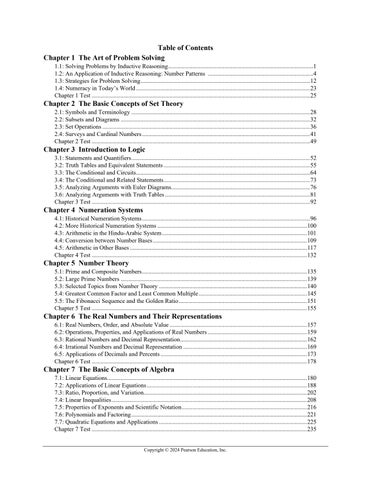
Table of Contents Chapter 1 The Art of Problem Solving 1.1: Solving Problems by Inductive Reasoning ............................................................................................... 1 1.2: An Application of Inductive Reasoning: Number Patterns ..................................................................... 4 1.3: Strategies for Problem Solving ............................................................................................................... 12 1.4: Numeracy in Today’s World .................................................................................................................. 23 Chapter 1 Test ............................................................................................................................................... 25
Chapter 2 The Basic Concepts of Set Theory 2.1: Symbols and Terminology ..................................................................................................................... 28 2.2: Subsets and Diagrams ............................................................................................................................ 32 2.3: Set Operations ........................................................................................................................................ 36 2.4: Surveys and Cardinal Numbers .............................................................................................................. 41 Chapter 2 Test ............................................................................................................................................... 49
Chapter 3 Introduction to Logic 3.1: Statements and Quantifiers ..................................................................................................................... 52 3.2: Truth Tables and Equivalent Statements ................................................................................................ 55 3.3: The Conditional and Circuits.................................................................................................................. 64 3.4: The Conditional and Related Statements................................................................................................ 73 3.5: Analyzing Arguments with Euler Diagrams........................................................................................... 76 3.6: Analyzing Arguments with Truth Tables ............................................................................................... 81 Chapter 3 Test ............................................................................................................................................... 92
Chapter 4 Numeration Systems 4.1: Historical Numeration Systems .............................................................................................................. 96 4.2: More Historical Numeration Systems .................................................................................................. 100 4.3: Arithmetic in the Hindu-Arabic System ............................................................................................... 101 4.4: Conversion between Number Bases ..................................................................................................... 109 4.5: Arithmetic in Other Bases .................................................................................................................... 117 Chapter 4 Test ............................................................................................................................................. 132
Chapter 5 Number Theory 5.1: Prime and Composite Numbers ............................................................................................................ 135 5.2: Large Prime Numbers .......................................................................................................................... 139 5.3: Selected Topics from Number Theory ................................................................................................. 140 5.4: Greatest Common Factor and Least Common Multiple ....................................................................... 145 5.5: The Fibonacci Sequence and the Golden Ratio .................................................................................... 151 Chapter 5 Test ............................................................................................................................................. 155
Chapter 6 The Real Numbers and Their Representations 6.1: Real Numbers, Order, and Absolute Value .......................................................................................... 157 6.2: Operations, Properties, and Applications of Real Numbers ................................................................. 159 6.3: Rational Numbers and Decimal Representation ................................................................................... 162 6.4: Irrational Numbers and Decimal Representation ................................................................................. 169 6.5: Applications of Decimals and Percents ................................................................................................ 173 Chapter 6 Test ............................................................................................................................................. 178
Chapter 7 The Basic Concepts of Algebra 7.1: Linear Equations................................................................................................................................... 180 7.2: Applications of Linear Equations ......................................................................................................... 188 7.3: Ratio, Proportion, and Variation........................................................................................................... 202 7.4: Linear Inequalities ................................................................................................................................ 208 7.5: Properties of Exponents and Scientific Notation .................................................................................. 216 7.6: Polynomials and Factoring ................................................................................................................... 221 7.7: Quadratic Equations and Applications ................................................................................................. 225 Chapter 7 Test ............................................................................................................................................. 235 Copyright © 2024 Pearson Education, Inc.
Chapter 8 Graphs, Functions, and Systems of Equations and Inequalities 8.1: The Rectangular Coordinate System and Circles ................................................................................. 240 8.2: Lines, Slope, and Average Rate of Change .......................................................................................... 245 8.3: Equations of Lines ................................................................................................................................ 255 8.4: Linear Functions, Graphs, and Models ................................................................................................. 264 8.5: Quadratic Functions, Graphs, and Models ........................................................................................... 268 8.6: Exponential and Logarithmic Functions, Graphs, and Models............................................................. 275 8.7: Systems of Linear Equations ................................................................................................................ 282 8.8: Applications of Linear Systems............................................................................................................ 290 8.9: Linear Inequalities, Systems, and Linear Programming ....................................................................... 299 Chapter 8 Test ............................................................................................................................................. 307
Chapter 9 Geometry 9.1: Points, Lines, Planes, and Angles ......................................................................................................... 311 9.2: Curves, Polygons, Circles, and Geometric Constructions .................................................................... 314 9.3: The Geometry of Triangles: Congruence, Similarity, and the Pythagorean Theorem.......................... 318 9.4: Perimeter, Area, and Circumference .................................................................................................... 329 9.5: Volume and Surface Area .................................................................................................................... 339 9.6: Transformational Geometry ................................................................................................................. 345 9.7: Non-Euclidean Geometry and Topology .............................................................................................. 349 9.8: Chaos and Fractal Geometry ................................................................................................................ 350 Chapter 9 Test ............................................................................................................................................. 353
Chapter 10 Counting Methods 10.1: Counting by Systematic Listing ......................................................................................................... 356 10.2: Using the Fundamental Counting Principle ........................................................................................ 369 10.3: Using Permutations and Combinations .............................................................................................. 375 10.4: Using Pascal’s Triangle ...................................................................................................................... 383 10.5: Counting Problems Involving “Not” and “Or” ................................................................................... 386 Chapter 10 Test ........................................................................................................................................... 392
Chapter 11 Probability 11.1: Basic Concepts ................................................................................................................................... 395 11.2: Events Involving “Not” and “Or”....................................................................................................... 403 11.3: Conditional Probability and Events Involving “And” ........................................................................ 409 11.4: Binomial Probability .......................................................................................................................... 421 11.5: Expected Value and Simulation ......................................................................................................... 426 Chapter 11 Test ........................................................................................................................................... 433
Chapter 12 Statistics 12.1: Visual Displays of Data ...................................................................................................................... 438 12.2: Measures of Central Tendency ........................................................................................................... 443 12.3: Measures of Dispersion ...................................................................................................................... 449 12.4: Measures of Position .......................................................................................................................... 461 12.5: The Normal Distribution .................................................................................................................... 466 Chapter 12 Test ........................................................................................................................................... 472
Chapter 13 Personal Financial Management 13.1: The Time Value of Money ................................................................................................................. 476 13.2: Consumer Credit................................................................................................................................. 483 13.3: Truth in Lending ................................................................................................................................. 488 13.4: The Costs and Advantages of Home Ownership ................................................................................ 495 13.5: Financial Investments ......................................................................................................................... 503 13.6: Income Tax Liability .......................................................................................................................... 510 Chapter 13 Test ........................................................................................................................................... 513
Copyright © 2024 Pearson Education, Inc.
Chapter 14 Graph Theory 14.1: Basic Concepts ................................................................................................................................... 515 14.2: Euler Circuits and Route Planning ..................................................................................................... 520 14.3: Hamilton Circuits and Algorithms ..................................................................................................... 523 14.4: Trees and Minimum Spanning Trees.................................................................................................. 531 Chapter 14 Test ........................................................................................................................................... 537
Chapter 15 Voting and Apportionment 15.1: The Possibilities of Voting ................................................................................................................. 540 15.2: The Impossibilities of Voting ............................................................................................................. 566 15.3: The Possibilities of Apportionment .................................................................................................... 595 15.4: The Impossibilities of Apportionment ................................................................................................ 613 Chapter 15 Test ........................................................................................................................................... 628
Copyright © 2024 Pearson Education, Inc.
1.1: SOLVING PROBLEMS BY INDUCTIVE REASONING
1
Chapter 1: The Art of Problem Solving Section 1.1: Solving Problems by Inductive Reasoning 1. 1, 2, 3, 4, 5
4. D
2. Saturday
5. 81
3. Each number is three more than the previous, so 13 3 16.
6. 21 34 55
7. This is an example of inductive reasoning because you are using the specific pattern of adding 3 each time to guess the next number. 8. This is an example of inductive reasoning because you are using the observed pattern of 61-minute intervals to hypothesize that this pattern will continue. 9. This is an example of deductive reasoning because you are applying the general formula for perimeter of a square to a specific square. 10. This is an example of deductive reasoning because you are applying the general policy for re-stocking fees to a specific item. 11. This is an example of a deductive argument because a specific conclusion, “you can expect it to be ready in ten days,” is drawn from the two given premises. 12. This is an example of a deductive argument because the specific conclusion, “you will feel better,” is drawn from the two given premises. 13. This is an example of inductive reasoning because you are reasoning from a specific pattern to the conclusion that “It will also rain tomorrow.” 14. This is an example of inductive reasoning because you are reasoning from the specific pattern of Rhonda’s babies exceeding 10 pounds at birth to the conclusion that her next child will also exceed 10 pounds at birth. 15. This represents deductive reasoning because you are moving from a general rule (formula for area of a circle) to a specific result (a search area of over 500,000 square miles). 16. This represents deductive reasoning because you are moving from a general rule (subtraction property of equality) to a specific result (the subtraction of 13 from both sides). 17. This is a deductive argument where you are reasoning from the two given premises. The first, “If you build it, they will come” is a general statement and the conclusion, “they will come” is specific. 18. This is deductive reasoning because (as in Exercise 11) you are reasoning from the given premises, the first being general, “All men are mortal”, to a specific conclusion “Socrates is mortal.” 19. This is an example of inductive reasoning because you are reasoning from a specific pattern of all previous attendees to a conclusion that the next one “I” will also be accepted into graduate school. 20. This is an example of inductive reasoning because you are reasoning from a specific historical pattern where the summer flowers have alternated their colorings from summer to summer to a specific conclusion about the color of this summer’s flowers. 21. This is an example of inductive reasoning because you are reasoning from a specific pattern to a general rule to obtain the next number in the sequence. 22. This is an example of inductive reasoning because you are reasoning from a specific pattern to a generalization as to the reason why the fleas no longer jump on command. 23. Writing exercise; answers will vary. 24. Writing exercise; answers will vary. 25. Each number in the list is obtained by adding 3 to the previous number. The most probable next term is 18 3 21. 26. The probable next term is 38 because each term in the list (after the first) can be obtained by adding 5 to the previous term. Copyright © 2024 Pearson Education, Inc.
2
CHAPTER 1: THE ART OF PROBLEM SOLVING
27. Each number in the list is obtained by multiplying the previous number by 4. The most probable next term is 4 768 3072. 28. The probable next term is 1 because each term following the first can be obtained by taking one half of the previous term (or dividing the preceding term by 2). 29. Beginning with the third term, each number in the sequence is the sum of the two previous terms. Because 9 (3 6), 15 (6 9), 24 (9 15), and 39 (15 24), the most probable next term is 63 (24 39). 30.
11 is the probable next term. The apparent pattern is to add 2 to both numerator and denominator. 13
31. The numerators and denominators are consecutive counting numbers. The probable next term is
11 . 12
32. The next term is probably 36, which is 6 2. Notice that the other numbers can be computed as 12, 2 2, 32, 4 2, and 5 2. 33. The most probable next term is 6 3 216. Observe the sequence: 1 13; 8 2 3; 27 33; 64 4 3; 125 53. This sequence is made up of the cubes of each counting number. 34. The next term is probably 56. Note that each term (after the first term) may be computed by adding successively 4, 6, 8, 10, and 12 to each preceding term. Thus, it follows that a probable next term would be 42 14 56. 35. The probable next term is 52. Note that each term (after the first) may be computed by adding successively 3, 5, 7, 9, and 11 to each preceding term. Thus, it follows that a probable next term would be 39 13 52. 36. The probable next term is 7. Note that each term after the first may be obtained by subtracting successively 6, 5, 4, and 3. Thus it follows that the next term would be 9 2 7. 37. There are many possibilities. One such list is 10, 20, 30, 40, 50, … . 38. There are many possibilities. One such list is 48, 38, 29, 21, 14, … . 39. Observe that on the left, the pattern suggests that the digit 5 will be appended to the first number. Thus, we get (98,765 9) which is added to 3. On the right, the pattern suggests appending another digit 8 to obtain 888,888. Therefore, (98, 765 9) 3 888,885 3 888,888. By computation, the conjecture is verified. 40. Observe that on the left, the pattern suggests that the digit 5 will be appended to the first number. Thus, (12, 345 9) 6 111,111 which can be verified using a calculator to compute the left side of the equation. 41. Observe that on the left, the pattern suggests that 3367 will be multiplied by the next multiple of 3, which is 15. On the right, the pattern suggests the result 50,505. The pattern suggests the following equation: 3367 15 50, 505. Multiply 3367 15 to verify the conjecture. 42. Observe that on the left, the pattern suggests that 15,873 will be multiplied by the next multiple of 7, which is 35. On the right, the pattern suggests the result 555,555. The pattern suggests the following equation: 15,873 35 555, 555. Multiply to verify the conjecture. 43. The given pattern suggests the following equation: 11,111 11,111 123, 454, 321. Multiply 11,111 11,111 to verify the conjecture. 44. The given pattern suggests the following equation: 33, 334 33, 334 1,111,155, 556. Multiply 33, 334 33, 334 to verify the conjecture. 45. The pattern suggests the following equation: 3 6 9 12 15
15(6) . Because both the left and right sides 2
equal 45, the conjecture is verified.
Copyright © 2024 Pearson Education, Inc.