Article I. Solution Manual Marieb Human Anatomy & Physiology, 12th edition Katja Hoehn Lawrence W. Haynes Matthew A. Abbott Chapter 1-29 with appendix A,B,C
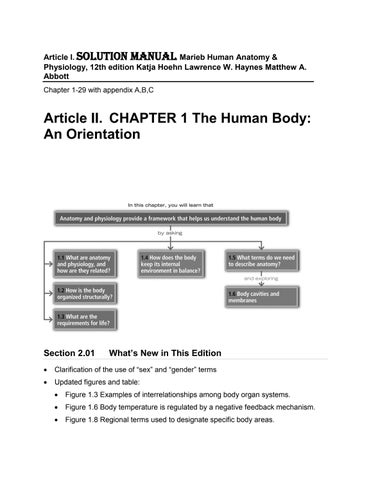
Article II. CHAPTER 1 The Human Body: An Orientation
Section 2.01
What’s New in This Edition
Clarification of the use of ―sex‖ and ―gender‖ terms
Updated figures and table:
Figure 1.3 Examples of interrelationships among body organ systems.
Figure 1.6 Body temperature is regulated by a negative feedback mechanism.
Figure 1.8 Regional terms used to designate specific body areas.
Figure 1.9 Planes of the body with corresponding magnetic resonance imaging (MRI) scans.
Figure 1.10 Dorsal and ventral body cavities and their subdivisions.
Table 1.1 Orientation and Directional Terms
Suggested Lecture Outline All of the figures in the main text are available in J PEG format, PPT, and labeled and unlabeled format in the Instructor Resources within Mastering. All of the figures and tables will also be available as digital transparencies. For more information, please go to (a) 1.1 Form (anatomy) determines function (physiology) (pp. 2–3) (i) Learning Outcomes
Define anatomy and physiology and describe their subdivisions.
Explain the principle of complementarity.
(ii) Figure
Figure 1.1 Complementarity of structure and function. (p. 2)
A. Anatomy is the study of the structure of body parts and their relationships to each other, and physiology is the study of the function of body parts. B. Topics of Anatomy 1. Gross (macroscopic) anatomy is the study of structures large enough to be seen with the naked eye. a. Regional anatomy is the study of all body structures in a given body region. b. Systemic anatomy is the study of all structures in a body system. c. Surface anatomy is the study of internal body structures as they relate to the overlying skin. 2. Microscopic anatomy is the study of structures that are too small to be seen with the naked eye. a. Cytology is the study of individual cells. b. Histology is the study of tissues. 3. Developmental anatomy is the study of the change in body structures over the course of a lifetime; embryology focuses on development that occurs before birth. 4. Specialized Branches of Anatomy a. Pathological anatomy is the study of structural changes associated with disease. b. Radiographic anatomy is the study of internal structures using specialized visualization techniques.
C. Studying Anatomy 1. Essential tools for studying anatomy include mastery of anatomical terminology, observation, manipulation, palpation, and auscultation. D. Topics of Physiology 1. There are several subdivisions of physiology, most of which consider the function of specific organ systems. 2. Physiology often focuses on cellular and molecular events as well as applying principles of physics and chemistry. E. Complementarity of Structure and Function 1. The principle of complementarity of structure and function is based on the fact that what a structure can do is related to its form. Demonstration: Obtain various types of anatomical and histological imagery (micrographs, X-ray films, C T scans, DSR scans) to show how we visualize the structures of the body. Teaching Tip: Many students have a very poor concept of the dynamics of the human body and how it functions in the environment. Try to stress throughout this chapter the adaptive nature of the body and the interrelationship between environmental variables and system response. (b) 1.2 The body’s organization ranges from atoms to the entire organism (pp. 4–7) (i) Learning Outcomes
Name the different levels of structural organization that make up the human body, and explain their relationships.
List the 11 organ systems of the body, identify their components, and briefly explain the major function(s) of each system.
(ii) Figures
Figure 1.2 Levels of structural organization. (p. 4)
Figure 1.3 Examples of interrelationships among body organ systems. (p. 5)
Figure 1.4 The body‘s organ systems and their major functions. (pp. 6, 7)
A. The body has several levels of organization: 1. The chemical level is the simplest level of organization. a. Atoms, tiny building blocks of matter, combine to form molecules. b. Molecules combine in specific ways to form organelles, which are the basic unit of living cells. 2. Cells are the smallest unit of life, and varies widely in size and shape according to the cells‘ function.
3. Tissues are groups of cells having a common function. 4. An organ is a discrete structure that performs a specific function for the body. 5. An organ system is a group of organs that work closely together to accomplish a specific purpose. 6. The organism is the total of all structures working together to promote life. B. The body comprises 11 organ systems (refer to Fig. 1.4): 1. Integumentary system: forms the external body covering that protect the deeper tissues of the body. 2. Skeletal system: protects and supports organs, attach muscles, and provide for blood cell formation. 3. Muscular system: allows movement, maintains posture, and produces heat. 4. Nervous system: a fast-acting control system that responds to internal and external changes, activating the appropriate muscles and glands. 5. Endocrine system: secretes hormones that regulate the processes of the body. 6. Cardiovascular system: the heart and blood vessels work together to transport blood containing oxygen, nutrients, and other substances, throughout the body. 7. Lymphatic and immune systems: returns excess fluid to blood, removes debris, and houses cells of the immune system 8. Respiratory system: keeps blood supplied with oxygen and removes carbon dioxide. 9. Digestive system: breaks down food into molecules that can be absorbed into the body, stores and eliminates wastes. 10. Urinary system: eliminates nitrogenous wastes, and regulates water and ion balance. 11. Male and female reproductive systems: produces sex hormones and gametes for the production of offspring, female provides support for the developing fetus. Teaching Tip: Often, students do not construct an effective picture in their minds of the level on which they are working. Make a point to, throughout all your lectures in the course, clarify which structural level you are discussing. (c) 1.3 What are the requirements for life? (pp. 5, 8–9) (i) Learning Outcomes
List the functional characteristics necessary to maintain life in humans.
List the survival needs of the body.
A. Necessary Life Functions 1. Maintaining boundaries allows an organism to maintain separate internal and external environments or separate internal chemical environments.
2. Movement allows the organism to travel through the environment, and allows transport of molecules within the organism. 3. Responsiveness, or excitability, is the ability to detect changes in the internal or external environment and respond to them. 4. Digestion is the process of breaking down food into molecules that are usable by the body. 5. Metabolism includes all chemical reactions that occur in the body. 6. Excretion is the process of removing wastes. 7. Reproduction is the process of producing more cells or organisms. 8. Growth is an increase in size in body parts or the whole organism. B. Survival Needs 1. Nutrients are consumed chemical substances that are used for energy and cell building. 2. Oxygen is required by the chemical reactions that release energy from foods. 3. Water, the most abundant chemical substance in the body, provides an environment for chemical reactions and a fluid medium for secretions and excretions. 4. Normal body temperature is required for the chemical reactions of the body to occur at the proper rate. 5. Appropriate atmospheric pressure within a range that ensures proper gas exchange in the lungs. Discussion Point: Ask students to consider how the life functions we perform facilitate meeting the survival needs. (d) 1.4 Homeostasis is maintained by negative feedback (pp. 9–12) (i) Learning Outcomes
Define homeostasis and explain its significance.
Describe how negative and positive feedback maintain body homeostasis.
Describe the relationship between homeostatic imbalance and disease.
(ii) Figures
Figure 1.5 Interactions among the elements of a homeostatic control system maintain stable internal conditions. (p. 10)
Figure 1.6 Body temperature is regulated by a negative feedback mechanism. (p. 11)
Figure 1.7 A positive feedback mechanism regulates formation of a platelet plug. (p. 12)