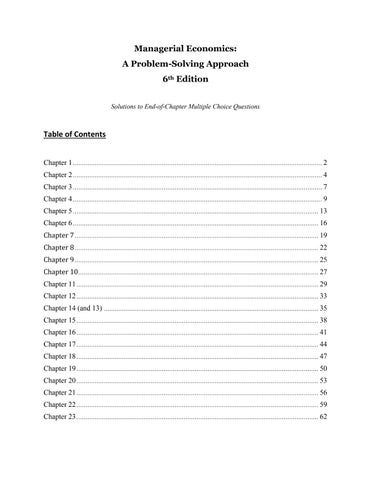
Managerial Economics: A Problem-Solving Approach 6th Edition Solutions to End-of-Chapter Multiple Choice Questions
Table of Contents Chapter 1 ......................................................................................................................................... 2 Chapter 2 ......................................................................................................................................... 4 Chapter 3 ......................................................................................................................................... 7 Chapter 4 ......................................................................................................................................... 9 Chapter 5 ....................................................................................................................................... 13 Chapter 6 ....................................................................................................................................... 16 Chapter 7 ...................................................................................................................................... 19 Chapter 8 ...................................................................................................................................... 22 Chapter 9 ...................................................................................................................................... 25 Chapter 10.................................................................................................................................... 27 Chapter 11 ..................................................................................................................................... 29 Chapter 12 ..................................................................................................................................... 33 Chapter 14 (and 13) ...................................................................................................................... 35 Chapter 15 ..................................................................................................................................... 38 Chapter 16 ..................................................................................................................................... 41 Chapter 17 ..................................................................................................................................... 44 Chapter 18 ..................................................................................................................................... 47 Chapter 19 ..................................................................................................................................... 50 Chapter 20 ..................................................................................................................................... 53 Chapter 21 ..................................................................................................................................... 56 Chapter 22 ..................................................................................................................................... 59 Chapter 23 ..................................................................................................................................... 62
Chapter 1 1.
Why might performance compensation caps be bad? a. Different pay rates promote dissent. [A compensation cap is a maximum salary limit; it does not necessarily produce varied pay rates] b. Compensation caps can discourage employees from being productive after the cap. [Correct; at least with regards to salary, the employee is not rewarded for further productivity beyond the amount that produces the cap value] c. Compensation caps can discourage employees from being productive before the cap. [Employees are incentivized to reach the value of the cap, encouraging productivity prior to its achievement] d. Both b and c
2.
What is a possible consequence of a performance compensation reward scheme? a. It creates productive incentives. [As pay is tied directly to performance, such a policy may motivate workers to improve their performance for the additional compensation] b. It creates harmful incentives. [Such a policy may create incentives to manipulate the performance indicators or outputs, or view that performance metric exclusive from the overall interests of the firm] c. Both a and b [Correct; could produce productive or harmful incentives depending on the situation and the character of the person being rewarded] d. Neither a nor b [Performance compensation schemes will produce some kind of incentives]
3.
Which of the following is NOT one of the three problem solving principles laid out in Chapter 1? a. Under whose jurisdiction is the problem? [Correct; this is NOT one of the key problem solving principles]. b. Who is making the bad decision? [This is one of the key problem solving principles] c. Does the decision maker have enough information to make a good decision? [This is one of the key problem solving principles] d. Does the decision maker have the incentive to make a good decision? [This is one of the key problem solving principles]
4.
Why might it be bad for hotels to not charge higher prices when rooms are in higher demand? a. Arbitrageurs might establish a black market by reserving rooms and then selling the reservations to customers. [This black market allows the arbitrageurs to capture the value of the increased demand rather than the hotels who are providing the rooms as well as creating a less reliable system for the consumer] b. Rooms may be rationed. [If demand increases but prices do not, demand for rooms may exceed supply, forcing the hotel to ration the rooms and turn customers who would have been willing to pay higher rates away] c. Without the profit from these high demand times, hotels would have less of an incentive to build/expand, making the long run scarcity problem even worse. [Such a policy essentially creates a performance cap on the hotels, limiting their profitability to the number of rooms rather than overall demand]
d. All of the above. [Correct; all of these are potential negative impacts of hotels not adjusting prices to accommodate demand]
5.
The rational-actor paradigm assumes the people do NOT a. Act rationally. [The rational actor paradigm does assume that people act rationally] b. Act randomly. [Correct; the rational actor paradigm assumes people will act rationally, optimally and self-interestedly. Random actions are not one of the assumptions] c. Act optimally. [The rational actor paradigm does assume people will act optimally, selecting or creating the outcome that provides them with the most benefit] d. Act self-interestedly. [The rational actor paradigm does assume that people will act in their own best interest]
6.
The problem-solving principles analyze firm problems, a. from the organization’s point of view. [Correct; considering a problem from the view of the overall organization will help ensure all elements and impacts are considered.] b. from the manager’s point of view. [Managers are also employees of the organization, thinking of a problem from only their perspective may overlook its impact on the company as a whole] c. from the worker’s point of view. [Thinking about a problem only from the employee’s point of view risks missing the fundamental problem of goal alignment with the overall organization] d. from society’s point of view. [Society does not have the same goals and incentives as the firm.]
7.
Why might welfare for low income households reduce the propensity to work? a. It will not. [It can if working can only provide similar benefits to those that can be received from welfare without working] b. It reduces the incentive to work. [Correct; those receiving welfare may have less incentive to work if the benefits of working are similar to or worse than those that are received without it. Additionally, welfare may reduce the value of working for higher income workers who have to support the system, also reducing their incentives] c. It is unfair. [Perception of fairness alone will not alter the propensity to work unless it also impacts the value of that work for the individual, which would impact his overall incentives] d. It encourages jealousy. [Jealousy itself will not alter the propensity to work unless it also impacts the perceived value of that work, which changes the incentives]
8.
Why might a “bonus cap” for executives be a bad policy for the company? a. It isn’t. Executives shouldn’t make more than a certain amount. [Just like other types of employees, setting a maximum value for executives eliminates the ability to separate, reward and motivate them based on their performance] b. It would sow discontent. [Even if discontented, the rational actor paradigm indicates executives would still perform to reach the cap value in order to maximize their bonus]
c.
d.
9.
It would encourage shirking after the executives reached the cap. [Correct; limiting the bonus may reduce the incentive of executives to continue improving or performing once it is achieved] The cap could be set too high, so execs may work too hard and not reach it. [This is a problem not with the cap itself, but with the level, which can be adjusted as needed]
What might happen if a car dealership is awarded a bonus by the manufacturer for selling a certain number of its cars monthly, but the dealership is just short of that quota near the end of the month? a. It may sell the remaining cars at huge discounts to hit the quota. [Correct; the loss of income from the reduced rate will be offset by the manufacturer’s bonus] b. It creates an incentive to sell cars from different manufacturers. [The dealership is more inclined to sell cars from the manufacturer providing the bonus] c. It would ruin the relationship between dealer and manufacturer. [The dealer is working to meet the requirements of the manufacturer to achieve the bonus] d. Potential buyers will lose buying power at the dealer. [Potential buyers would gain buying power in this scenario since the dealership has incentive to lower prices]
10. Why might a supermarket advertise low prices on certain high profile items and sell them at a loss? a. It is a way for companies to be charitable. [The rational actor paradigm tells us the firm will act in its own self-interest] b. The store will sell other groceries to the same customers, often at a markup. [Correct; by using the discounted items to bring consumers into the stores, the supermarket can profit by increasing the prices on the other items they will purchase while they are there] c. They would not. [Actually, they do quite often. Can you think of why this may be?] d. This reduces the incentives of trade. [Trade incentives do not apply in this case]
Chapter 2 Multiple Choice Solutions:
1.
An individual’s value for a good or service is a. The amount of money he or she used to pay for a good. [Past payments do not necessarily indicate the current value of a good or service to an individual] b. The amount of money he or she is willing to pay for it. [Correct; to “value” a good means that you want it and can pay for it] c. The amount of money he or she has to spend on goods. [Total individual wealth does not reflect the value of a particular good or service] d. None of the above [To “value” a good means that you want it and can pay for it]
2.
The biggest advantage of capitalism is that a. it allows the market to self-regulate [Competition in the market results in self-regulation] b. it allows a person to follow his self-interest [Transactions will not be consummated unless both sides’ interests are met] c. it allows voluntary transactions which creates wealth [Wealth-creating transactions only occur when both buyer and seller see a surplus]
d. All of the above [Correct] 3.
Wealth creating transactions are more likely to occur a. with private property rights [Private property rights facilitate voluntary transactions] b. with strong contract enforcement [Contract enforcement helps facilitate voluntary transactions] c. with black markets [Black markets are often created from a wealth-generating arbitrage opportunity] d. All of the above [Correct; by making sure that buyers and sellers can keep the gains of trade, legal mechanisms such as private property and contract rights that facilitate voluntary transactions will help generate wealth; black markets also create wealth from seizing arbitrage opportunities that exist from inefficiencies in the market]
4.
Which of these actions creates value? a. Buying a struggling firm and selling off its assets for more than the purchase price. [Other firms value the sum of the individual assets more than they did when the firm was a collection of individual assets.] b. A baseball slugger drawing paying fans into the ballpark. [The baseball player increases the value of attending the game for ticket holders and potential ticket holders, thereby increasing ticket sales.] c. A student increasing his decision-making ability with an MBA. [The student is more valuable to firms with an MBA than without] d. All of the above [Correct]
5.
Which of the following are examples of a price floor? a. Minimum wages [Correct; by outlawing wages below a certain price, minimum wages are an example of a price floor] b. Rent controls in New York [This is an example of a price ceiling, in which the price of rent cannot go above a specified value] c. Both a and b [Of the two options, one is indeed an example of a price floor, while the other is a price ceiling] d. None of the above. [At least one of the answers above is an example of a price floor, which is defined as a regulation that outlaws trade at prices below the specified “floor” value]
6.
A price ceiling a. Is a government-set maximum price above market equilibrium. [A price ceiling is a regulation that outlaws trade above a specified price; it does not have to be above market equilibrium] b. Is an implicit tax on producers and an implicit subsidy to consumers. [Correct; Price ceilings prevent producers from selling at a higher price to consumers who would be willing to pay more, while consumers have the opportunity to purchase something they may not have been able to otherwise] c. Will create a surplus. [Likely, both the consumer (buyer) and producer (seller) will value the good at or above the specified ceiling. If the producer is forced to sell, any surplus for the consumer is a loss for the producer, so no net surplus is created from the transaction]
d.
7.
Causes an increase in consumer and producer surplus. [Both the consumer (buyer) and producer [seller] likely value the item at or above the specified ceiling, resulting in a benefit for the consumer but a loss of potential wealth for the producers]
Taxes a.
impede the movement of assets to higher valued uses. [This is the result of anything that deters a wealth creating transaction] b. reduce incentives to work. [By not allowing people to capture the full value of their labor and production, taxes reduce the incentive to work] c. decrease the number of wealth-creating transactions. [If a tax is larger than the total surplus created by a transaction, the transaction will not take place] d. All of the above. [Correct; when taxes are larger than the surplus of a transaction, that transaction will not take place, thus deterring a wealth creating transaction. Likewise, by not allowing people to keep the gains from their own trade, taxes can diminish the incentive to work]
8.
A consumer values a car at $20,000 and it costs a producer $15,000 to make the same car. If the transaction is completed at $18,000, the transaction will generate a. no surplus [A surplus is created from this transaction] b. $5,000 worth of seller surplus and unknown amount of buyer surplus [Seller surplus is $3,000, (Final price less seller value); Similarly, buyer surplus can be calculated by looking at the difference between the buyer value and the final price] c. $2,000 worth of buyer surplus and $3,000 of seller surplus [Correct; Buyer surplus is calculated by looking at the difference between the buyer value and the final price ($20,000$18,000=$2,000), while the seller surplus is calculated by looking at the difference between the final price and the seller’s value ($18,000-$15,000=$3,000)] d. $3,000 worth of buyer surplus and unknown amount of seller surplus. [Buyer surplus is $2,000, (Buyer value less final price); similarly, seller surplus can be calculated by looking at the difference between the final price and the seller value]
9.
A consumer values a car at $525,000 and a seller values the same car at $485,000. If sales tax is 8% and is levied on the seller, then the seller’s bottom line price is (rounded to the nearest thousand) a. $527,000 (Correct; $485,000/0.92 = $527,173.93, rounded to the nearest thousand is $527,000. (Note: as the seller requires a number at or above this value, $528,000 is arguably a better answer)] b. $524,000 [At a price of $524,000, the seller will only receive $482,080 ($524,000*0.92) which is below his bottom line] c. $525,000 [At a price of $525,000, the seller will only receive $483,000 ($525,000*0.92) which is below his bottom line] d. $500,000 [At a price of $500,000, the seller will only receive $460,000 ($500,000*0.92) which is below his bottom line]
10. Voluntary transactions a. Always produce gains for both parties [Correct; To be voluntary, both sides must see gains from consummating the transaction]
b.
Produce gains for at least one party [If one side does not see value in the transaction, they will choose to not consummate the deal. Both sides must see value] c. Always increase wealth for everyone [Voluntary transactions only create wealth for the parties involved] d. Are inefficient [Voluntary transactions move assets to their higher-value uses, a feature of an efficient market]
Chapter 3 Multiple Choice Solutions:
1.
A business owner makes 1000 items a day. Each day she contributes eight hours to produce those items. If hired elsewhere, she could have earned $250 an hour. The item sells for $15 each. Production does not stop during weekends. If the explicit costs total $150,000 for 30 days, the firm’s accounting profit for the month equals: a. $300,000 [Correct; Revenue equals 1000 items per day * $15/item*30days = $450,000. Explicit costs are given as $150,000. Therefore, accounting profit = $450,000-$150,000 = $300,000] b. $60,000 [This number represents the opportunity cost of her labor; $250/hr*8hrs/day*30 days = $60,000] c. $450,000 [This number represents the total revenue; 1000 items per day * $15/item*30days = $450,000.] d. $240,000 [For accounting profit, opportunity costs are not considered]
2.
If a firm is earning negative economic profits, it implies a. That the firm’s accounting profits are zero. [Not necessarily, it is impossible to determine the relationship between economic and accounting profit without information on the economic costs involved]. b. That the firm’s accounting profits are positive. [Not necessarily, it is impossible to determine the relationship between economic and accounting profit without information on the economic costs involved]. c. That the firm’s accounting profits are negative. [Not necessarily, it is impossible to determine the relationship between economic and accounting profit without information on the economic costs involved]. d. That more information is needed to determine accounting profits [Correct; it is impossible to determine the relationship between economic and accounting profit without information on the economic costs involved]
3.
Opportunity costs arise due to a. Resource scarcity [Correct; without scarce resources (time, labor, money, etc.), the pursuit of another alternative does not require one to give up anything in return. b. Lack of alternatives [ Opportunity costs come from foregoing alternatives. If there are no alternatives, there are no opportunity costs] c. Limited wants [Limited wants would not generate opportunity costs]