Solution Manul For Managerial Accounting, Canadian Edition, 5th edition Karen W. Braun, Wendy M. Tietz, Louis Beaubien Chapter 1-14
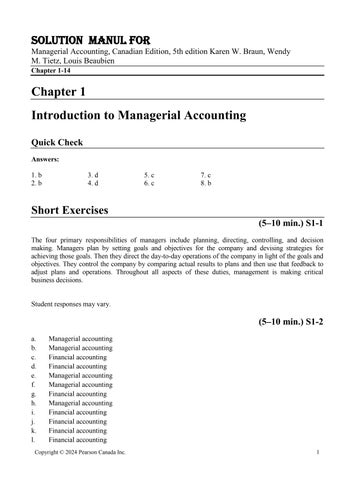
Chapter 1 Introduction to Managerial Accounting Quick Check Answers: 1. b 2. b
3. d 4. d
5. c 6. c
7. c 8. b
Short Exercises (5–10 min.) S1-1 The four primary responsibilities of managers include planning, directing, controlling, and decision making. Managers plan by setting goals and objectives for the company and devising strategies for achieving those goals. Then they direct the day-to-day operations of the company in light of the goals and objectives. They control the company by comparing actual results to plans and then use that feedback to adjust plans and operations. Throughout all aspects of these duties, management is making critical business decisions.
Student responses may vary.
(5–10 min.) S1-2 a. b. c. d. e. f. g. h. i. j. k. l.
Managerial accounting Managerial accounting Financial accounting Financial accounting Managerial accounting Managerial accounting Financial accounting Managerial accounting Financial accounting Financial accounting Financial accounting Financial accounting
Copyright © 2024 Pearson Canada Inc.
1
Managerial Accounting Fifth Canadian Edition Instructor’s Solutions Manual
m.
Managerial accounting
(5–10 min.) S1-3 a. b. c. d. e. f. g. h. i. j. k. l. m.
Internal auditing department Controller Treasurer Internal auditing department Controller Controller Treasurer Internal auditing department Controller Controller Treasurer Internal auditing department Controller
(5–10 min.) S1-4 Characteristic
Check () if related to internal auditing
a.
Helps to ensure that the company’s internal controls are functioning properly
b.
Reports to the treasurer or controller
c.
Required by the Toronto Stock Exchange if company stock is publicly traded on the TSX
d.
Reports directly to the audit committee
e.
Ensures that the company achieves its profit goals
f.
Is part of the accounting department
g.
Usually reports to a senior executive (CFO or CEO) for administrative matters
h.
Performs the same function as independent certified public accountants
i.
External audits can be performed by the internal auditing department
2
Copyright © 2024 Pearson Canada Inc.
Managerial Accounting Fifth Canadian Edition Instructor’s Solutions Manual
(10 min.) S1-5 Each of the five ethical standards contributes to maintaining CPA Canada’s expectation that management accountants will uphold the highest standards of ethical behaviour. Without the necessary competence, management accountants will be unable to perform their responsibilities. Even if they do recognize an ethical dilemma, they could lack the competence required to determine all the alternative courses of action and the implications of each alternative. Having independence is important for minimizing or eliminating the impact of others’ influences. Management accountants need to provide opinions based on their own interpretation of data rather than the interpretations of other stakeholders. Management accountants have access to confidential information. If they do not maintain that confidentiality, their companies could suffer. Their companies would be reluctant to provide access to information, which would prevent management accountants from performing their responsibilities. Additionally, employers must have confidence that management accountants have the integrity to apply their skills appropriately and avoid being prejudiced by any conflicts of interest. Management accountants should have the ability as well to effectively analyze situations so that they might communicate them faithfully to employers, regulators, or clients to ensure proper action is taken. Finally, an important part of management accountants’ responsibilities is communicating information and providing reports to senior management. To be able to rely on these reports, management must have confidence that the management accountant is not hiding inconvenient facts or presenting a biased view.
Student responses may vary.
(5 min.) S1-6 a. Providing earnings information to your brother before it is publicly announced violates the concept of client confidentiality and fails to uphold trust. b. Stealing from your employer is a violation of the concept of integrity and is illegal. c. Skipping continuing education sessions could violate the requirement to maintain professional competence in enabling competencies. If your company paid for you to attend the conference, skipping the sessions also violates the notion of integrity. d. Failing to read the specifications of the software package before purchasing it violates professional competence in enabling competencies. e. Failing to provide job description information to management because you fear it may be used to cut a position in your department violates the notion of integrity and the required skills of a competent accountant.
(5 min.) S1-7 Copyright © 2024 Pearson Canada Inc.
3
Managerial Accounting Fifth Canadian Edition Instructor’s Solutions Manual
a. b. c. d. e.
ISO 9001:2008 Enterprise resource planning (ERP) system The Sarbanes-Oxley Act (SOX) XBRL E-commerce
(5 min.) S1-8 a. b. c. d. e.
Prevention costs Lean production Appraisal costs Internal failure costs External failure costs
(5–10 min.) S1-9 a. b. c. d. e. f. g. h. i. j. k. l. m.
Lean Traditional Traditional Lean Traditional Lean Lean Traditional Lean Lean Lean Lean Traditional
(5 min.) S1-10 1. 2. 3. 4. 5. 6. 7. 8. 9. 10.
4
Reworking defective units—internal failure Litigation costs from product liability claims—external failure Inspecting incoming raw materials—appraisal Training employees—prevention Warranty repairs—external failure Redesigning the production process—prevention Lost productivity due to machine breakdown—internal failure Inspecting products that are halfway through the production process—appraisal Incremental cost of using a higher grade raw material—prevention Cost incurred producing and disposing of defective units—internal failure
Copyright © 2024 Pearson Canada Inc.
Managerial Accounting Fifth Canadian Edition Instructor’s Solutions Manual
(10–15 min.) S1-11 Req. 1 Prevention costs: Negotiating with, and training, suppliers to obtain higher-quality materials and on-time delivery Redesigning the speakers to make them easier to manufacture Appraisal costs: Additional 20 minutes of testing for each speaker Eliminate inspection of raw materials Internal failure costs: Reduce reword (fewer defective units) Avoid lost production time due to rework External failure costs: Reduce warranty repair costs Avoid lost sales due to disappointed customers
(continued) S1-11 Req. 2
Cost –Benefit Analysis
Costs Savings
Prevention costs: Negotiating with, and training, suppliers to obtain higher-quality materials and on-time delivery……………………….. Redesigning the speakers to make them easier to manufacture………………………………………………….
$ 300,000 1,400,000
Appraisal costs: Additional 20 minutes of testing for each speaker……………………
500,000
Savings on inspection of raw materials……………………………….
$(400,000)
Internal failure costs: Savings on rework……………………………………………….............. Savings on lost profits from lost production time due to Copyright © 2024 Pearson Canada Inc.
(650,000) (300,000) 5