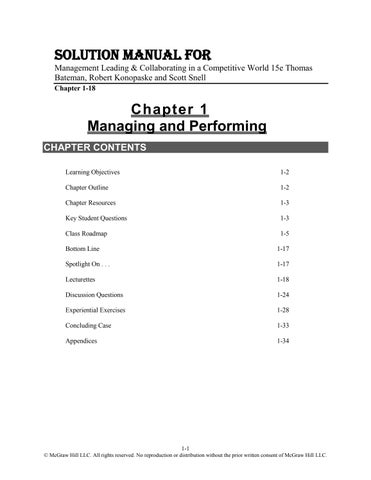
Solution Manual For Management Leading & Collaborating in a Competitive World 15e Thomas Bateman, Robert Konopaske and Scott Snell Chapter 1-18
Chapter 1 Managing and Performing CHAPTER CONTENTS Learning Objectives
1-2
Chapter Outline
1-2
Chapter Resources
1-3
Key Student Questions
1-3
Class Roadmap
1-5
Bottom Line
1-17
Spotlight On . . .
1-17
Lecturettes
1-18
Discussion Questions
1-24
Experiential Exercises
1-28
Concluding Case
1-33
Appendices
1-34
1-1 © McGraw Hill LLC. All rights reserved. No reproduction or distribution without the prior written consent of McGraw Hill LLC.
LEARNING OBJECTIVES 1.1 1.2 1.3 1.4 1.5 1.6
Summarize the major challenges of managing in the new competitive landscape. Describe the sources of competitive advantage for a company. Explain how the functions of management are evolving in today‘s business environment. Compare how the nature of management varies at different organizational levels. Define the skills you need to be an effective manager. Understand the principles that will help you manage your career.
CHAPTER OUTLINE Managing in a Competitive World Globalization Technological Change Knowledge Management Collaboration across Boundaries Managing for Competitive Advantage Innovation Quality Service Speed Cost Competitiveness Sustainability Delivering All Types of Performance The Functions of Management Planning: Delivering Strategic Value Organizing: Building a Dynamic Organization Leading: Mobilizing People Controlling: Learning and Changing Performing All Four Management Functions Management Levels and Skills Top-Level Managers Middle-Level Managers Frontline Managers Working Leaders with Broad Responsibilities Must-Have Management Skills You and Your Career Be Both a Specialist and a Generalist Be Self-Reliant Connect with People Actively Manage Your Relationship with Your Organization Survive and Thrive
1-2 © McGraw Hill LLC. All rights reserved. No reproduction or distribution without the prior written consent of McGraw Hill LLC.
CHAPTER RESOURCES Experiential Exercises 1.1 Your Personal Network
Concluding Case
Spotlight On . . .
Lecturettes
A New Manager at USA Hospital Supply
Business for the Better
1.1: An Analysis of United States vs. Japanese Management
1.2 Are You an Effective Manager?
1.2: An Examination of Managerial Roles
1.3 Career Skills Development Connect® Video Cases
Connect® iSeeit! Video Case
Connect® Click and Drag
Fair Oaks Farms
The Hawthorne Studies
The Four Functions of Management at Trader Joe‘s
Connect® Case Analysis Likely to Succeed as an Executive?
Connect® Application-Based Activity THE MANAGEMENT GAME: FUNCTIONS, SKILLS, LEVELS, AND ROLES You‘ve earned a coveted summer internship at Thriller Games. Part of your internship is observing what managers at this world-famous organization do and how they work together to develop some of the most thrilling video games on the planet! Are you ready to play this exciting management game?
KEY STUDENT QUESTIONS Students who enroll in an introductory management course typically have two primary questions: 1. 2.
―What makes a ―good‖ manager?‖ ―How can I apply the material we learn in this class to my daily life?‖
How you answer these questions depends on your teaching style and the tone you want to set for the class.
To increase class involvement, ask two or three students to describe the best managers they have ever known. Capture what the students say, and then ask the class to tell you what similarities and differences they hear in the stories.
Link the similarities to the skills needed for planning, organizing, leading and controlling, and then discuss the differences regarding leadership style and the flexibility leaders need to react differently to different situations. It is important to let students know that there is not a single set of skills or guidelines to become a ―good‖ 1-3
© McGraw Hill LLC. All rights reserved. No reproduction or distribution without the prior written consent of McGraw Hill LLC.
manager. The best managers are the ones who have a wide range of skills which they apply in different situations. Then ask students to describe situations they have encountered recently where they needed to use planning, organizing, leading and/or controlling.
Based on the discussion, help students to see that the best way for them to apply the material is to think about how to use each concept in their own lives. One useful analogy here is to compare technical, interpersonal, and conceptual skills to different types of tools. Not every tool is right for every person, and not every tool is right for every task, but the more tools you have in a toolbox, the more likely it is that you will be able to get the job done effectively.
To help engage your class in discussion, start the class by saying, ―This is your first day as a manager.‖ Explain that whenever anyone creates a ―to do‖ list, he or she are planning, whenever anyone tries to persuade someone else to do something they are leading, whenever anyone plans their day in the morning they are organizing, and whenever anyone balances a checkbook, he or she are controlling. Go on to explain that just as people have different styles of writing ―to do‖ lists and keeping track of their schedules, managers use different styles of management. However, certain key skills have emerged and that the purpose of the class is to help students learn these skills.
Teaching Tip The first day of class sets the tone for the rest of the quarter. If at all possible, I try to do three things on the first day of class: 1) Go over the class syllabus (which helps the students understand my expectations for the class). 2) Find out about your students—what are their majors, hobbies, future goals? 3) Cover introductory material from Chapter 1 of the text (usually managerial skills, levels of management, etc.) By starting to lecture and discuss material on the first day of class, you convey your excitement about the subject matter, and you help your students become more excited about it, too.
CLASS ROADMAP The Class Roadmap gives Learning Objectives at appropriate places and lists PowerPoints. The boxes Management in Action are addressed. Teaching Tips and Examples are presented and Connect® activities are also given to enhance class instruction.
POWERPOINTS Slide 1 Managing and Performing Slide 2 Learning Objectives
MANAGEMENT IN ACTION LYNSI SNYDER: MANAGING IN-N-OUT TO SUCCESS 1-4 © McGraw Hill LLC. All rights reserved. No reproduction or distribution without the prior written consent of McGraw Hill LLC.
Manager’s Brief Lynsi Snyder the CEO of In-N-Out Burger is profiled in this Management in Action. She has exemplified what the best managers do: lead, plan, organize, and control, helping employees to reach their full potential. Doing these things well has put Snyder in the company of the top five CEOs in the United States and In-N-Out Burger ranked as fourth in the United States as one of the best places to work. The past ten years has seen In-N-Out Burger expand to 300 stores. Synder can take credit for creating the kind of company employees enjoy working for, by offering strong job-training programs and good benefits, as well as paying them 25% more than other fast-food companies. This Management in Action Manager‘s Brief is followed by the Progress Report with Discussion Questions, and an Onward, also with Discussion Questions.
POWERPOINTS Slide 3 Managing in a Competitive World Slide 4 Globalization Slide 5 Technological Change Slide 6 Knowledge Management Slide 7 Collaboration LO 1.1: Summarize the major challenges of managing in the new competitive landscape.
I. Managing in a Competitive World A. Globalization 1. Business leaders recognize that the change from a local to a global marketplace is gaining momentum and it is irreversible. 2. Whereas U.S. companies used to dominate, today the most admired companies come from countries around the world such as Switzerland-based Nestlé, Japan‘s Toyota Motor, and Britain‘s Diagio was the most admired provider of beverages. 3. Many companies are seeing exponential growth in markets outside the United States and are drawing their talent from many countries. 4. Today, business schools must encourage students to explore the global market, not just their own region or community.
Example 1.1. Technological Change In today‘s world, communications rarely take place via letters or faxes; e-mail and text messaging are the order of the day. But with more efficient delivery systems also come problems. The U.S. government has implemented Federal Rules of Civil Procedure that require companies to save all electronic communications for up to seven years. Of even more concern, at least to some banks, is being sure that as much care is being given to data destruction as it is to
1-5 © McGraw Hill LLC. All rights reserved. No reproduction or distribution without the prior written consent of McGraw Hill LLC.