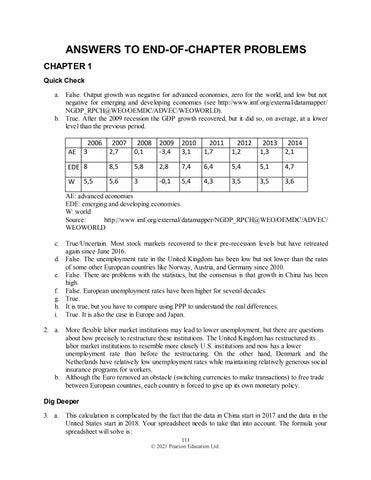
ANSWERS TO END-OF-CHAPTER PROBLEMS CHAPTER 1 Quick Check a. False. Output growth was negative for advanced economies, zero for the world, and low but not negative for emerging and developing economies (see http://www.imf.org/external/datamapper/ NGDP_RPCH@WEO/OEMDC/ADVEC/WEOWORLD). b. True. After the 2009 recession the GDP growth recovered, but it did so, on average, at a lower level than the previous period.
AE
2006 2007 3 2,7
EDE 8 W
5,5
2008 0,1
2009 -3,4
2010 3,1
2011 1,7
2012 1,2
2013 1,3
2014 2,1
8,5
5,8
2,8
7,4
6,4
5,4
5,1
4,7
5,6
3
-0,1
5,4
4,3
3,5
3,5
3,6
AE: advanced economies EDE: emerging and developing economies W: world Source: http://www.imf.org/external/datamapper/NGDP_RPCH@WEO/OEMDC/ADVEC/ WEOWORLD c. True/Uncertain. Most stock markets recovered to their pre-recession levels but have retreated again since June 2016. d. False. The unemployment rate in the United Kingdom has been low but not lower than the rates of some other European countries like Norway, Austria, and Germany since 2010. e. False. There are problems with the statistics, but the consensus is that growth in China has been high. f. False. European unemployment rates have been higher for several decades. g. True. h. It is true, but you have to compare using PPP to understand the real differences. i. True. It is also the case in Europe and Japan. 2. a. More flexible labor market institutions may lead to lower unemployment, but there are questions about how precisely to restructure these institutions. The United Kingdom has restructured its labor market institutions to resemble more closely U.S. institutions and now has a lower unemployment rate than before the restructuring. On the other hand, Denmark and the Netherlands have relatively low unemployment rates while maintaining relatively generous social insurance programs for workers. b. Although the Euro removed an obstacle (switching currencies to make transactions) to free trade between European countries, each country is forced to give up its own monetary policy. Dig Deeper 3. a.
This calculation is complicated by the fact that the data in China start in 2017 and the data in the United States start in 2018. Your spreadsheet needs to take that into account. The formula your spreadsheet will solve is: 111 © 2021 Pearson Education Ltd.