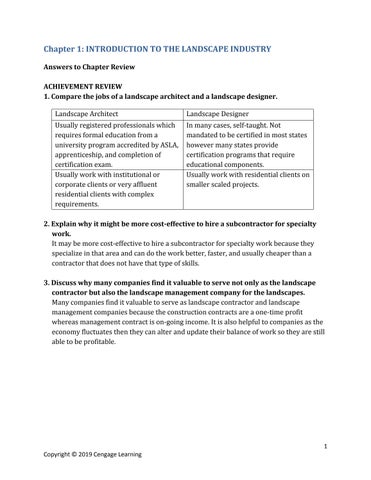
Chapter 1: INTRODUCTION TO THE LANDSCAPE INDUSTRY Answers to Chapter Review ACHIEVEMENT REVIEW 1. Compare the jobs of a landscape architect and a landscape designer. Landscape Architect
Landscape Designer
Usually registered professionals which requires formal education from a university program accredited by ASLA, apprenticeship, and completion of certification exam. Usually work with institutional or corporate clients or very affluent residential clients with complex requirements.
In many cases, self-taught. Not mandated to be certified in most states however many states provide certification programs that require educational components. Usually work with residential clients on smaller scaled projects.
2. Explain why it might be more cost-effective to hire a subcontractor for specialty work. It may be more cost-effective to hire a subcontractor for specialty work because they specialize in that area and can do the work better, faster, and usually cheaper than a contractor that does not have that type of skills. 3. Discuss why many companies find it valuable to serve not only as the landscape contractor but also the landscape management company for the landscapes. Many companies find it valuable to serve as landscape contractor and landscape management companies because the construction contracts are a one-time profit whereas management contract is on-going income. It is also helpful to companies as the economy fluctuates then they can alter and update their balance of work so they are still able to be profitable.
1 Copyright © 2019 Cengage Learning
Chapter 2: PRINCIPLES OF DESIGN Answers to Chapter Review ACHIEVEMENT REVIEW 1. Indicate which principle of design is being applied in the following situations: a. Balance b. Focalization of interest c. Unity d. Simplicity e. Balance f. Focalization of interest g. Rhythm and line h. Proportion i. Rhythm and line j. Unity 2. Compare the three types of balance. • Symmetric balance is concerned with the visual weight of the left and right sides of a landscape composition. Each side is an identical mirror image of the other side. • Asymmetric balance is concerned with the visual weight of the left and right sides of a landscape composition. The two sides are not identical. • Proximal-distal balance is concerned with the visual weight of the near and far components of a landscape composition. 3. Explain how the principles of design are affected by the viewer’s cone of vision. People seldom see a landscape design in its entirety from one vantage point. Their vision is confined to a certain width and length (the cone of vision). As they move through the landscape, the cone of vision is constantly changing, so the landscape must be designed to anticipate the changing views and perceptions of the users. 4. Using the proper instruments and a drawing board, duplicate the corner planting bed shown in Figure 2-29, drawn to the scale of 1" = 10'. Design a planting for a viewer looking in the direction of the incurve. Select plants and dimensions from Table 2-1. Draw to scale and label all species used. Drawing should be completed with 1" = 10' scale using Table 2-1 plants. All plants should be labeled. 5. With the proper equipment, duplicate the planting bed in Figure 2-30. Assume that the viewer is located south of the bed and that there is an attractive mountain 2 Copyright © 2019 Cengage Learning
scene north of the bed. Design a planting that frames but does not block the view. Select plants from Table 2-1. Draw to the scale of 1" = 10'. Drawing should be completed with 1" = 10' scale using Table 2-1 plants. All plants should be labeled. No plants should be planted in the middle of the view of the mountains. Plant should only be on each side of the view. 6. Figure 2-31 illustrates the entry portion of a house. The garage and driveway are also shown. With the proper instruments, design the public area portion of the foundation planting. Use the plants in Table 2-1. Design to the scale of 1" = 10'. Drawing should be completed with 1" = 10' scale using Table 2-1 plants. All plants should be labeled. Low lying plants should be used in front of windows. Entry should be highlighted.
3 Copyright © 2019 Cengage Learning
Chapter 3: USING DRAWING INSTRUMENTS Answers to Chapter Review ACHIEVEMENT REVIEW 1. Tape a piece of drawing paper onto a drawing board. Use a T-square to practice drawing parallel horizontal lines and vertical lines. Use a 2H pencil first and then a 3H or 4H pencil. Which pencil marks smear most easily? Which are easiest to erase? The 2H pencil should smear easier since it in the softest and the 4H pencil should be the hardest to erase since it has the highest hardness and the line is the lightest. 2. With your protractor, measure the angles in Figure 3-23. Duplicate the angles on a separate sheet of paper. Angles should be duplicated on sheet. • 1. 45 degrees • 2. 45 degrees • 3. 100 degrees (or close) • 4. 65 degrees • 5. 65 degrees • 6. 180 degrees 3. Using an engineer’s scale instrument to measure and triangle as a straightedge, draw a line 30 feet long to the sale of 1" = 10'. Draw another 30-foot line to the scale of 1" = 50'. Draw an 87-foot line to the scale of 1" = 40' and another to the scale of 1" = 30'. Lines should measure 30 feet long with 1"=10', 1"=50', and 1"=40' using engineer scale. 4. Using an architect’s scale instrument to measure and a triangle as a straightedge, draw a line 18 feet long to the scale of 3/8" = 1'. Draw a line 68 feet and 4 inches long to the scale of 1/8" = 1'. Lines should measure 18 feet long with 3/8"=0', and 68 feet and 4 Inches long to scale of 1/8"=1' using architect's scale. 5. Use a compass and a scale instrument to create a circle with a 20-foot diameter drawn to the scale of 1" = 10'. What is the radius setting for the compass? Draw another circle with a 20-foot diameter to the scale of 1" = 20'. Draw another circle with a 24-foot diameter to the scale of 1/4" = 1'. Circles should be drawn to scale. The radius setting for the 20-foot circle diameter circle would be 1". 4 Copyright © 2019 Cengage Learning
Chapter 4: LETTERING Answers to Chapter Review ACHIEVEMENT REVIEW 1. Compare three different methods of lettering commonly used by landscape architects and designers. • Lettering templates are guides that reproduce the same letter size and style over and over. They are used with a drawing pencil. • Waxed press-on letters are commercially manufactured letters that are easy to use and are dry-transferred to the drawing surface by the heat or friction created with a pencil is rubbed over the surface. • Transfer film are paper-thin, transparent, plastic sheeting with a clear adhesive backing and sheet of protective wax paper over it. • Hand lettering are distinctive and offers visual evidence of designers’ competency but is time intensive. 2. Assuming that all lettering choice were available to a landscape designer, what would most likely determine the method selected? The level of graphic sophistication needed would determine the lettering choice for the landscape designer. 3. What characteristic must all methods of lettering possess if used in landscape designing? The importance of the immediate drawing and the time schedule for its production would determine method selected. 4. What is the purpose of guidelines and hand lettering? Controlling the size and style of the letters is why you would use guidelines in hand lettering. 5. What happens when the middle guideline of a three-line style is raised or lowered from the center? When the middle guideline is lowered or raised in a three-line style then weight of the letter shifts. 6. What does the deliberate introduction of line-width variation do to the letters created? Deliberate introduction of line-width variation creates a desirable difference in the lettering style. 5 Copyright © 2019 Cengage Learning