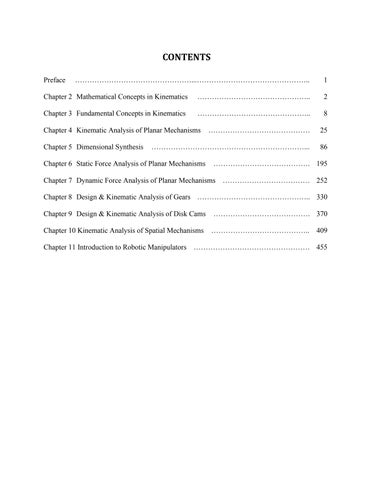
CONTENTS …………………………………………...………………………………………..
1
Chapter 2 Mathematical Concepts in Kinematics
………………………………………..
2
Chapter 3 Fundamental Concepts in Kinematics
………………………………………..
8
……………………………………
25
………………………………………………………...
86
Preface
Chapter 4 Kinematic Analysis of Planar Mechanisms Chapter 5 Dimensional Synthesis
Chapter 6 Static Force Analysis of Planar Mechanisms
…………………………………. 195
Chapter 7 Dynamic Force Analysis of Planar Mechanisms ……………………………… 252 Chapter 8 Design & Kinematic Analysis of Gears ……………………………………….. 330 Chapter 9 Design & Kinematic Analysis of Disk Cams
…………………………………. 370
Chapter 10 Kinematic Analysis of Spatial Mechanisms
………………………………….. 409
Chapter 11 Introduction to Robotic Manipulators ………………………………………… 455
PREFACE Because all the computed solutions in this manual were produced using the 2021 version of MATLAB™ (specifically version R2021b, win64). any version of MATLAB™ post 2020 is also suitable to run the MATLAB™ and Simscape Multibody™ files associated with this textbook (provided all the required toolkits listed in Appendix A.1 are installed). As presented in Chapter 5 (in the textbook), there is an infinite number of solutions for a given dimensional synthesis problem. Because the solution values for a dimensional synthesis problem depend on the dyad angles specified, the solutions given here for Chapter 5 (which were calculated using arbitrary dyad displacement angles) are intended to serve as a guide to the solution calculation process and not as a benchmark for evaluating student solutions. We encourage and look forward to any feedback you may have. For e-mail correspondence, we can be reached at kevin.russell@njit.edu. Thank you.
K. Russell Q. Shen R.S. Sodhi
1
CHAPTER 2 Problem 2.1 Statement: Formulate an equation for the vector loop illustrated in Figure P.2.1. Consider that vector V j always lies along the real axis.
Figure P.2.1 Vector loop (3 vectors where V j changes length) in 2-D complex space Problem 2.1 Solution: Taking the clockwise sum of the vector loop in Figure P.2.1 produces the equation V1ei( 1 +1 ) − V2 ei( 2 +2 ) + V j = 0 .
When expanded and separated into real and imaginary terms, the vector loop equation becomes
V1 cos ( 1 + 1 ) − V2 cos ( 2 + 2 ) + V j = 0 V1 sin ( 1 + 1 ) − V2 sin ( 2 + 2 ) = 0
.
Problem 2.2 Statement: Formulate an equation for the vector loop illustrated in Figure P.2.2. Consider that vector V j always lies along the real axis and vector V3 is always perpendicular to the real axis.
2
Figure P.2.2 Vector loop (4 vectors where V j changes length) in 2-D complex space Problem 2.2 Solution: Taking the clockwise sum of the vector loop in Figure P.2.2 produces the equation −V1ei( 1 +1 ) + V2 ei( 2 +2 ) − V3 − V j = 0 .
When expanded and separated into real and imaginary terms, the vector loop equation becomes
−V1 cos ( 1 + 1 ) + V2 cos ( 2 + 2 ) − V j = 0 −V1 sin ( 1 + 1 ) + V2 sin ( 2 + 2 ) − V3 = 0
.
Problem 2.3 Statement: Calculate the first derivative of the vector loop equation solution from Problem 2.2. Consider angles 1 , 2 and vector V j from Problem 2 to be time-dependent. Problem 2.3 Solution: Differentiating the vector loop equation solution from Problem 2.2 produces the equation −i1V1ei( 1 +1 ) + i 2V2ei( 2 +2 ) − V j = 0 .
When expanded and separated into real and imaginary terms, the vector loop equation becomes
1V1 sin ( 1 + 1 ) − 2V2 sin ( 2 + 2 ) − V j = 0 −1V1 cos ( 1 + 1 ) + 2V2 cos ( 2 + 2 ) = 0 3
.
Problem 2.4 Statement: Calculate the second derivative of the vector loop equation solution from problem 2.2. Consider only angles 1 , 2 and vector V j from Problem 2 to be time-dependent. Problem 2.4 Solution: Differentiating the vector loop equation solution from Problem 2.3 produces the equation 12V1ei( 1 +1 ) − i1V1ei( 1 +1 ) − 22V2 ei( 2 +2 ) + i 2V2 ei( 2 +2 ) − V j = 0 .
When expanded and separated into real and imaginary terms, the vector loop equation becomes
12V1 cos ( 1 + 1 ) + 1V1 sin ( 1 + 1 ) − 22V2 cos ( 2 + 2 ) − 2V2 sin ( 2 + 2 ) − V j = 0 12V1 sin ( 1 + 1 ) − 1V1 cos ( 1 + 1 ) − 22V2 sin ( 2 + 2 ) + 2V2 cos ( 2 + 2 ) = 0
.
Problem 2.5 Statement: Formulate an equation for the vector loop illustrated in Figure P.2.3.
Figure P.2.3 Vector loop (4 vectors) in 2-D complex space Problem 2.5 Solution: Taking the clockwise sum of the vector loop in Figure P.2.3 produces the equation V1ei( 1 +1 ) − V2 ei( 2 + 2 ) + V3e ( 3
i +3 )
− V0 ei0 = 0 .
When expanded and separated into real and imaginary terms, the vector loop equation becomes 4