Solutions Manual Introduction to Biomass Energy Conversions, 2E Sergio Capareda Chapters 1-14
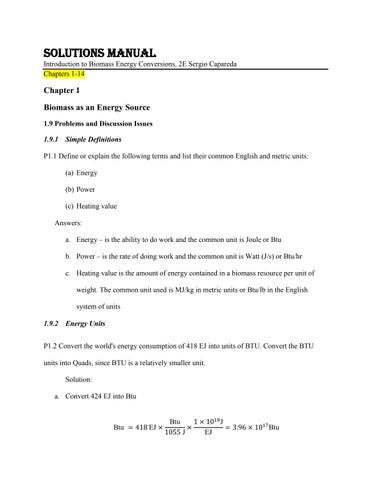
Chapter 1 Biomass as an Energy Source 1.9 Problems and Discussion Issues 1.9.1 Simple Definitions P1.1 Define or explain the following terms and list their common English and metric units: (a) Energy (b) Power (c) Heating value Answers: a. Energy – is the ability to do work and the common unit is Joule or Btu b. Power – is the rate of doing work and the common unit is Watt (J/s) or Btu/hr c. Heating value is the amount of energy contained in a biomass resource per unit of weight. The common unit used is MJ/kg in metric units or Btu/lb in the English system of units 1.9.2 Energy Units P1.2 Convert the world's energy consumption of 418 EJ into units of BTU. Convert the BTU units into Quads, since BTU is a relatively smaller unit. Solution: a. Convert 424 EJ into Btu
J
J J
J
b. Btu units into Quads
1.9.3 Net Energy Trends in US P1.3 Plot the net energy use in the US from 2010 to 2020 using data from Table 1.1 (consumption minus production). Describe the trends in net energy use in the US. Solution: a. Subtract consumption from production column from Table 1 and plot the net energy. The net energy graph follows:
Net Energy Use (Consumption-Production) 25.0
Net Energy USe (Quads)
20.0 15.0 10.0 5.0 0.0 2010
2011
2012
2013
2014
-5.0
2015
2016
2017
2018
2019
2020
Year
b. The net energy has decreased from 2010 to 2018 and became negative in 2019 and 2020. For 2019 and 2020, simply based on production and consumption, the US is a net exporter of energy instead of net importer.
1.9.4 Contribution of Energy Sources in the US Economy P1.4 Make a pie chart showing the percentage contribution of each energy source consumed in the US in 2020. Discuss the sources that comprised majority of use. Please use Table 1.2 for this problem. What was the percentage of use for renewables? Solution: a. The energy sources are added and percentage is calculated. The result is shown in the graph below.
US Primary Energy Consumption in 2020 Renewables, 11.6, 12%
Coal, 9.2, 10%
Nuclear, 8.2, 9%
Natural Gas, 31.5, 34%
Petroleum, 32.2, 35%
Coal
Natural Gas
Petroleum
Nuclear
Renewables
b. About 34% of consumption comes from natural gas, followed by petroleum (35%). Reneewables comprised around 12%.
1.9.5 Moisture Removal in Biomass P1.5 Algae biomass is harvested with around 87% moisture (wet basis). Determine the amount of moisture to be removed per 1000 kg of algae if the ideal safe storage moisture content is 13%. Solution: a. The total amount of moisture in this algae biomass is 870 kg and the dry weight is 130 kg. These results can also be calculated from the equation provided in this chapter as shown below:
b. However, not all of this moisture will be removed to keep the biomass at 13% moisture content. The dry weight of the final product will be calculated using the above equation, and with the moisture content of 13% to estimate the new total weight of the product at 13% MC as shown below:
c. The wet weight of the 13% MC product is 149.4 kg and of this, the amount of moisture will be 19.4 kg. Thus, the amount of moisture to be removed will be (870 - 19.4) = 850.6 kg. This problem is a little bit tricky.
1.9.6 Energy from Imported Crude Oil P1.6 The United States consumed an average of 19.8 million barrels of oil per day in 2021. How many Quads does this represent for the year? How many EJ per year? Assume one gallon of crude oil contains 138,095 Btu. There are 42 gallons to a barrel. Solution: a. This is a pretty straightforward conversion problem as shown below.
b. The equivalent EJ is then calculated.
b. One should now be familiar that Quads and EJ are about the same order of magnitude.
1.9.7 Pure Sugar to Ethanol Conversion P1.7 Determine the amount of pure sucrose sugar (in kg) to generate a liter of ethanol using the idealized equation shown. The density of ethanol is 0.8 kg/liter. Convert this unit into its English equivalent (lbs/gallon). C12H22O11 + H2O + yeast 4 C2H5OH + 4 CO2 + heat Sucrose
+ Water + yeast ethanol + carbon dioxide + heat
Solution: a. The ratio of sucrose to ethanol is given as follows: