Interplanetary Astrodynamics Chapter 2 Problem Solutions For all numerical problems, use 𝜇 = 398, 600 km3 /s2 as the gravitational parameter of the Earth.
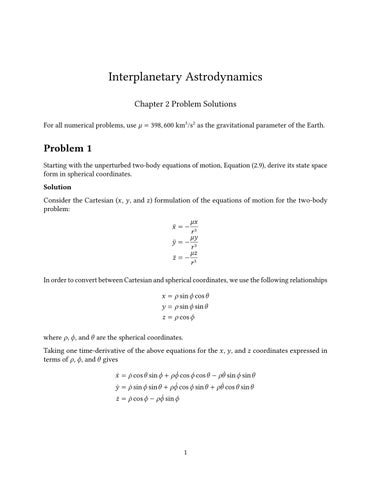
Problem 1 Starting with the unperturbed two-body equations of motion, Equation (2.9), derive its state space form in spherical coordinates. Solution Consider the Cartesian (𝑥, 𝑦, and 𝑧) formulation of the equations of motion for the two-body problem: 𝜇𝑥 𝑥̈ = − 3 𝑟 𝜇𝑦 𝑦̈ = − 3 𝑟 𝜇𝑧 𝑧̈ = − 3 𝑟 In order to convert between Cartesian and spherical coordinates, we use the following relationships 𝑥 = 𝜌 sin 𝜙 cos 𝜃 𝑦 = 𝜌 sin 𝜙 sin 𝜃 𝑧 = 𝜌 cos 𝜙 where 𝜌, 𝜙, and 𝜃 are the spherical coordinates. Taking one time-derivative of the above equations for the 𝑥, 𝑦, and 𝑧 coordinates expressed in terms of 𝜌, 𝜙, and 𝜃 gives 𝑥̇ = 𝜌̇ cos 𝜃 sin 𝜙 + 𝜌𝜙̇ cos 𝜙 cos 𝜃 − 𝜌𝜃̇ sin 𝜙 sin 𝜃 𝑦̇ = 𝜌̇ sin 𝜙 sin 𝜃 + 𝜌𝜙̇ cos 𝜙 sin 𝜃 + 𝜌𝜃̇ cos 𝜃 sin 𝜃 𝑧̇ = 𝜌̇ cos 𝜙 − 𝜌𝜙̇ sin 𝜙
1
Taking another time-derivative: 𝑥̈ = 𝜌̈ cos 𝜃 sin 𝜙 − 𝜌𝜙̇ 2 cos 𝜃 sin 𝜙 − 𝜃̇ 2 cos 𝜃 sin 𝜙 + 𝜌𝜙̈ cos 𝜙 cos 𝜃+ ̈ sin 𝜙 sin 𝜃 + 2𝜌̇ 𝜙̇ cos 𝜙 cos 𝜃 − 2𝜌̇ 𝜃̇ sin 𝜙 sin 𝜃 − 2𝜌𝜙̇ 𝜃̇ cos 𝜙 sin 𝜃 − 𝜃𝜌 𝑦̈ = 𝜌̈ sin 𝜙 sin 𝜃 − 𝜌𝜙̇ 2 sin 𝜙 sin 𝜃 − 𝜌𝜃̇ 2 sin 𝜙 sin 𝜃 + 𝜌𝜙̈ cos 𝜙 sin 𝜃+ + 𝜌𝜃̈ cos 𝜃 sin 𝜙 + 2𝜌̇ 𝜙̇ cos 𝜙 sin 𝜃 + 2𝜌̇ 𝜃̇ cos 𝜃 sin 𝜙 + 2𝜌𝜃̇ 𝜙̇ cos 𝜙 cos 𝜃 𝑧̈ = 𝜌̈ cos 𝜙 − 2𝜌̇ 𝜙̇ sin 𝜙 − 𝜌𝜙̈ sin 𝜙 − 𝜌𝜙̇ 2 cos 𝜙 Equating each 𝑥, 𝑦, and 𝑧 acceleration expressed in spherical coordinates with its respective acceleration terms gives us the equations of motion for the two-body problem in terms of spherical coordinates 𝜌, 𝜙, and 𝜃 𝜌̈ cos 𝜃 sin 𝜙 − 𝜌𝜙̇ 2 cos 𝜃 sin 𝜙 − 𝜃̇ 2 cos 𝜃 sin 𝜙 + 𝜌𝜙̈ cos 𝜙 cos 𝜃+ ̈ sin 𝜙 sin 𝜃 + 2𝜌̇ 𝜙̇ cos 𝜙 cos 𝜃 − 2𝜌̇ 𝜃̇ sin 𝜙 sin 𝜃 − 2𝜌𝜙̇ 𝜃̇ cos 𝜙 sin 𝜃+ − 𝜃𝜌 𝜇 sin 𝜙 cos 𝜃 =0 𝜌2 𝜌̈ sin 𝜙 sin 𝜃 − 𝜌𝜙̇ 2 sin 𝜙 sin 𝜃 − 𝜌𝜃̇ 2 sin 𝜙 sin 𝜃 + 𝜌𝜙̈ cos 𝜙 sin 𝜃+ + 𝜌𝜃̈ cos 𝜃 sin 𝜙 + 2𝜌̇ 𝜙̇ cos 𝜙 sin 𝜃 + 2𝜌̇ 𝜃̇ cos 𝜃 sin 𝜙 + 2𝜌𝜃̇ 𝜙̇ cos 𝜙 cos 𝜃 +
+
𝜇 sin 𝜙 sin 𝜃 =0 𝜌2
𝜇 cos 𝜙 𝜌̈ cos 𝜙 − 2𝜌̇ 𝜙̇ sin 𝜙 − 𝜌𝜙̈ sin 𝜙 − 𝜌𝜙̇ 2 cos 𝜙 + =0 𝜌2 √ where we used the fact that 𝜌 = 𝑟 = 𝑥 2 + 𝑦 2 + 𝑧 2 .
2
Problem 2 Prove that for the unperturbed two-body problem, orbital energy is constant. Solution 2
Start with the vis-viva equation, Equation (2.50): 𝐸 = 𝑣2 − 𝜇𝑟 To prove that energy is constant, we need to take its time derivative and show that it is equal to zero: 𝑑 𝐯⋅𝐯 𝜇 𝑑𝐸 𝑑 = ( − ) 𝑑𝑡 𝑑𝑡 2 𝑑𝑡 [ (𝐫 ⋅ 𝐫)1/2 ] =
1 𝐯̇ ⋅ 𝐯 + 𝐯 ⋅ 𝐯̇ ̇ − 𝜇 − 𝐫−3 (2𝐫 ⋅ 𝐫) ) [ 2 ) ( 2
Recall that 𝐯̇ = 𝐫̈ = −𝜇𝐫 and 𝐫̇ = 𝐯, so 𝑟3 −𝜇𝐫 𝜇𝐫 𝑑𝐸 =𝐯⋅( 3 )+ 3 ⋅𝐯 𝑑𝑡 𝑟 𝑟 𝜇𝐫 𝜇𝐫 = −𝐯 ⋅ ( 3 ) + 𝐯 ⋅ 3 = 0 𝑟 𝑟 Thus, 𝑑𝐸 = 0 which means that orbital energy is constant. 𝑑𝑡
3
Problem 3 Prove that the angular momentum vector and eccentricity vector are orthogonal to each other. Solution In order to prove that two vectors are orthogonal, or perpendicular, to each other, one must show that their dot product is zero. Starting with the definitions of eccentricity, Equation (2.27), 𝐞=
𝐯×𝐡 𝐫 − 𝜇 𝑟
and angular momentum, Equation (2.41), 𝐡=𝐫×𝐯 we take the dot product between angular momentum and eccentricity, 𝐡⋅𝐞=𝐡⋅ =
𝐯×𝐡 𝐫 − ( 𝜇 𝑟)
1 1 𝐡 ⋅ (𝐯 × 𝐡) − (𝐫 × 𝐯) ⋅ 𝐫 𝜇 𝑟
where we used the definition of angular momentum for the second term. We then use the scalar triple product on the above equation, which, for three generic vectors 𝐀, 𝐁, and 𝐂 is 𝐀 ⋅ (𝐁 × 𝐂) = 𝐁 ⋅ (𝐂 × 𝐀) = 𝐂 ⋅ (𝐀 × 𝐁) This helps us simplify the first term as 1 1 1 𝐡 ⋅ (𝐯 × 𝐡) = 𝐯 ⋅ (𝐡 × 𝐡) = 𝐯 ⋅ 𝟎 = 0 𝜇 𝜇 𝜇 and the second term as 1 1 1 − 𝐫 ⋅ (𝐯 × 𝐫) = − 𝐯 ⋅ (𝐫 × 𝐫) = − 𝐯 ⋅ 𝟎 = 0 𝑟 𝑟 𝑟 which proves that 𝐡 ⋅ 𝐞 = 0 and thus 𝐡 ⟂ 𝐞 = 0.
4
Problem 4 Prove that for the unperturbed two-body problem, orbital motion is confined to a plane (this is the orbital plane). Solution Planar motion means that the angular momentum (𝐡) is conserved. Thus, showing that the time derivative of 𝐡 is zero is sufficient to show that the motion is constrained to a plane. This derivation is shown in Section 2.3, and summarized here. Taking the cross product of 𝐫 with Equation (2.9) gives 𝐫 × (𝐫̈ +
𝜇𝐫 =0 𝑟3 )
𝐫 × 𝐫̈ + 𝐫 ×
𝜇𝐫 =0 𝑟3
The second term is zero (cross product of a vector with itself), simplifying the above equation to 𝐫 × 𝐫̈ = 0 which is equivalent to 𝑑 𝑑𝐡 𝑑 ̇ = (𝐫 × 𝐯) = =0 (𝐫 × 𝐫) 𝑑𝑡 𝑑𝑡 𝑑𝑡 which proves that angular momentum is constant, and thus orbital motion is planar for the unperturbed two-body problem.
5