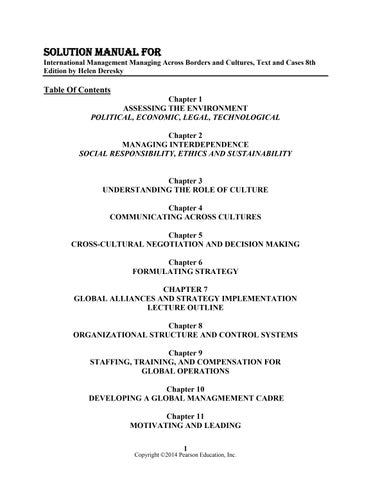
Solution Manual For International Management Managing Across Borders and Cultures, Text and Cases 8th Edition by Helen Deresky
Table Of Contents Chapter 1 ASSESSING THE ENVIRONMENT POLITICAL, ECONOMIC, LEGAL, TECHNOLOGICAL Chapter 2 MANAGING INTERDEPENDENCE SOCIAL RESPONSIBILITY, ETHICS AND SUSTAINABILITY
Chapter 3 UNDERSTANDING THE ROLE OF CULTURE Chapter 4 COMMUNICATING ACROSS CULTURES Chapter 5 CROSS-CULTURAL NEGOTIATION AND DECISION MAKING Chapter 6 FORMULATING STRATEGY CHAPTER 7 GLOBAL ALLIANCES AND STRATEGY IMPLEMENTATION LECTURE OUTLINE Chapter 8 ORGANIZATIONAL STRUCTURE AND CONTROL SYSTEMS Chapter 9 STAFFING, TRAINING, AND COMPENSATION FOR GLOBAL OPERATIONS Chapter 10 DEVELOPING A GLOBAL MANAGMEMENT CADRE Chapter 11 MOTIVATING AND LEADING 1
Copyright ©2014 Pearson Education, Inc.
LECTURE OUTLINE Chapter 1 ASSESSING THE ENVIRONMENT POLITICAL, ECONOMIC, LEGAL, TECHNOLOGICAL LECTURE OUTLINE General Outline Opening Profile: The Globalization of Risk The Global Business Environment Globalization Global Trends Globality and Emerging Markets Backlash against Globalization Effects of Institutions on Global Trade Effects of Globalization on Corporations Small and Medium-Sized Enterprises Regional Trading Blocs The European Union (EU) Asia The Americas Comparative Management in Focus China Helps Prop Up the Global Economy Other Regions in the World The Russian Federation The Middle East Developing Economies The African Union (AU) The Globalization of Information Technology Management in Action: Intel Brings Changes to Vietnam’s Economy and Culture The Globalization of Human Capital The Global Manager‘s Role The Political and Economic Environment Political Risk Political Risk Assessment Managing Political Risk Managing Terrorism Risk Economic Risk The Legal Environment Contract Law Other Regulatory Issues The Technological Environment Under the Lens: Information Technology Global E-Business Conclusion 2
Copyright ©2014 Pearson Education, Inc.
Summary of Key Points Discussion Questions Application Exercises Experiential Exercises Internet Resources Case Study: Apple’s iPhone—Not ―Made in America‖ The Video Correlation Guide can be downloaded from the Instructor Resource Center. To obtain a user name and password please contact your local Pearson sales representative.
Learning Objectives 1. To understand the global business environment and how it affects the strategic and operational decisions which managers must make. 2. To critically assess the developments, advantages, and disadvantages of globalization. 3. To review the role of technology in international business. 4. To develop an appreciation for the ways in which political, economic, legal, and technological factors and changes impact the opportunities that companies face. 5. To discuss the complexities of the international manager‘s job. Opening Profile: The Globalization of Risk (see slide 1-3) This opening section briefly describes the top risks involved in globalization as well as other issues such as natural disasters and business risks. The section describes the severe income disparity risk and the chronic fiscal imbalance risk. Natural disasters such as the 2011 earthquake in Japan, flood in Thailand, and uncertainty in China and the Middle East are discussed. Globalization has compounded the types and levels of business risks. (see slide 1-4) I. The Global Business Environment A. International Management International management (see slide 1-6) is the process of developing strategies, designing and operating systems, and working with people around the world to ensure sustained competitive advantage. 1. Globalization a. Global competition (see slide 1-7) global competition characterized by networks of international linkages that bind countries, institutions, and people in an interdependent global economy. Economic integration results from the lessening of trade barriers and the increased flow of goods and services, capital, labor, and technology around the world. b. Emerging economies now produce as much trade, capital, and knowledge flow as do developed economies. Sirkin et al. use the term ―globality,‖ stating that business these days is all about ―competing with everyone from everywhere for everything.‖ 2. Global Trends (see slide 1-8)
3
Copyright ©2014 Pearson Education, Inc.
a. The rapid development of globalization is attributable to many factors, including the burgeoning use of technology and its accompanying uses in international business; political developments that enable cross-border trade agreements; and global competition for the growing numbers of consumers around the world. b. The changing balance of growth toward emerging markets compared with developed ones, along with the growing number of middle-class consumers in those areas. c. The need for increased productivity and consumption in developed countries in order to stimulate their economies. d. The increasing global interconnectivity—technologically and otherwise, as previously discussed, and, in particular, the phenomenon of an ―electronically flattened earth‖ that gives rise to increased opportunity and fast-developing competition. e. The increasing gap between demand and supply of natural resources, in particular to supply developing economies, along with the push for environmental protection. f. The challenge facing governments to develop policies for economic growth and financial stability. 3. Globality and Emerging Markets It is clear that globalization—in the broader sense—has led to the narrowing of differences in regional output growth rates, driven largely by increases led by China, India, Brazil and Russia (often called the BRICs, which together accounted for over 18 percent of global gross domestic product (GDP) as of 2011. There is no doubt that the global economic turmoil has curtailed investment, and company executives remained wary of investment in 2012. However, global trade is increasingly including those developing nations judged to have significant growth potential, with investments from developed economies to emerging economies of over $1,000 billion a year as of 2011. It is clear that as emerging markets continue to grow their countries‘ economies, they will provide growth markets for the products and services of developed economies. 4. Backlash against Globalization (see slide 1-10) The backlash against globalization comes from those who feel that it benefits advanced industrial nations at the expense of many other countries and the people within them who are not sharing in those benefits. Joseph Stiglitz, a Nobel Laureate, for example, argues that such an economic system has been pressed upon many developing countries at the expense of their sovereignty, their well-being, and their environment. Critics point to the growing numbers of people around the world living in poverty. While the debate about the effects of globalization continues, it is clear that economic globalization will be advanced by corporations looking to maximize their profits with global efficiencies, by politicians and leaders wishing to advance their countries‘ economies, and by technological and transportation advances that make their production and supply networks more efficient. However, pressure by parties against those trends, as well as the resurgence in nationalism and protectionism, may
4
Copyright ©2014 Pearson Education, Inc.
serve to pull back those advances to a more regional scope in some areas, or limit them to bilateral pacts. 5. Effects of Institutions on Global Trade a. Two major groups of institutions play differing roles in globalization: World Trade Organization and International Labor Organization are examples of supranational institutions which are trying to promote the convergence of how international activities should be conducted. National organizations such as the Food and Drug Administration in the United States sometimes plays a role in making it more difficult for foreign firms to compete in the domestic market. 6. Effects of Globalization on Corporations a. Global companies are becoming less tied (see slide 1-11) to specific locations and their operations and allies are spreading around the world as they source and coordinate resources and activities wherever needed. Companies that desire to remain competitive will have to develop a cadre of experienced international managers. 7. Small and Medium-Sized Enterprises (SMEs) Small companies also affect and, are affected by globalism. They play a vital role in contributing to their national economies through new job creation and employment, development of new products and services, and international operations such as exporting. There has never been a better time for SMEs to go global; the Internet is as valid a tool for small companies to and customers and suppliers around the world as it is for large companies. By using the Internet, email, and Web-conferencing, small companies can inexpensively contact customers and set up their global businesses. Discussion Question: Evaluate the statement by Thomas Friedman that the world is flat. What does he mean by this statement? Teaching Resource: For the latest statistics, have your students visit one of the following Web sites: World Trade Organization—www.WTO.org Financial Times—www.ft.com CEO Express—www.ceoexpress.com B. Regional Trading Blocs (see slide 1-12) — Much of today‘s world trade takes place within three regional free-trade blocs (Western Europe, Asia, and the Americas). These trade blocs are continually expanding their borders to include neighboring countries, either directly or with separate agreements. 1. European Union (EU) a. EU (see slide 1-13) refers to the 27 nations who created an economic union among its member nations. Seventeen of the nations have a common currency— the Euro. The U.S. had a two-way trade of $560 billion and a $3 trillion two-way investment relationship as of 2011. Although trade continued to grow in 2010 despite the 2008 global financial crisis, the EU GDP growth was only at 1.8 percent that year and economic problems in some member states continuing into 5
Copyright ©2014 Pearson Education, Inc.