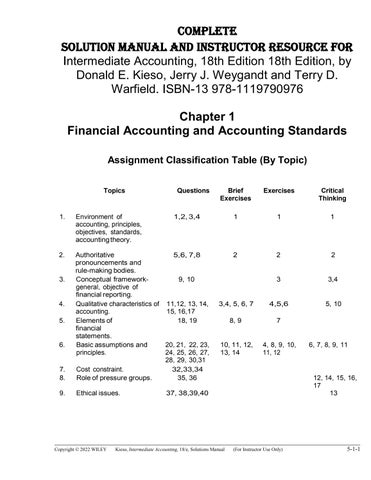
Complete Solution Manual and Instructor Resource for Intermediate Accounting, 18th Edition 18th Edition, by Donald E. Kieso, Jerry J. Weygandt and Terry D. Warfield. ISBN-13 978-1119790976 Chapter 1 Financial Accounting and Accounting Standards Assignment Classification Table (By Topic) Topics
Questions
1.
Environment of accounting, principles, objectives, standards, accounting theory.
2.
7. 8.
Authoritative 5,6, 7,8 pronouncements and rule-making bodies. Conceptual framework9, 10 general, objective of financial reporting. Qualitative characteristics of 11,12, 13, 14, accounting. 15, 16,17 Elements of 18, 19 financial statements. Basic assumptions and 20, 21, 22, 23, principles. 24, 25, 26, 27, 28, 29, 30,31 Cost constraint. 32,33,34 Role of pressure groups. 35, 36
9.
Ethical issues.
3.
4. 5.
6.
Copyright © 2022 WILEY
Brief Exercises
Exercises
Critical Thinking
1
1
1
2
2
2
3
3,4
3,4, 5, 6, 7
4,5,6
5, 10
8, 9
7
10, 11, 12, 13, 14
4, 8, 9, 10, 11, 12
1,2, 3,4
12, 14, 15, 16, 17 13
37, 38,39,40
Kieso, Intermediate Accounting, 18/e, Solutions Manual
6, 7, 8, 9, 11
(For Instructor Use Only)
5-1-1
Assignment Classification Table (By Learning Objective) Learning Objectives
Questions
Brief Exercises
Exercises
Critical Thinking
1.
Describe the financial reporting environment, major standardsetting bodies, and the meaning of generally accepted accounting principles (GAAP).
1, 2, 3, 4, 5, 6, 7, 8
1, 2
1, 2
2.
Describe the components and usefulness of the conceptual framework.
9, 10, 11, 12, 13, 14, 15, 16, 17, 18, 19
3, 5, 6, 7, 8,9
3, 4, 5, 6, 7
2,3,4, 5, 10
3.
Discuss the basic assumptions and principles of accounting.
4, 10, 11, 12, 13, 14
8, 9, 10, 11, 12
6, 7, 8, 9, 11, 12
4.
Identify the major challenges in the financial reporting environment.
20, 21, 22, 23, 24, 25, 26, 27, 28, 29, 31, 32, 33, 34 30, 35, 36, 37, 38, 39,40
2
11, 13, 14, 15, 16
1
Assignment Characteristics Table (Time on Task) Item
Description
Level of Difficulty
Time (minutes)
E1.1 E1.2 E1.3 E1.4
Simple Simple Simple Simple
15-20 15-20 15-20 15-20
E1.5 E1.6 E1.7 E1.8 E1.9 E1.10 E1.11 E1.12
Need for GAAP. Financial reporting and accounting standards. Usefulness, objective of financial reporting. Usefulness, objective of financial reporting, qualitative characteristics. Qualitative characteristics. Qualitative characteristics. Elements of financial statements. Assumptions, principles, and constraint. Assumptions, principles, and constraint. Full disclosure principle. Accounting principles and assumptionscomprehensive. Accounting principles-comprehensive.
Moderate Simple Simple Simple Moderate Complex Moderate Moderate
20-30 15-20 15-20 15-20 20-25 20-25 20-25 20-25
CT1.1 CT1.2 CT1.3 CT1.4 CT1.5
Securities and Exchange Commission. Conceptual framework-general. Conceptual framework-general. Objective of financial reporting. Qualitative characteristics.
Moderate Simple Simple Moderate Moderate
30-40 20-25 25-35 25-35 30-35
5-1-2
Copyright © 2022 WILEY
Kieso, Intermediate Accounting, 18/e, Solutions Manual
(For Instructor Use Only)
CT1.6 CT1.7 CT1.8 CT1.9 CT1.10 CT1.11 CT1.12 CT1.13 CT1.14 CT1.15 CT1.16
Revenue recognition principle. Expense recognition principle. Expense recognition principle. Expense recognition principle. Qualitative characteristics. Expense recognition principle. Cost Constraint. Rule-making Issues. Models for setting GAAP. Economic consequences. GAAP and economic consequences.
Complex Complex Moderate Moderate Moderate Moderate Moderate Complex Simple Moderate Moderate
25-30 20-25 20-25 20-30 20-30 20-25 30-35 20-25 15-20 25-35 25-35
Answers to Questions 1.
If a company‘s financial performance is measured accurately, fairly, and on a timely basis, the right managers and companies can attract investment capital. Unreliable and irrelevant information leads to poor capital allocation, which adversely affects the efficiency of the securities market.
LO: 1, Bloom: K, Difficulty: Simple, Time: 1-3, AACSB: Communication, AICPA BC: None, AICPA AC: Reporting, AICPA PC: Communication
2.
The objective of general purpose financial reporting is to provide financial information about the reporting entity that is useful to present and potential equity investors, lenders, and other creditors in making decisions about providing resources to the entity through equity investments and loans or other forms of credit. Information that is decision-useful to capital providers (investors) may also be useful to other users of financial reporting who are not investors.
LO: 1, Bloom: K, Difficulty: Simple, Time: 3-5, AACSB: Communication, AICPA BC: None, AICPA AC: Reporting, AICPA PC: Decision Making
3.
Investors are interested in financial reporting because it provides information that is useful for making decisions (referred to as the decision-usefulness approach). When making these decisions, investors are interested in assessing the company‘s (1) ability to generate net cash inflows and (2) management‘s ability to protect and enhance the capital providers‘ investments. Financial reporting should therefore help investors assess the amounts, timing, and uncertainty of prospective cash inflows from dividends or interest, and the proceeds from the sale, redemption, or maturity of securities or loans. For investors to make these assessments, the economic resources of an enterprise, the claims to those resources, and the changes in them must be understood.
LO: 1, Bloom: K, Difficulty: Simple, Time: 3-5, AACSB: Communication, AICPA BC: None, AICPA AC: Reporting, AICPA PC: Decision Making
4.
A common set of financial accounting and reporting standards applied by all businesses and entities should produce financial statements which are reasonably comparable. Without a common set of standards, each enterprise could, and would, develop a theory structure and set of practices, resulting in noncomparability among the financial statements of enterprises.
LO: 1, Bloom: K, Difficulty: Simple, Time: 3-5, AACSB: Communication, AICPA BC: None, AICPA AC: Reporting, AICPA PC: Communication
5.
The SEC has the power to prescribe, in whatever detail it desires, the accounting practices and principles to be employed by companies that fall within its jurisdiction. Because the SEC receives audited financial statements from nearly all companies that issue securities to the public or are listed on stock exchanges, it is greatly interested in the content, accuracy, and credibility of the statements. For many years, the SEC relied on the AICPA to regulate the profession and develop and enforce accounting principles. Lately, the SEC has assumed a more active role in the development of
Copyright © 2022 WILEY
Kieso, Intermediate Accounting, 18/e, Solutions Manual
(For Instructor Use Only)
5-1-3
accounting standards, especially in the area of disclosure requirements. In December 1973, in ASR No. 150, the SEC said the FASB‘s statements would be presumed to carry substantial authoritative support and anything contrary to them to lack such support. It thereby supports the development of accounting principles in the private sector. LO: 1, Bloom: K, Difficulty: Simple, Time: 3-5, AACSB: Communication, AICPA BC: None, AICPA AC: Reporting, AICPA PC: Communication
6.
The explanation should note that generally accepted accounting principles or standards have ―substantial authoritative support.‖ They consist of accounting practices, procedures, concepts, and methods that are recognized by a large majority of practicing accountants as well as other members of the business and financial community. Statements issued by the Financial Accounting Standards Board constitute ―substantial authoritative support.‖
LO: 1, Bloom: K, Difficulty: Simple, 5-10, AACSB: Communication, AICPA BC: None, AICPA AC: Reporting, AICPA PC: Communication
Questions Chapter 1 (Continued) 7.
The FASB Accounting Standards Codification (Codification) is a compilation of all GAAP in one place. Its purpose is to integrate and synthesize existing GAAP, not to create new GAAP. It creates one level of GAAP which is considered authoritative. The FASB Codification Research Systems (CRS) is an online real-time database that provides easy access to the Codification. The Codification and the related CRS provide a topically organized structure that is subdivided into topics, subtopics, sections, and paragraphs.
LO: 1, Bloom: K, Difficulty: Moderate, Time: 5-7, AACSB: Communication, AICPA BC: None, AICPA AC: Reporting, AICPA PC: Communication
8.
It is hoped that the Codification will help users to better understand what GAAP is. If this occurs, companies will be more likely to comply with GAAP and the time to research accounting issues will be substantially reduced. In addition, through the electronic web-based format, GAAP can be easily updated which will help users stay current.
LO: 1, Bloom: K, Difficulty: Simple, Time: 3-5, AACSB: Communication, AICPA BC: None, AICPA AC: Reporting, AICPA PC: Communication
9.
A conceptual framework is a coherent system of interrelated objectives and fundamentals that can lead to consistent standards and that prescribes the nature, function, and limits of financial accounting and financial statements. A conceptual framework is necessary for financial accounting for the following reasons: (1) It enables the FASB to issue more useful and consistent standards in the future. (2) New issues will be more quickly solvable by reference to an existing framework of basic theory. (3) It increases financial statement users‘ understanding of and confidence in financial reporting. (4) It enhances comparability among companies‘ financial statements.
LO: 2, Bloom: K, Difficulty: Simple, Time: 3-5, AACSB: Communication, AICPA BC: None, AICPA AC: Reporting, AICPA PC: Communication
10. The objective of financial reporting is to provide financial information about the reporting entity that is useful to present and potential equity investors, lenders, and other creditors in making decisions about providing resources to the entity. LO: 2, Bloom: K, Difficulty: Simple, Time: 3-5, AACSB: Communication, AICPA BC: None, AICPA AC: Reporting, AICPA PC: Communication
11. ―Qualitative characteristics of accounting information‖ are those characteristics that contribute to the quality or value of the information. The overriding qualitative characteristic of accounting information is usefulness for decision-making. LO: 2, Bloom: K, Difficulty: Simple, Time: 3-5, AACSB: Communication, AICPA BC: None, AICPA AC: Reporting, AICPA PC: Communication
12. Relevance and faithful representation are the two fundamental qualities of useful accounting information. For information to be relevant, it should be capable of making a difference in a decision by helping users to form predictions about the outcomes of past, present, and future events or to
5-1-4
Copyright © 2022 WILEY
Kieso, Intermediate Accounting, 18/e, Solutions Manual
(For Instructor Use Only)
confirm or correct expectations. Faithful representation rests on whether the numbers and descriptions match what really existed or happened. LO: 2, Bloom: K, Difficulty: Simple, Time: 3-5, AACSB: Communication, AICPA BC: None, AICPA AC: Reporting, AICPA PC: Communication
Questions Chapter 1 (Continued) 13. The concept of materiality refers to the relative significance of an amount, activity, or item to informative disclosure, proper presentation of financial position, and the results of operations. Materiality has qualitative and quantitative aspects; both the nature of the item and its relative size enter into its evaluation. An accounting misstatement is said to be material if knowledge of the misstatement could affect the decisions of the average informed reader of the financial statements. Financial statements are misleading if they omit a material fact or include so many immaterial matters as to be confusing. In the examination, the auditor concentrates efforts in proportion to degrees of materiality and relative risk and disregards immaterial items. The relevant criteria for assessing materiality will depend upon the circumstances and the nature of the item and will vary greatly among companies. For example, an error in current assets or current liabilities will be more important for a company with a flow of funds problem than for one with adequate working capital. The effect upon net income (or earnings per share) is the most commonly used measure of materiality. This reflects the prime importance attached to net income by investors and other users of the statements. The effects upon assets and equities are also important, as are misstatements of individual accounts and subtotals included in the financial statements. The FASB defines materiality to be consistent with the legal concept of materiality, as established in the securities laws. Specifically, information is material ―if there is a substantial likelihood that the omitted or misstated item would have been viewed by a reasonable resource provider as having significantly altered the total mix of information.‖ There are no rigid standards or guidelines for assessing materiality. The lower bound of materiality has been variously estimated at 5% of net income, but the determination will vary based upon the individual case and might not fall within these limits. Certain items, such as a questionable loan to a company officer, may be considered material even when minor amounts are involved. In contrast, a large misclassification among expense accounts may not be deemed material if there is no misstatement of net income. LO: 2, Bloom: C, Difficulty: Simple, Time: 5-7, AACSB: Communication, AICPA BC: None, AICPA AC: Reporting, AICPA PC: Decision Making
14. The enhancing characteristics are comparability, verifiability, timeliness, and understandability. Enhancing qualities are qualitative characteristics that are complementary to the fundamental qualitative characteristics. These characteristics distinguish more useful information from less useful information. LO: 2, Bloom: K, Difficulty: Simple, Time: 3-5, AACSB: Communication, AICPA BC: None, AICPA AC: Reporting, AICPA PC: Communication
15. In providing information to users of financial statements, the FASB relies on general-purpose financial statements. The intent of such statements is to provide the most useful information possible at minimal cost to various user groups. Underlying these objectives is the notion that a user needs a reasonable knowledge of business and financial accounting matters to understand the information contained in financial statements. This point is important. It means that in the preparation of financial statements, a level of reasonable competence for the user can be assumed; this has an impact on the way and the extent to which information is reported. LO: 2, Bloom: C, Difficulty: Simple, Time: 3-5, AACSB: Communication, AICPA BC: None, AICPA AC: AICPA AC: Reporting, AICPA PC: Communication
Copyright © 2022 WILEY
Kieso, Intermediate Accounting, 18/e, Solutions Manual
(For Instructor Use Only)
5-1-5