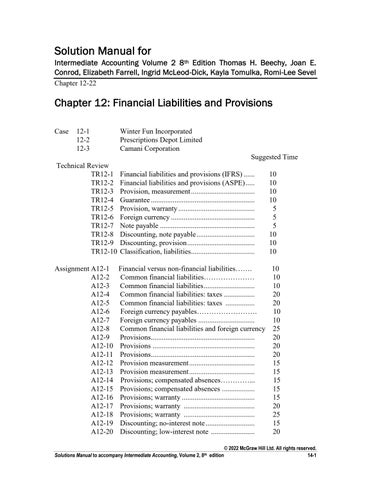
Solution Manual for Intermediate Accounting Volume 2 8 th Edition Thomas H. Beechy, Joan E. Conrod, Elizabeth Farrell, Ingrid McLeod-Dick, Kayla Tomulka, Romi-Lee Sevel Chapter 12-22
Chapter 12: Financial Liabilities and Provisions Case
12-1 12-2 12-3
Winter Fun Incorporated Prescriptions Depot Limited Camani Corporation Suggested Time
Technical Review TR12-1 Financial liabilities and provisions (IFRS) ...... TR12-2 Financial liabilities and provisions (ASPE) ..... TR12-3 Provision, measurement ................................... TR12-4 Guarantee ......................................................... TR12-5 Provision, warranty .......................................... TR12-6 Foreign currency .............................................. TR12-7 Note payable .................................................... TR12-8 Discounting, note payable ................................ TR12-9 Discounting, provision ..................................... TR12-10 Classification, liabilities................................... Assignment A12-1 A12-2 A12-3 A12-4 A12-5 A12-6 A12-7 A12-8 A12-9 A12-10 A12-11 A12-12 A12-13 A12-14 A12-15 A12-16 A12-17 A12-18 A12-19 A12-20
10 10 10 10 5 5 5 10 10 10
Financial versus non-financial liabilities……. 10 Common financial liabilities………………… 10 Common financial liabilities ............................ 10 Common financial liabilities: taxes ................. 20 Common financial liabilities: taxes ................ 20 Foreign currency payables……………………. 10 Foreign currency payables ............................... 10 Common financial liabilities and foreign currency 25 Provisions......................................................... 20 Provisions ........................................................ 20 Provisions......................................................... 20 Provision measurement .................................... 15 Provision measurement .................................... 15 Provisions; compensated absences…………... 15 Provisions; compensated absences .................. 15 Provisions; warranty ........................................ 15 Provisions; warranty ....................................... 20 Provisions; warranty ....................................... 25 Discounting; no-interest note ........................... 15 Discounting; low-interest note ........................ 20
Solutions Manual to accompany Intermediate Accounting, Volume 2, 8th edition
© 2022 McGraw Hill Ltd. All rights reserved. 14-1
A12-21 A12-22 A12-23 A12-24 A12-25 A12-26 A12-27 A12-28 A12-29 A12-30 A12-31 A12-32
Discounting; low-interest note ......................... Discounting; provision ..................................... Discounting; provision ..................................... Discounting; provision ..................................... Classification and SCF..................................... SCF .................................................................. Liabilities – IFRS and ASPE .......................... Liabilities - ASPE ........................................... Liabilities - ASPE ............................................ Provisions/Contingencies – IFRS and ASPE…. DAIS – warranty provision trend……………... DAIS – provision for coupon refund…………
20 15 25 25 20 20 10 20 20 20 15 15
Cases Case 12-1 (LO12.3, LO12.5, LO12.6) Winter Fun Incorporated To: Members of Board of Directors From: Accounting Consultant RE: Winter Fun Incorporated Overview Winter Fun Incorporated (WFI) uses IFRS for financial reporting. The bank loan has a minimum current ratio so you will need to be careful and watch for any impacts on the ratio. You have had a tough year this year and faced a loss so the bank financing is critical to your operations. Issues 1. Revenue recognition memberships 2. Revenue recognition guests 3. Special promotions 4. Coupons 5. Manufacturer Loan 6. Lawsuit 7. Warranty 8. Gasoline storage tanks 9. Foreign currency payables 10. Compensated absences
Solutions Manual to accompany Intermediate Accounting, Volume 2, 8th edition
© 2022 McGraw Hill Ltd. All rights reserved. 14-2
Analysis and Recommendations 1. Revenue recognition memberships Following the 5 step IFRS model: Initiation fee Step 1: The contract with the customer is for the membership in the club. This would be a written agreement between the member and WFI. Step 2: There is one performance obligation, the promised service is membership in the ski club. There is no transfer of the service until the membership is provided. Step 3: The contract price is $10,000. The non-refundable deposit is an advance payment towards this initiation fee and is part of the overall transaction price. Step 4: No allocation since there is only one performance obligation. Step 5: The performance obligation for the initiation fee is satisfied over the period of time that the member belongs to the club. The $10,000 would be recognized over the average period a member belongs. There should be enough historical data available to come up with a reasonable estimate. There would be no cash collection risk since the amount is paid upfront. Annual fee Step 1: The annual fee is a written agreement between the member and WFI. Step 2: There is again one performance obligation, the service for this year. Step 3: The fee of $2,000 is the total contract price and is received in 20X5 for the 20X6 ski season. This would be unearned revenue when received. Step 4: There is no allocation since there is only one performance obligation. Step 5: Assuming the ski season goes from Dec 1 until March 31 $500 would be recognized in 20X5 and the remainder in 20X6 which would be the period in which the service is performed. There would be no cash collection risk since the amount is paid upfront. 2. Revenue recognition guests Following the 5 step IFRS model: Step 1: The contract with the guest is the written contract when they receive the ticket to ski, not when the reservation is made since this reservation could be cancelled.
Solutions Manual to accompany Intermediate Accounting, Volume 2, 8th edition
© 2022 McGraw Hill Ltd. All rights reserved. 14-3
Step 2: The performance obligation is the right to ski that day. Step 3: The overall contract price is the price of the ski ticket. Step 4: There is no allocation since there is only one performance obligation. Step 5: The performance would be the right to ski on that day. There is no cash collection risk since the guest pays by credit card when they purchase the ticket. 3. Special promotions Following the 5 step IFRS model: Step 1: The contract with the customer is the written contract when they receive the ticket and the right to a future lesson. Step 2: There are two separate performance obligations the right to ski and the right to the lesson. Step 3: The total contract price is $100. Step 4: This price would need to be allocated to the two separate performance obligations based on their relative fair value. Fair value ski pass Fair value lesson Total fair value
80 = 61.5% x 100 = $61.50 50 = 38.5% x 100 = $38.50 130
Step 5: The $61.50 allocated to the performance obligation for the ski pass would be satisfied on the day that they ski. For the $38.50, the performance obligation would be satisfied on the day they take the lesson. There would be no cash collection risk assuming a credit card is used to purchase the special pass. 4. Coupons It must be determined if an economic loss would occur for the coupons. The coupons are for $5 and the price of a ski pass is $80. This is a minor amount compared to the price of the ski pass so WFI would still be selling the ski pass at a profit. Therefore, the coupons should only be recognized as a cost when they are redeemed. 5. Manufacturer Loan The manufacturer of the ski lift has provided a 0% interest loan. This is often referred to as a dealer loan. The loan is either measured in FVTPL or other liabilities. Most liabilities Solutions Manual to accompany Intermediate Accounting, Volume 2, 8th edition
© 2022 McGraw Hill Ltd. All rights reserved. 14-4
are measured in other liabilities and since there is no mismatch I recommend this loan be recorded in other liabilities and not to elect FVPL. WFI is required to record the loan at fair value using the market rate of interest which would be their incremental borrowing rate of 8%. Therefore, the loan would be recorded at $2.5 million (2 periods, 8%) = $2,143,350. The loan would then be amortized using the effective interest method and interest expense of $171,468 would be recorded in 20X5. This would not impact the current ratio in 20X5 because the full amount would be presented as long term. 6. Lawsuit It must be determined if the lawsuit is probable and if the amount can be measured. The Board has decided to settle the lawsuit therefore it is probable there will be a payment. The amount will be based on management‘s best estimate. Since there is a range, this would be the midpoint of the range or $250,000 should be accrued as a provision, assuming each point is equally likely. In addition, there would be note disclosure on the details of the lawsuit. This liability would be current if the payment is expected to be made next year, which would have a negative impact on the current ratio. 7. Warranty The warranty is not a separate performance obligation – it is an assurance warranty (also known as a standard warranty). In the period in which the skis are sold, a warranty provision should be set up for the estimated costs to be incurred to service the skis as long as the warranty costs are considered probable. If historically costs are low, the provision may be small. The provision is set up with a debit to warranty expense and credit to the provision for warranty. Subsequently, when costs are incurred, the warranty provision is debited, and cash, parts or other materials is credited. Since the warranty provides a lifetime guarantee, at least a portion would likely be a noncurrent liability. The portion that is expected to relate to the following year, would be reported as a current liability at the reporting date. Any current portion would affect the current ratio negatively. 8. Gasoline storage tanks The gasoline storage tanks would be set up as an item of property, plant and equipment and depreciated over the 15 years. The costs to remove the tanks would be a legal obligation and would need to be set up as a decommissioning provision. The provision would be set up at the present value of the $2.5 million. The PV would be $2.5 million (15 periods, 8%) = $788,100. This amount would be debited to the gasoline storage tanks and credited to the provision. Since the life of the storage tanks and the decommission
Solutions Manual to accompany Intermediate Accounting, Volume 2, 8th edition
© 2022 McGraw Hill Ltd. All rights reserved. 14-5