Solution Manual For Intermediate Accounting, Volume 2, 5th edition Kin Lo, George Fisher Chapter 11-20 With Appendix(A D)
Chapter 11 Current Liabilities, Non-Financial Liabilities, and Contingencies
L. Problems P11-1. Suggested solution:
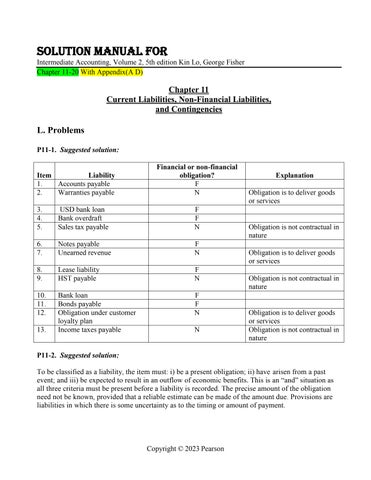
Item Liability 1. Accounts payable 2. Warranties payable
Financial or non-financial obligation? F N
3. 4. 5.
USD bank loan Bank overdraft Sales tax payable
F F N
6. 7.
Notes payable Unearned revenue
F N
8. 9.
Lease liability HST payable
F N
10. 11. 12.
Bank loan Bonds payable Obligation under customer loyalty plan Income taxes payable
F F N
13.
N
Explanation Obligation is to deliver goods or services
Obligation is not contractual in nature Obligation is to deliver goods or services Obligation is not contractual in nature
Obligation is to deliver goods or services Obligation is not contractual in nature
P11-2. Suggested solution: To be classified as a liability, the item must: i) be a present obligation; ii) have arisen from a past event; and iii) be expected to result in an outflow of economic benefits. This is an ―and‖ situation as all three criteria must be present before a liability is recorded. The precise amount of the obligation need not be known, provided that a reliable estimate can be made of the amount due. Provisions are liabilities in which there is some uncertainty as to the timing or amount of payment.
Copyright © 2023 Pearson
Trade accounts payable meet the criteria of a liability as set out below: * Present obligation: The debtor is presently contractually obliged to pay for goods or services received. * Past event: The trade payable arose from a good or service the debtor previously received or consumed. * Outflow of economic benefits: Trade payables are typically settled in cash—an outflow of economic benefits. P11-3. Suggested solution: a. Provisions are liabilities in which there is some uncertainty as to the timing or amount of payment. b. Financial liabilities are contracts to deliver cash or other financial assets to another party. They differ from non-financial liabilities as the latter category is typically settled through the provision of goods or services. c. A non-exhaustive list of financial liabilities includes accounts payable; bank loans; notes payable; bonds payable; and lease liabilities. A non-exhaustive list of non-financial obligations includes warranties payable; unearned revenue; and income taxes payable. P11-4. Suggested solution: a. The three broad categories of liabilities are: 1. Financial liabilities held for trading 2. Other financial liabilities 3. Non-financial liabilities b. * Held-for-trading liabilities are initially recognized at fair value. * Other financial liabilities are initially reported at fair value minus the transaction costs directly resulting from incurring the obligation. * The initial measurement of non-financial liabilities depends on their nature. For instance, warranties are recorded at management’s best estimate of the downstream cost of meeting the entity’s contractual obligations, while prepaid magazine subscription revenue is valued at the consideration initially received. c. * Held-for-trading liabilities are subsequently recognized at fair value. * Other financial liabilities are subsequently measured at amortized cost using the effective rate method. * Non-financial liabilities are subsequently measured at the initial obligation less the amount earned to date or satisfied to date through performance. For example, a publisher that received $750 in advance for a three-year subscription and has delivered the magazine for one year would report an obligation of $500 ($750 – $250).
Copyright © 2023 Pearson
P11-5. Suggested solution: Item
Liability
1. 2.
Accounts payable Warranties payable
3.
Deposits
B
4. 5. 6.
Bank overdraft Sales tax payable Bank loan maturing in five years was in default during the year; before year-end, the lender grants a grace period that extends 12 months after the balance sheet date Five-year term loan, amortized payments are payable annually
C C N
8.
Unearned revenue
B
9.
Lease liability
B
10. 11. 12.
HST payable 90-day bank loan Bond payable that matures in two years
C C N
13.
Obligation under customer loyalty plan
C
7.
Current or non-current liability, or potentially both? C B
B
Explanation
The obligation that is expected to be settled within one year of the balance sheet date is current, the balance non-current The classification of the deposit as current or non-current depends upon the expected settlement date. If less than one year after the balance sheet date, the obligation is classified as current
The obligation is reported as a non-current liability because the grace period was granted before the balance sheet date and extends twelve months after year-end
The principal portion of the payments due within one year of the balance sheet date are classified as current, the balance as noncurrent The classification of the obligation as current or non-current depends upon when revenue is the expected to be recognized. If less than one year after the balance sheet date, the obligation is classified as current The principal portion of the payments due within one year of the balance sheet date are classified as current, the balance as noncurrent
The obligation is reported as non-current as the maturity date is two years after the balance sheet date Classified as current as the entity does not have the right at the end of the reporting period to defer settlement of the liability for at least twelve months after the reporting
Copyright © 2023 Pearson
period. 14. 15.
Income taxes payable Bank loan that matures in five years that is currently in default Three-year bank loan that matures six months after the balance sheet date
16.
C C C
P11-6. Suggested solution: a. Jan. 6
Jan. 12
Jan. 15
Jan. 31
b. Jan. 6
Jan. 12
Jan. 31
Feb. 2
Gross method – discount taken Dr. Inventory Cr. Accounts payable Dr. Inventory Cr. Accounts payable
300,000 300,000 2,000 2,000
Dr. Accounts payable Cr. Cash ($300,000 × (100% - 1%)) Cr. Inventory Dr. Accounts payable Cr. Cash
300,000 297,000 3,000 2,000 2,000
Net method – discount not taken Dr. Inventory Cr. Accounts payable ($300,000 × (100% - 1%))
297,000 297,000
Dr. Inventory Cr. Accounts payable
2,000
Dr. Accounts payable Cr. Cash
2,000
2,000
2,000
Dr. Accounts payable Dr. Purchase discounts lost Cr. Cash
297,000 3,000 300,000
P11-7. Suggested solution: Summary journal entries 1.
Dr. Inventory
10,000
Copyright © 2023 Pearson
2.
3.
4.
5.
6.
Dr. HST recoverable ($10,000 × 15%) Cr. Accounts payable ($10,000 + $1,500)
1,500
Dr. Equipment ($20,000 + $500) Dr. HST recoverable ($20,500 × 15%) Cr. Accounts payable ($20,500 + $3,075)
20,500 3,075
Dr. Cash [$15,000 × (1 + 15%)] Cr. Sales Cr. HST payable ($15,000 × 15%) Dr. Cost of goods sold ($15,000 x 50%) Cr. Inventory
17,250
Dr. Accounts receivable [$20,000 × (1 + 15%)] Cr. Sales Cr. HST payable ($20,000 × 15%) Dr. Cost of goods sold ($20,000 x 50%) Cr. Inventory
23,000
Dr. Accounts payable Cr. Cash
23,575
Dr. HST payable ($12,000 + $2,250 + $3,000) Cr. HST recoverable ($8,000 + $1,500 + $3,075) Cr. Cash ($17,250 – $12,575)
17,250
11,500
23,575
15,000 2,250 7,500 7,500
20,000 3,000 10,000 10,000
23,575
Copyright © 2023 Pearson
12,575 4,675