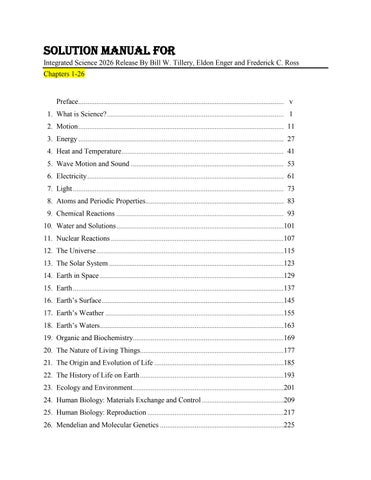
Solution Manual For Integrated Science 2026 Release By Bill W. Tillery, Eldon Enger and Frederick C. Ross Chapters 1-26
Preface................................................................................................................. v 1. What is Science? ................................................................................................. 1 2. Motion ................................................................................................................. 11 3. Energy ................................................................................................................. 27 4. Heat and Temperature ......................................................................................... 41 5. Wave Motion and Sound .................................................................................... 53 6. Electricity ............................................................................................................ 61 7. Light .................................................................................................................... 73 8. Atoms and Periodic Properties............................................................................ 83 9. Chemical Reactions ............................................................................................ 93 10. Water and Solutions ............................................................................................101 11. Nuclear Reactions ...............................................................................................107 12. The Universe .......................................................................................................115 13. The Solar System ................................................................................................123 14. Earth in Space .....................................................................................................129 15. Earth ....................................................................................................................137 16. Earth‘s Surface ....................................................................................................145 17. Earth‘s Weather ..................................................................................................155 18. Earth‘s Waters .....................................................................................................163 19. Organic and Biochemistry...................................................................................169 20. The Nature of Living Things...............................................................................177 21. The Origin and Evolution of Life .......................................................................185 22. The History of Life on Earth ...............................................................................193 23. Ecology and Environment ...................................................................................201 24. Human Biology: Materials Exchange and Control .............................................209 25. Human Biology: Reproduction ...........................................................................217 26. Mendelian and Molecular Genetics ....................................................................225
Preface Integrated Science is designed for introductory-level, non-science majoring undergraduates and future teachers who are required to take one or two courses in the field of science. High school students will also benefit from this treatment. The goal of this textbook is to provide a conceptual overview of the different domains of science that are relevant to today‘s students. As such, there is an emphasis on conceptual understanding and less emphasis on doing rote calculations. Similarly, there is an emphasis on applications for the modern world and far less emphasis on memorizing historical figures. Many of the students taking this course are anxious about a science course, particularly if there are elements of mathematics. As such, it is the instructor‘s responsibility to use all available resources and energy to help students understand and appreciate the role science plays in our world. Today, society has a great need for a few technically trained people, but a much larger need for individuals who understand science. Thus, we need a text that presents a coherent and clear picture of all science disciplines—an interdisciplinary approach—which helps students confirm and calibrate the big picture with the real world. Interdisciplinary science is an attempt to broaden and humanize science education by reducing and breaking down the barriers that enclose traditional science disciplines as distinct subjects. The spirit of interdisciplinary science is sometimes found in courses called ―General Science,‖ ―Combined Science,‖ or ―Integrated Science.‖ These courses draw concepts from a wide range of the traditional fields of science, but are not concentrated around certain problems or questions. For example, rather than just dealing with the physics of energy an interdisciplinary approach might consider broad aspects of energy—dealing with potential problems of an energy crisis—including social and ethical issues. There are a number of approaches that can be used in interdisciplinary science, including the teaching of science in a social, historical, philosophical, or problem-solving context but there is no single best approach. One of the characteristics of interdisciplinary science is that it is not constrained by the necessity of teaching certain facts or by traditions. It likewise cannot be imposed as a formal discipline, with certain facts to be learned. It is justified by its success in attracting and holding the attention and interest of students, making them a little wiser as they make their way toward various careers and callings. This book is our attempt to help as instructors build their own mix of descriptive and analytical aspects of science, arousing student interest and feelings as they help students reach the educational goals of their particular course. Integrated Science contains a number of innovative learning aids to help students, giving you more time to concentrate on presentations of important principles and concepts. A brief overview of some of these learning aids follows, together with suggestions about how they could be used.
The text contains a selection of multiple-choice, essay, or short-answer questions and two sets of quantitative exercises for each chapter. To meet a wide range of course objectives for different instructors, the questions are written at several taxonomic levels. They serve (1) as a source of feedback of student understandings, (2) as a means of preparing and studying for exams and quizzes, and (3) as a model for problem solving. The multiple-choice questions cover the main concepts, with answers provided for immediate correction or reinforcement of major understandings. The thought questions provide an excellent source of material for study group discussions. Many of these questions ask students to apply concepts, and the answers cannot be found specifically in the chapters. The Group A Exercises have complete solutions in appendix D of the text, with all unit work shown, and brief comments on needed understandings for successful working of problem exercises. Answers to these exercises are provided in this Instructor's Manual. Two sets are provided so that assignments can be made from the set without solutions (Group B). Diligent students who need help with the assigned problems are able to find a similar problem in the set with solutions (Group A) and study the model problemsolving technique. There are enough multiple-choice, short-answer, and problem exercises spaced throughout the text that quiz and examination questions can be taken directly from the end-ofchapter materials. Nonscience students typically appreciate this kind of assistance in preparing for quizzes and examinations. The questions and problems selected from the text can be tailored to the abilities of a particular class. If this is done with forethought, the overall performance of a large nonscience class approaches a standard distribution. Additional multiple-choice questions with answers for each chapter are found in the accompanying and extensive test bank. It is helpful if nonscience students are given an opportunity to familiarize themselves with the nature of a science course. They should know how it requires different reading, study, and thinking skills than required in other courses. Students cannot read a science text as they ―read‖ other textbooks (typically while thinking about something else). They must mentally ―act upon‖ the concepts, turning them over in their minds and making connections with previously learned concepts. For this reason, study groups of three or four students are suggested so students can question, talk about, ponder, and teach each other. Overall, the successful student will have a positive mental attitude; basic arithmetic skills, mostly dealing with fractions; an ability to follow directions; and an open mind and willingness to think.
Teaching Students Working in Collaborative Groups Collaborative group teaching techniques have been developed to correct many weaknesses of the traditional lecture-demonstration method, including overcoming the more obvious aspects of student passivity, memorizing equations, and a resulting fragmentation of knowledge. The idea of collaborative group teaching is simple and there are many easily implemented models that require just a few resources. In general, class members involved in
collaborative instruction are involved in structured learning situations, and they do receive some information from the instructor. The basic difference is that teams or groups of students work together until they successfully understand and complete an assignment. Such mutually worked assignments can range from answering a simple multiple-choice test item, to as complex as finding answers through unstructured research experiments in a laboratory setting. No matter how complex the assignment, cooperative efforts result in individual group members gaining from each other's efforts, along with feelings of belonging to a group. Today, many nonscience students have a misconception that one does not have to attend lectures, but can learn by simply memorizing the textbook. And, to be fair, for too many college courses, this approach works. And, in the reverse as well, as far too many college faculty simply read students what is already in their textbook. As a result, to enhance students‘ understanding, it is impingent on the instructor to make class time worthwhile. Cooperative group teaching involves more than directives for students to ―work together‖ or ―form teams.‖ As you have probably experienced, placing students in teams and telling them to work together does not in and of itself automatically result in cooperation. Not all groups are cooperative and invariably some ―team members‖ will want to sit by and watch others do all the work. To structure lessons so students do in fact work cooperatively with others requires an understanding of the basic things that can be done to make cooperation work. This will allow you to take existing lessons and restructure them for cooperative learning. Peer instruction is one method of peer-to-peer teaching, advocated at Harvard University by Physics Professor Eric Mazur. This teaching technique has been tried at several universities, and student testing shows that it works. It raises student scores on conceptual questions, as well as on traditional problem-solving questions. Peer instruction is described in Professor Mazur's book, Peer Instruction—A User's Manual (Prentice Hall, Inc, 1997). Professor Mazur's method includes a highly structured approach, and some of the ideas are briefly described here. There are basically three steps to the method: • The Peer Instruction sequence begins with an assignment to read certain materials in the text. The following class period begins with a one question (1 minute) quiz on that reading assignment. Students are expected to become familiar with definitions presented in the reading, and to begin thinking about the concepts. This is a test on the readings only, not on mastering the concepts. • The reading quiz is followed by 15 minutes or so of demonstrations, videos, and clarification of concepts by the instructor. • Students are then shown a conceptual multiple choice test question, perhaps on an overhead projector. These questions are designed to require students to make assumptions, make estimates, develop a model, or apply a worked out model. Students record their answers, then have ―one minute‖ to convince their classmates their answer is correct. The students then record a revised answer, which is reviewed by the professor (from students using a show of hands, posters, or one of numerous electronic systems) to learn what the students do or do not understand. The concept behind the correct answer is discussed. A new topic question is
selected if more than about 90% have the correct answer. A related question is selected next if about 30 to 80% have the correct answer. Less than 30% with the correct answer could mean the instructor should try again. His results have been replicated widely. He finds that this approach helps in the following ways: students were not passive, they were not memorizing equations, and they were learning from other students, as well as from the professor.
1
What is Science?
Contents Objects and Properties Quantifying Properties Measurement Systems Standard Units for the Metric System Length Mass Time Metric Prefixes Understandings from Measurements Data Ratios and Generalizations The Density Ratio Symbols and Equations The Nature of Science The Scientific Method Explanations and Investigations Scientific Laws Models and Theories Science, Nonscience, and Pseudoscience From Experimentation to Application Science and Nonscience Pseudoscience Limitations of Science
Overview Students begin by considering how one might observe and describe their immediate environment, and then logically proceed to an understanding that science is a particular strategy based observation-based logical reasoning and a way of describing their environment in a quantitative way. Within this opening chapter, deeper understandings about measurement as a way of describing the world. Concepts of ratios, proportions, and equations are developed as the student learns the specific scientific meaning of significant science words such as ―theory,‖ ―law,‖ and ―data.‖ A critical aspect is to point at the in the context of a science class, words like theory and