Solution Manual For Human Development A Life-Span View 9e Robert V. Kail, John C. Cavanaugh ______________________________________________________________________________ Chapters 1-16 Chapter 1: The Study of Human Development
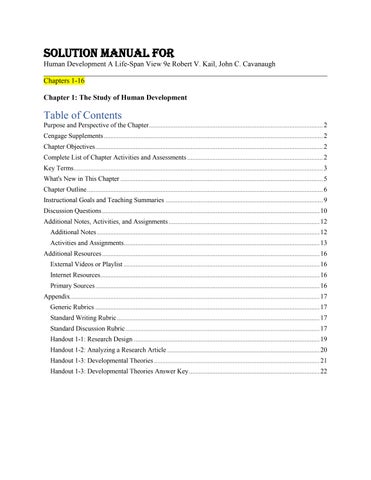
Table of Contents Purpose and Perspective of the Chapter ........................................................................................................ 2 Cengage Supplements ................................................................................................................................... 2 Chapter Objectives ........................................................................................................................................ 2 Complete List of Chapter Activities and Assessments ................................................................................. 2 Key Terms..................................................................................................................................................... 3 What's New in This Chapter ......................................................................................................................... 5 Chapter Outline ............................................................................................................................................. 6 Instructional Goals and Teaching Summaries .............................................................................................. 9 Discussion Questions .................................................................................................................................. 10 Additional Notes, Activities, and Assignments .......................................................................................... 12 Additional Notes ..................................................................................................................................... 12 Activities and Assignments..................................................................................................................... 13 Additional Resources .................................................................................................................................. 16 External Videos or Playlist ..................................................................................................................... 16 Internet Resources................................................................................................................................... 16 Primary Sources ...................................................................................................................................... 16 Appendix ..................................................................................................................................................... 17 Generic Rubrics ...................................................................................................................................... 17 Standard Writing Rubric ......................................................................................................................... 17 Standard Discussion Rubric .................................................................................................................... 17 Handout 1-1: Research Design ............................................................................................................... 19 Handout 1-2: Analyzing a Research Article ........................................................................................... 20 Handout 1-3: Developmental Theories ................................................................................................... 21 Handout 1-3: Developmental Theories Answer Key .............................................................................. 22
Purpose and Perspective of the Chapter Chapter 1 defines the study of human development and establishes it as the multidisciplinary study of how people change and how they remain the same over time. Beginning in this chapter and reappearing in subsequent chapters, students will read about three recurring issues in human development: (1) nature versus nurture; (2) continuity versus discontinuity; and (3) universal versus context-specific development. Because of the influence of nature and nurture on everything human, and the continuing debate regarding the influence of genetics versus environment on development, the authors have expanded this discussion. They also introduce readers to the biopsychosocial framework, which focuses on the four interactive forces that influence human development across the life span: biological forces, psychological forces, sociocultural forces, and life-cycle forces. The second part of Chapter 1 focuses on the developmental theories used in life-span research to help us address the ―whys‖ for development. Although there are no truly comprehensive theories of human development, five general perspectives influence current research: psychodynamic theory, learning theory, cognitive theory, ecological and systems theory, and the lifespan/selective optimization with compensation/life-course perspective. The latter part of the chapter focuses on conducting the developmental research and the various research methods used. The chapter ends with a discussion regarding the responsibilities of researchers in conducting ethical research and in communicating results from research findings. The authors also highlight the importance of research results in driving public policy.
Cengage Supplements The following product-level supplements provide additional information that may help you in preparing your course. They are available in the Instructor Resource Center.
Educator Guide (describes MindTap activities) PowerPoints (provides text-based lectures and presentations) Test Bank (contains assessment questions and problems) Guide to Teaching Online (provides information on how to teach virtually)
Chapter Objectives The following objectives are addressed in this chapter: 1.1
Identify issues and biopsychosocial forces in the study of life-span development.
1.2
Describe the theories used in the study of life-span psychology.
1.3
Describe the scientific methods used to conduct research in life-span development.
Complete List of Chapter Activities and Assessments For additional guidance, refer to the Teaching Online Guide. Chapter Objective 1.1 Identify issues and biopsychosocial forces in the study of life-span development
PPT Slide 2
Activity/Assessment Icebreaker: Think, Pair, and Share
Duration 5–10 minutes
9
Think, Pair, and Share Activity: Your Experiences
5–10 minutes
1.2 Describe the theories used in the study of lifespan psychology 1.3 Describe the scientific methods used to conduct research in life-span development
15
41
42
Discussion Activity: Erikson's Psychosocial Theory Discussion Activity: Participating in Research
10–15 minutes
Self-Assessment
10–15 minutes
5–10 minutes
MindTap Activities Why Does The Study of Human Development Matter to Me? Concept Clip: General Theories of Human Development Mastery Training Adaptive Test Prep Research Application Activity: Developmental Theories Chapter 1 Quiz [return to top]
Key Terms biological forces (7): All genetic and healthrelated factors that affect development biopsychosocial framework (8): Useful way to organize the biological, psychological, and sociocultural forces on human development chronosystem (18): The changes and continuities that occur over the life span that influence development cohort effects (31): A problem with cross-sectional designs in which differences between age groups (cohorts) may result from environmental events, not from developmental processes competence (18): Upper limit of a person’s ability to function in five domains: physical health, sensoryperceptual skills, motor skills, cognitive skills, and ego strength continuity–discontinuity issue (6): Concerns whether a particular developmental phenomenon represents a smooth progression throughout the life span (continuity) or a series of abrupt shifts (discontinuity) correlation coefficient (27): An expression of the strength and direction of a relation between two variables correlational study (27): Investigation looking at relations between variables as they exist naturally in the world cross-sectional study (31): Study in which developmental differences are identified by testing people of different ages dependent variable (28): The behavior being observed in an experiment, used to evaluate the impact of the independent variable
ecological theory (17): Theory that views human development as inseparable from the environmental contexts in which a person develops environmental press (19): The demands put on people by the environment epigenetic principle (13): Each psychosocial strength has its own special period of particular importance exosystem (18): Social settings that a person may not experience firsthand but that still influence development experiment (28): A systematic way of manipulating the key factor(s) that the investigator thinks causes a particular behavior human development (5): The multidisciplinary study of how people change and how they remain the same over time imitation or observational learning (14): Learning by simply watching those around us independent variable (28): The factor manipulated in an experiment information-processing theory (16): Proposes that human cognition consists of mental hardware and mental software intersectionality (9): Interaction of, for example, race and gender that results in unique life experiences beyond what might otherwise be predicted based on each aspect separately life-course perspective (21): Describes the ways in which various generations experience the biological, psychological, and sociocultural forces of development in their respective historical contexts life-cycle forces (8): Differences in how the same event affects people of different ages life-span perspective (19): View that human development is multiply determined and cannot be understood within the scope of a single framework longitudinal study (29): A research design in which the same individuals are observed or tested repeatedly at different points in their lives macrosystem (18): The cultures and subcultures in which the microsystem, mesosystem, and exosystem are embedded mesosystem (17): Provides connections across microsystems because what happens in one microsystem is likely to influence others meta-analysis (33): A tool that enables researchers to synthesize the results of many studies to estimate relations between variables microsystem (17): The people and objects in an individual’s immediate environment naturalistic observation (24): Observing people as they behave spontaneously in a real-life situation nature–nurture issue (6): The degree to which genetic or hereditary influences (nature) and experiential or environmental influences (nurture) determine the kind of person you are neuroscience (10): The study of the brain and the nervous system, especially in terms of brain–behavior relationships operant conditioning (13): Technique in which the consequences of a behavior determine whether a behavior is repeated in the future
populations (26): Broad groups of people that are of interest to researchers psychodynamic theories (12): Hold that development is largely determined by how well people resolve conflicts they face at different ages psychological forces (8): All internal perceptual, cognitive, emotional, and personality factors that affect development psychosocial theory (12): Erikson’s theory that personality development is determined by the interaction of an internal maturational plan and external societal demands punishment (13): A consequence that decreases the likelihood of the behavior that it follows qualitative research (29): Method that involves gaining in-depth understanding of human behavior and what governs it reinforcement (13): A consequence that increases the likelihood of the behavior that it follows reliability (26): The extent to which a measure provides a consistent index of a characteristic sample (26): A subset of the population selective optimization with compensation (SOC) model (20): View that selection, optimization, and compensation form a system of behavioral action that generates and regulates development and aging self-efficacy (14): People’s beliefs about their own abilities and talents self-reports (25): People’s answers to questions about the topic of interest sequential design (31): Developmental research design based on cross-sectional and longitudinal designs sociocultural forces (8): Interpersonal, societal, cultural, and ethnic factors that affect development structured observations (24): Method in which the researcher creates a setting that is likely to bring out the behavior of interest systematic observation (24): Watching people and carefully recording what they do or say theory (12): An organized set of ideas that explains development universal and context-specific development issue (7): Concerns whether there is one path of development or several validity (26): Whether a measure actually measures what researchers think it measures [return to top]
What's New in This Chapter The following elements are improvements in this chapter from the previous edition:
New Real People feature on Ellis Marsalis, Jr., famed jazz musician who died from COVID-19 Intersectionality added as an example of the complexity of sociocultural forces and how those play out in life Introduced Black Lives Matter movement as a sociocultural force in human development that is referenced in later chapters as well Coronavirus pandemic examples used to illustrate life-cycle forces, how development forces interact, and cohort effects; research on COVID-19 is included in several later chapters