Solution Manual For Green Building An Engineering Approach to Sustainable Construction, Edition 1 By Christian M. Carrico Chapters 2-15
1 Introduction to Green Building No exercises in this chapter
2 Energy Science: Key Underlying Physics 2.1
End of Chapter Exercises
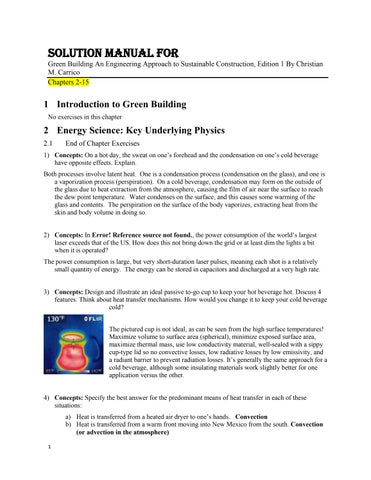
1) Concepts: On a hot day, the sweat on one‘s forehead and the condensation on one‘s cold beverage have opposite effects. Explain. Both processes involve latent heat. One is a condensation process (condensation on the glass), and one is a vaporization process (perspiration). On a cold beverage, condensation may form on the outside of the glass due to heat extraction from the atmosphere, causing the film of air near the surface to reach the dew point temperature. Water condenses on the surface, and this causes some warming of the glass and contents. The perspiration on the surface of the body vaporizes, extracting heat from the skin and body volume in doing so. 2) Concepts: In Error! Reference source not found., the power consumption of the world‘s largest laser exceeds that of the US. How does this not bring down the grid or at least dim the lights a bit when it is operated? The power consumption is large, but very short-duration laser pulses, meaning each shot is a relatively small quantity of energy. The energy can be stored in capacitors and discharged at a very high rate. 3) Concepts: Design and illustrate an ideal passive to-go cup to keep your hot beverage hot. Discuss 4 features. Think about heat transfer mechanisms. How would you change it to keep your cold beverage cold? The pictured cup is not ideal, as can be seen from the high surface temperatures! Maximize volume to surface area (spherical), minimize exposed surface area, maximize thermal mass, use low conductivity material, well-sealed with a sippy cup-type lid so no convective losses, low radiative losses by low emissivity, and a radiant barrier to prevent radiation losses. It‘s generally the same approach for a cold beverage, although some insulating materials work slightly better for one application versus the other. 4) Concepts: Specify the best answer for the predominant means of heat transfer in each of these situations: a) Heat is transferred from a heated air dryer to one‘s hands. Convection b) Heat is transferred from a warm front moving into New Mexico from the south. Convection (or advection in the atmosphere) 1
c) Standing in front of a fireplace with a roaring fire behind a glass door. Radiation d) Burning one's hand on a hot surface. Conduction e) A cat warming itself in a sunbeam. Radiation 5) Problem: Draw the conceptual heat engine diagram showing the flow directions of heat and work as well as the hot and cold temperature reservoirs. Express the work output and efficiency in terms of the hot and cold heat flows, Qh and Qc.
Wout = Qhot – Qcold η = efficiency = Wout/Qhot 6) Problem: Convert the global average energy use of ~500 Quads to (a) an equivalent ExaJoules (1018) per year, (b) an equivalent TWh per year, and (c) a steady-state horsepower. Given: 5oo Quads/yr Find: Annual energy use in EJ/yr, TWh/yr, and P (hp) Assume: steady state Solution: Annual Energy Use (EJ/y) = 500E15 BTU/y × 1055 J/BTU × 1 EJ/1E18J = 527.5 EJ/y 1 kWh = 1000W×3600s = 3.6E6J Annual Energy Use (TWh/y) = 500E15 BTU/y × 1.055 KJ/BTU × (1kWh/3600kJ) = 1.47E14kWh/y = 147,000 TWh/y Steady State P = 527.5E18J/yr × yr/ [(365)(24)(3600)]s × 1 hp/(749J/s) = 2.2E10 hp or 22 billion horses working for our needs continuously! Fortunately, we don‘t have to deal with that quantity of horse apples, though we have other waste products that are a concern. Whatever way you quantify it, it‘s a staggering rate of energy use, which has been both a blessing and a curse. 7) Problem: The first steam engine worked between the upper and lower temperatures of 10 and 100°C. What is the maximum efficiency possible? Efficiency = 1 – Tcold/Thot = 1 – 283K/373K = 0.24 or 24%
2
8) Problem: Estimate the mass of the atmosphere. Assume surface P = 1 atmosphere (Earth‘s radius is 6370 km). Given: P = 1 atm; R = 6370 km Find: Matm Assume: uniform pressure at the surface Solution: F = ma = mg = P × A = 101325 N/m2 × 4π(R)2 = 101325 N/m2 × 4π (6370E3 m)2 = 5.17E19 N M = (5.17E19 kg·m/s2) / (9.8 m/s2) = 5.3E18 kg 9) Problem: You are using a heated 1-m diameter mass of iron at 500 °C to provide warmth in a room. At the outset, what is the rate of heat transfer via radiation in a room-temperature environment? Assume a perfect blackbody. Given: D = 1 m; T = 500 °C Find: P(t=0) Assume: Є = 1; perfect sphere Solution: Area = 4πR2 = 4π(0.5)2 = 3.14159 m2 Qrad = σAϵ ((T2)4 – (T1)4) = (5.67E-8 W/m2-K4) (3.14159 m2) (1) ((773K)4 – (293K)4) Qrad = (5.67E-8 W/m2-K4) (3.14159 m2) (3.497E11 K4) Qrad = 62,286W
10) Problem: A heat engine is generating useful work at a rate of 50 kW. The waste heat loss rate to the environment in the heat engine is 30kW. What is the thermal efficiency of this engine? What is the hp rating of the engine? What is the rate of gasoline consumption (120,000 BTU/gal) in gal/h? Given:
heat engine; Wout = 50 kW; Qwaste = 30 kW
Find: P(hp); η; Qin (gal/h) Assume: steady state Solution: Energy Balance Qin = Qwaste + Wout So, Qin = Wout + Qwaste
Wout = 50 kW (1 hp/0.746 kW) = 67 hp Qin = 80KJ/s (kBTU/1055 kJ) (gal/120kBTU) (3600 s/h) = 2.27 gal/h
3
11) Problem: Your power plant has an output of 2000 MW. Its flame temperature is 1227 °C and it is exhausting to ambient conditions at 20 °C. a) b) c) d)
Find Carnot Efficiency. For the idealized Carnot cycle heat engine, what is the minimum rate of input heat (Qhot)? What is the waste heat (Qcold) being dumped into the surroundings? Draw a diagram showing the energy flows in and out, and that they balance.
Given:
Wout = 2000 MWe; Tflame = 1227 °C; Tamb = 20 °C
Find: For Carnot Qhot; Qcold Assume: Carnot cycle Solution: Wout = 2000 MW Carnot efficiency = 1 – Tc/Th = 1 – 293K/1500K = 0.805 Rate of heat input: Qhot = Wout/η = 2000MJ/s / 0.8 = 2484MW Qwaste = (2484 -2000) MW = 484MW 12) Problem: Power consumed by an engine as it ramps up is given by P(t) = 100 kW + 10 kW/min × t. Find the energy consumed in kWh in 1 hour. Energy =
13) Problem: You successfully lift a 25 kg stone to the top of the Empire State Building (1250 ft to the top floor). How much work did you do on the stone, assuming constant g? If you burned the calories you ingested from drinking a Coke while accomplishing this (Coke has 182 food Calories), what is the thermodynamic efficiency of the process (your body!)? Given: M = 25 kg; ∆z = 1250 ft; Qin = 182 Cal Find: Wout, η Assume: steady state; constant g = 9.8 m/s2 Solution: Wout = f × d = m × g × d = 25 kg × 9.8 m/s2 × 1250 ft × (m/3.28 ft) = 93368 N×m = 93.4 kJ Qin = Energy Expended = 182,000 cal × 4.18 J/calorie = 760760 J = 760.8 kJ η= Wout/Qin = 93.4 kJ/760.8 kJ = 0.123 = 12.3% efficient 14) Problem: An inventor has a new power plant design that is claimed to have a 2000 MW output with a feed rate of 100 kg/s of fuel with an energy content of 25 MJ/kg. The plant is operating at hot and cold reservoir temperatures of 1000 °C and 20 °C. Is this possible? Given: 4
Wout = 2000 MWe; dM/dt = 100 kg/s; Ec = 25 MJ/kg; Thot = 1000 °C; Tcold = 20 °C
Find: Possible? Assume: Carnot cycle Solution: Qhot = 100 kg/s (25 MJ/kg) = 2500 MJ/s Wout = 2000 MW Actual efficiency = 2000MW/2500MW = 0.8 Carnot efficiency = 1 – Tc/Th = 1 – 293K/1273K = 0.77 The efficiency of the plant exceeds the Carnot limit and thus this is IMPOSSIBLE. 15) Problem: A human can be approximated as a puny little machine outputting ~1/10 hp steady state. (a) If the person is maintaining a constant temperature, what is the rate of heat transfer for this system? Think about the heat coming from the stored fat tissues into the human machine, which then produces some useful work. (b) Assume that the human‘s useful work output can be converted into electricity with no loss and at a value of $0.12/kWh. Calculate the value of the work output over a year and a lifetime if the same output can be maintained around the clock. Given: Human with 1/10 HP useful work; Electric = $0.12/kWh Find: Value of 1 year‘s useful work and a lifetime career if electric Assume: no losses in human-electric conversion Solution: ΔU = 0 = Qin –Wout or Qin = Wout = 75W or 75W of net thermal energy is going into the system, and 75W of useful work is coming out. There is likely additional heat flowing in from the fat tissues, but flowing out of the system as waste heat. P = 0.1 HP × 0.746 kW/HP = 0.0746 kW or 75W Since T is constant, U is constant. E = P × T = 0.1 HP × 0.746 kW/HP × 24 h/d × 365 d/y × $0.12/kWh = $78.41 for a full year. For a 75-year lifetime, this equates to $5881! 16) Problem: Your bicycle tire gauge reads the following: 33.5 psi. You are at sea-level ambient pressure. Find the absolute pressure in kPa. Estimate the mass of air in the tire using reasonable assumptions. Given:
P = 33.5 PSI at sea level
Find: Pabs; Mair in bike tire Assume: Patm = 1 atm; T = 293K; tire: D = 27‖ and d = 1‖ Solution: P = Pgauge + Patm = [33.5 psi (1 atm/14.7 psi) (101.3 kPa/atm)] + 101.3 kPa = 332.1 kPa = 3.28 atm The diameter of the Tire is ~ 1 inch; the Diameter of the Wheel is ~ 27 inches, forming a cylinder. Volume = XSA of Tire × Circumference of Tire = π/4× d2 × (π×D) = π/4×(0.0254 m)2 × (π (27 in × 0.0254 m/in) = 1.09E-3 m3 M = n×MW = PV/RT = 3.28 atm (1.09 L)/ (0.08206 L-atm/mol-K × 293K) ×28.96 g/mol = 4.3 g 5