Solution and Answer Guide RIZZO, RATLIFF, FUNDAMENTALS OF ANATOMY AND PHYSIOLOGY, 5E, 2026, 9798214106915; CHAPTER 1: T HE HUMAN BODY
TABLE OF CONTENTS Review Questions ........................................................................................................................................ 1 Matching ...................................................................................................................................................... 4
REVIEW QUESTIONS 1.
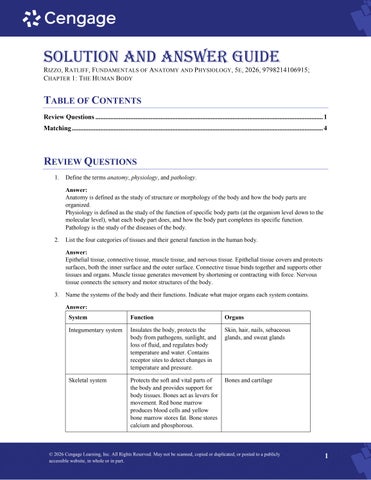
Define the terms anatomy, physiology, and pathology. Answer: Anatomy is defined as the study of structure or morphology of the body and how the body parts are organized. Physiology is defined as the study of the function of specific body parts (at the organism level down to the molecular level), what each body part does, and how the body part completes its specific function. Pathology is the study of the diseases of the body.
2.
List the four categories of tissues and their general function in the human body. Answer: Epithelial tissue, connective tissue, muscle tissue, and nervous tissue. Epithelial tissue covers and protects surfaces, both the inner surface and the outer surface. Connective tissue binds together and supports other tissues and organs. Muscle tissue generates movement by shortening or contracting with force. Nervous tissue connects the sensory and motor structures of the body.
3.
Name the systems of the body and their functions. Indicate what major organs each system contains. Answer: System
Function
Organs
Integumentary system
Insulates the body, protects the body from pathogens, sunlight, and loss of fluid, and regulates body temperature and water. Contains receptor sites to detect changes in temperature and pressure.
Skin, hair, nails, sebaceous glands, and sweat glands
Skeletal system
Protects the soft and vital parts of the body and provides support for body tissues. Bones act as levers for movement. Red bone marrow produces blood cells and yellow bone marrow stores fat. Bone stores calcium and phosphorous.
Bones and cartilage
© 2026 Cengage Learning, Inc. All Rights Reserved. May not be scanned, copied or duplicated, or posted to a publicly accessible website, in whole or in part.
1
Muscular system
Skeletal muscles pull on bones to allow movement; smooth muscle pushes food through the digestive tract and blood through the circulatory system; and cardiac muscle causes contraction of the heart
Skeletal muscles and tendons
Nervous system
Controls, correlates, and regulates the other systems of the body; interprets stimuli from the outside world; and controls the special senses of sight, hearing, taste, and smell
Brain, spinal cord, and peripheral nerves
Endocrine system
Secretes hormones to regulate body processes
Pituitary gland, pancreas, thyroid gland, adrenal gland, parathyroid glands, ovaries and testes
Cardiovascular system
Pumps and distributes blood, which carries oxygen, nutrients, and wastes to and from the cells of the body
Heart and blood vessels: arteries, veins, and capillaries
Lymphatic system
Drains tissue spaces of excess interstitial fluids and absorb fats from the intestine and carries them to the blood. It also protects the body from disease by developing immunities and destroying most invading disease-causing microorganisms
Lymph nodes, thymus, spleen, and lymph vessels
© 2026 Cengage Learning, Inc. All Rights Reserved. May not be scanned, copied or duplicated, or posted to a publicly accessible website, in whole or in part.
2
4.
Respiratory system
Provides the surface area for the exchange of oxygen and carbon dioxide with the blood.
Nasal cavity, pharynx, larynx, trachea, bronchi and lungs
Digestive System
Converts food into smaller substances for absorption and eliminates indigestible waste.
Alimentary canal (esophagus, stomach, small intestine, large intestine, rectum, anus) and accessory organs (e.g., liver and pancreas)
Urinary system
Chemical regulation of the blood and removes waste in the form of urine.
Kidneys, ureters, and urinary bladder
Reproductive system
Maintains sexual characteristics and helps perform reproductive functions. Produce and exchange gametes, house the fetus until birth, and lactation.
ovaries, uterine tubes, uterus, and vagina in the female and the testes, vas deferens, seminal vesicles, prostate gland, penis, and the urethra in the male
The body has two major cavities, each divided into two lesser cavities. List them and explain what each cavity contains. Answer: The two main body cavities are the dorsal cavity and the ventral cavity. The dorsal cavity contains the cranial cavity and the spinal cavity. The ventral cavity contains the thoracic cavity and the abdominopelvic, or abdomen and pelvic, cavity.
5.
Briefly describe cells, tissues, organs, and organ systems. Answer: Cells are the smallest living units. Tissue is a group of cells that perform similar functions. Organs are groups of tissue that come together to serve a common function. Organ systems are a group of organs that function closely together and make up a whole organism.
6.
*Discuss how the body maintains homeostasis in terms of regulating blood glucose levels. Answer: Negative feedback loops are used to maintain blood glucose levels. After one eats, blood glucose increases owing to the breakdown of complex carbohydrates into simple sugar molecules (glucose). The pancreas detects the increase in blood glucose and secretes insulin. While the cells take in the glucose they require, insulin helps move the excess glucose into the liver. This causes the blood glucose levels to decrease. When the levels drop below the normal threshold, glucagon is secreted by the pancreas which breaks down glycogen to glucose. This brings back the normal glucose levels in the bloodstream.
7.
*Differentiate between positive and negative feedback and provide an example of each. Answer: Negative feedback is when the body revises disturbances, or reverses the variable, back to homeostatic levels. An example of negative feedback is temperature or blood glucose control. Positive feedback responds to a stimulus by increasing and amplifying the variable. An example of positive feedback is childbirth.
8.
List and define the main directional terms of the body. Answer:
© 2026 Cengage Learning, Inc. All Rights Reserved. May not be scanned, copied or duplicated, or posted to a publicly accessible website, in whole or in part.
3
The main directional terms of the body are: Posterior (toward the back) and anterior (toward the front); Superior (uppermost or above) and inferior (lowermost or below); medial (toward the middle) and lateral (toward the side); proximal (near the attachment or origin) and distal (away from the point of origin). 9.
List and define the three planes of division of the body. Answer: The three planes of the body are sagittal, frontal (coronal), and transverse (horizontal). The sagittal plane separates the body into left and right portions. The transverse plane separates the body into superior and inferior portions. The frontal, or coronal, plane separates the body into anterior and posterior portions.
10. Describe how the body is situated in the correct anatomical position. Answer: In standard anatomical position, the body is standing, facing forward with arms at the sides and the palms of the hand and feet pointing forward. *Critical Thinking Questions
MATCHING Place the most appropriate number in the blank provided. ______ Superior ______ Anterior ______ Inferior ______ Posterior ______ Medial ______ Lateral ______ Proximal ______ Distal ______ Transverse ______ Midsagittal
1. 2. 3. 4. 5.
Toward the back, dorsal Uppermost or above Toward the side Near the point of attachment or origin Any plane dividing the body into superior and inferior 6. Away from the point of attachment 7. Toward the front, ventral 8. The plane vertically dividing the body into equal right and left halves 9. Toward the midline of the body 10. Lowermost or below
© 2026 Cengage Learning, Inc. All Rights Reserved. May not be scanned, copied or duplicated, or posted to a publicly accessible website, in whole or in part.
4
Answer: 1. Posterior 2. Superior 3. Lateral 4. Proximal 5. Transverse 6. Distal 7. Anterior 8. Midsagittal 9. Medial 10. Inferior
Solution and Answer Guide RIZZO, RATLIFF, FUNDAMENTALS OF ANATOMY AND PHYSIOLOGY, 5E, 2026, 9798214106915; CHAPTER 2 T HE CHEMISTRY OF LIFE
TABLE OF CONTENTS Review Questions ........................................................................................................................................ 5 Fill in the Blank ........................................................................................................................................... 7 Matching ...................................................................................................................................................... 8
REVIEW QUESTIONS 1.
Describe the nature and structure of an atom. Answer: An atom is the smallest particle of an element that maintains all the characteristics of that element and enters chemical reactions through its electrons. Each atom consists of a nucleus with protons (positively charged) and neutrons (neutral). Lighter particles called electrons (negatively charged) orbit the nucleus.
2.
List the major chemical elements found in living systems. Answer: Some of the major chemical elements in living systems include carbon, hydrogen, nitrogen, oxygen, phosphorus, and sulfur. Some ions of importance are magnesium, potassium, sodium, chloride, and calcium. (Refer to Figure 2-2)
3.
*Compare ionic and covalent bonding and indicate which major four elements found in cells bond covalently. Answer: An ionic bond is formed when one atom gains electrons while the other atom loses electrons from its outermost energy level. An example is NaCl, or table salt. A covalent bond is formed when atoms share
© 2026 Cengage Learning, Inc. All Rights Reserved. May not be scanned, copied or duplicated, or posted to a publicly accessible website, in whole or in part.
5