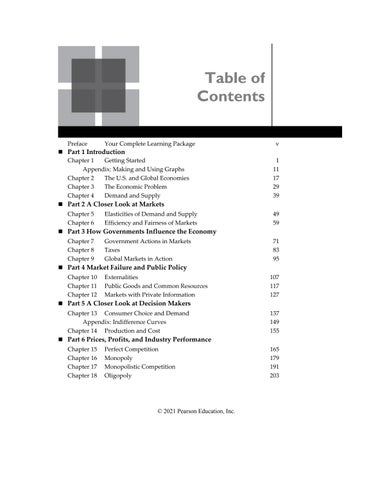
Table of Contents Preface Your Complete Learning Package Part 1 Introduction Chapter 1 Getting Started Appendix: Making and Using Graphs Chapter 2 The U.S. and Global Economies Chapter 3 The Economic Problem Chapter 4 Demand and Supply Part 2 A Closer Look at Markets Chapter 5 Chapter 6
Elasticities of Demand and Supply Efficiency and Fairness of Markets
v 1 11 17 29 39 49 59
Part 3 How Governments Influence the Economy Chapter 7 Chapter 8 Chapter 9
Government Actions in Markets Taxes Global Markets in Action
71 83 95
Part 4 Market Failure and Public Policy Chapter 10 Chapter 11 Chapter 12
Externalities Public Goods and Common Resources Markets with Private Information
107 117 127
Part 5 A Closer Look at Decision Makers Chapter 13 Consumer Choice and Demand Appendix: Indifference Curves Chapter 14 Production and Cost
137 149 155
Part 6 Prices, Profits, and Industry Performance Chapter 15 Chapter 16 Chapter 17 Chapter 18
Perfect Competition Monopoly Monopolistic Competition Oligopoly
© 2021 Pearson Education, Inc.
165 179 191 203
IV
Part 7 Incomes and Inequality Chapter 19 Chapter 20
Markets for Factors of Production Economic Inequality
215 225
Part 8 Monitoring the Macroeconomy Chapter 21 GDP: A Measure of Total Production and Income Appendix: Measuring Real GDP Chapter 22 Jobs and Unemployment Chapter 23 The CPI and the Cost of Living
239 249 253 263
Part 9 The Real Economy Chapter 24 Chapter 25 Chapter 26
Potential GDP and the Natural Unemployment Rate Economic Growth Finance, Saving, and Investment
273 283 295
Part 10 The Money Economy Chapter 27 Chapter 28
The Monetary System Money, Interest, and Inflation
305 317
Part 11 Economic Fluctuations Chapter 29 Chapter 30 Chapter 31
Aggregate Supply and Aggregate Demand Aggregate Expenditure Multiplier The Short-Run Policy Tradeoff
327 337 347
Part 12 Macroeconomic Policy Chapter 32 Chapter 33 Chapter 34
Fiscal Policy Monetary Policy International Finance
© 2021 Pearson Education, Inc.
359 369 379
Chapter
Getting Started ANSWERS TO CHAPTER CHECKPOINTS
Problems and Applications 1.
Provide three examples of scarcity that illustrate why even the 1,826 billionaires in the formworld face scarcity. The 1,826 billionaires might want to be able to eat unlimited meals without gaining weight; live to be at least 140 years old and enjoy perfect health everyday; be able to wake up in San Francisco and go to sleep in Paris after spending no more than 3 hours on a plane. None of these wants can be fulfilled given the present state of technology and resources available.
2.
Label each entry in the list as dealing with a microeconomic topic or a macroeconomic topic. Explain your answer. • Motor vehicles production in China is growing by 10 percent a year. This entry is a microeconomic topic because individuals and businesses make decisions whether to buy or sell cars. •
Coffee prices rocket. This entry is a microeconomic topic because individuals and businesses make decisions whether to buy or sell coffee.
•
Globalization has reduced African poverty. This entry is a macroeconomic topic because globalization is the result of choices made by billions of people rather than an individual or business.
•
The government must cut its budget deficit. This entry is a macroeconomic topic because neither an individual nor a business makes decision to cut expenditures.
•
Apple sells 20 million iPhone 6 smartphones a month. This entry is a microeconomic topic because individuals and Apple make decision whether to buy or sell iPhones.
© 2021 Pearson Education, Inc.
Part 1 . INTRODUCTION
2
Use the following information to work Problems 3 to 6. Jurassic World had world-wide box office receipts of $1.66 billion. The movie’s production budget was $150 million with additional marketing costs. A successful movie brings pleasure to millions, creates work for thousands, and makes a few people rich. 3. What contribution does a movie like Jurassic World make to coping with scarcity? When you buy a movie ticket, are you buying a good or a service? Scarcity still exists but the amount of entertainment available in the economy increases. Buying a ticket to watch a movie is buying a service. 4.
Who decides whether a movie is going to be a blockbuster? How do you think the creation of a blockbuster movie influences what, how, and for whom goods and services are produced? The audience decides whether a movie will be a blockbuster because the audience decides whether to attend the movie. The “what” question is affected in three ways: First, one good or service that is produced is the blockbuster movie. Second, the people whose incomes are higher as a result of the blockbuster then buy an assortment of goods and services and so this assortment of goods and services is produced. Finally, the “what” question is influenced if the movie leads to spinoff goods (such as toys) or creates a series of sequels or similar films. The “how” question is affected to the extent that movies use different production methods. Some movies, for instance, have a lot of special effects while other movies have few or none. The “for whom” question is influenced because those people who receive the profits of a blockbuster movie have higher incomes and so more goods and services are produced for them.
5.
What are some of the components of marginal cost and marginal benefit that the producer of a movie faces? Some of the marginal costs the producer faces are the cost of an actor or actress, the costs of the crew for a day, the costs of a location, and the costs of advertising in a newspaper. The marginal benefits the producer enjoys are his or her salary and/or profit participation from the movie, royalties from the movie, the prestige resulting from a successful movie, and any awards given to the producer of the movie.
6.
Suppose that Chris Pratt had been offered a part in another movie and that to hire him for Jurassic World, the producer had to double Chris Pratt’s pay. What incentives would have changed? How might the changed incentives have changed the choices that people made? The higher pay would have increased Mr. Pratt’s incentive to make Jurassic World rather than the other movie and perhaps affected his choice to
© 2021 Pearson Education, Inc.
Chapter 1 . Getting Started
make Jurassic World rather than the other movie. The higher pay would have increased the incentive of the producer to decrease the expense of other aspects of the movie so the producer might have chosen to reduce the pay of the other stars in the movie. 7.
What is the social interest? Distinguish it from self-interest. In your answer give an example of self-interest and an example of social interest. The social interest looks at what is best for society as a whole; choices that are best for society as a whole are said to be in the social interest. The selfinterest looks at what is best for the individual; choices that are best for the individual making the choice are said to be in the self-interest. An example of a choice made in the self-interest is a student’s decision to take an economics class. An example of a choice made in the social interest is a firm’s decision to reduce its air pollution.
8.
Pam, Pru, and Pat are deciding how they will celebrate the New Year. Pam prefers to take a cruise, is happy to go to Hawaii, but does not want to go skiing. Pru prefers to go skiing, is happy to go to Hawaii, but does not want to take a cruise. Pat prefers to go to Hawaii or to take a cruise but does not want to go skiing. Their decision is to go to Hawaii. Is this decision rational? What is the opportunity cost of the trip to Hawaii for each of them? What is the benefit that each gets? Pam, Pru and Pat’s decision to go to Hawaii is rational. All three of them considered the cost and benefit of various New Year’s plans. All three were at least willing to go to Hawaii while Pam and Pat were unwilling to go skiing and Pru was unwilling to go on a cruise. The opportunity cost of the trip for Pam is a cruise; for Pru, it is skiing; and for Pat, it is a cruise. The benefit each receives is the pleasure, the relaxation, excitement, and/or knowledge gained from the trip.
9.
Label each of the entries in the list as a positive or a normative statement. • Low-income people pay too much for housing. The entry that low-income people pay too much for housing is a normative statement. •
The number of U.S. farms has decreased over the past 50 years. The entry about the number of farms is a positive statement.
•
Toyota expands parts production in the United States. The entry about Toyota expanding parts production is a positive statement.
•
Imports from China are swamping U.S. department stores. The entry about imports is a normative statement.
•
The rural population in the United States is declining. The entry about the population in rural areas is a positive statement.
© 2021 Pearson Education, Inc.
3