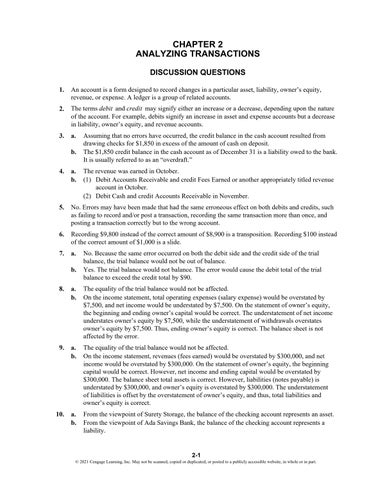
CHAPTER 2 ANALYZING TRANSACTIONS DISCUSSION QUESTIONS 1.
An account is a form designed to record changes in a particular asset, liability, owner’s equity, revenue, or expense. A ledger is a group of related accounts.
2.
The terms debit and credit may signify either an increase or a decrease, depending upon the nature of the account. For example, debits signify an increase in asset and expense accounts but a decrease in liability, owner’s equity, and revenue accounts.
3.
a. b.
Assuming that no errors have occurred, the credit balance in the cash account resulted from drawing checks for $1,850 in excess of the amount of cash on deposit. The $1,850 credit balance in the cash account as of December 31 is a liability owed to the bank. It is usually referred to as an “overdraft.”
4.
a. b.
5.
No. Errors may have been made that had the same erroneous effect on both debits and credits, such as failing to record and/or post a transaction, recording the same transaction more than once, and posting a transaction correctly but to the wrong account.
6.
Recording $9,800 instead of the correct amount of $8,900 is a transposition. Recording $100 instead of the correct amount of $1,000 is a slide.
7.
a. b.
The revenue was earned in October. (1) Debit Accounts Receivable and credit Fees Earned or another appropriately titled revenue account in October. (2) Debit Cash and credit Accounts Receivable in November.
No. Because the same error occurred on both the debit side and the credit side of the trial balance, the trial balance would not be out of balance. Yes. The trial balance would not balance. The error would cause the debit total of the trial balance to exceed the credit total by $90.
8.
a. b.
The equality of the trial balance would not be affected. On the income statement, total operating expenses (salary expense) would be overstated by $7,500, and net income would be understated by $7,500. On the statement of owner’s equity, the beginning and ending owner’s capital would be correct. The understatement of net income understates owner’s equity by $7,500, while the understatement of withdrawals overstates owner’s equity by $7,500. Thus, ending owner’s equity is correct. The balance sheet is not affected by the error.
9.
a. b.
The equality of the trial balance would not be affected. On the income statement, revenues (fees earned) would be overstated by $300,000, and net income would be overstated by $300,000. On the statement of owner’s equity, the beginning capital would be correct. However, net income and ending capital would be overstated by $300,000. The balance sheet total assets is correct. However, liabilities (notes payable) is understated by $300,000, and owner’s equity is overstated by $300,000. The understatement of liabilities is offset by the overstatement of owner’s equity, and thus, total liabilities and owner’s equity is correct.
10.
a. b.
From the viewpoint of Surety Storage, the balance of the checking account represents an asset. From the viewpoint of Ada Savings Bank, the balance of the checking account represents a liability.
2-1 © 2021 Cengage Learning, Inc. May not be scanned, copied or duplicated, or posted to a publicly accessible website, in whole or in part.
CHAPTER 2
Analyzing Transactions
PRACTICE EXERCISES PE 2-1A 1. 2. 3. 4. 5. 6.
Debit and credit entries (c), normal debit balance Credit entries only (b), normal credit balance Credit entries only (b), normal credit balance Debit entries only (a), normal debit balance Credit entries only (b), normal credit balance Debit and credit entries (c), normal credit balance
`
PE 2-1B 1. 2. 3. 4. 5. 6.
Debit and credit entries (c), normal credit balance Debit and credit entries (c), normal debit balance Debit entries only (a), normal debit balance Debit entries only (a), normal debit balance Debit entries only (a), normal debit balance Credit entries only (b), normal credit balance
PE 2-2A Feb.
19 Office Equipment Cash Accounts Payable
14,800
30 Office Supplies Cash Accounts Payable
1,900
3,600 11,200
PE 2-2B Sept.
600 1,300
2-2 © 2021 Cengage Learning, Inc. May not be scanned, copied or duplicated, or posted to a publicly accessible website, in whole or in part.
CHAPTER 2
Analyzing Transactions
PE 2-3A Apr.
30 Accounts Receivable Fees Earned
12,980
13 Cash Fees Earned
7,480
23 Graeme Schneider, Drawing Cash
27,000
30 Claire Hope, Drawing Cash
9,500
12,980
PE 2-3B Aug.
7,480
PE 2-4A Dec.
27,000
PE 2-4B June
9,500
PE 2-5A Using the following T account, solve for the amount of cash receipts (indicated by ? below). Cash July 1 Bal. Cash receipts July 31 Bal.
42,830 ? 33,850
132,500
Cash payments
$33,850 = $42,830 + Cash receipts – $132,500 Cash receipts = $33,850 + $132,500 – $42,830 = $123,520
PE 2-5B Using the following T account, solve for the amount of supplies expense (indicated by ? below). Supplies Aug. 1 Bal. Supplies purchased Aug. 31 Bal.
1,240 3,760 1,600
?
Supplies expense
$1,600 = $1,240 + $3,760 – Supplies expense Supplies expense = $1,240 + $3,760 – $1,600 = $3,400
2-3 © 2021 Cengage Learning, Inc. May not be scanned, copied or duplicated, or posted to a publicly accessible website, in whole or in part.
CHAPTER 2
Analyzing Transactions
PE 2-6A a.
The trial balance totals are unequal. The debit total is higher by $900 ($9,800 – $8,900).
b.
The trial balance totals are equal because both the debit and credit entries were journalized and posted for $530.
c.
The trial balance totals are unequal. The debit total is higher by $5,800 ($2,900 + $2,900).
PE 2-6B a.
The trial balance totals are equal because both the debit and credit entries were journalized and posted for $14,200.
b.
The trial balance totals are unequal. The credit total is higher by $360 ($1,730 – $1,370).
c.
The trial balance totals are unequal. The debit total is higher by $4,500 ($7,250 – $2,750).
2-4 © 2021 Cengage Learning, Inc. May not be scanned, copied or duplicated, or posted to a publicly accessible website, in whole or in part.
CHAPTER 2
Analyzing Transactions
PE 2-7A a.
Journal Entry That Was Made in Error Miscellaneous Expense 3,220 Rent Expense 3,220
Journal Entry That Should Have Been Made Rent Expense 3,220 Cash
3,220
Comparison Rent Expense instead of Miscellaneous Expense should have been debited. Cash instead of Rent Expense should have been credited. The debit and credit amount of $3,220 is correct.
Correcting Journal Entries Rent Expense Miscellaneous Expense Rent Expense Cash
3,220 3,220 3,220 3,220
Note: The first entry reverses the incorrect entry, and the second entry is what should have been recorded initially. These two entries could have been combined into one entry; however, preparing two entries makes it easier for someone later to understand what happened and why the entries were necessary.
b.
Journal Entry That Was Made in Error Cash 5,080 Accounts Payable 5,080
Journal Entry That Should Have Been Made Cash 5,080 Accounts Receivable
5,080
Comparison Accounts Receivable instead of Accounts Payable should have been credited.
Correcting Journal Entry Accounts Payable Accounts Receivable
5,080 5,080
2-5 © 2021 Cengage Learning, Inc. May not be scanned, copied or duplicated, or posted to a publicly accessible website, in whole or in part.