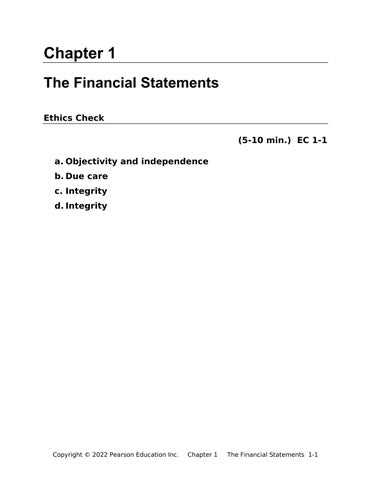
Chapter 1 The Financial Statements Ethics Check (5-10 min.) EC 1-1 a. Objectivity and independence b. Due care c. Integrity d. Integrity
Copyright © 2022 Pearson Education Inc.
Chapter 1
The Financial Statements 1-1
Short Exercises (10 min.) S 1-1 a. Corporation,
limited
partners
of
a
Limited-liability
partnership (LLP) and Limited-liability company (LLC). If any of these businesses fails and cannot pay its liabilities, creditors cannot force the owners to pay the business’s debts from the owners’ personal assets. Creditors can go after the general partner of a limited liability partnership. b. Proprietorship. There is a single owner of the business, so the owner is answerable to no other owner. c. Partnership. If the partnership fails and cannot pay its liabilities, creditors can force the partners to pay the business’s
debts
from
their
personal
assets.
A
partnership affords more protection for creditors than a proprietorship because there are two or more owners to share this liability.
(5 min.) S 1-2 1. The entity assumption applies. 2. Application of the entity assumption will separate Osmond’s personal assets from the assets of Simple Treats, Inc. This will help Osmond, investors, and Copyright © 2022 Pearson Education Inc.
Chapter 1
The Financial Statements 1-2
lenders know how much assets, liabilities and equity the business has, and this knowledge will help all parties evaluate the business realistically. (5-10 min.) S 1-3 a.
Stable-monetary-unit assumption
b.
Historical cost principle; $300 is the accounting value of the laptop
c.
Historical cost principle; the sale price is the amount actually received from the sale
d.
Entity assumption
(10 min.) S 1-4 Computed amounts in boxes Total Assets =
Total Liabilities
+
Stockholders’ Equity
a.
$660,000
=
$300,000
+
$360,000
b.
85,000
=
50,000
+
35,000
c.
350,000
=
75,000
+
275,000
(5 min.) S 1-5 1. Liabilities = Assets − Owners’ Equity
Copyright © 2022 Pearson Education Inc.
Chapter 1
The Financial Statements 1-3
2. Owners’ Equity = Assets − Liabilities This way of determining the amount of owners’ equity applies to any company or your household. (5-10 min.) S 1-6 a. Land
A
g. Retained earnings
S
b. Accrued expenses payable L
h. Prepaid expenses
A
c. Supplies
i. Accounts payable
L
A
d. Equipment
A
j. Accounts receivable A
e. Notes payable f. Long-term debt
L L
k. Merchandise inventory A l. Common stock
S
(5-10 min.) S 1-7 1. Assets are the economic resources of a business that are expected to produce a benefit in the future.
Owners’ (stockholders’) equity represents the insider claims of a business, the owners’ interest in its assets. Assets and owners’ equity differ in that assets are
resources and owners’ equity is a claim to assets. Assets must be at least as large as owners’ equity, so equity can be smaller than assets.
Copyright © 2022 Pearson Education Inc.
Chapter 1
The Financial Statements 1-4
2. Both liabilities and owners’ (stockholders’) equity are
claims to assets. Liabilities are the outsider claims to the assets of a business; they are obligations to pay creditors. Owners’ equity represents the insider claims to the assets of the business; they are the owners’ interest in its assets. (5 min.) S 1-8 1. Revenues and expenses
2. Net income (or net loss)
(10 min.) S 1-9 a.
Salary expense
I
b.
Dividends
c.
Accounts payable
d.
Net income
e.
Common stock
f.
Inventory
g.
Interest revenue
h.
Cash
i.
Retained earnings
j.
Long-term debt
k.
Increase or decrease in cash
l.
Net cash provided by operating activities
R, C B
I, R, C B B I
B, C R, B B
Copyright © 2022 Pearson Education Inc.
Chapter 1
C C
The Financial Statements 1-5