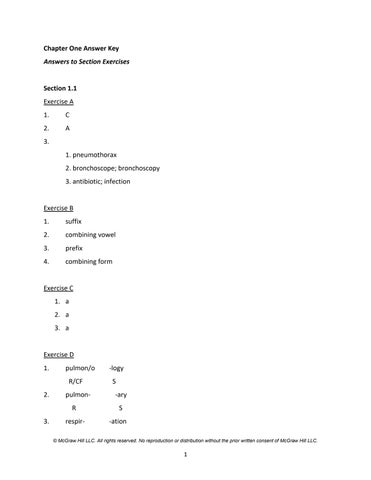
Chapter One Answer Key Answers to Section Exercises
Section 1.1 Exercise A 1.
C
2.
A
3. 1. pneumothorax 2. bronchoscope; bronchoscopy 3. antibiotic; infection
Exercise B 1.
suffix
2.
combining vowel
3.
prefix
4.
combining form
Exercise C 1. a 2. a 3. a
Exercise D 1.
2.
3.
pulmon/o
-logy
R/CF
S
pulmon-
-ary
R
S
respir-
-ation
© McGraw Hill LLC. All rights reserved. No reproduction or distribution without the prior written consent of McGraw Hill LLC.
1
4.
R
S
pneumon-
ia
R
S
Exercise E 1.
pneumonitis
pneumon-
- itis
R
S
2.
respiration - process of breathing
3.
-logist
inflammation of the lung
specialist, one who studies
Exercise F 1. Pertaining to birth 2. peri / nat/ al P
R
S
3. post/ nat/ al P
R
S
4. pre/ nat/
al
P
R
S
Exercise G 1.
d
2.
b
Section 1.2 Exercise A 1. cardiology 2. infarction (acute myocardial infarction) 3. b 4. electrocardiogram (ECG/EKG) © McGraw Hill LLC. All rights reserved. No reproduction or distribution without the prior written consent of McGraw Hill LLC.
2
Exercise B
1.
diagnosis (noun)
2.
diagnose
3.
diagnostic (adjective)
4.
diagnoses (plural)
(verb)
Exercise C 1. Dr. Bannerjee is unable to diagnose this patient until he receives the lab results. 2. It is possible for this patient to have multiple diagnoses if there is more than one condition present. 3. The primary diagnosis for this patient is myocardial ischemia. 4. The diagnostic tests have been ordered for this patient first thing in the morning.
Exercise D 1.
mucous
2.
prostate
3.
reflex
4.
ilium
Exercise E 1.
diagnoses
2.
axillae
3.
septa
4.
ganglia
Exercise F 1.
d
2.
b © McGraw Hill LLC. All rights reserved. No reproduction or distribution without the prior written consent of McGraw Hill LLC.
3
Exercise G 1.
vertebrae
2.
neurology
3.
infusion
4.
hypotensive
5.
transfusion
6.
cervical
Exercise H 1.
A medical specialist who studies the urinary system is a urologist.
2.
The term that means high blood pressure is hypertension, and the term that means low blood pressure is hypotension. The difference in these two terms is the prefix. Hypermeans excessive or above normal, and hypo- means deficient or below normal.
3.
ureter
4.
blood
© McGraw Hill LLC. All rights reserved. No reproduction or distribution without the prior written consent of McGraw Hill LLC.
4
Chapter Two Answer Key Answers to Section Exercises
Section 2.1 Exercise A 1. IVF 2. ovaries 3. b
Exercise B (smallest to largest) 1.
a.
atoms
b.
molecules
c.
organelles
d.
cells
e.
tissues
f.
organs
g.
organ systems
h.
organism
Exercise C 1.
The suffix -logy means study of. The suffix that means specialist in the study of is -logist.
2.
A combining form is a root and its associated combining vowel. The combining vowel o makes cyt/o a combining form rather than a root.
3.
The union of a male sperm and a female egg is called fertilization.
4.
The suffix –elle refers to a small size.
5.
A cytologist studies cells. Cyt/o is a root that means cells and –logist is a suffix that means specialist in the study of. © McGraw Hill LLC. All rights reserved. No reproduction or distribution without the prior written consent of McGraw Hill LLC.
1