Chapter One: The Role of Marketing Research
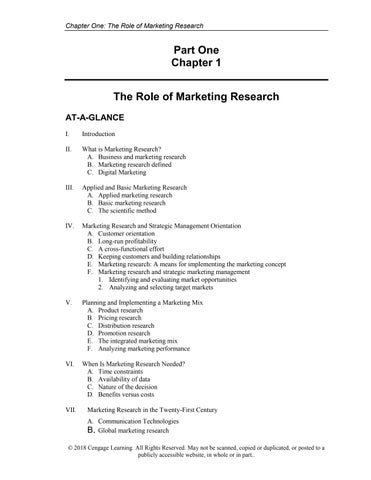
Part One Chapter 1 The Role of Marketing Research AT-A-GLANCE I.
Introduction
II.
What is Marketing Research? A. Business and marketing research B. Marketing research defined C. Digital Marketing
III.
Applied and Basic Marketing Research A. Applied marketing research B. Basic marketing research C. The scientific method
IV.
Marketing Research and Strategic Management Orientation A. Customer orientation B. Long-run profitability C. A cross-functional effort D. Keeping customers and building relationships E. Marketing research: A means for implementing the marketing concept F. Marketing research and strategic marketing management 1. Identifying and evaluating market opportunities 2. Analyzing and selecting target markets
V.
Planning and Implementing a Marketing Mix A. Product research B. Pricing research C. Distribution research D. Promotion research E. The integrated marketing mix F. Analyzing marketing performance
VI.
When Is Marketing Research Needed? A. Time constraints B. Availability of data C. Nature of the decision D. Benefits versus costs
VII.
Marketing Research in the Twenty-First Century A. Communication Technologies B. Global marketing research
© 2018 Cengage Learning. All Rights Reserved. May not be scanned, copied or duplicated, or posted to a publicly accessible website, in whole or in part..
Chapter One: The Role of Marketing Research
LEARNING OUTCOMES 1. 2. 3. 4. 5. 6.
Know what marketing research is and what it does for business. Understand the difference between basic and applied marketing research. Understand how the role of marketing research changes with the orientation of the firm. Be able to integrate marketing research results into the strategic planning process. Know when marketing research should and should not be conducted. Appreciate the way that technology and internationalization continue to change the way we do and use marketing research.
CHAPTER VIGNETTE: “Look Ma, No Hands” What is the future of the automobile. Uber, General Motors, Baidu, Didi, and others are betting on a future where autonomous vehicles (AVs) make hands-off driving a reality. For generations of Americans, a love affair with the automobile grew out of the sense of freedom that the car driving experience embodied. Driving the car meant going where you want to go, when you want to go, the way you want to go. The future of the AV will depend heavily on marketing research. Firms are investing in the technology because they see the potential for sales. Certainly, many consumers may be attracted initially by the added convenience of being able to go places while tending to other tasks like reading news or checking social media. But market research will reveal the deeper motives. This vignette clearly illustrates the importance of e marketing research to understand what consumers want in an automobile.
RESEARCH IN ACTION This feature allows students to better understand the researcher‘s job in determining what information is needed so that data can be analyzed and become an intelligent source of information. This first interaction with the ―RESEARCH IN ACTION‖ feature is to understand the initial stage of research and the critical questions which must be answered.
RESEARCH SNAPSHOT Do Consumers Want the Real Joe? Marketing creates value by providing solutions and creating experiences. Providing a solution is associated with utilitarian value while hedonic value results from rewarding experiences. Today, lots of experts espouse consumers‘ search for ―authenticity,‖ but sometimes authenticity butts heads with value creation. In the coffee example, ―authentic‖ coffee comes with its own costs. Engaged to a Robot, I Do or I Don’t? Marketing research feeds artificial intelligence (AI) systems, which in turn, model consumers‘ behavior. Survey research suggests that consumers are skeptical of AI. The move to technology like chatbots may be premature.
© 2018 Cengage Learning. All Rights Reserved. May not be scanned, copied or duplicated, or posted to a publicly accessible website, in whole or in part..
Chapter One: The Role of Marketing Research
When the Nudge Is Gone! Lots of marketing managers today are excited by the idea of nudge marketing. Instead of trying to convince a consumer to use a product, just give them a nudge. A nudge is a psychological push that encourages a certain type of behavior. An example like Blue Apron shows that a nudge must be backed up with a unified message and follow through..
TIPS OF THE TRADE Throughout the text, a Tips of the Trade section is provided to give hints for using and doing marketing research. Here is a summary of this chapter‘s tips:
Customers and employees are valuable sources for input. Business problems ultimately boil down to information problems. Research plays a role before, during, and after key marketing decisions. Research that costs more than it can ever return should not be conducted. Researchers must stay in touch with changes in media technology.
OUTLINE I.
INTRODUCTION A. The firm needs to be in touch with the marketplace overall and with consumers, both its current and potential customers. B. Marketing research plays a vital role in firm success by keeping the firm in touch. C. Staying in touch also means sifting through the profusion of data that exists today to identify actionable intelligence that assists the firm in making better decisions.
II.
WHAT IS MARKETING RESEARCH? A. Business and Marketing Research 1. Companies need to produce benefits that people want to buy, and successful companies must understand the bundle of benefits consumers need. Answering several key questions help provide this understanding: a. What do we sell? – This includes not only the benefits that are easily seen, but also the more emotional benefits. b. How do consumers view our company? – All too often, companies define themselves too narrowly based only on the physical product they sell. Who will the customer do business with if they do not choose your company? c. What does our company/product mean? – What knowledge do people have of the company and its products? d. What do consumers desire? – How can the company make the lives of its customers better, and how can it do this in a way that is not easily duplicated by another firm? e. How does our brand touch consumers? - Does the company understand all the various touchpoints with its current customers and with potential customers?
© 2018 Cengage Learning. All Rights Reserved. May not be scanned, copied or duplicated, or posted to a publicly accessible website, in whole or in part..
Chapter One: The Role of Marketing Research 2. Answering these questions requires information, and marketing research‘s function is supplying that information. With useful information, decisions can be made with less risk. 3. The emphasis of marketing research is to shift decision makers from intuitive information gathering to systematic and objective investigating. B. Marketing Research Defined 1. Marketing research is the application of the scientific method in searching for the truth about marketing phenomena. 2. The process includes: a. Idea and theory development b. Problem definition c. Information gathering d. Analyzing data e. Communicating the findings and their implications 3. This definition suggests that marketing research: a. information is not intuitive or haphazardly gathered b. is accurate and objective, using the scientific method c. is relevant to all aspects of the marketing mix d. is limited by one‘s definition of marketing C. Digital Marketing 1. Digital marketing is a term used to capture all the various electronic, communicative technologies through which marketing enterprises (suppliers, manufacturers, retailers, etc.) work together with customers toward enhancing value from interaction, including exchange and relationships. 2. Today, so-called smart technologies (phones, tablets, computers) are ubiquitous enabling not only online purchases to be recorded, but app usage, search behavior, and a consumer‘s whereabouts all become potentially useful data. 3. Marketing research programs digital technologies to collect information and that information feeds back into marketing research as consumers use various devices and applications. III.
APPLIED AND BASIC MARKETING RESEARCH A. Applied Marketing Research 1. Applied marketing research is conducted to address a specific marketing decision for a specific firm or organization. B. Basic Marketing Research 1. Basic marketing research is conducted without a specific decision in mind and it usually does not address the needs of a specific organization. 2. It attempts to expand the limits of marketing knowledge in general, and as such it is not aimed at solving a particular pragmatic problem. C. The two types of research are not completely independent. 1. Some reserve the term marketing research to refer to basic research and the term market research to capture applied research addressing the needs of a firm within a particular market. 2. However, there are very few aspects of research that apply to only basic or only applied research. 3. This text uses the term marketing research more generally to refer to either type of research. D. The Scientific Method 1. All marketing research, whether basic or applied, involves the scientific method.
© 2018 Cengage Learning. All Rights Reserved. May not be scanned, copied or duplicated, or posted to a publicly accessible website, in whole or in part..
Chapter One: The Role of Marketing Research 2. The scientific method is the way researchers go about using knowledge and evidence to reach objective conclusions about the real world. 3. The method involves developing hypotheses and testing them against empirical evidence (facts from observation or experimentation). From these results, new knowledge is acquired. 4. Its use in basic research leads to inferences and conclusions about phenomena and leads to the establishment of general laws. 5. Its use in applied research ensures objectivity in gathering facts and testing creative ideas for alternative marketing strategies. IV.
MARKETING RESEARCH AND STRATEGIC MANAGEMENT ORIENTATION A. In all of business strategy, there are only a few business orientations: 1. Product-oriented – the firm prioritizes decision making in a way that emphasizes technical superiority in the product. Research is not a priority. 2. Production-oriented – the firm prioritizes efficiency and effectiveness of the production processes in making decisions (i.e., to drive costs down). Research is not a priority. 3. Marketing-oriented – the firm follows the marketing concept, which focuses on how the firm provides value to customers more than on the physical product or production process. B. Developing a marketing orientation calls on management to: 1. Be customer-oriented. 2. Emphasize long-run profitability rather than short-term profits or sales volume. 3. Adopt a cross-functional perspective. a. A stakeholder orientation recognizes that multiple parties are affected by a firm‘s decisions. C. Customer Orientation 1. The consumer should be the primary focus of attention. 2. The firm creates products and services with consumers‘ needs in mind. 3. The creation of value for consumers is the justification for a firm‘s existence. 4. Marketing research addressing consumer desires, beliefs, and attitudes is essential. 5. Although technology firms are usually thought of as product-oriented, that view is changing to a customer orientation. D. Long-Run Profitability 1. Implicit in the marketing concept is the assumption of the continuity of the firm. 2. One way to ensure long-run profitability is to utilize online sentiment analysis, which allows researchers to use data to indicate the total positive or negative mentions of a brand on the Internet. 3. Another aspect of long-run profitability argues against profitless volume or sales volume for the sake of volume alone. E. A Cross-Functional Effort 1. Marketing personnel do not work in a vacuum – actions of people in other areas (i.e., production, credit, and R&D) may affect marketing efforts, and the work of marketers will affect activities in other departments. 2. Problems occur when the marketing department views focusing on consumer needs as its sole responsibility. 3. It is vital that management conducts marketing research, that researchers produce valid and reliable results, and that those results be communicated to decision makers.
© 2018 Cengage Learning. All Rights Reserved. May not be scanned, copied or duplicated, or posted to a publicly accessible website, in whole or in part..