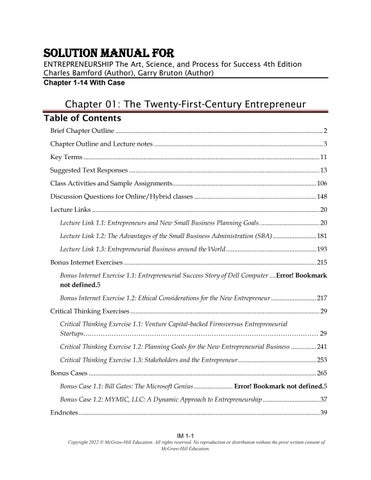
Solution Manual For ENTREPRENEURSHIP The Art, Science, and Process for Success 4th Edition Charles Bamford (Author), Garry Bruton (Author) Chapter 1-14 With Case
Chapter 01: The Twenty-First-Century Entrepreneur Table of Contents Brief Chapter Outline ............................................................................................................................ 2 Chapter Outline and Lecture notes ..................................................................................................... 3 Key Terms ............................................................................................................................................. 11 Suggested Text Responses .................................................................................................................. 13 Class Activities and Sample Assignments...................................................................................... 106 Discussion Questions for Online/Hybrid classes ......................................................................... 148 Lecture Links ........................................................................................................................................ 20 Lecture Link 1.1: Entrepreneurs and New Small Business Planning Goals. ................................... 20 Lecture Link 1.2: The Advantages of the Small Business Administration (SBA) .......................... 181 Lecture Link 1.3: Entrepreneurial Business around the World ...................................................... 193 Bonus Internet Exercises ................................................................................................................... 215 Bonus Internet Exercise 1.1: Entrepreneurial Success Story of Dell Computer ....Error! Bookmark not defined.5 Bonus Internet Exercise 1.2: Ethical Considerations for the New Entrepreneur ........................... 217 Critical Thinking Exercises ................................................................................................................. 29 Critical Thinking Exercise 1.1: Venture Capital-backed Firmsversus Entrepreneurial Startups….………………………………………………………………………………………… 29 Critical Thinking Exercise 1.2: Planning Goals for the New Entrepreneurial Business ............... 241 Critical Thinking Exercise 1.3: Stakeholders and the Entrepreneur............................................... 253 Bonus Cases ........................................................................................................................................ 265 Bonus Case 1.1: Bill Gates: The Microsoft Genius ....................... Error! Bookmark not defined.5 Bonus Case 1.2: MYMIC, LLC: A Dynamic Approach to Entrepreneurship .................................. 37 Endnotes ................................................................................................................................................ 39
IM 1-1 Copyright 2022 © McGraw-Hill Education. All rights reserved. No reproduction or distribution without the prior written consent of McGraw-Hill Education.
Brief Chapter Outline I.
Learning Objectives
LO 01-01: Explain the rationale behind starting an entrepreneurial business. LO 01-02: Discuss the history of entrepreneurship in the United States. LO 01-03: Identify the type of people who are entrepreneurs. LO 01-04: Describe the impact of entrepreneurial businesses on society. LO 01-05: Discuss the worldwide impact of entrepreneurial businesses. LO 01-06: Define an entrepreneurial business.
II.
Why Start a Business? Learning Objective 01-01: Explain the rationale behind starting an entrepreneurial business. Key Terms: United States Small Business Administration (SBA); Fortune 500 Economies of scale Opening vignette – Ancestry.com
III.
A Brief History of Entrepreneurial Businesses in the United States Learning Objective 01-02: Discuss the history of entrepreneurship in the United States. Figure 1.1 – Business Time Line
IV.
Who are entrepreneurial business owners today? Learning Objective 01-03: Identify the type of people who are entrepreneurs. Key Terms: Stakeholders Exercise 1
V.
How does society benefit? Learning Objective 01-04: Describe the impact of entrepreneurial businesses on society. Ethical Challenge inset
VI.
Entrepreneurship around the world. Learning Objective 01-05: Discuss the worldwide impact of entrepreneurial businesses. Exercise 2 IM 1-2 Copyright 2022 © McGraw-Hill Education. All rights reserved. No reproduction or distribution without the prior written consent of McGraw-Hill Education.
VII.
What is an entrepreneurial business? Learning Objective 01-06: Define an entrepreneurial business. Key Terms: Harvest plan A. Business Plans—Another Difference in Types of Firms Figure 1.2—One-Page Pitch Sheet B. Lean Startup
VIII.
Summary
Chapter Outline and Lecture notes I.
Learning Objectives
II.
LO 01-01: Explain the rationale behind starting an entrepreneurial business. LO 01-02: Discuss the history of entrepreneurship in the United States. LO 01-03: Identify the type of people who are entrepreneurs. LO 01-04: Describe the impact of entrepreneurial businesses on society. LO 01-05: Discuss the worldwide impact of entrepreneurial businesses. LO 01-06: Define entrepreneurial business.
Why Start a Business? Learning Objective 01-01: Explain the rationale behind starting an entrepreneurial business. There is great potential for entrepreneurial businesses to provide positive outcomes in the communities they serve • The United States Small Business Administration (SBA) provides assistance for current and potential small business owners o New business start-up assistance o Continued business support o Business development •
The development of an entrepreneurial business stimulates the United States economy o Small businesses created 9.6 million net new jobs from 2000 to 2018 o For the same period, large businesses were responsible for just 5.2 million net new jobs IM 1-3
Copyright 2022 © McGraw-Hill Education. All rights reserved. No reproduction or distribution without the prior written consent of McGraw-Hill Education.
•
Many entrepreneurial businesses have the potential to become larger profitable businesses o Every Fortune 500 company started as a new venture o Discuss historical companies that experienced unexpected growth (Apple is one example for students to discuss) o Small businesses are the foundation for all businesses
•
Historically, small businesses have proven success rates o Individuals and groups that initiate their own business have the potential to become successful entrepreneurs Individuals become independent when they achieve entrepreneurial status
•
III.
•
Compare and contrast the characteristics of small and large businesses o New businesses are free to put all their energy into satisfying customer‘s needs o Large firms experience economies of scale because they have lower long-range average cost as their production continues to increase o Small businesses are more efficient because they respond more quickly to market changes compared to larger organizations
•
Business Plan Development o The implementation of business plans are a combination of art and science o Many new businesses fail o Elements that an entrepreneur must solve for success: Effective sales generation model Sustainable operating profit margins. Being properly financed.
A brief history of entrepreneurial businesses in the United States Learning Objective 01-02: Discuss the history of entrepreneurship in the United States. Small businesses have existed in our society for many years • Prior to the 1880s the majority of businesses were small ventures • The development of industry occurred after 1880 in the U.S. IM 1-4 Copyright 2022 © McGraw-Hill Education. All rights reserved. No reproduction or distribution without the prior written consent of McGraw-Hill Education.
o Robber barons developed o They took advantage of economies of scale possible in the industrial age – Carnegie dominated the steel industry o New small businesses continued to thrive to serve the needs of new industrial sectors •
The Great Depression of the 1930s led to industrial concentration o The outcome was that entrepreneurial business as a percentage of U.S. economic output began to decline o It was believed that what was good for big business would be good for all of the people in the country
•
Decline in large industries in the 1970s and 1980s o Economic turmoil due to global competition o There was a decline in entire industries, such as steel and auto manufacturing o Japan gained a competitive advantage an dominated an economic position in the markets o There was a decline in large multinational firms o New opportunities were advantageous for entrepreneurial businesses.
Today, startups are responsible for much of the innovation pushing established companies to new levels • Figure 1.1 shows a business time line in the U.S., highlighting the central role of new business development IV.
Who are entrepreneurial business owners today? Learning Objective 01-03: Identify the type of people who are entrepreneurs Entrepreneurs have common motivations to initiate entrepreneurial businesses • Entrepreneurs want to be their own boss • Individuals experience increased personal rewards and self fulfillment from entrepreneurship • It is common for entrepreneurs to gain greater financial rewards as a result of small business ownership Stakeholders are known as individuals and groups that have a stake in the performance outcome of an organization IM 1-5 Copyright 2022 © McGraw-Hill Education. All rights reserved. No reproduction or distribution without the prior written consent of McGraw-Hill Education.