Solution Manual For Electrocardiography for Healthcare Professionals 6e By Kathryn A. Booth, Thomas Edward O'Brien Chapter 1-15
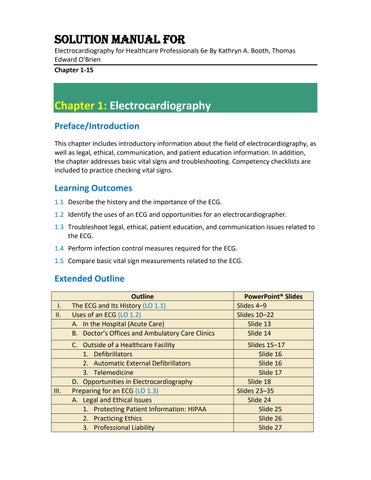
Chapter 1: Electrocardiography Preface/Introduction This chapter includes introductory information about the field of electrocardiography, as well as legal, ethical, communication, and patient education information. In addition, the chapter addresses basic vital signs and troubleshooting. Competency checklists are included to practice checking vital signs.
Learning Outcomes 1.1 Describe the history and the importance of the ECG. 1.2 Identify the uses of an ECG and opportunities for an electrocardiographer. 1.3 Troubleshoot legal, ethical, patient education, and communication issues related to the ECG. 1.4 Perform infection control measures required for the ECG. 1.5 Compare basic vital sign measurements related to the ECG.
Extended Outline I. II.
III.
Outline The ECG and Its History (LO 1.1) Uses of an ECG (LO 1.2) A. In the Hospital (Acute Care) B. Doctor’s Offices and Ambulatory Care Clinics
PowerPoint® Slides Slides 4–9 Slides 10–22 Slide 13 Slide 14
C. Outside of a Healthcare Facility 1. Defibrillators 2. Automatic External Defibrillators 3. Telemedicine D. Opportunities in Electrocardiography Preparing for an ECG (LO 1.3) A. Legal and Ethical Issues 1. Protecting Patient Information: HIPAA 2. Practicing Ethics 3. Professional Liability
Slides 15–17 Slide 16 Slide 16 Slide 17 Slide 18 Slides 23–35 Slide 24 Slide 25 Slide 26 Slide 27
IV.
V.
Outline 4. Slander and Libel 5. Documentation 6. Consent B. Patient Education and Communication Infection Control (LO 1.4) A. Standard Precautions B. Isolation Precautions Vital Signs (LO 1.5) A. Pulse and Respiration 1. Pulse 2. Respiration B. Blood Pressure 1. Factors Affecting Blood Pressure C. Measuring Blood Pressure
PowerPoint® Slides Slide 28 Slide 29 Slide 30 Slide 31 Slides 36–43 Slides 37–38 Slide 39 Slides 44–54 Slide 45–47 Slide 46 Slide 47 Slides 48–50 Slide 49 Slide 50
Teaching Strategies Introduce students to “Electrocardiography” using the following techniques: 1. Have students discuss why they are taking the program and why they think ECG will be necessary for their career objective. 2. Have students visit a clinic, hospital, or outpatient area to discuss with healthcare professionals how ECGs are utilized in their area. 3. Present a variety of equipment that has changed over the last 10 years, such as defibrillators and pacemakers. With the presentation, have students discuss how technology advancements have changed the practice. Examples may include: technology of mobile phones have allowed ECGs to be electronically transmitted to a physician’s computer/phone from the back of an ambulance. 4. Encourage students to discuss their personal stories about how heart disease has affected them, their family, or someone they know. With this discussion, identify the risk factors for heart disease and stroke and ways to prevent them. Suggest identifying differences due to gender or cultural background and how to prevent heart diseases. 5. Have students identify different locations where AEDs (automatic external defibrillators) are used. 6. Relate the importance of and responsibility for performing accurate diagnostic tests. Suggest that students personalize the concept by stressing that they would expect accurate test results for themselves, a friend, or a significant other. 7. Have students compare and contrast the roles of various healthcare professionals with regard to EGCs. 8. Have students discuss the purpose of ECGs, including common pathology for this test. 9. Emphasize the importance of infection control through hand hygiene, precautions, and use of personal protective equipment.
10. Discuss the necessity of being cognizant of legal and ethical issues, including HIPAA, practicing ethics, liability, slander, obtaining consent, and accurate documentation in the medical record.
In-Class Activities
Encourage students to complete the Checkpoint Questions throughout the chapter and check their answers. You can use the Checkpoint Questions as practice by providing the answer key, or as a graded assignment. They can also work on Checkpoint Questions in small groups for reporting out or group discussion. Have students working on Troubleshooting sections in groups and report the responses out to the class for discussion. Provide scenarios for students to role-play in a variety of situations, such as obtaining consent, communicating appropriately with patients and other healthcare professionals, and documentation. Facilitate group discussions in class on various topics, such as legal and ethical considerations, the role of EGCs in healthcare, the importance of HIPAA, preventing the transmission of infection during ECG testing, troubleshooting, the relevance and purpose of vital signs, and communication with patients. Use the PowerPoint® presentation for Chapter 1 for a class lecture and/or review. Use the Apply Your Knowledge questions for discussion. Have students complete and check the Chapter Review questions in preparation for the final chapter evaluation. Have students complete Connect and LearnSmart assignments. These can be assigned as practice opportunities or graded work for submission.
Assessment
Using the test bank for Chapter 1, create a written test in two versions for a final evaluation of student proficiency. Have students complete LearnSmart and Connect activities, as assigned. Create a Chapter 1 test or quiz in Connect to evaluate student proficiency. Have students write and submit a reflection of key concepts for Chapter 1. Submission can also be via an uploaded assignment through Connect.
Answer Key Checkpoint Questions/Think It Through LO 1.1
Checkpoint Questions 1. Cardiovascular disease 2. Willem Einthoven LO 1.2 Think It Through: Remain Calm Say: “The physician would like me to do a recording of your heart.” Do not show signs of fear or anxiety. Remain calm during the procedure.
Checkpoint Questions 1. Sudden cardiac arrest caused by ventricular tachycardia and ventricular fibrillation. 2. Records the ECG tracing, determines if the ECG tracing is accurate and without abnormalities caused by interference during the recording procedure, and prepares the tracing for the physician’s interpretation. LO 1.3 Think It Through: Obtaining Consent A family member, legal representative, or witness, but the patient should write an X if possible.
Checkpoint Question 1. Answers will vary; an example is provided here. Step 1: Identify and define the problem: You have been assigned to perform an ECG, and the patient refuses. Step 2: Identify possible solutions: a. Do not perform the ECG. b. Insist that the patient allow you to perform the ECG. c. Report the patient to your supervisor. d. Question the patient as to why she does not want the ECG and attempt to gain her cooperation. Step 3: Select the best solution: d. Question the patient as to why she does not want the ECG and attempt to remove her objection. Step 4: Implement the selected solution: You question the patient, and she feels uncomfortable about lying exposed on the table during the procedure. You tell her you will cover her and maintain her privacy to the best of your ability. Step 5: Evaluate the results: The patient allows you to perform the ECG, so the problem is solved.
Step 6: There is no need to return to step 2 because the problem is solved. LO 1.4
Checkpoint Questions 1. Follow standard precautions and, when necessary, the appropriate isolation precautions. 2. Airborne precautions require special air handling, ventilation, and HEPA or N95 respirator; Droplet precautions requires goggles and masks; Contact precautions require gloves and gowns. LO 1.5
Checkpoint Questions 1. Pulse, respirations, and blood pressure. 2. Palpated blood pressure is performed by applying the blood pressure cuff to the patient's arm, then placing the fingers on the radial pulse point and inflating the blood pressure cuff. When the pulse disappears, you continue to inflate the cuff an additional 30 mm/Hg, then begin to deflate the cuff slowly in 5mm intervals. When the pulse returns it is an approximation of the systolic blood pressure. Auscultated blood pressure is determined using a stethoscope and provides a more accurate systolic and diastolic blood pressure reading.
Chapter Review Matching 1. 2. 3. 4. 5. 6. 7. 8.
f (LO 1.1) b (LO 1.1) d (LO 1.1) h (LO 1.4) a (LO 1.1) g (LO 1.2) e (LO 1.2) c (LO 1.4)
True/False 9. 10. 11. 12.
(LO 1.1) True. (LO 1.4) True. (LO 1.3) False; slander is the act of making derogatory remarks about someone. (LO 1.2) False; digital monitoring transmits an ECG over the Internet. (OR: A transtelephonic monitor transmits an ECG over the telephone.)