Circuit Variables
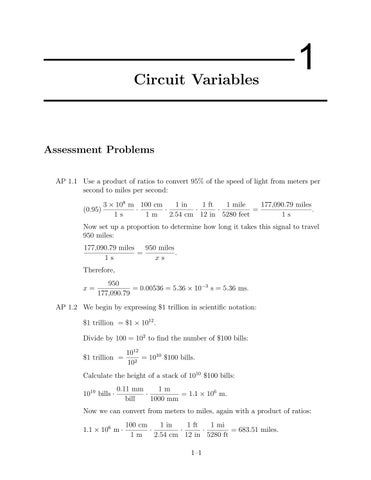
Assessment Problems AP 1.1 Use a product of ratios to convert 95% of the speed of light from meters per second to miles per second: (0.95)
1 in 1 ft 1 mile 177,090.79 miles 3 × 10⁸ m 100 cm · · · · = . 1s 1m 2.54 cm 12 in 5280 feet 1s
Now set up a proportion to determine how long it takes this signal to travel 950 miles: 177,090.79 miles 950 miles = . 1s xs Therefore, x=
950 = 0.00536 = 5.36 × 10⁻³ s = 5.36 ms. 177,090.79
AP 1.2 We begin by expressing $1 trillion in scientific notation: $1 trillion = $1 × 10¹² . Divide by 100 = 102 to find the number of $100 bills: $1 trillion =
1012 = 1010 $100 bills. 102
Calculate the height of a stack of 1010 $100 bills: 1010 bills ·
0.11 mm 1m · = 1.1 × 10⁶ m. bill 1000 mm
Now we can convert from meters to miles, again with a product of ratios: 1.1 × 106 m ·
100 cm 1 in 1 ft 1 mi · · · = 683.51 miles. 1m 2.54 cm 12 in 5280 ft 1–1
1–2
CHAPTER 1. Circuit Variables
AP 1.3 [a] First we use Eq. (1.2) to relate current and charge: i=
dq = 0.25te−2000t . dt
Therefore, dq = 0.25te−2000t dt. To find the charge, we can integrate both sides of the last equation. Note that we substitute x for q on the left side of the integral, and y for t on the right side of the integral: Z q(t) q(0)
dx = 0.25
Z t
ye−2000y dy.
0
We solve the integral and make the substitutions for the limits of the integral: t
e−2000y q(t) − q(0) = 0.25 (−2000y − 1) (−2000)2 0 = 62.5 × 10⁻⁹ e−2000t (−2000t − 1) + 62.5 × 10−9 = 62.5 × 10⁻⁹ (1 − 2000te−2000t − e−2000t ). But q(0) = 0 by hypothesis, so q(t) = 62.5(1 − 2000te−2000t − e−2000t ) nC. [b] q(0.001) = (62.5)[1 − 2000(0.001)e−2000(0.001) − e−2000(0.001) ] = 37.12 nC. AP 1.4 n =
75 × 10−6 C/s = 4.681 × 10¹⁴ elec/s. 1.6022 × 10⁻¹⁹ C/elec
AP 1.5 Start by drawing a picture of the circuit described in the problem statement:
Also sketch the four figures from Fig. 1.6:
Problems
1–3
[a] Now we have to match the voltage and current shown in the first figure with the polarities shown in Fig. 1.6. Remember that 250 mA of current entering Terminal 2 is the same as 250 mA of current leaving Terminal 1. We get (a) v = 50 V,
i = −0.25 A;
(b) v = 50 V,
(c) v = −50 V,
i = −0.25 A;
(d) v = −50 V,
i = 0.25 A; i = 0.25 A.
[b] Using the reference system in Fig. 1.6(a) and the passive sign convention, p = vi = (50)(−0.25) = −12.5 W. [c] Since the power is less than 0, the box is delivering power. AP 1.6 p = vi;
w=
Z t
p dx.
0
Since the energy is the area under the power vs. time plot, let us plot p vs. t.
Note that in constructing the plot above, we used the fact that 60 hr = 216,000 s = 216 ks. p(0) = (6)(15 × 10−3 ) = 90 × 10−3 W; p(216 ks) = (4)(15 × 10−3 ) = 60 × 10−3 W; 1 w = (60 × 10−3 )(216 × 103 ) + (90 × 10−3 − 60 × 10−3 )(216 × 103 ) = 16,200 J. 2 AP 1.7 [a] p = vi = (15e−250t )(0.04e−250t ) = 0.6e−500t W; p(0.01) = 0.6e−500(0.01) = 0.6e−5 = 0.00404 = 4.04 mW. [b] wtotal =
Z ∞ 0
p(x) dx =
Z ∞ 0
0.6e−500x dx =
0.6 −500x ∞ e −500 0
= −0.0012(e∞ − e0 ) = 0.0012 = 1.2 mJ.
1–4
CHAPTER 1. Circuit Variables
Chapter Problems P 1.1
[a] Use a product of ratios to convert 40,075 km to inches: 1000 m 100 cm 1 in · · = 1,577,755,905.5 in. 1 km 1m 2.54 cm Now calculate the number of $20 bills this distance represents:
40,075 km ·
Number of bills =
1,577,755,905.5 in = 256,963,502.5 ≈ 256,963,503. 6.14 in/bill
The total dollar amount represented by this number of $20 bills is Total dollars = (256,963,503)($20) ≈ $5.14 billion. [b] The weight of the number of bills calculated in part (a) is (256,963,503)(1 g) = 256,963.5 kg. Use a product of ratios to convert kg to tons: 1 ton 2.2 lbs · = 282.66 tons. 256,963.5 kg · 1 kg 2000 lbs P 1.2
1s = 10.48 s. 50 × 106 bits 1s = 262 ms. [b] 8(65.5 × 10⁶ ) bits · 2 × 109 bits 1s [c] 8(74 × 1012 ) bits · = 11.84 × 10⁶ s 6 50 × 10 bits [a] 8(65.5 × 10⁶ ) bits ·
11.84 × 106 s ·
1 hr 1 day 1 min · · = 137 days! 60 s 60 min 24 hr
[d] 8(74 × 1012 ) bits · 296 × 103 s · P 1.3
1s = 296 × 103 s. 2 × 109 bits
1 min 1 hr 1 day · · = 3.4 days. 60 s 60 min 24 hr
[a] To begin, we calculate the number of pixels that make up the display: npixels = (1920)(1080) = 2,073,600 pixels. Each pixel requires 24 bits of information. Since 8 bits equal one byte, each pixel requires 3 bytes of information. We can calculate the number of bytes of information required for the display by multiplying the number of pixels in the display by 3 bytes per pixel: nbytes =
2,073,600 pixels 3 bytes · = 6,220,800 bytes/display. 1 display 1 pixel
Problems
1–5
Finally, we use the fact that there are 106 bytes per MB: 1 MB 6,220,800 bytes · 6 = 6.22 MB/display. 1 display 10 bytes 6,220,800 bytes 8 bits · = 4.98 Gbps. 10 ms 1 byte [c] Convert the dimensions of the monitor from inches to mm:
[b]
24 in ·
25.4 mm = 609.6 mm. 1 in
14 in ·
25.4 mm = 355.6 mm. 1 in
Calculate the area of the monitor in mm2 : Screen area = (609.6)(355.6) = 126,773.76 mm2 . Divide the area of the monitor by the number of pixels in the monitor to find the area of an indiviual pixel: 126,773.76 mm2 = 0.1045 mm2 /pixel. 2,073,600 pixels P 1.4
(1024)(600) pixels 3 bytes 60 frames · · = 110,592 × 103 bytes/sec; 1 frame 1 pixel 1 sec (110,592 × 103 bytes/sec)(x secs) = 128 × 109 bytes; x=
128 × 109 = 1157 sec = 19.3 min of video. 110,592 × 103
P 1.5
(0.8)(5.4 × 10⁶ )(1.5 × 10³ ) + (0.9)(1.4 × 10⁶ )(45 × 103 ) = 63.18 GWh. 109
P 1.6
[a] (0.6)(64 kWh) · 240 km · [b] 200 mi ·
100 km = 240 km; 16 kWh
0.62 mi = 148.8 mi. 1 km
1 km = 322.58 km; 0.62 mi
100 km 322.58 km = 16 kWh x kWh
so x =
51.61 kWh (100) ≈ 81%. 64 kWh
322.58(16) = 51.61 kWh. 100