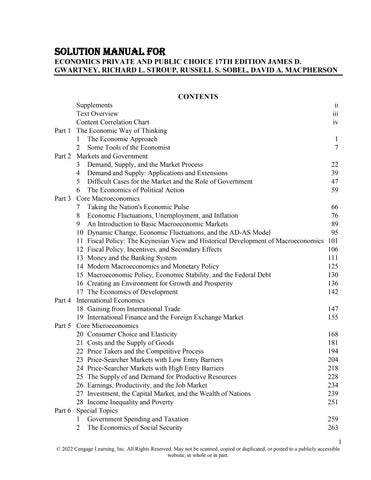
SOLUTION MANUAL FOR ECONOMICS PRIVATE AND PUBLIC CHOICE 17TH EDITION JAMES D. GWARTNEY, RICHARD L. STROUP, RUSSELL S. SOBEL, DAVID A. MACPHERSON
CONTENTS
Part 1
Part 2
Part 3
Part 4
Part 5
Part 6
Supplements ii Text Overview iii Content Correlation Chart iv The Economic Way of Thinking 1 The Economic Approach 1 2 Some Tools of the Economist 7 Markets and Government 3 Demand, Supply, and the Market Process 22 4 Demand and Supply: Applications and Extensions 39 5 Difficult Cases for the Market and the Role of Government 47 6 The Economics of Political Action 59 Core Macroeconomics 7 Taking the Nation's Economic Pulse 66 8 Economic Fluctuations, Unemployment, and Inflation 76 9 An Introduction to Basic Macroeconomic Markets 89 10 Dynamic Change, Economic Fluctuations, and the AD-AS Model 95 11 Fiscal Policy: The Keynesian View and Historical Development of Macroeconomics 101 12 Fiscal Policy, Incentives, and Secondary Effects 106 13 Money and the Banking System 111 14 Modern Macroeconomics and Monetary Policy 125 15 Macroeconomic Policy, Economic Stability, and the Federal Debt 130 16 Creating an Environment for Growth and Prosperity 136 17 The Economics of Development 142 International Economics 18 Gaining from International Trade 147 19 International Finance and the Foreign Exchange Market 155 Core Microeconomics 20 Consumer Choice and Elasticity 168 21 Costs and the Supply of Goods 181 22 Price Takers and the Competitive Process 194 23 Price-Searcher Markets with Low Entry Barriers 204 24 Price-Searcher Markets with High Entry Barriers 218 25 The Supply of and Demand for Productive Resources 228 26 Earnings, Productivity, and the Job Market 234 27 Investment, the Capital Market, and the Wealth of Nations 239 28 Income Inequality and Poverty 251 Special Topics 1 Government Spending and Taxation 259 2 The Economics of Social Security 263 1
© 2022 Cengage Learning, Inc. All Rights Reserved. May not be scanned, copied or duplicated, or posted to a publicly accessible website, in whole or in part.
2 Chapter 1/The Economic Approach
3
The Stock Market: Its Function, Performance, and Potential as an Investment Opportunity 4 Keynes and Hayek: Contrasting Views on Sound Economics and the Role of Government 5 The 2020 COVID-19 Recession: Cause, Response, and Implications for the Future 6 The Great Recession of 2008–2009: Causes and Response 7 Lessons from the Great Depression 8 The Economics of Health Care 9 Earnings Differences between Men and Women 10 Do Labor Unions Increase the Wages of Workers? 11 The Question of Resource Exhaustion 12 Difficult Environmental Cases and the Role of Government
267 270 272 275 279 284 288 290 294 297
SUPPLEMENTS A full set of supplements accompanies the text. They include the following: MindTap MindTap is a fully online, highly personalized learning experience built on Cengage Learning content. MindTap combines student learning tools--readings, multimedia, activities, and assessments--into a singular Learning Path that guides students through their course. Instructors personalize the experience by customizing authoritative Cengage Learning content and learning tools, including the ability to add their own content in the Learning Path via apps that integrate into the MindTap framework seamlessly with Learning Management Systems. Interactive eBook In addition to interactive teaching and learning tools, Economic MindTap includes an interactive eBook. Students can take notes, highlight, search, and interact with embedded media specific to their book. Use it as a supplement to the printed text or as a substitute—with MindTap, the choice is up to your students. Test Banks The test banks for the 17th edition were prepared by the author team with the assistance of Shannon Aucoin and other members of Cengage‘s excellent team of subject matter experts. The authors have worked hard to update and improve the test banks for this edition. Joe Calhoun of Florida State University was the primary author of the test bank for the last edition and the current version is reflective of this excellent work. The three test banks contain approximately 6,000 questions—multiple choice and short answer. Within each chapter, the questions are tied to the major heads and specific topics within the chapter. Instructors who want to motivate their students to study will find online practice quizzes on MindTap that can easily be incorporated into their quizzes and exams. The cloud-based test banks for this edition have been enhanced significantly. Cognero contains all of the questions in the test bank so that you can create and customize tests in minutes. You can easily edit and import your own questions and graphics and edit and maneuver existing questions.
Chapter 1/The Economic Approach 3
PowerPoint We believe our PowerPoint presentation, prepared by Joseph Connors of Florida Southern University, is the best you will find in the principles market. The presentation includes chapterby-chapter lecture notes with fully animated, hyperlinked slides of the textbook‘s exhibits. Its dynamic graphs and accompanying captions make it easy for instructors to present (and students to follow) sequential changes. The graphs are also used to highlight various relationships among economic variables. To facilitate classroom discussion and interaction, questions are strategically interspersed throughout the PowerPoint slides to help students develop the economic way of thinking. Instructions explaining how professors can easily add, delete, and modify slides in order to tailor the presentation to their liking are included. If instructors want to make the PowerPoint presentation available to students, they can place it on their website (or the site for their course). TEXT OVERVIEW Each chapter starts with an outline of the text. Second, a list of Focus Questions, a Context section that covers the important points of each chapter, and a section with tips on how best to use the text and supplementary materials are included. Third, possible answers (or approaches) to many of the Critical Analysis questions that are not answered in Appendix B of the text are included. In some chapters, fun illustrations and games that have been successfully used to communicate economic concepts to students are provided. CONTENT CORRELATION CHART Core
Part/Chapter Title
Macro
Micro
Part 1 1 2 Part 2 3 4 5 6 Part 3 7 8 9 10 11
The Economic Way of Thinking The Economic Approach Some Tools of the Economist Markets and Government Demand, Supply, and the Market Process Demand and Supply: Applications and Extensions Difficult Cases for the Market, and the Role of Government The Economics of Political Action Core Macroeconomics Taking the Nation‘s Economic Pulse Economic Fluctuations, Unemployment, and Inflation An Introduction to Basic Macroeconomic Markets Dynamic Change, Economic Fluctuations, and the AD-AS Model Fiscal Policy: The Keynesian View and the Historical Development of Macroeconomics Fiscal Policy, Incentives, and Secondary Effects Money and the Banking System Modern Macroeconomics and Monetary Policy Macroeconomic Policy, Economic Stability, and the Federal Debt Creating an Environment for Growth and Prosperity The Economics of Development International Economics Gaining from International Trade International Finance and the Foreign Exchange Market Core Microeconomics
Part 1 1 2 Part 2 3 4 5 6 Part 3 7 8 9 10 11
Part 1 1 2 Part 2 3 4 5 6
12 13 14 15 16 17 Part 4 18 19 Part 5
12 13 14 15 16 17 Part 4 18 19
Part 4 16 Part 3
4 Chapter 1/The Economic Approach 20 21 22 23 24 25 26 27 28 Part 6 ST1 ST2 ST3 ST4 ST5 ST6 ST7 ST8 ST9 ST10 ST11 ST12
Consumer Choice and Elasticity Costs and the Supply of Goods Price Takers and the Competitive Process Price-Searcher Markets with Low Entry Barriers Price-Searcher Markets with High Entry Barriers The Supply of and Demand for Productive Resources Earnings, Productivity, and the Job Market Investment, the Capital Market, and the Wealth of Nations Income Inequality and Poverty Applying the Basics: Special Topics in Economics Government Spending and Taxation The Economics of Social Security The Stock Market: Its Function, Performance, and Potential as an Investment Opportunity Keynes and Hayek: Contrasting Views on Sound Economics and the Role of Government The 2020 COVID-19 Recession: Cause, Response, and Implications for the Future The Great Recession of 2008-2009: Causes and Response Lessons from the Great Depression The Economics of Health Care Earnings Differences between Men and Women Do Labor Unions Increase the Wages of Workers? The Question of Resource Exhaustion Difficult Environmental Cases and the Role of Government
Part 5 ST1 ST2 ST3
7 8 9 10 11 12 13 14 15 Part 5 ST1 ST2 ST3
ST4
ST4
ST5 ST6 ST7
ST5 ST6 ST7 ST8 ST9 ST10 ST11 ST12
Chapter 1 The Economic Approach OUTLINE I. What Is Economics About? A. Scarcity means having to make choices. 1. Scarcity and choice are the two essential ingredients of an economic topic. 2. Scarcity is present whenever there is less of a good or resource freely available than people would like. a. Scarce goods are called economic goods. b. Resources are the inputs that people use to produce goods and services and may include human, physical, and natural resources. 3. Scarcity forces us to choose among available alternatives. B. Scarcity and poverty are not the same. 1. Scarcity is a factual concept in which limited resources cause our desires for goods and services to be lacking. 2. Poverty is more subjective in nature; different people have different ideas of what it means to be ―poor.‖ 3. We may someday eliminate poverty, but scarcity will always be with us.
Chapter 1/The Economic Approach 5
C. Scarcity necessitates rationing. 1. Every society must have a method to ration the scarce resources among competing uses. a. Various factors can be used to ration (first-come, first-served). b. In a market setting, price is used to ration goods and resources. c. When price is used, the good or resource is allocated to those willing to give up ―other things‖ in order to obtain ownership rights. D. The method of rationing influences the nature of competition. 1. Competition is a natural outgrowth of the need to ration scarce goods. 2. Changing the rationing method used will change the form of competition, but it will not eliminate competitive tactics. II. The Economic Way of Thinking A. Eight guideposts to economic thinking 1. The use of scarce resources is costly, so decision-makers must make trade-offs. a. Someone must give up something if we are to have more scarce goods. (1) The highest-valued alternative that must be sacrificed is the opportunity cost of the choice. 2. Individuals choose purposefully—they try to get the most from their limited resources. a. Economizing: gaining a specific benefit at the least possible cost. 3. Incentives matter—changes in incentives influence human choices in a predictable way. Both monetary and nonmonetary incentives matter. a. As personal benefits (costs) from choosing an option increase, other things constant, a person will be more (less) likely to choose that option. 4. Individuals make decisions at the margin. a. Decisions will be based on marginal costs and marginal benefits (utility). 5. Although information can help us make better choices, its acquisition is costly.. 6. Beware of the secondary effects: Economic actions often generate indirect as well as direct effects. 7. The value of a good or service is subjective. 8. The test of a theory is its ability to predict. III. Positive and Normative Economics A. Positive economics is the scientific study of ―what is‖ among economic relationships. 1. Positive economic statements can be proved either true or false. a. Ex: The inflation rate rises when the money supply is increased. B. Normative economics are judgments about ―what ought to be‖ in economic matters. 1. Normative statements cannot be proved true or false. a. Ex: The inflation rate should be lower. IV. Pitfalls to Avoid in Economic Thinking A. Violation of the ceteris paribus condition can lead one to draw the wrong conclusion. 1. Ceteris paribus is a Latin term meaning ―other things constant.‖