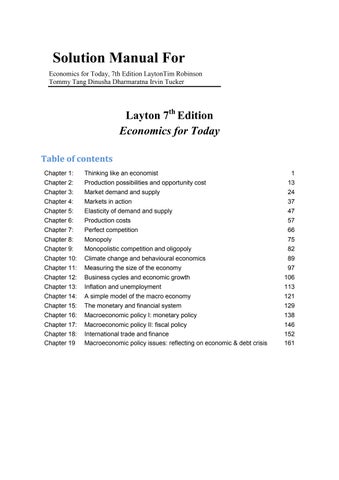
Solution Manual For Economics for Today, 7th Edition LaytonTim Robinson Tommy Tang Dinusha Dharmaratna Irvin Tucker
Layton 7th Edition Economics for Today Table of contents Chapter 1:
Thinking like an economist
1
Chapter 2: Chapter 3: Chapter 4:
Production possibilities and opportunity cost Market demand and supply Markets in action
13 24 37
Chapter 5:
Elasticity of demand and supply
47
Chapter 6:
Production costs
57
Chapter 7:
Perfect competition
66
Chapter 8: Chapter 9:
Monopoly Monopolistic competition and oligopoly
75 82
Chapter 10:
Climate change and behavioural economics
89
Chapter 11:
Measuring the size of the economy
97
Chapter 12:
Business cycles and economic growth
106
Chapter 13: Chapter 14:
Inflation and unemployment A simple model of the macro economy
113 121
Chapter 15:
The monetary and financial system
129
Chapter 16:
Macroeconomic policy I: monetary policy
138
Chapter 17: Chapter 18: Chapter 19
Macroeconomic policy II: fiscal policy International trade and finance Macroeconomic policy issues: reflecting on economic & debt crisis
146 152 161
Instructor Manual - Economics for Today, 7th Edition
Contents Chapter summary ..................................................................................................................... 2 Key concepts ............................................................................................................................ 2 Learning objectives ................................................................................................................... 3 Chapter 1 outline....................................................................................................................... 3 Hints for effective teaching ........................................................................................................ 4 Tutorial ethics discussion .......................................................................................................... 4 Solutions to text problems ......................................................................................................... 5 Global perspective ................................................................................................................. 5 Economists disagree about how to get the best from teachers (pp. 12–13)........................ 5 Analyse the issue .................................................................................................................. 5 The myriad ways in which economists disagree (pp. 15–16) .............................................. 5 Study questions and problems: Solutions .............................................................................. 6 (p. 19) ................................................................................................................................ 6 Multiple-choice questions: Solutions ...................................................................................... 7 (p. 20) ................................................................................................................................ 7 Appendix summary ................................................................................................................... 8 Key concepts ............................................................................................................................ 8 Learning objectives ................................................................................................................... 8 Appendix to Chapter 1 outline ................................................................................................... 8 Hints for effective teaching ........................................................................................................ 9 Solutions to text problems ....................................................................................................... 10 Study questions and problems ............................................................................................ 10 (pp. 29–30) ...................................................................................................................... 10 Multiple-choice questions: Solutions .................................................................................... 12 (p. 30) .............................................................................................................................. 12
Layton, Robinson, Tucker, Economics for Today, 7th Edition. © 2022 Cengage Australia Pty Ltd. All Rights 1 hole or in Reserved. May not be scanned, copied or duplicated, or posted to a publicly accessible website, in w part.
Chapter 1 Thinking like an economist Chapter summary Understanding the economic way of thinking provides a framework for understanding a wide range of economic issues and events. These include the global challenge arising from the coronavirus pandemic and the policy responses from organisations such as the G20 (the world’s leading 19 economies plus the European Union). It also provides a framework for understanding the behaviour of firms and the government policies of individual nations. Scarcity is an economic problem faced by everyone. It is a situation in which we are unable to have as much as we would like to have. While society has unlimited wants, it faces limited means. In essence, society has insufficient resources or factors of production (i.e. land, labour and capital) to produce all goods and services to meet everyone’s needs. As a result of scarcity, society has to make choices. These choices are made at the ‘micro’ and ‘macro’ levels. Microeconomics is the branch of economics that studies decision-making by a single individual, household, firm or industry, while macroeconomics is the branch of economics that studies decision-making for the economy as a whole. Economic theories are developed in much the same way as scientific theories; both are based on induction and deduction. These theories can be expressed:
in verbal or written form
as a numerical table
graphically
mathematically. From these theories, models are formed that help explain the relationship between economic variables. However, models should be used with caution. Two common pitfalls to clear thinking are the failure to understand the ceteris paribus assumption and confusing association and causation. Behavioural economics makes comprehensive assumptions about human behaviour that are being explored in experimental economics, to help explain how decisions are made. Economics can also be subdivided into positive (‘what is’) and normative (‘what ought to be’) economics. We would all be well advised first to have a firm grasp of ‘what is’ before we argue ‘what ought to be’. This does not mean that economics is about non-ethical behaviour. The key concept here is enlightened self-interest: people pursuing individual goals, but in the context of the society in which they live and its laws and norms. The appendix to this chapter focuses on how theories can be expressed graphically. Graphs are visual aids that help us see the direct or inverse relationship between two or more sets of data or variables.
Key concepts
Scarcity
Microeconomics
Factors of production
Macroeconomics
Land
Model
Labour
Ceteris paribus
Entrepreneurship
Behavioural economics
Capital
Experimental economics
Economics
Positive economics
2
© Cengage Learning Australia 2022
Normative economics
Enlightened self-interest
Learning objectives After completing this chapter, students should be able to:
Understand why the problem of scarcity is central to economics.
Explore the differences between macroeconomics and microeconomics.
Discover the methodology of economics.
Understand the hazards of economics ways of thinking.
Understand why economists disagree.
Discover the practical applications of economics.
Chapter 1 outline Introduction The problem of scarcity Exhibit 1.1: Three factors of production Land Labour Capital Macroeconomics and microeconomics Microeconomics You’re the economist: What is the price of economic freedom in Cuba or China? Macroeconomics The methodology of economics Exhibit 1.2: The steps in the model-building process Identifying the problem Developing a model Exhibit 1.3: A map of Auckland CBD Testing the model Hazards of the economic way of thinking The ceteris paribus assumption Association versus causation Why do economists disagree? Behavioural economics Positive economics Normative economics Analyse the issue: The myriad ways in which economists disagree Practical applications of economics Economics and ethics: Does economics promote greed? Key concepts Summary Study questions and problems Answers to ‘You’re the economist’ Multiple-choice questions
© Cengage Learning Australia 2022
3