Solution Manual For Economics, 13th Edition by Michael Parkin Chapter 1-31
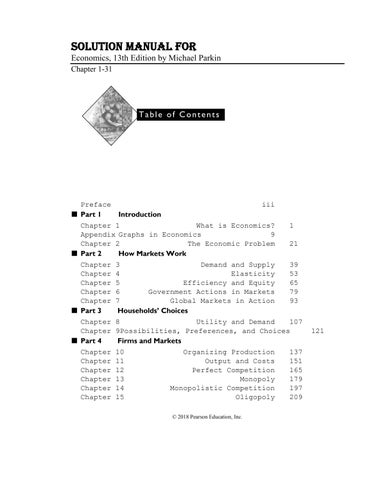
Table of Contents
Preface Part 1
iii Introduction
Chapter 1 What is Economics? Appendix Graphs in Economics 9 Chapter 2 The Economic Problem Part 2 How Markets Work
1
Chapter 3 Demand and Supply Chapter 4 Elasticity Chapter 5 Efficiency and Equity Chapter 6 Government Actions in Markets Chapter 7 Global Markets in Action Part 3 Households’ Choices
39 53 65 79 93
21
Chapter 8 Utility and Demand 107 Chapter 9Possibilities, Preferences, and Choices Part 4 Firms and Markets Chapter 10 Chapter 11 Chapter 12 Chapter 13 Chapter 14 Chapter 15
Organizing Production Output and Costs Perfect Competition Monopoly Monopolistic Competition Oligopoly © 2018 Pearson Education, Inc.
137 151 165 179 197 209
121
Part 5
Market Failure and Government
Chapter 16Public Choices, Public Goods, and Healthcare 223 Chapter 17 Externalities 237 Part 6 Factor Markets, Inequality, and Uncertainty Chapter 18 Markets for Factors of Production Chapter 19 Economic Inequality Chapter 20 Uncertainty and Information Part 7 Monitoring Macroeconomic Performance
249 261 275
Chapter 21 Measuring GDP and Economic Growth Chapter 22 Monitoring Jobs and Inflation Part 8 Macroeconomic Trends
285 299
Chapter 23 Economic Growth 313 Chapter 24 Finance, Saving, and Investment 325 Chapter 25Money, the Price Level, and Inflation 337 Chapter 26The Exchange Rate and the Balance of Payments 351 Part 9 Macroeconomic Fluctuations Chapter 27Aggregate Supply and Aggregate Demand 365 Chapter 28 Expenditure Multipliers 381 Chapter 29The Business Cycle, Inflation, and Deflation 397 Part 10 Macroeconomic Policy Chapter 30 Chapter 31
Fiscal Policy Monetary Policy
© 2018 Pearson Education, Inc.
413 427
2
CHAPTER 1
C h a p t e r
1
WHAT IS ECONOMICS?
Answers to the Review Quiz Page 2 1.
List some examples of the scarcity that you face. Examples of scarcity common to students include not enough income to afford both tuition and a nice car, not enough learning capacity to study for both an economics exam and a chemistry exam in one night, and not enough time to allow extensive studying and extensive socializing.
2.
Find examples of scarcity in today‘s headlines. A headline in The Baltimore Sun on June 20, 2017 was ―Davis Says Special Deployment Helped Stall Violence.‖ The story presented Police Commissioner Kevin Davis stating that a week-long deployment of uniformed police officers on the streets of Baltimore helped reduce shootings in the city. But the story pointed out the role of scarcity when Commissioner Davis said that ―the deployment was not sustainable over the long term‖ due to its cost.
3.
Find an example of the distinction between microeconomics and macroeconomics in today‘s headlines. Microeconomics: On June 20, 2017 a headline in East Bay Times was ―Reality vs Fantasy: FTC to Block FanDuel-DraftKings Merger.‖ This story covers a microeconomic topic because it discusses how two online fantasy sports sites, which were trying to merge, now faced opposition by the Federal Trade Commission (FTC) which announced it would challenge the merger. Macroeconomics: On June 20, 2017, a headline in The Wall Street Journal was ―Ryan Talks Up Likelihood of Tax Overhaul.‖ This story covers a macroeconomic topic because it concerns taxes that affect every business and individual in the entire economy.
Page 7 1.
Describe the broad facts about what, how, and for whom goods and services are produced. What gets produced is significantly different today than in the past. Today the U.S. economy produces more services, such as medical operations, teaching, and hair styling, than goods, such as pizza, automobiles, and computers. How goods and services are produced is © 2018 Pearson Education, Inc.
2
CHAPTER 1
by businesses determining how the factors of production, land, labor, capital and entrepreneurship, are combined to make the goods and services we consume. Land includes all natural resources, both renewable natural resources such as wood, and nonrenewable natural resources such as natural gas. Labor’s quality depends on people’s human capital. In the U.S. economy, human capital obtained through schooling has increased over the years with far more people completing high school and attending college than in past years. Finally, for whom are goods and services to be produced depends on the way income is distributed to U.S. citizens. This distribution is not equal; the 20 percent of people with the lowest income earn about 5 percent of the nation’s total income while the 20 percent of people with the highest incomes earn about 50 percent of total income. On the average, men earn more than women, whites more than non-whites, and college graduates more than high school graduates.
2.
Use headlines from the recent news to illustrate the potential for conflict between self-interest and the social interest. One example of an issue concerns the use of a school board’s credit card to make personal purchases. A June 20, 2017 headline from Star Tribune was ―Shakopee Board Approves Superintendent’s Resignation Will Pay Him $50,000.‖ This story discusses the superintendent’s use of a school board credit card to buy items such as a television and trip to Nashville. The superintendent was following his selfinterest because he may not have repaid the purchases had they not been uncovered. The school board chair said ―In light of the current issues facing the school district, the school board feel (sic) that a change in leadership is warranted.‖ The chair believes that the social interest is served by having a new superintendent without the issue of misuse of a credit card hanging over his or her head.
Page 10 1.
Explain the idea of a tradeoff and think of three tradeoffs that you have made today. A tradeoff reflects the point that when someone gets one thing, something else must be given up. What is given up is the opportunity cost of whatever is obtained. Three examples of tradeoffs that are common to students include: a) When a student sleeps in rather than going to his or her early morning economics class, the student trades off additional sleep for study time. The opportunity cost of the decision is a lower grade on the exam. b) When a student running late for class parks his or her car illegally, the student trades off saving time for the risk of a ticket. The potential opportunity cost of the decision is the goods and services that cannot be purchased if the student receives an expensive parking ticket. c) A student trades off higher income by spending time during the day working at a part-time job for less time spent at leisure time and study. The opportunity cost for the higher income is less leisure and lower grades in classes.
2.
Explain what economists mean by rational choice and think of three choices that you‘ve made today that are rational. © 2018 Pearson Education, Inc.
WHAT IS ECONOMICS?
3
A rational choice is one that compares the costs and benefits of the different actions and then chooses the action that has the greatest benefit over cost for the person making the choice. Three rational choices made by students include: a) The choice to skip breakfast to go to class. In this case the benefit is the higher grade in the class and the cost is the breakfast forgone. b) The choice to stop talking with a friend on the phone and start studying for an impending exam. In this case the benefit is the resulting higher grade in the class and the cost is the conversation forgone. c) The choice to do laundry today rather than watch television. In this case the benefit is the fact the student will have clean clothes to wear and the cost is the loss of the entertainment the television show would have provided.
3.
Explain why opportunity cost is the best forgone alternative and provide examples of some opportunity costs that you have faced today. When a decision to undertake one activity is made, often many alternative activities are no longer possible. Often these activities are mutually exclusive so only the highest valued alternative is actually forgone. For instance, the decision to go to a student’s 8:30 AM class eliminates the possibility of sleeping in during the hour and of jogging during the hour. But in this case, it is impossible to both sleep in and to jog during the hour, so the opportunity cost cannot be both activities. What is lost is only the activity that otherwise would have been chosen—either sleeping in or jogging—which is whatever activity would have been chosen, that is, the most highly valued of the forgone alternatives. For students, attending class, doing homework, studying for a test are all activities with opportunity costs.
4.
Explain what it means to choose at the margin and illustrate with three choices at the margin that you have made today. Choosing at the margin means choosing to do a little more or a little less of some activity. Three common examples students encounter are: a) When a student faces a chemistry and an economics final exam in one day, the student must determine whether spending the last hour studying a little more chemistry or a little more economics will yield a better contribution (marginal benefit) to his or her overall GPA. b) A college student buying a computer must decide whether the marginal benefit of adding 1 GB of additional memory is worth the marginal cost of the additional memory. c) A student football fan with a choice of a cheap seat in the student bleachers located at the far end of the playing field or a more expensive seat located on the 30 yard line must determine whether the marginal benefit of watching the game from a better seat is worth the marginal cost of the higher ticket price.
5.
Explain why choices respond to incentives and think of three incentives to which you have responded today. People making rational decisions compare the marginal benefits of different actions to their marginal costs. Therefore people’s © 2018 Pearson Education, Inc.