1-1
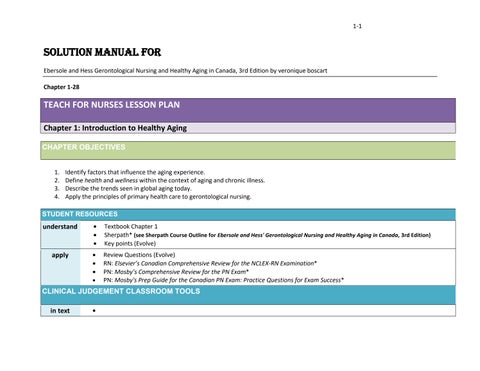
Solution Manual for Ebersole and Hess Gerontological Nursing and Healthy Aging in Canada, 3rd Edition by veronique boscart Chapter 1-28
TEACH FOR NURSES LESSON PLAN Chapter 1: Introduction to Healthy Aging CHAPTER OBJECTIVES 1. 2. 3. 4.
Identify factors that influence the aging experience. Define health and wellness within the context of aging and chronic illness. Describe the trends seen in global aging today. Apply the principles of primary health care to gerontological nursing.
STUDENT RESOURCES
understand
Textbook Chapter 1 Sherpath* (see Sherpath Course Outline for Ebersole and Hess' Gerontological Nursing and Healthy Aging in Canada, 3rd Edition) Key points (Evolve)
apply
Review Questions (Evolve) RN: Elsevier’s Canadian Comprehensive Review for the NCLEX-RN Examination* PN: Mosby’s Comprehensive Review for the PN Exam* PN: Mosby's Prep Guide for the Canadian PN Exam: Practice Questions for Exam Success*
CLINICAL JUDGEMENT CLASSROOM TOOLS in text
1-2
lesson focus - RN
Recognize Cues o Fertility Rate o Life Expectancy o Cohort Analyze Cues o Figure 1.1: Percentage of Population Aged 0 to 14 and 65 years and older, July 1, 2019, Canada, Provinces and Territories o Global Aging o Figure 1.2: Total Fertility Rate by Region, Estimates and Projections, 1950–2100 Generate Solutions o Holistic Health Care o Wellness o Figure 1.3: Healthy Aging o Promoting Healthy Aging o Determinants of Health o Figure 1.4: Growth Potential: Crisis as a Challenge o Social Determinants of Health Take Actions o Primary Health Care Principles o Box 1.1: Questions to Consider for Principles of Primary Health Care o Health Promotion o Intersectoral Collaboration Evaluate Outcomes o Public Participation o Appropriate Technology o Interprofessional Collaboration
1-3
lesson focus -PN
Assessment o Fertility Rate o Life Expectancy o Cohort Analysis/Diagnosis o Figure 1.1: Percentage of Population Aged 0 to 14 and 65 years and older, July 1, 2019, Canada, Provinces and Territories o Global Aging o Figure 1.2: Total Fertility Rate by Region, Estimates and Projections, 1950–2100 Planning o Holistic Health Care o Wellness o Figure 1.3: Healthy Aging o Promoting Healthy Aging o Determinants of Health o Figure 1.4: Growth Potential: Crisis as a Challenge o Social Determinants of Health Implementation o Primary Health Care Principles o Box 1.1: Questions to Consider for Principles of Primary Health Care o Health Promotion o Intersectoral Collaboration Evaluation o Public Participation o Appropriate Technology o Interprofessional Collaboration
INSTRUCTOR RESOURCES before class
Clinical Judgement Classroom Tools (above)
1-4
in class
after class
PowerPoint Presentations (Evolve) Image Collection (Evolve) • Figure 1.1: Percentage of Population Aged 0 to 14 and 65 years and older, July 1, 2019, Canada, Provinces and Territories • Figure 1.2: Total Fertility Rate by Region, Estimates and Projections, 1950–2100 • Figure 1.3: Healthy Aging • Figure 1.4: Growth Potential: Crisis as a Challenge Teaching Strategies (below)
Test Bank (Evolve) HESI Practice Tests* RN: Elsevier’s Canadian Comprehensive Review for the NCLEX-RN Examination* PN: Mosby’s Comprehensive Review for the PN Exam* PN: Mosby's Prep Guide for the Canadian PN Exam: Practice Questions for Exam Success*
* Sold separately from textbook.
TEACHING STRATEGIES Activity Type Pre-Class
Related Objective(s) 1, 3, 4
Activity Assign students to watch one hour of television during prime time. Instruct the students to focus on the number of older adults portrayed in the program, as well as in the commercials. Identify the type of program (e.g., comedy, drama). Calculate the number of minutes of camera time. Analyze intergenerational themes, character conflicts, and roles that the older adults play. During classroom time, graph the results of the informal survey, using the type of program, on-camera time, and role of characters. Identify stereotypes presented during the programs. Discuss the findings.
NGN-RN Clinical Judgement Skill Recognize cues Analyze cues Generation solutions Take Actions Evaluate Outcomes
Freeform
1, 2, 3, 4
Analyze the job description of a nurse in a setting for older adults. Identify unique skills needed to fulfill the
Recognize cues Analyze cues
1-5
Clinical Judgement
1, 2, 3, 4
Discussion Topic
2, 4
role successfully. Brainstorm potential nursing positions Prioritize Hypotheses in the community that address the needs of aging adults. Generation solutions Take Actions Assign students to observe their communities during the Evaluate Outcomes next week. Ask them to estimate the percentage of older adults they encounter—driving cars, in the grocery store, on the bus, in the movie theatre, and in the shopping mall. Have them profile the older adult—their approximate age, their mobility and functional capacities, the types of tasks they are engaging in, their ethnic culture, and their interactions with those around them. During a follow-up class, have a discussion regarding the number of older adults and various aspects of diversity. Have students share their experiences with older adults Recognize cues in previous clinical placements. What is the prevalence Analyze cues of older adults in health care settings? What types of Generation solutions care needs are common? What attitudes and values Take Actions have they observed in those caring for older adults in Evaluate Outcomes these settings? What is the impact on the health and well-being of the older adult? Review the determinants of health and discuss examples Generate solutions of their impact on an older adult’s health. Consider how Evaluate Outcomes each determinant has contributed to an existing health condition, for example, COPD, heart disease, or osteoporosis. Discuss how the determinants of health continue to influence the well-being of the individual, for example, current income, social support network, and physical environment. For employment and working conditions, consider what activities the individual likes to participate in and their ability to access those activities that continue to provide a sense of purpose and meaning.