Solution Manual For Early Childhood Development A Multicultural Perspective, 8th edition Jeffrey Trawick-Smith _____________________________________________________________________________________________
Chapters 1-18
Chapter 1
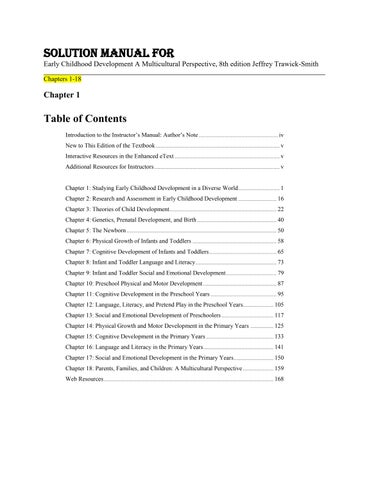
Table of Contents Introduction to the Instructor’s Manual: Author’s Note .................................................... iv New to This Edition of the Textbook ................................................................................. v Interactive Resources in the Enhanced eText ..................................................................... v Additional Resources for Instructors .................................................................................. v
Chapter 1: Studying Early Childhood Development in a Diverse World ........................... 1 Chapter 2: Research and Assessment in Early Childhood Development ......................... 16 Chapter 3: Theories of Child Development ...................................................................... 22 Chapter 4: Genetics, Prenatal Development, and Birth .................................................... 40 Chapter 5: The Newborn .................................................................................................. 50 Chapter 6: Physical Growth of Infants and Toddlers ....................................................... 58 Chapter 7: Cognitive Development of Infants and Toddlers ............................................ 65 Chapter 8: Infant and Toddler Language and Literacy ..................................................... 73 Chapter 9: Infant and Toddler Social and Emotional Development ................................. 79 Chapter 10: Preschool Physical and Motor Development ................................................ 87 Chapter 11: Cognitive Development in the Preschool Years ........................................... 95 Chapter 12: Language, Literacy, and Pretend Play in the Preschool Years.................... 105 Chapter 13: Social and Emotional Development of Preschoolers .................................. 117 Chapter 14: Physical Growth and Motor Development in the Primary Years ............... 125 Chapter 15: Cognitive Development in the Primary Years ............................................ 133 Chapter 16: Language and Literacy in the Primary Years.............................................. 141 Chapter 17: Social and Emotional Development in the Primary Years.......................... 150 Chapter 18: Parents, Families, and Children: A Multicultural Perspective .................... 159 Web Resources ............................................................................................................... 168
Copyright © 2023, Pearson Education
ii
Introduction to the Instructor’s Manual: Author’s Note Over the years, I have used Early Childhood Development: A Multicultural Perspective to teach a variety of courses—huge undergraduate lecture classes and tiny graduate seminars, field-based courses, and even one-on-one internships. In all of these settings, I have tried to apply constructivist learning techniques—engaging students in cooperative learning activities and assessing their knowledge using exam items that require reflection. In this manual I present some of these strategies. The materials presented here have been field-tested and found to work in a variety of teaching contexts. Many of them focus on extending student learning beyond the concepts in the textbook. They help students to form and express personal viewpoints, to apply ideas to authentic problems, and to critically analyze theory and research. Although these materials have worked for me, each instructor is urged to borrow from and adapt these materials based on the unique needs of specific groups of students. As discussed in the textbook, the learning styles and cultural backgrounds of students will determine the best ways to approach teaching and assessment. The following paragraphs describe the components of the Instructor’s Manual (Word document). Chapter Overview The manual provides an overview of each chapter as an introduction to the content for that chapter. Important concepts and ideas are presented as a means of providing a context for the chapter. The chapter overview is typically several descriptive statements. Learning Outcomes Each chapter in the textbook opens with a list of learning outcomes students should be able to achieve after reading and studying the chapter content. These learning outcomes are presented in the Instructor’s Manual as a guide for developing instruction that aligns with the chapter content. Key (Guiding) Questions In order to identify the important issues for each chapter, a list of key questions is presented, related to the ―Guiding Questions‖ presented for students at the beginning of each text chapter. Presented along with the Critical Concepts which answer them, these key questions help to organize the instructor’s thinking and preparation for class presentation. They are helpful in identifying and summarizing the key concepts for consideration in each chapter. Research into Practice: Critical Concepts Each chapter in the textbook closes with a list of critical concepts, and each critical concept is reinforced by several application suggestions. The critical concepts (not including applications) are copied into the Instructor’s Manual as a reminder of this valuable teaching and learning resource. The critical concepts may be viewed as concise summaries that allow the instructor to determine, at a glance, the key points addressed in the text. They may be used as a guide in developing a course outline and syllabus and in planning class discussions and lectures. Interactive Resources in the Enhanced eText The list of interactive resources for each chapter includes the titles and descriptions of the Pearson eText video examples from the chapter, the multiple-choice self-check quizzes (one per learning outcome), and the application
Copyright © 2023, Pearson Education
iii
exercises based on videos that provide visual examples of concepts. During lesson preparation, instructors may refer to these digital elements and use them to develop discussion questions and create group application activities. Please remind students to take advantage of this digital content that offers application opportunities and self-assessment tools. Cooperative Learning Activities The manual provides a set of cooperative learning activities in each chapter—designed for use in both large and small courses—that the instructor can photocopy directly and use in class. These engage students in group problem solving, role-playing, simulations, and other experiences that promote reflection and an exchange of ideas. Every activity has been tried in college classrooms, modified, and then tried again. Application Activities The manual suggests several activities to be completed both inside and outside class that require students to practice applying their understanding of concepts presented in each chapter to the real world of early childhood education. These activities are designed to help build students’ skills and confidence in using what they are learning to make their classroom teaching more effective on a daily basis. Web Resources The last section of the manual lists and describes resources available on the World Wide Web to allow both instructors and students to investigate chapter topics in more depth. These pages may be copied and handed to students or distributed electronically.
Jeffrey Trawick-Smith
The author of this edition of the Instructor’s Manual wishes to thank author Jeffrey Trawick-Smith and to recognize and express gratitude for the valuable contributions of Lauren Sherman and Gail Gottfried as well as significant efforts by specialists at Pearson Education, Inc. Thank you.
Copyright © 2023, Pearson Education
iv
New to This Edition of the Textbook This eighth edition has been completely revised to include new research findings from over two thousand recent journal articles. Many engaging, real-life vignettes profiling children, families, and professionals have been added to illustrate key concepts. The following are new topics that are included or expanded in this edition: Trauma, trauma-informed professional practice, and the cumulative effects of adverse childhood experiences (ACES) are explored in every chapter. Extensive sections are included on the impact on young children of current societal problems, such as: o Global warming and environmental inequality o The COVID-19 pandemic o The harm caused by recent separation of children from their families at the Southern border o Young children’s understandings of racism in the era of Black Lives Matter New research findings on children with autism spectrum disorder and other neurologically-based disabilities are presented. Greater discussion is provided of childhood gender identity, including the development of gender fluid and transgender children. Greatly enhanced sections on the language and literacy development of dual language learners are added. The contributions of play to young children’s social and emotional development have been expanded and updated.
Interactive Resources in the Enhanced eText Pearson eText Video Examples Within each chapter, embedded videos provide illustrations of early childhood development principles or concepts in action. Captions tie the video directly to specific chapter content. These video examples provide valuable realworld examples that can serve as a springboard for whole group discussions or small group activities. Enhanced eText Self-Check Quizzes (LMS compatible) For each learning outcome, the eText includes a self-check quiz over that portion of the chapter content. These quizzes consist of multiple-choice questions with immediate feedback to help students self-assess how well they have mastered the concepts. Feedback indicates whether each question was answered correctly or incorrectly, and every possible response includes specific feedback designed to further learning, either enriching the correct response or providing guidance that explains why another option was not the best choice. Enhanced eText Application Exercises (LMS compatible) Each chapter offers three Application Exercises (with the exception of chapter 1, which has only two) for students to practice using what they have learned. These exercises are built around eText video examples that are embedded in the chapter, and they challenge students to use chapter content to reflect on teaching and learning in real classrooms or child care centers with real children. The questions in these exercises are constructed-response items. As soon as students submit their answers to the questions, they receive feedback in the form of model answers written by experts and based on information presented in the chapter.
Additional Resources for Instructors Test Bank (LMS compatible) A chapter-by-chapter test bank with multiple-choice and essay questions and answer key is available and contains approximately 25 questions per chapter. The test bank questions are designed to assess students’ application of course concepts rather than simply testing recall of information. The test items for any given chapter contain questions related to each of the learning outcomes for that chapter, providing a comprehensive assessment of student learning. PowerPoint Slides The chapter-by-chapter PowerPoint slide sets that accompany this textbook are coordinated with chapter content and provide a summary of critical concepts. The slides are designed to be user friendly and ADA compliant. Instructors are encouraged to customize the slides for their teaching purposes and/or make the slides available to students as a learning tool.
Copyright © 2023, Pearson Education
v