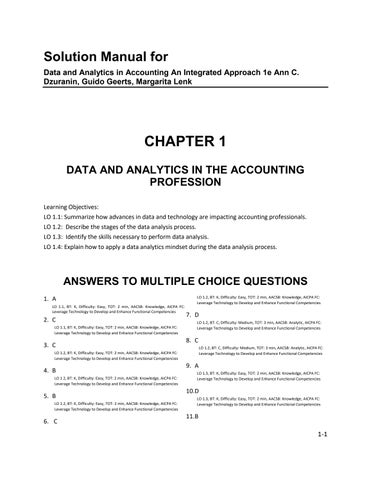
Solution Manual for Data and Analytics in Accounting An Integrated Approach 1e Ann C. Dzuranin, Guido Geerts, Margarita Lenk
CHAPTER 1 DATA AND ANALYTICS IN THE ACCOUNTING PROFESSION Learning Objectives: LO 1.1: Summarize how advances in data and technology are impacting accounting professionals. LO 1.2: Describe the stages of the data analysis process. LO 1.3: Identify the skills necessary to perform data analysis. LO 1.4: Explain how to apply a data analytics mindset during the data analysis process.
ANSWERS TO MULTIPLE CHOICE QUESTIONS 1. A LO 1.1, BT: K, Difficulty: Easy, TOT: 2 min, AACSB: Knowledge, AICPA FC: Leverage Technology to Develop and Enhance Functional Competencies
2. C LO 1.1, BT: K, Difficulty: Easy, TOT: 2 min, AACSB: Knowledge, AICPA FC: Leverage Technology to Develop and Enhance Functional Competencies
3. C
LO 1.2, BT: K, Difficulty: Easy, TOT: 2 min, AACSB: Knowledge, AICPA FC: Leverage Technology to Develop and Enhance Functional Competencies
7. D LO 1.2, BT: C, Difficulty: Medium, TOT: 3 min, AACSB: Analytic, AICPA FC: Leverage Technology to Develop and Enhance Functional Competencies
8. C LO 1.2, BT: C, Difficulty: Medium, TOT: 3 min, AACSB: Analytic, AICPA FC: Leverage Technology to Develop and Enhance Functional Competencies
LO 1.2, BT: K, Difficulty: Easy, TOT: 2 min, AACSB: Knowledge, AICPA FC: Leverage Technology to Develop and Enhance Functional Competencies
4. B LO 1 2, BT: K, Difficulty: Easy, TOT: 2 min, AACSB: Knowledge, AICPA FC: Leverage Technology to Develop and Enhance Functional Competencies
5. B LO 1.2, BT: K, Difficulty: Easy, TOT: 2 min, AACSB: Knowledge, AICPA FC: Leverage Technology to Develop and Enhance Functional Competencies
6. C
9. A LO 1.3, BT: K, Difficulty: Easy, TOT: 2 min, AACSB: Knowledge, AICPA FC: Leverage Technology to Develop and Enhance Functional Competencies
10.D LO 1.3, BT: K, Difficulty: Easy, TOT: 2 min, AACSB: Knowledge, AICPA FC: Leverage Technology to Develop and Enhance Functional Competencies
11.B
1-1
LO 1.3, BT: K, Difficulty: Easy, TOT: 2 min, AACSB: Knowledge, AICPA FC: Leverage Technology to Develop and Enhance Functional Competencies
12.A LO 1.4, BT: K, Difficulty: Easy, TOT: 2 min, AACSB: Knowledge, AICPA FC: Leverage Technology to Develop and Enhance Functional Competencies
13.D
14.A LO 1.4, BT: C, Difficulty: Medium, TOT: 3 min, AACSB: Analytic, AICPA FC: Leverage Technology to Develop and Enhance Functional Competencies
15.B LO 1.4, BT: C, Difficulty: Medium, TOT: 3 min, AACSB: Analytic, AICPA FC: Leverage Technology to Develop and Enhance Functional Competencies
LO 1.4, BT: K, Difficulty: Easy, TOT: 2 min, AACSB: Knowledge, AICPA FC: Leverage Technology to Develop and Enhance Functional Competencies
ANSWERS TO REVIEW QUESTIONS 1. Both the CPA exam and the CMA exam have added data analytic content to their exams. This is in response to what new professionals need to know as they enter the accounting profession. The CPA Exam Evolution is a strong indication of how the accounting profession is changing. The new CPA exam will have more technology and data analytics questions in the Core exam, as well as the Discipline exams. LO 1.1, BT: K, Difficulty: Easy, TOT: 6 min, AACSB: Knowledge, AICPA FC: Leverage Technology to Develop and Enhance Functional Competencies
2. Changes 1. Ability to use entire data sets to identify exceptions, anomalies, and outliers 2. Automation of manual processes 3. Automation of journal entries 4. Risk identification 5. Forecasting 6. Compliance reporting
Accounting Practice Area ANS: a. Auditing, c. Managerial accounting ANS: a., b., c., d. (All areas) ANS: b. Financial accounting ANS:. a. Auditing, c. Managerial accounting ANS: b. Financial accounting, c. Managerial accounting ANS: d. Tax accounting
LO 1.1, BT: C, Difficulty: Medium, TOT: 8 min, AACSB: Analytic, AICPA FC: Leverage Technology to Develop and Enhance Functional Competencies
3. Data are raw facts and figures. Technology helps covert that data into information. Information is the knowledge gained from analyzing the data. LO 1.1, BT: C, Difficulty: Medium, TOT: 6 min, AACSB: Analytic, AICPA FC: Leverage Technology to Develop and Enhance Functional Competencies
4. Purpose 1. Understanding what is happening currently and what has happened in the past.
Method ANS: a. Descriptive
1-2
2. Understanding what should happen to meet our goals and objectives.
ANS: d. Prescriptive
3. Understanding what might happen in the future. 4. Understanding why something happened.
ANS: c. Prescriptive ANS: b. Diagnostic
LO 1.2, BT: C, Difficulty: Medium, TOT: 6 min, AACSB: Analytic, AICPA FC: Leverage Technology to Develop and Enhance Functional Competencies
5. The first step is to identify the motivation for the analysis. The motivation for a project is the why the analysis is being performed. It is important to understand the reason for the analysis before beginning the analysis. The second step is to set an objective. In other words, “What is the goal of the analysis?” This step will help articulate the goal and specific questions that will be analyzed. The third step is to develop a strategy. In this step, we determine the data and analysis methods necessary to achieve the project’s goal. LO 1.2, BT: K, Difficulty: Easy, TOT: 8 min, AACSB: Knowledge, AICPA FC: Leverage Technology to Develop and Enhance Functional Competencies
6. Extracting is the process in which data is retrieved from a source. This could involve downloading an Excel file or extracting data from a database or a data warehouse. Transforming the data occurs when data is cleaned, restructured, and/or integrated prior to using it for analysis. Loading data is the process of importing transformed data into the software used to perform analyses. LO 1.2, BT: K, Difficulty: Easy, TOT: 8 min, AACSB: Knowledge, AICPA FC: Leverage Technology to Develop and Enhance Functional Competencies
7. Example 1. Develop a model to calculate contribution margin. 2. Get data from a database. 3. Upload data into analysis software. 4. Determine the objective of the analysis. 5. Create a forecast of net income. 6. Identify the data needed for analysis. 7. Identify relationships within the data. 8. Create a visualization to show the results of the analyses. 9. Identify sales patterns.
Data Analysis Process Stage ANS: b. Analyze ANS: b. Analyze ANS:b. Analyze ANS: a. Plan ANS: b. Analyze ANS: a. Plan ANS: b. Analyze ANS: c. Report ANS: b. Analyze
LO 1.2, BT: C, Difficulty: Medium, TOT: 12 min, AACSB: Analytic, AICPA FC: Leverage Technology to Develop and Enhance Functional Competencies
1-3
8. A data analytics mindset is the habit critically thinking through the planning, analysis, and interpretation of data results before making and communicating a professional choice or decision. Individuals with a data analytics mindset are inquisitive. They always ask “why” when interpreting results, are open to learning new technologies, and take the time to evaluate their own thinking. LO 1.3, BT: C, Difficulty: Medium, TOT: 6min, AACSB: Analytic, AICPA FC: Leverage Technology to Develop and Enhance Functional Competencies
9. The ability to communicate well is important in all areas of accounting. In data analytics it is important to have good communication skills to explain the results of analyses so others can understand and act if needed. LO 1.3, BT: C, Difficulty: Medium, TOT: 6min, AACSB: Analytic, AICPA FC: Leverage Technology to Develop and Enhance Functional Competencies
10. Definition 1. Willingness to try new technology. 2. The ability to read, write, and communicate data in context. 3. Ability to create effective data visualizations 4. Disciplined reasoning used to investigate, understand, and evaluate an event, opportunity, or an issue.
Skill ANS: c. Technological agility ANS: b. Data literacy ANS: d. Communication ANS: a. Critical thinking
LO1. 3, BT: K, Difficulty: Easy, TOT: 8min, AACSB: Knowledge, AICPA FC: Leverage Technology to Develop and Enhance Functional Competencies.
11.
Stakeholders: Understand the internal and external parties impacted by the data analysis results. Purpose: Determine the reason for the analysis. Alternatives: Evaluate and rank all potential data and analysis choices during the data analysis process. Risks: Consider risks to the data and the analysis choices, including assumptions and potential biases. Knowledge: Identify and acquiring the knowledge necessary to properly prepare and interpret the analyses. Self-reflection: Review decisions and processes for lessons learned and apply them to future projects.
LO 1. 4, BT: C, Difficulty: Medium, TOT: 10min, AACSB: Analytic, AICPA FC: Leverage Technology to Develop and Enhance Functional Competencies
12. Student answers will vary. General examples follow.
1-4
Motivation: All elements of critical thinking can be applied. For example, it is important to identify the stakeholders so that their motivations are understood. Understanding those motivations allows a better understanding of why the analysis is being performed. Objective: All elements of critical thinking can be applied. For example, staying focused on the purpose of the analysis will make identifying relevant questions easier. Strategy: All elements of critical thinking can be applied. For example, consider alternatives for data analysis and then choose the best data analysis method.
LO 1.4, BT: AP, Difficulty: Hard, TOT: 16 min, AACSB: Analytic, AICPA FC: Leverage Technology to Develop and Enhance Functional Competencies
13. Student answers will vary. General examples follow.
Prepare data: All elements of critical thinking can be applied. For example, be aware of risks when preparing data. Risks include incomplete or inaccurate data. Incomplete or inaccurate data will result in incorrect analyses. Build information models: All elements of critical thinking can be applied. For example, it may be necessary to consider alternative models and/or alternative data for our models. By considering alternatives, we can feel more confident that we have chosen the best model. Explore data: All elements of critical thinking can be applied. For example, maintaining focus on the project’s purpose will help avoid wasting time exploring the data for irrelevant questions. Staying focused on the purpose of the analysis makes us more efficient.
LO 1.4, BT: AP, Difficulty: Hard, TOT: 14 min, AACSB: Analytic, AICPA FC: Leverage Technology to Develop and Enhance Functional Competencies
14. Student answers will vary. General examples follow.
Interpret results: All elements of critical thinking can be applied. For example, it is necessary to identify the knowledge that is needed to understand the analysis before we interpret it. When that knowledge is identified, we are better prepared to interpret the analysis results. Communicate results: All elements of critical thinking can be applied. For example, when preparing to communicate results, it helps to consider the stakeholders who will receive the communication. Understanding the stakeholders let’s us better identifythe audience and structure the presentation of results based on the information they need to know.
LO 1.4, BT: AP, Difficulty: Hard, TOT: 14 min, AACSB: Analytic, AICPA FC: Leverage Technology to Develop and Enhance Functional Competencies
SOLUTIONS TO BRIEF EXERCISES BE 1.1 1. This analysis can be used to identify sales patterns and to help detect unusual sales. If unusual patterns or sales are identified, the auditor can do further testing. 2. The months of August – November look low compared to prior months. December looks high. It would also be helpful to compare this pattern to the prior year to identify any similarities.
1-5