Richardson, Teeter, Terrell – Data Analytics for Accounting, 3e
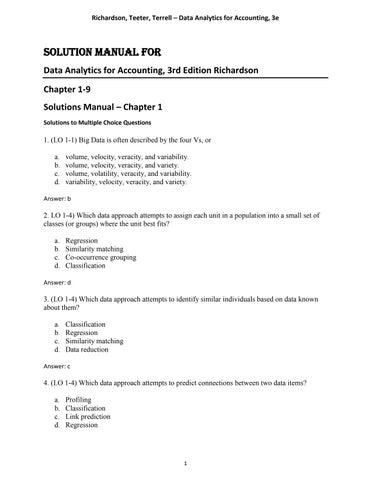
Solution Manual For Data Analytics for Accounting, 3rd Edition Richardson Chapter 1-9 Solutions Manual – Chapter 1 Solutions to Multiple Choice Questions
1. (LO 1-1) Big Data is often described by the four Vs, or a. b. c. d.
volume, velocity, veracity, and variability. volume, velocity, veracity, and variety. volume, volatility, veracity, and variability. variability, velocity, veracity, and variety.
Answer: b
2. LO 1-4) Which data approach attempts to assign each unit in a population into a small set of classes (or groups) where the unit best fits? a. b. c. d.
Regression Similarity matching Co-occurrence grouping Classification
Answer: d
3. (LO 1-4) Which data approach attempts to identify similar individuals based on data known about them? a. b. c. d.
Classification Regression Similarity matching Data reduction
Answer: c
4. (LO 1-4) Which data approach attempts to predict connections between two data items? a. b. c. d.
Profiling Classification Link prediction Regression
1
Richardson, Teeter, Terrell – Data Analytics for Accounting, 3e
Answer: c
5. (LO 1-6) Which of these terms is defined as being a central repository of descriptions for all of the data attributes of the dataset? a. b. c. d.
Big Data Data warehouse Data dictionary Data Analytics
Answer: c
6. (LO 1-5) Which skills were not emphasized that analytic-minded accountants should have? a. b. c. d.
Developed an analytics mindset Data scrubbing and data preparation Classification of test approaches Statistical data analysis competency
Answer: c
7. (LO 1-5) In which areas were skills not emphasized for analytic-minded accountants? a. b. c. d.
Data quality Descriptive data analysis Data visualization and data reporting Data and systems analysis and design
Answer: d
8. (LO 1-4) The IMPACT cycle includes all except the following steps: a. b. c. d.
perform test plan. visualize the data. master the data. track outcomes.
Answer: b
9. (LO 1-4) The IMPACT cycle specifically includes all except the following steps: a. b. c. d.
data preparation. communicate insights. address and refine results. perform test plan.
2
Richardson, Teeter, Terrell – Data Analytics for Accounting, 3e
Answer: a
10. LO 1-1) By the year 2024, the volume of data created, captured, copied, and consumed worldwide will be 149 ________ . a. b. c. d.
zettabytes petabytes exabytes yottabytes
Answer: a Solutions to Discussion and Analysis Questions 1. The accounting function is one of being an information provider. To the extent that data is available to address accounting questions, be they tax, managerial, audit or financial questions. With such rich available data, and software tools to prepare and analyze the data, data analytics will continue to be an important tool for accountants to use. 2. Data analytics is defined as the process of evaluating data with the purpose of drawing conclusions to address business questions. Indeed, effective Data Analytics provides a way to search through large structured and unstructured data to identify unknown patterns or relationships. A university might learn from the analyzing the demographics of its current set of students in order to attract its future student recruits. Did they come from cities or high schools that were close by? Were their parents alumni of the university? Did they score high on certain parts of the ACT? Were those offered a scholarship more likely to attend, etc.? Was social media effective in attracting new, potentially stronger students? By analyzing this type of data, previously unknown patterns will emerge that will make recruiting students more effective. 3. There are many potential answers. For example, Monsanto may use mathematical and statistical models to plot out the best times to plant both male and female plants and where to plant them to maximize yield. (https://www.cio.com/article/3221621/analytics/6-dataanalytics-success-stories-an-inside-look.html#tk.cio_rs) 4. There are many potential answers. Data analytics gives both internal and external auditors additional tools to examine every accounting transaction and assess for compliance with GAAP. The audit process is changing from a traditional process toward a more automated one, which will allow audit professionals to focus more on the logic and rationale behind data queries and less on the gathering of the actual data. No longer will they be simply checking for errors, material misstatements, fraud, and risk in financial statements or merely be reporting their findings at the end of the engagement. Instead, audit professionals will now be collecting and
3
Richardson, Teeter, Terrell – Data Analytics for Accounting, 3e
analyzing the company’s data similar to the way a business analyst would help management make better business decisions. In this way, data analytics offers value to the audit function. 5. There are many potential answers. For example, data analytics associated with financial reporting may help accountants determine if any of their inventory obsolete? It may also help the company benchmark on the financial statements and financial reporting of other similar companies and understand their accounting practices to help infer their own. 6. Management accountants address the information needs of management. They will often see what questions management has, find applicable data to address those questions, conduct analysis of the data, and report the results to management to help them make data-driven decisions. This is consistent with the data analytics process and the IMPACT model. 7. The IMPACT cycle suggests an order of 1) Identifying the Questions; 2) Mastering the Data; 3) Performing the test plan; 4) Addressing and refining results; 5) Communicating insights and 6) Tracking outcomes. The cycle starts with a question and then identifying data and test plan that might address that question. The results of the data analysis are communicated and tracked which may lead to additional, possibly more refined questions that then restart the cycle. 8. Data analysis is most effective when a question is identified that needs to be addressed. That will focus the analysis on which data and which test method might be most effective in addressing or answering the question. 9. Mastering the data requires one to know what data is available and whether it might be able to help address the business problem. We need to know everything about the data, including how to access it, its availability, how reliable it is (if there are errors), and what time periods it covers to make sure it coincides with the timing of our business problem, etc. 10. Facebook uses link prediction to predict a relationship between two people when it suggests people that one likely knows due to similar other friends, extended family, high schools, college or work locations, etc. 11. While sampling is useful, it is still just that, sampling. By looking at all of the transactions and testing them in a way that will highlight the ones that are the biggest dollar items, or are most unusual, that will allow auditors to focus on specific items that might be of material significance. 12. There are several correct answers. One data approach might be regression analysis where, given a balance of total accounts receivable held by a firm, how long it has been outstanding, if they have paid debts in the past all will help predict the appropriate level of allowance for doubtful accounts for bad debts. 13. The Debt-to-Income ratio might suggest to LendingClub that the person asking for the loan was simply asking for too big of a loan and they would have little ability to repay it. The lower the credit score, the less likely the potential borrower would be able to repay the loan. 14. There are many other potential predictors of whether the LendingClub would pay a loan. Here are a few possibilities: What other debt do they have? How much is their disposable income? Do
4
Richardson, Teeter, Terrell – Data Analytics for Accounting, 3e
they have a clean criminal record? Have they had a loan with LendingClub before and did they repay it? Do they rent or own their house?
Solutions to Problems Note: Some problems and solutions may be altered in Connect for auto grading purposes. 1. (LO 1-4) Match each specific Data Analytics test to a specific test approach, as part of performing test plan: Classification Regression Similarity Matching Clustering Co-occurrence Grouping Profiling Link Prediction Data Reduction Specific Data Analytics Test 1. Predict which firms will go bankrupt and which firms will not go bankrupt. 2. Use stratified sampling to focus audit effort on transactions with greatest risk. 3. Work to understand normal behavior, to then be able identify abnormal behavior (such as fraud). 4. Look for relationships between related parties that are not otherwise disclosed. 5. Predict which new customers resemble the company’s best customers. 6. Predict the relationship between an investment in advertising expenditures and subsequent operating income. 7. Segment all of the company’s customers into groups that will allow further specific analysis. 8. The customers who buy product X will be most likely to be also interested in product Y.
5
Test Approach Classification Data Reduction Profiling Link Prediction Similarity Matching Regression
Clustering Co-occurrence Grouping