Solution Manual For Cost Accounting With Integrated Data Analytics, 1st Edition Karen Congo Farmer, Amy Fredin Chapter 1-18
Chapter 1 Cost Accounting Has Purpose Note: the end of chapter brief exercises, exercises, and problems are coded K (knowledge), C (comprehension), AP (application), AN (analysis), S (synthesize), and E (evaluation) according to the original Blooms Taxonomy published in 1956.
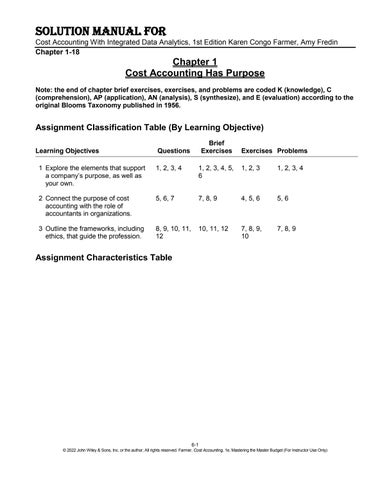
Assignment Classification Table (By Learning Objective) Brief Exercises
Learning Objectives
Questions
Exercises Problems
1. Explore the elements that support a company‘s purpose, as well as your own.
1, 2, 3, 4
1, 2, 3, 4, 5, 6
1, 2, 3
1, 2, 3, 4
2. Connect the purpose of cost accounting with the role of accountants in organizations.
5, 6, 7
7, 8, 9
4, 5, 6
5, 6
3. Outline the frameworks, including ethics, that guide the profession.
8, 9, 10, 11, 12
10, 11, 12
7, 8, 9, 10
7, 8, 9
Assignment Characteristics Table
6-1 © 2022 John Wiley & Sons, Inc. or the author, All rights reserved. Farmer, Cost Accounting, 1e, Mastering the Master Budget (For Instructor Use Only)
Item E1.1 E1.2 E1.3 E1.4 E1.5 E1.6 E1.7 E1.8 E1.9 E1.10 P1.1 P1.2 P1.3 P1.4 P1.5 P1.6 P1.7 P1.8 P1.9
Case
Description Get to know the mission and vision of each of the Big 4 firms and their underlying values. Evaluate the state of competition within an industry given a company‘s SWOT analysis. Explain how a balanced scorecard reveals a company‘s strategy. Get to know how cost accounting skill sets are valued as consulting services in the Big 4. Use the decision-making framework to make a personal decision. Use the decision-making framework to make a business decision. Get to know the IMA. Get to know the continuing education requirements for IMA‘s flagship certification. Get to know IMA‘s Statement of Ethical Professional Practice. Get to know the AICPA. What is your own personal purpose? What are your goals in this course? What strategies will you use to achieve your course goals? Conduct your own personal SWOT analysis related to your role as a student. Determine which data analytics approaches would be useful in addressing a business question. Explain the steps in the value chain. Get to know IMA‘s Statements on Management Accounting. Get to know the CPE requirements for CPAs in your state. Get to know how NASBA supports the State Boards of Accountancy. Sort out the issues in an ethical dilemma using IMA‘s Statement of Ethical Professional Practice alongside the decision-making framework.
Level of Difficulty Moderate
Time (minutes) 10–15
Moderate
10–15
Moderate
10–15
Moderate
10–15
Moderate
10–15
Simple
10–15
Simple Moderate
5–10 10–15
Moderate
15–20
Simple Simple Simple Simple
5–10 5–10 5–10 10–15
Moderate
10–15
Moderate
10–15
Moderate Moderate
5–10 10–15
Moderate
10–15
Moderate Moderate
15–20 10–15
Answers to Questions 1.
A vision reflects what you strive to be (or what an organization strives to be) or what you strive to achieve by some future date. In contrast, a mission (i.e., a purpose) is the reason you exist (or an organization exists). Your mission, or purpose, is what drives you. A strategy reflects the chosen method(s) and technique(s) to get you to the end goal (the vision). You can think of a vision as being your destination, a mission (i.e., purpose) as your vehicle (what drives you!), and a strategy is the road you take to get there. Being aware of these key pieces as well as how they work together can help you stay motivated and adjust course as needed. By keeping your end goal in mind, you will be more motivated and driven as you travel the road there. 6-2 © 2022 John Wiley & Sons, Inc. or the author, All rights reserved. Farmer, Cost Accounting, 1e, Mastering the Master Budget (For Instructor Use Only)
LO: 1, Bloom: C, Difficulty: Simple, Time: 3-5, AACSB: Knowledge, Communication, Reflective Thinking, AICPA BC: N/A, AICPA AC: Reporting, AICPA PC: Communication, IMA: N/A
2.
A SWOT analysis is a survey of a company‘s internal Strengths and Weaknesses along with its external Opportunities and Threats. Companies use this type of analysis to evaluate their position in the market so they can work to capitalize on their strengths and address their weaknesses in an effort to take advantage of opportunities in the market while also addressing the threats. In the process of conducting a SWOT analysis, managers often recognize Porter‘s Five Forces among the company‘s strengths, weaknesses, opportunities, and threats. The five forces are customer power, supplier power, threat of substitute products, threat of new entrants, and industry rivalry. Through a formal SWOT analysis or a formal evaluation of Porter‘s Five Forces, a company will have a very thorough understanding of where it is positioned in the market and in the industry, which can help decision-makers determine the best course forward in order to live the company‘s mission and reach its vision.
LO: 1, Bloom: C, Difficulty: Simple, Time: 3-5, AACSB: Knowledge, Communication, AICPA BC: Strategic Perspective, AICPA AC: Reporting, AICPA PC: Communication, IMA: Strategy, Planning, & Performance: Enterprise Risk Management
3.
A balanced scorecard is a performance management tool in which managers can comprehensively evaluate their organization‘s performance. Within the balanced scorecard, four traditional perspectives are often used (described below). Within each perspective, the company recognizes its key objectives, key initiatives for each objective, and specific metrics for each objective, using both financial and nonfinancial metrics—hence the term ―balanced‖ scorecard. Targets are specified for each objective, and at the end of the month/quarter/year, managers can compare actual results against the company‘s stated objectives and targets. A balanced scorecard can be implemented for the entire entity, for subunits, and/or for individuals. The four perspectives of a traditional balanced scorecard include: o Financial perspective—considers the shareholder‘s perspective and how metrics like growth, profit, and risk that impact shareholder value translate into company objectives. o Customer perspective—considers the customer and includes the metrics that create value for the customer, while also often measuring customer satisfaction and retention. o Internal business process perspective—considers processes internal to a company that are responsible for creating value for the customer and shareholder. o Learning and growth perspective—considers how an organization supports its people and infrastructure to drive and maintain new products and service development and growth. The objectives within each of the four perspectives should be linked such that improvement in more foundational areas of the scorecard, such as learning and growth or internal business process perspectives, will lead to expected improvement in customer and financial areas, as well.
LO: 1, Bloom: C, Difficulty: Simple, Time: 3-5, AACSB: Knowledge, Communication, AICPA BC: Strategic Perspective, Process and Resource Management Perspectives, AICPA AC: Reporting, Systems and Process Management, AICPA PC: Communication, IMA: Business Acumen & Operations: Quality Management and Continuous Improvement
Questions Chapter 1 (Continued) 4.
Health goals are linked to friends/family goals, suggesting that once a basic level of health is achieved, one can pursue healthy relationships with family and friends. Friends/family goals are then linked to self-enrichment goals, suggesting once one has healthy relationships with friends/family, one can pursue self-enrichment goals. Self-enrichment goals are then linked to career goals, suggesting that once one has self-enrichment in his or her life, he or she can pursue career goals. The lower levels are considered more foundational, allowing a person to progressively pursue higher-level goals. Responses here will likely vary by student. A student‘s response to the order of the proposed scorecard might be to move the career perspective a bit lower in the list, with self-enrichment at the top, as an ultimate goal. Others may put certain social or 6-3 © 2022 John Wiley & Sons, Inc. or the author, All rights reserved. Farmer, Cost Accounting, 1e, Mastering the Master Budget (For Instructor Use Only)
environmental goals at the very top of their scorecard, suggesting the ultimate reward would be contributing to world peace, for example. LO: 1, Bloom: C, Difficulty: Simple, Time: 3-5, AACSB: Communication, Reflective Thinking, AICPA BC: N/A, AICPA AC: Reporting, AICPA PC: Communication, IMA: N/A
5.
Cost accounting and financial accounting differ in their purpose, scope, and reporting as follows: Cost accounting‘s purpose is to support internal decision-making. Financial accounting‘s purpose is to present financial information to external users and decisionmakers, who might be investors, stock analysts, regulators, lenders, suppliers, competitors, customers, or others. Cost accounting‘s scope is far broader than simply costing products. Cost accountants analyze activities and transactions of every aspect of an organization‘s value chain, from inception of idea through to sales and customer service. Cost accounting‘s reporting is unlimited, as reports can be arranged and presented in any reasonable way that supports managers‘ needs. Managers‘ feedback further modifies the type of reports created. Financial accounting‘s scope and reporting includes the details, format, and content required by GAAP or IFRS.
LO: 2, Bloom: C, Difficulty: Simple, Time: 3-5, AACSB: Knowledge, Communication, AICPA BC: N/A, AICPA AC: Reporting, AICPA PC: Communication, IMA: N/A
Questions Chapter 1 (Continued) 6.
The main steps of the complete value chain are: (1) Inception of an idea and its resulting development (R&D)—this is where a company explores new product and/or service ideas and conducts research on the viability of such an idea. (2) Design—this is where designers collaborate to find the best possible solution for a new product idea. (3) Supply of inputs like direct materials and direct labor—this is where manufacturers procure the raw materials and labor resources needed in order to produce a given product. This is where service providers hire laborers to provide the company‘s services. (4) Production—this is where manufacturers actually produce the product, or where service providers actually provide the service. Much value is added in this key step. (5) Marketing—this is where organizations of all types provide education to potential customers about their available products/services, as well as where they make an appeal to customers for why they need the given product or service. (6) Distribution—this includes the physical movement of goods to customers, to intermediaries, or to retail locations. (7) Customer service—this includes handling post-sale activities, including returns and warranty support. While most of these activities work best in this specific order, particularly for manufacturing companies that would be unable to produce a product without raw materials and labor, it is not set in stone that they must always be completed in this order. For example, marketing activities may take place before or during production, and sourcing of raw materials and labor could take place while designers are fine-tuning the specifications of a product. Also, not all companies participate in all steps of the value chain. Pure retailers, for example, might not take part in steps 1 and 2.
LO: 2, Bloom: C, Difficulty: Simple, Time: 3-5, AACSB: Knowledge, Communication, AICPA BC: Process and Resource Management Perspectives, AICPA AC: Reporting, Systems and Process Management, AICPA PC: Communication, IMA: N/A
7.
Some decision-making tools available to cost accountants include: o Break-even analysis—can help managers determine the volume of units to be sold to break even or to generate a target amount of income. 6-4 © 2022 John Wiley & Sons, Inc. or the author, All rights reserved. Farmer, Cost Accounting, 1e, Mastering the Master Budget (For Instructor Use Only)
o o o o o o o o
Budgeting—can help managers plan and allocate resources to different priorities across the organization. Net present value—can help managers evaluate the viability of different investment opportunities. Contribution margin—can help managers determine the amount left over from each different type of unit sold that contributes to fixed costs and operating profit. Regression—can help managers evaluate which cost driver/s (independent variable/s) best explains/predicts a mixed cost (dependent variable). Segment margin—can help managers determine the profitability of each division within the company before common or allocated fixed costs are considered. Transfer pricing—can help managers determine the viability of inter-departmental sales, and if viable, the range within which the transfer price should land. Variance analysis—can help managers evaluate differences between standard and actual prices and/or quantities used for key resources, which can facilitate more targeted investigation for continuous improvement efforts. Data analytics—can help managers gain insights from data available, by generating descriptive, diagnostic, predictive, and/or prescriptive information.
LO: 2, Bloom: C, Difficulty: Simple, Time: 3-5, AACSB: Knowledge, Communication, Data Analytics, AICPA BC: Process and Resource Management Perspectives, AICPA AC: Measurement Analysis and Interpretation, Reporting, AICPA PC: Communication, IMA: Reporting & Control: Cost Accounting
Questions Chapter 1 (Continued) 8.
The Sarbanes Oxley Act of 2002 (SOX) has forever changed the accounting profession by addressing many previous weaknesses in the financial reporting process. While the financial reporting process is primarily under the purview of financial accountants, there are a few sections of SOX that are particularly relevant to cost accountants. Section 302 requires CFOs and CEOs of publicly traded companies to certify the accuracy of their reported financial information, creating heightened awareness of the significant impacts that financial information has on a company‘s stakeholders. Cost accountants are intimately involved in, and often directly responsible for, many fundamental business processes reflected in the company‘s financial statements. Specific examples include production and processing costs, inventory costs, and overhead allocation just to name a few. If cost accountants provide clear, accurate, and reliable information to their fellow financial accountants, the financial accountants will feel confident presenting that information to the controller and CFO, in turn, allowing the CFO and CEO to feel confident signing the financial statements release to external users. Section 404 requires management of public companies to recognize their responsibility for establishing internal controls. Further, they are required to provide an assessment of the effectiveness of those internal controls in their external reporting, as well. Since cost accountants are often intimately involved in many fundamental business processes that support transactional reporting and information sharing, cost accountants are often important participants in these internal control discussions. Section 406 requires public companies to disclose if they adopted a code of ethics for their senior officers. Espousing an ethical climate throughout the organization is a key tenet of cost accounting, thus making this section of SOX relevant to cost accountants, as well.
LO: 3, Bloom: C, Difficulty: Simple, Time: 5-10, AACSB: Knowledge, Communication, AICPA BC: Governance Perspective, AICPA AC: Reporting, AICPA PC: Professional Behavior, Communication, IMA: Professional Ethics & Values: Legal and Regulatory Requirements
9.
The IMA‘s key activities areas as it guides the profession include: o Serving as a thought leader in research and industry best practices. o Issuing Statements on Management Accounting (SMAs)—publications on best practices within management accounting. o Offering the Certified Management Accounting (CMA) credential, which reflects best-in-class competencies related to organizations‘ internal financial management. o Helping members build a professional network. 6-5 © 2022 John Wiley & Sons, Inc. or the author, All rights reserved. Farmer, Cost Accounting, 1e, Mastering the Master Budget (For Instructor Use Only)