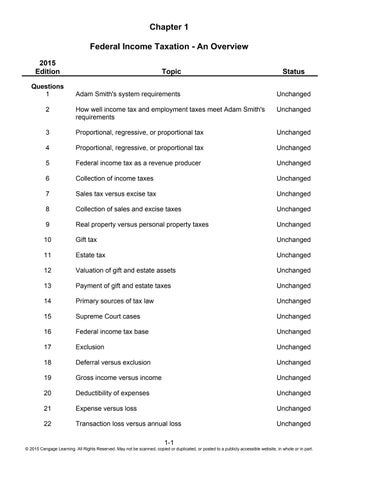
Chapter 1 Federal Income Taxation - An Overview 2015 Edition
Topic
Questions 1
Adam Smith's system requirements
Unchanged
2
How well income tax and employment taxes meet Adam Smith's requirements
Unchanged
3
Proportional, regressive, or proportional tax
Unchanged
4
Proportional, regressive, or proportional tax
Unchanged
5
Federal income tax as a revenue producer
Unchanged
6
Collection of income taxes
Unchanged
7
Sales tax versus excise tax
Unchanged
8
Collection of sales and excise taxes
Unchanged
9
Real property versus personal property taxes
Unchanged
10
Gift tax
Unchanged
11
Estate tax
Unchanged
12
Valuation of gift and estate assets
Unchanged
13
Payment of gift and estate taxes
Unchanged
14
Primary sources of tax law
Unchanged
15
Supreme Court cases
Unchanged
16
Federal income tax base
Unchanged
17
Exclusion
Unchanged
18
Deferral versus exclusion
Unchanged
19
Gross income versus income
Unchanged
20
Deductibility of expenses
Unchanged
21
Expense versus loss
Unchanged
22
Transaction loss versus annual loss
Unchanged
Status
1-1 © 2015 Cengage Learning. All Rights Reserved. May not be scanned, copied or duplicated, or posted to a publicly accessible website, in whole or in part.
1-2
2015 Edition
Topic
Status
23
Legislative grace concept
Unchanged
24
Exemptions
Unchanged
25
Inflation effects on taxes
Unchanged
26
Pay-as-you-go collection of taxes
Unchanged
27
Tax credits
Unchanged
28
Tax credit versus deduction
Unchanged
29
Tax credit versus deduction
Unchanged
30
Statute of limitations
Unchanged
31
Auditing returns
Unchanged
32
IRS examinations
Unchanged
33
30-day letters
Unchanged
34
90-day letters
Unchanged
35
Individual versus corporate taxable income
Unchanged
36
Deductions for and from AGI
Unchanged
37
Standard deduction
Unchanged
38
Why study taxes?
Unchanged
39
Goal of tax planning
Unchanged
40
Tax planning-who benefits
Unchanged
What is a tax?
Unchanged
42
Definition of a tax - five scenarios
Unchanged
43
Calculation of tax and tax rates (marginal, average, effective)
Unchanged
44
Calculation of tax - comparing entities
Unchanged
45
Social Security calculation/tax rate (marginal, average, effective)
Unchanged
46
Progressive, proportional, regressive taxes
Unchanged
Problems 41
© 2015 Cengage Learning. All Rights Reserved. May not be scanned, copied or duplicated, or posted to a publicly accessible website, in whole or in part.
1-3
2015 Edition
Topic
Status
Progressive, proportional, regressive taxes
Unchanged
48
Social Security tax calculation
Unchanged
49
Social Security tax calculation
Unchanged
50
Social Security tax calculation/payment by employer
Unchanged
51
Self-employment tax calculation
Unchanged
52
Social security/self-employment tax
Unchanged
53
Classification of income items
Unchanged
54
Classification of income items
Unchanged
55
What is deductible?
Unchanged
56
Classification of deduction items
Unchanged
57
Calculation of taxable income/tax liability
Unchanged
58
Calculation of taxable income/tax liability
Unchanged
59-COMM
Effect of deduction FOR/FROM adjusted gross income
Unchanged
60-COMM
Tax planning
Unchanged
Gift versus Income
Unchanged
62-CT
Tax planning
Unchanged
63
Tax planning
Unchanged
64
Tax planning
Unchanged
65-CT
Tax planning - income splitting
Unchanged
66-CT
Tax planning - income splitting
Unchanged
67
Evasion versus avoidance
Unchanged
68
Evasion versus avoidance
Unchanged
69-IID
Prepaid taxes
Unchanged
70-IID
Student loan interest
Unchanged
71-IID
Gift versus sale of stock
Unchanged
47-CT
61
© 2015 Cengage Learning. All Rights Reserved. May not be scanned, copied or duplicated, or posted to a publicly accessible website, in whole or in part.
1-4
2015 Edition 72-IID
Topic
Status
Income splitting
Unchanged
73
INTERNET
Unchanged
74
INTERNET
Unchanged
75
Research Problem
Unchanged
76
Research Problem
Unchanged
77
Spreadsheet Problem
Unchanged
78-DC-CT
Value-added Tax
Unchanged
79-DC-CT
How inflation adjustments preserve after tax income
Unchanged
80-TPC-COMM Actions an owner can take to reduce taxes 81-TPC 82-EDC-CT
Unchanged
Tax effects of financing options
Unchanged
Statements on Standards for Tax Services (SSTS) to situations in problem 67
Unchanged
© 2015 Cengage Learning. All Rights Reserved. May not be scanned, copied or duplicated, or posted to a publicly accessible website, in whole or in part.
CHAPTER 1 FEDERAL INCOME TAXATION - AN OVERVIEW DISCUSSION QUESTIONS 1.
Briefly state Adam Smith's four requirements for a good tax system.
2.
a.
Equality - A tax should be imposed based on the taxpayer's ability to pay.
b.
Certainty - The taxpayer should be able to determine the amount of tax and how to make the required payment.
c.
Convenience - The tax should be levied as close as possible to the time the taxpayer receives the amount subject to tax.
d.
Economy - The cost of taxpayer compliance and administering the tax system should be small in relation to the revenue generated.
Based on the discussion in the chapter, evaluate how well each of these taxes meets Adam Smith's four requirements: a.
Income tax Adam Smith's four criteria for evaluating a tax are Equality, Certainty, Convenience, and Economy. The aspects of the income tax that promote each of the individual criteria are: Equality - Progressive tax rates; the use of a standard deduction and exemption amounts have the effect of exempting low-income taxpayers from the tax; indexing of tax rates, standard deduction and exemption amounts are adjusted for inflation. Certainty - The use of an annual accounting period and the consistent use of the same tax return due date. Convenience - The use of a pay as you go system of collecting taxes is more convenient than collecting all taxes at one date. Taxpayer's determine their own tax due in privacy. Economy - The cost of running the IRS is a small percentage of the total tax collected.
1-5 © 2015 Cengage Learning. All Rights Reserved. May not be scanned, copied or duplicated, or posted to a publicly accessible website, in whole or in part.