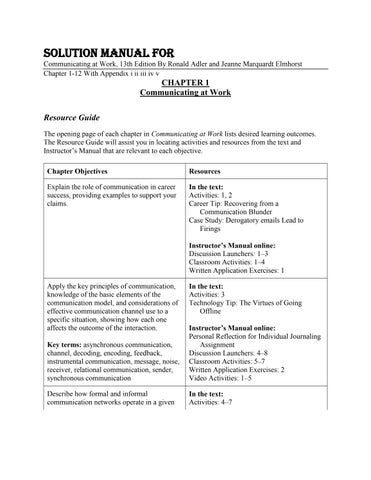
Solution Manual For Communicating at Work, 13th Edition By Ronald Adler and Jeanne Marquardt Elmhorst Chapter 1-12 With Appendix i ii iii iv v
CHAPTER 1 Communicating at Work Resource Guide The opening page of each chapter in Communicating at Work lists desired learning outcomes. The Resource Guide will assist you in locating activities and resources from the text and Instructor‘s Manual that are relevant to each objective. Chapter Objectives
Resources
Explain the role of communication in career success, providing examples to support your claims.
In the text: Activities: 1, 2 Career Tip: Recovering from a Communication Blunder Case Study: Derogatory emails Lead to Firings Instructor’s Manual online: Discussion Launchers: 1–3 Classroom Activities: 1–4 Written Application Exercises: 1
Apply the key principles of communication, knowledge of the basic elements of the communication model, and considerations of effective communication channel use to a specific situation, showing how each one affects the outcome of the interaction.
In the text: Activities: 3 Technology Tip: The Virtues of Going Offline
Key terms: asynchronous communication, channel, decoding, encoding, feedback, instrumental communication, message, noise, receiver, relational communication, sender, synchronous communication
Instructor’s Manual online: Personal Reflection for Individual Journaling Assignment Discussion Launchers: 4–8 Classroom Activities: 5–7 Written Application Exercises: 2 Video Activities: 1–5
Describe how formal and informal communication networks operate in a given
In the text: Activities: 4–7
situation in your career field; then create a strategic plan of personal networking to accomplish your goals within an organization. Key terms: downward communication, formal communication networks, horizontal communication, informal communication
Career Tip: Getting Recognized by Your Bosses Career Tip: Your Elevator Speech Technology Tip: Using LinkedIn Effectively A Professional Perspective: Albert Ramon, Chief Meteorologist Culture at Work: Guanxi: Networking Chinese Style
networks, networking, organizational charts, upward communication
Instructor’s Manual online: Discussion Launchers: 9–13 Classroom Activities: 8–12 Written Application Exercises: 3 Video Activities: 6
Apply the concepts of ethical communication discussed here to one or more ethically challenging situations.
In the text: Activities: 8 Ethical Challenge: Ethical Communication Choices Instructor’s Manual online: Discussion Launchers: 14 Classroom Activities: 13, 14 Written Application Exercises: 4
About Chapter 1 This chapter stresses the importance of communication for entering and advancing in a career. It establishes the central role of communication skills and principles in the inventory of competencies students need in the workplace. The chapter lays the groundwork for understanding the nature of communication. Communication is unavoidable, strategic, and irreversible; it must be understood in context; it involves instrumental, relational, and identity goals; and it is not a panacea. Each communication context is a unique combination of factors. Communicators can become more effective by recognizing the role that each of the communication model element (sender, encoding, message, channel, receiver, decoding, noise, feedback) plays in the process of building shared meaning. Readers are alerted to the impact of noise (environmental, physiological, and psychological). Channel characteristics are discussed, enabling readers to make informed choices. Formal (upward, downward, and horizontal) and informal networks or organizational communication are introduced, with tips for using each to effectively manage our professional
identities. The importance of personal networking is also discussed. Several approaches to examining the ethics of communication are presented. While emphasizing that communication is not a panacea for all business and professional concerns, this chapter heightens awareness of the many choices and channels available to communicators, and it spurs appreciation for the implications and consequences of those choices. The goal is to encourage students to become more astute analyzers of the communication process and to become more aware of their own and others‘ choices while communicating in various business environments. Each ensuing chapter builds on ideas introduced here. The instructor can reinforce this groundwork by referring back to Chapter 1 concepts as they are expanded on throughout the rest of the text.
Personal Reflection for Individual Journaling Assignment Before reading this chapter, write down what communication means to you. After reading the chapter, reread your initial response. In what ways was your description similar to the characteristics pointed out in the text? In what ways did your description differ? How could your new knowledge about the process of communication help you become a better communicator?
Discussion Launchers 1. From your own work experience, add to the reasons given in the text for the importance of
communication in the workplace. 2. In this course, you will be studying several communication skills such as listening, giving
clear instructions, interviewing, writing reports, participating in groups, and delivering presentations. Select a career or hobby that interests you, and explain which of these communication skills would be most important to your success in that area. 3. Choose one of the principles of communication explained in the text. Provide three examples
that illustrate this principle. How could you apply your knowledge of this principle in a future interaction to prevent or reduce misunderstanding? 4. One of the first models of communication was based on the telegraph. Known as the linear
model of communication, it represented the communication process as: Sender–Message– Receiver. Compare and contrast this model to the transactional model presented in your text. How accurate is each of these models as an illustration of the communication process? 5. Does meaning reside in words, in people, or in the interactions that take place among people?
Use the communication model from the text to justify your answers. 6. What are some of the advantages and disadvantages of relying solely on oral communication
to send your ideas? What are some of the advantages and disadvantages of relying solely on written communication? 7. Recall instances you‘ve witnessed of inappropriate or rude use of mobile phones or voice
mail. Identify the consequences of each example. What can be done to educate the public
about appropriate usage? 8. ―New technology ensures better communication in the workplace.‖ Take a stand on this
statement, and use examples to bolster your position. 9. As a new employee, why is it especially important to be able to identify your organization‘s
conventional (formal) communication networks? 10. Describe an effective and an ineffective use of downward communication you have
experienced in an organization. Why was the communication effective or ineffective? What was the outcome? What improvements would you suggest? 11. Upward communication in many organizations is neither open nor frank. Have you (or
someone you know) ever distorted a message to your superiors? Why did you (or your acquaintance) distort the information? Would the distortion be considered ethical in light of any of the ethical principles you read about in this chapter? Explain your answer. 12. Can you think of situations in which there are clear advantages to using only the formal or
informal networks in an organization? Can you think of situations in which using both is preferable? 13. Describe situations when communication goals would be better met by using informal
networks before formal ones, and other situations when goals would be better met by using informal networks after formal ones. What difference does the chronological context make? What is the impact of each message when the order is switched? (For example, is there a difference between asking for a raise in person and then following up with a letter versus asking in a letter and then following up with a personal request?) 14. Think of a ―white lie‖ you have told. Why did you tell the lie? After reading the section on
ethical challenges in this chapter, do you believe the lie was justified? What guidelines would you use for deciding when lying can be justified?
Classroom Activities 1. Students’ Hopes, Concerns, and Expectations for the Course Objective: The purpose of this activity is to discuss students‘ hopes, concerns, expectations, and/or goals for the course that might serve as a guide or checklist for their progress during the semester. Procedure: First, have students write down several communication goals they would like to accomplish as a result of completing this course and several expectations they have of the course. (Provide some 5″ × 8″ note cards for their use.) Be sure to tell the students not to write their names on the cards, and then collect them. Class Discussion: Spend some time on each goal or purpose and the reasons why it is important. Relate these goals to your goals as the instructor and to the goals outlined in the
textbook. Point out where your goals and the students‘ goals are similar and where they are different. In the next class, you might want to point out any modifications you made to your goals as a result of student input. Throughout the semester, you can call attention to student goals as they relate to each chapter or project. Variation: This activity could be done with the nominal group technique, with each group giving you five to six goals and expectations. This provides for individual input, student discussion, and an introduction to NGT, which will be taught in Chapter 8. 2. Communication in Your Local Job Market Objective: The purpose of this activity is to allow students to apply information on the importance of communication in the workplace to the current trends in one‘s own locale. Further, students should be able to identify the various types of skills that are associated with enhanced communication. Procedure: Have students bring in the classified ads from your local (or nearest metropolitan area) newspaper or screenshots of online ads. In class, divide students into small groups or pairs. Have students scan ads and keep track of the number of ads scanned and the number that ask specifically for communication skills. They can make a quick graph, like one of the following:
Number of Ads Scanned
Number of Ads Scanned
Number Requesting Communication Skills
Number Requiring Communication Skills by That Name
Number that Used Other Words That Connote Communication Skills
%
Type of Field
After about 10−15 min, tally up the totals from each group and compare the results with information in the text. Variation: Ask students to bring to class descriptions of their current jobs or jobs they are or will be interested in applying for. (You can have several descriptions on hand that represent a variety of career areas that you obtained from local businesses or from job placement