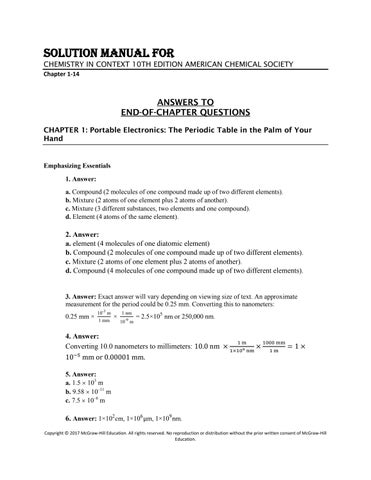
SOLUTION MANUAL FOR CHEMISTRY IN CONTEXT 10TH EDITION AMERICAN CHEMICAL SOCIETY Chapter 1-14
ANSWERS TO END-OF-CHAPTER QUESTIONS CHAPTER 1: Portable Electronics: The Periodic Table in the Palm of Your Hand
Emphasizing Essentials 1. Answer: a. Compound (2 molecules of one compound made up of two different elements). b. Mixture (2 atoms of one element plus 2 atoms of another). c. Mixture (3 different substances, two elements and one compound). d. Element (4 atoms of the same element).
2. Answer: a. element (4 molecules of one diatomic element) b. Compound (2 molecules of one compound made up of two different elements). c. Mixture (2 atoms of one element plus 2 atoms of another). d. Compound (4 molecules of one compound made up of two different elements).
3. Answer: Exact answer will vary depending on viewing size of text. An approximate measurement for the period could be 0.25 mm. Converting this to nanometers: -
or 250,000 nm.
-
4. Answer: Converting 10.0 nanometers to millimeters:
5. Answer: a. 1.5 103 m b. 9.58 10–11 m c. 7.5 10–6 m
6. Answer:
,
,
.
Copyright © 2017 McGraw-Hill Education. All rights reserved. No reproduction or distribution without the prior written consent of McGraw-Hill Education.
7. Answer: a. Group 1 and Group 17 b. 1A: lithium, sodium, potassium, rubidium, cesium, francium 7A: fluorine, chlorine, bromine, iodine, astatine c. 1A: All but hydrogen (a nonmetal) are reactive metals. 7A: All but astatine (a metalloid) are reactive nonmetals.
8. Answer: a.
b. iron, Fe; magnesium, Mg; aluminum, Al; sodium, Na; potassium, K; silver, Ag. c.
d. sulfur, S; oxygen, O, carbon, C, chlorine, Cl, fluorine, F (and others).
9. Answer: a. compound d. element
b. compound e. mixture
c. mixture f. element
10. Answer: a. heterogenous mixture d. homogenous mixture
b. heterogenous mixture e. heterogenous mixture
c. heterogenous mixture
11. Answer:
Copyright © 2017 McGraw-Hill Education. All rights reserved. No reproduction or distribution without the prior written consent of McGraw-Hill Education.
Grey spheres: electrons Black spheres: protons White spheres: neutrons
12. Answer: There are several allotropes of sulfur. The most stable and common allotrope consists of 8 atoms in a ring. Other common allotropes include rings of 5, 6, 7, 10 and larger number of atoms. Most allotropes are yellow solids, although they can be found in liquid or gaseous forms at appropriate temperatures. Most of these allotropes are created by heating sulfur of the 8-membered ring form.
13. Answer: An aluminum atom with mass number 27 has 13 protons, 14 neutrons, and 13 electrons.
14. Answer: A copper atom with a mass number 64 has 29 protons, 35 neutrons, and 29 electrons. 15. Answer: Electrical conductivity is the transport of electrons from one location to another. Thermal conductivity is the transfer of heat from one location to another. Their difference is in what is being transferred. 16. Answer: a. t t
ss ss
H H Os
(
t t
ss ss
H Os
(
)
( )
b. t t
ss ss
s
(
)
( )
t t
ss ss
s
(
) (
( ) )( )
(
H O
)( ) )
( )
Copyright © 2017 McGraw-Hill Education. All rights reserved. No reproduction or distribution without the prior written consent of McGraw-Hill Education.
c. t t
ss ss
Os
(
)
t t
ss ss
Os
(
)
t t
ss ss
Os
(
)
d. t t
ss ss
F O
(
)
t t
ss ss
F O
(
)
e. t t
ss ss
O
(
t t
ss ss
O
(
t t
ss
O
(
)
t t
ss ss
O
(
)
t t
ss ss
O
(
)
f.
( (
)
( ) (
)( )
)( ) ( ) (
)( )
)( ) ( ) (
)( )
( ) (
)( )
)( ) ( ) (
)( )
)( ) ( ) (
)( )
( )
(
)( ) )
( )
ss (
(
17. Answer: a. 1 carbon atom (nonmetal), 2 oxygen atoms (nonmetals) b. 2 hydrogen atoms (nonmetals), 1 sulfur atom (nonmetal) c. 1 nitrogen atom (nonmetal), 2 oxygen atoms (nonmetals) d. 1 silicon atom (metalloid), 2 oxygen atoms (nonmetals)
Concentrating on Concepts 18. Answer: A variety of answers are possible. An example of an illustration of 9N purity is the time span of 1 second compared to 31.7 years. A similar example with 12 N purity is 1 second compared to 31,700 years. A volume-related example of 9N purity would be like taking 1 liter of water out of 400 Olympic-sized swimming pools full of water!
19. Answer: Answers will vary widely but could include food, drink, furniture, books, and appliances, among others. Examples of homogeneous mixtures may be air (nitrogen, N2, oxygen, O2, argon, Ar, etc.), Gatorade (water, H2O, sucrose, C12H22O11, sodium chloride, NaCl, citric acid, C6H8O7, etc.), and glass (silicon dioxide, SiO2, sodium oxide, Na2O, calcium oxide, CaO, aluminum oxide, Al2O3, Copyright © 2017 McGraw-Hill Education. All rights reserved. No reproduction or distribution without the prior written consent of McGraw-Hill Education.
etc.). Examples of heterogeneous mixtures include books (cellulose, (C6H10O5)n, carbon black, C, titanium oxide, TiO2, polyvinyl acetate, (C4H6O2)n, etc.), granola bar (sucrose, C12H22O11, sodium chloride, NaCl, baking soda, NaHCO3, etc.), and a banana (water, H2O, glucose, C6H12O6, fructose, C6H12O6, isoamyl acetate, C7H14O2, etc.)
20. Answer: Answers will vary, depending on year selected. As of 2019, the latest technology node is 5 nm, which features a gate length of around 10 nm (https://en.wikichip.org/wiki/5_nm_lithography_process). -
This is equivalent to
-
.
21. Answer: The periodic table allowed gaps for unknown elements. The elements were placed into gaps based on their atomic weight and number of protons. 22. Answer: There are many steps involved during this process. Many resources are available on the Internet that describe this process (e.g., http://www.australianminesatlas.gov.au/education/fact_sheets/aluminium.html) 23. Answer: Sapphire is about three times as hard as Gorilla glass but is about 67% more dense. This means that although sapphire could greater resist scratches, a similar sized piece would weigh more than a piece of Gorilla glass. Gorilla glass has an amorphous structure composed primarily of silicon and oxygen atoms with other minority component atoms. Sapphire is a single crystal of aluminum and oxygen atoms. Both materials require high temperature melting of raw materials followed by slow cooling. Gorilla glass requires another heating step in a molten bath of salts. Sapphire requires a much higher temperature melt. Regular glass is also amorphous & is composed primarily of silicon and oxygen atoms with additives of sodium and calcium oxides. A comprehensive website that quantitatively compares the physical and optical properties of typical soda-lime glass, Gorilla glass, and quartz is found at: http://abrisatechnologies.com/specs/AT%20Specialty%20Glass%20Technical%20Capabilities%2 0Brochure.pdf
24. Answer: A thin layer of a transparent conducting material is deposited on the surface of glass. The most common material used for this purpose is indium tin oxide (ITO), which is used in applications ranging from LED displays to solar cells. Do-it-yourself enthusiasts have posted to the internet a way to coat glass using stannous chloride (SnCl2) to create a layer of conductive tin oxide.
Copyright © 2017 McGraw-Hill Education. All rights reserved. No reproduction or distribution without the prior written consent of McGraw-Hill Education.