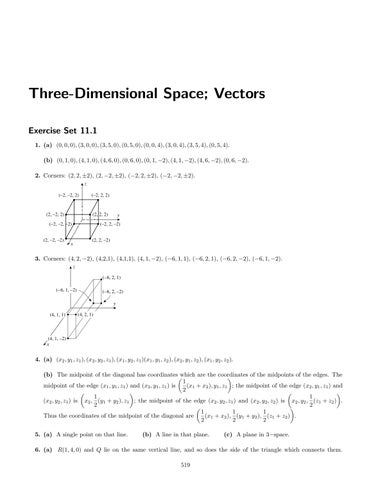
Three-Dimensional Space; Vectors Exercise Set 11.1 1. (a) (0, 0, 0), (3, 0, 0), (3, 5, 0), (0, 5, 0), (0, 0, 4), (3, 0, 4), (3, 5, 4), (0, 5, 4). (b) (0, 1, 0), (4, 1, 0), (4, 6, 0), (0, 6, 0), (0, 1, −2), (4, 1, −2), (4, 6, −2), (0, 6, −2). 2. Corners: (2, 2, ±2), (2, −2, ±2), (−2, 2, ±2), (−2, −2, ±2). z
(–2, –2, 2)
(2, –2, 2)
(–2, 2, 2)
(2, 2, 2)
(–2, –2, –2) (2, –2, –2)
y
(–2, 2, –2) (2, 2, –2)
x
3. Corners: (4, 2, −2), (4,2,1), (4,1,1), (4, 1, −2), (−6, 1, 1), (−6, 2, 1), (−6, 2, −2), (−6, 1, −2). z
(–6, 2, 1) (–6, 1, –2)
(–6, 2, –2) y
(4, 1, 1)
(4, 2, 1)
(4, 1, –2) x
4. (a) (x2 , y1 , z1 ), (x2 , y2 , z1 ), (x1 , y2 , z1 )(x1 , y1 , z2 ), (x2 , y1 , z2 ), (x1 , y2 , z2 ). (b) The midpoint of the diagonal has coordinates which are the coordinates of the midpoints of the edges. The 1 midpoint of the edge (x1 , y1 , z1 ) and (x2 , y1 , z1 ) is (x1 + x2 ), y1 , z1 ; the midpoint of the edge (x2 , y1 , z1 ) and 2 1 1 (x2 , y2 , z1 ) is x2 , (y1 + y2 ), z1 ; the midpoint of the edge (x2 , y2 , z1 ) and (x2 , y2 , z2 ) is x2 , y2 , (z1 + z2 ) . 2 2 1 1 1 Thus the coordinates of the midpoint of the diagonal are (x1 + x2 ), (y1 + y2 ), (z1 + z2 ) . 2 2 2 5. (a) A single point on that line.
(b) A line in that plane.
(c) A plane in 3−space.
6. (a) R(1, 4, 0) and Q lie on the same vertical line, and so does the side of the triangle which connects them. 519
520
Chapter 11 R(1, 4, 0) and P lie in the plane z = 0. Clearly the two sides are perpendicular, and √ the sum of the squares of the two sides is |RQ|2 + |RP |2 = 42 + (22 + 32 ) = 29, so the distance from P to Q is 29. z
Q (1, 4, 4)
y R (1, 4, 0) P(3, 1, 0) x
(b) Clearly, SP is parallel to the y-axis. S(3, 4, 0) and p Q lie in the plane p y = 4, and so does √ SQ. Hence the two sides |SP | and |SQ| are perpendicular, and |P Q| = |P S|2 + |QS|2 = 32 + (22 + 42 ) = 29. z
Q(1, 4, 4)
y
P(3, 1, 0)
S (3, 4, 0)
x
(c) T (1, 1, 4) and Q lie on a line through (1, 0, 4) and is thus parallel to the y-axis, and T Q lies on this line. T and P lie in the same plane y = 1 which is perpendicular to any line which is parallel to the y-axis, thus T P , which lies on such a line, is perpendicular to T Q. Thus |P Q|2 = |P T |2 + |QT |2 = (4 + 16) + 9 = 29. z
T (1, 1, 4)
Q (1, 4, 4)
y
P(3, 1, 0) x
7. (a) Let the base of the box have sides a and b and diagonal d1 . Then a2 + b2 = d21 , and d1 is the base of a rectangular of height c and diagonal d, with d2 = d21 + c2 = a2 + b2 + c2 . (b) Two unequal points (x1 , y1 , z1 ) and (x2 , y2 , z2 ) form diagonally opposite corners of a rectangular box with p sides x1 − x2 , y1 − y2 , z1 − z2 , and by Part (a) the diagonal has length (x1 − x2 )2 + (y1 − y2 )2 + (z1 − z2 )2 .
1 8. (a) The vertical plane that passes through ( , 0, 0) and is perpendicular to the x-axis. 2
1 1 (b) Equidistant: (x − )2 + y 2 + z 2 = x2 + y 2 + z 2 , or −2x + 1 = 0 or x = . 2 2 p √ √ √ 9. The diameter is d = (1 − 3)2 + (−2 − 4)2 + (4 + 12)2 = 296, so the radius is 296/2 = 74. The midpoint (2, 1, −4) of the endpoints of the diameter is the center of the sphere. 10. Each side has length
√
14 so the triangle is equilateral.
√ 11. (a) sides have lengths 7, 14, and 7 5; it is a right triangle because the sides satisfy the Pythagorean theorem, √ The (7 5)2 = 72 + 142 .
Exercise Set 11.1
521
(b) (2,1,6) is the vertex of the 90◦ angle because it is opposite the longest side (the hypotenuse). (c) Area = (1/2)(altitude)(base) = (1/2)(7)(14) = 49. 12. (a) 3
(b) 2
(c) 5
(d)
p
(2)2 + (−3)2 =
√
13.
(e)
13. (a) (x − 7)2 + (y − 1)2 + (z − 1)2 = 16.
p
(−5)2 + (−3)2 =
√
34.
(f )
p
(−5)2 + (2)2 =
√
29.
(b) (x − 1)2 + y 2 + (z + 1)2 = 16. (c) r = (d) r =
p √ (−1 − 0)2 + (3 − 0)2 + (2 − 0)2 = 14, (x + 1)2 + (y − 3)2 + (z − 2)2 = 14.
1p 1√ (−1 − 0)2 + (2 − 2)2 + (1 − 3)2 = 5, center (−1/2, 2, 2), (x + 1/2)2 + (y − 2)2 + (z − 2)2 = 5/4. 2 2
14. r = |[distance between (0,0,0) and (3, −2, 4)] ± 1| =
√
29 ± 1, x2 + y 2 + z 2 = r2 =
√
15. (x − 2)2 + (y + 1)2 + (z + 3)2 = r2 , so (a) (x − 2)2 + (y + 1)2 + (z + 3)2 = 9.
(b) (x − 2)2 + (y + 1)2 + (z + 3)2 = 1.
16. (a) The sides have length 1, so the radius is (b) The diagonal has length
√
1+1+1=
√
√ 2 29 ± 1 = 30 ± 2 29.
(c) (x − 2)2 + (y + 1)2 + (z + 3)2 = 4.
1 1 ; hence (x + 2)2 + (y − 1)2 + (z − 3)2 = . 2 4 3 and is a diameter, so (x + 2)2 + (y − 1)2 + (z − 3)2 =
3 . 4
6+2 5+9 4+0 , , ), so (x − 4)2 + (y − 7)2 + (z − 2)2 = 4. 2 2 2 √ (d) Center is the same, radius is half the diagonal, r = 2 3, so (x − 4)2 + (y − 7)2 + (z − 2)2 = 12.
(c) Radius: (6 − 2)/2 = 2, center: (
17. Let the center of the sphere be (a, b, c). The height of the center over the x-y plane is measured along the radius that is perpendicular to the plane. But this is the radius itself, so height = radius, i.e. c = r. Similarly a = r and b = r. 18. If r is the radius of the sphere, then the center of the sphere √ √ has coordinates (r, r, r) (see Exercise 17). Thus the 2 + r2 + r2 = distance from the origin to the center is r √ √3r, from which √ it follows √ that the distance from the √ 3r − r. Equate that with 3 − 3: 3r − r = 3 − 3, r = 3. The sphere is given by the origin to the sphere is √ √ √ equation (x − 3)2 + (y − 3)2 + (z − 3)2 = 3. 19. False; need be neither right nor circular, see “extrusion”. 20. False, it is a right circular cylinder. 21. True; y = z = 0. 22. False, the sphere satisfies the equality, not the inequality. 23. (x + 5)2 + (y + 2)2 + (z + 1)2 = 49; sphere, C(−5, −2, −1), r = 7. 24. x2 + (y − 1/2)2 + z 2 = 1/4; sphere, C(0, 1/2, 0), r = 1/2.
√ 25. (x − 1/2)2 + (y − 3/4)2 + (z + 5/4)2 = 54/16; sphere, C(1/2, 3/4, −5/4), r = 3 6/4. 26. (x + 1)2 + (y − 1)2 + (z + 1)2 = 0; the point (−1, 1, −1).
522
Chapter 11
27. (x − 3/2)2 + (y + 2)2 + (z − 4)2 = −11/4; no graph. 28. (x − 1)2 + (y − 3)2 + (z − 4)2 = 25; sphere, C(1, 3, 4), r = 5. z
z
z
y
29. (a)
y
x
(b)
x
y
(c)
z
z
x
y=1 z
x=1
y
y
z=1 y
30. (a)
x
(b)
x
x
(c)
z
z
z
y y
5
y
5
5
31. (a)
(b)
x
(c)
x
x
z z
z
y
32. (a) x
33. (a) −2y + z = 0.
y
(b) x
(b) −2x + z = 0.
34. (a) (x − a)2 + (z − a)2 = a2 .
x
y
(c)
(c) (x − 1)2 + (y − 1)2 = 1.
(b) (x − a)2 + (y − a)2 = a2 .
(d) (x − 1)2 + (z − 1)2 = 1.
(c) (y − a)2 + (z − a)2 = a2 .
Exercise Set 11.1
523 z
z
z z 1
y
1
y
y
y
36. x
35. x
x
37.
z
z
z
3
z y
2
y
3 2
√3 –3
2
40. x
x
y
3
3
39.
38. x
41.
3
y
x
42. x
z
z
–2
2
y
y
43.
x
x
44. 1.4 z
–1.4
1.4
–1.4
45. (a)
(b)
x
y
1 z –2
46. (a)
2
–1
(b) x
y
47. Complete the squares to get√(x + 1)2 + (y − 1)2 + (z − 2)2 = 9; center (−1, 1, 2), radius 3. The distance between √ the origin and the center is 6 < 3 so the origin is inside the sphere. The largest distance is 3 + 6, the smallest √ is 3 − 6. 48. (x − 1)2 + y 2 + (z + 4)2 ≤ 25; all points on and inside the sphere of radius 5 with center at (1, 0, −4). 49. (y + 3)2 + (z − 2)2 > 16; all points outside the circular cylinder (y + 3)2 + (z − 2)2 = 16.