Solution Manual For Biofluid Mechanics, Edition 3 By David Rubenstein, Wei Yin and Mary D. Frame ___________________________________________________________________________
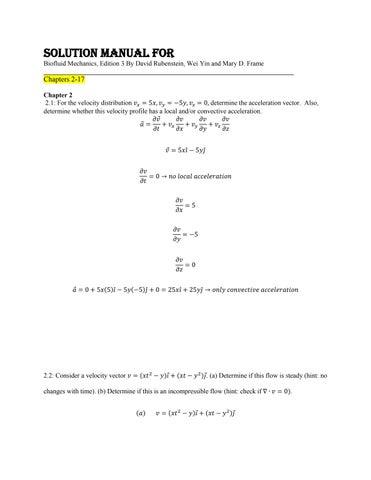
Chapters 2-17 Chapter 2 2.1: For the velocity distribution determine the acceleration vector. Also, determine whether this velocity profile has a local and/or convective acceleration. ⃗ ⃗
⃗
⃗
( )̂
2.2: Consider a velocity vector
(
̂
)̂
(
̂
̂
)⃗
̂
(
) ⃗. (a) Determine if this flow is steady (hint: no
changes with time). (b) Determine if this is an incompressible flow (hint: check if ( )
(
)⃗
(
)⃗
).
̂
̂
( )
( (
2.3: Given the velocity
(
2.4
) ̂
(
)
(
)⃗
(
* ̂
(
)̂ ) ⃗, determine if it is irrotational.
)̂
(
)̂
(
)̂
(
(
)) ̂
̂
The velocity vector for a steady incompressible flow in the xy plane is given by , where the
coordinates are measured in centimeters. Determine the time it takes for a particle to move from x = 1cm to x = 4cm for a particle that passes through the point
x, y 1, 4 .
⃗
⃗
⃗
⃗
Check (
)
Time at 1cm is equal to 0.25s; for time at 4cm
Therefore, it takes 3.75 seconds for this particular particle to move from 1cm to 4cm
2.5: Flow in a 2-dimensional channel of width W has a velocity profile defined by:
( )
*(
+
)
where y=0 is located at the center of the channel. Sketch the velocity distribution and find the shear stress/unit width of the channel at the wall.
(
( (
Velocity Distribution (k=1, W=10):
)+)
(
(
)+
6
Channel Location
4
2 0 0
10
20
30
40
50
60
-2
-4 -6
Velocity
2.6: A velocity filed is given by (
)
⃗
⃗, calculate the acceleration, the angular
velocity, and the vorticity vector at the point (-1,1,1), where the units of the velocity equation are mm/s.
⃗
⃗⃗
[(
[
(
⃗(
)
)̂
(
)̂
(
[
)̂
(
(
̂)] ̂
[
( ) ̂]
)( ) ̂
) ̂]
[
]̂
[
⃗⃗
̂
̂] ̂
̂] ̂
(
)̂
̂
2.7: Considering one-dimensional fluid (density, ; viscosity, ) flow in a tube with an inlet pressure of , and outlet pressure of
and tube radius of and length . The density of the fluid can be represented
as . Express the wall shear stress as a function of these variables. Hint: balance Newton’s second law of motion.
̂
̂
(
̂
)̂ ̂
(
(
)̂ ̂
( )̂ )
2.8: Data obtained from one experiment are presented in the table below, plot the data and determine if the fluid is pseudoplastic, Newtonian or dilatants. Approximate the viscosity (or the apparent viscosity for this fluid). Shear stress (dyne/cm2)
5
9
23
48
95
Shear rate (s-1)
0.1
1
10
100
1000