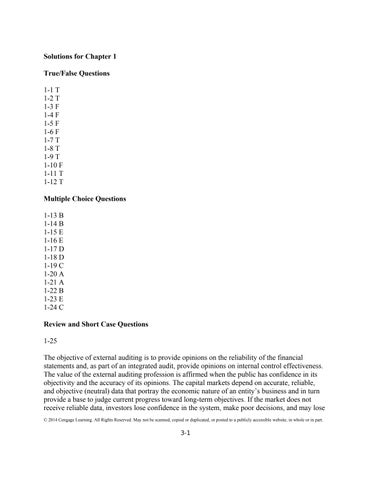
Solutions for Chapter 1 True/False Questions 1-1 T 1-2 T 1-3 F 1-4 F 1-5 F 1-6 F 1-7 T 1-8 T 1-9 T 1-10 F 1-11 T 1-12 T Multiple Choice Questions 1-13 B 1-14 B 1-15 E 1-16 E 1-17 D 1-18 D 1-19 C 1-20 A 1-21 A 1-22 B 1-23 E 1-24 C Review and Short Case Questions 1-25 The objective of external auditing is to provide opinions on the reliability of the financial statements and, as part of an integrated audit, provide opinions on internal control effectiveness. The value of the external auditing profession is affirmed when the public has confidence in its objectivity and the accuracy of its opinions. The capital markets depend on accurate, reliable, and objective (neutral) data that portray the economic nature of an entity’s business and in turn provide a base to judge current progress toward long-term objectives. If the market does not receive reliable data, investors lose confidence in the system, make poor decisions, and may lose © 2014 Cengage Learning. All Rights Reserved. May not be scanned, copied or duplicated, or posted to a publicly accessible website, in whole or in part.
3-1
a great deal of money; ultimately, the system may fail. By providing an independent audit opinion, the capital markets can be assured that the financial data that they are basing their decisions upon are accurate. 1-26 The special function performed by the external auditing profession is the attestation to the fairness of the financial statements of clients. The special function helps ensure the reliability and integrity of the financial reporting system. The auditing profession exists to serve the users of an organization's financial statements. These include lenders, investors, management, government, and (indirectly) all individuals who are ultimately affected by the integrity of the financial reporting process. Auditors need to remember that they are serving the public interest and not the interests of client management. 1-27 Audit services are needed because there is a:
Potential bias in providing information. Remoteness between a user and the organization or trading partner. Complexity in the transaction, information, or processing systems such that it is difficult to determine their proper presentation without a review by an independent expert. Need to limit negative consequences that arise from relying on inaccurate information.
1-28 The audit enhances the quality of financial statements because the user has the assurance that an independent, qualified professional has examined the financial statements and has rendered an opinion on their fairness. The independence and expertise of the auditor serve as a quality control function to overcome the potential bias of management in presenting the financial statements in a manner that most flatters an assessment of their performance. The audit is designed to add credibility to the financial statements. An audit does not necessarily guarantee a fair presentation of a company's financial statements, although it does dramatically increase the likelihood that there are no material misstatements in the company's financial statements. The audit provides reasonable, not absolute, assurance about the accuracy of the financial statements. The caveats about fairness exist for two reasons:
Fairness is judged within a framework of GAAP. Some question whether GAAP results in the fairest possible presentations when there are significant changes in market values of investments or assets. For example, the SEC has encouraged financial institutions to move from using historical cost required by GAAP to market values for all investments in securities because it believes that market value presents a better picture of economic reality than does historical cost.
Although designed to detect material fraud, it might be possible that a well-executed audit may still fail to detect fraud.
1-29 Independence means objectivity and freedom from bias. The auditor can favor neither the client nor the third party in evaluating the fairness of the financial statements. The auditor must be independent in fact and in appearance. Independence in fact means the auditor is unbiased and objective. An auditor could be independent in fact if he or she owned a few shares of common stock in an audit client, but might not appear independent to a third party. Independence in appearance means that a third party with knowledge of the auditor’s relationship with the client would consider the auditor to be independent. If users don’t perceive auditors to be independent then the value of the audit is lacking. 1-30 a. An organization’s financial statements should reflect a true and fair view of the organization’s financial results. The statements should not favor one user over another. However, the interests of the various users can conflict. By having rules that encourage auditor independence (e.g., not owning stock in the client company, not performing consulting services for a publicly traded audit client), the profession encourages auditor independence. b. Management Stockholders Bondholders Financial Institutions Taxing Authorities Regulatory Agencies Labor Unions Court System Vendors Retired Employees 1-31
Review performance, make operational decisions, report results to capital markets Buy or sell stock Buy or sell bonds Evaluate loan decisions, considering interest rates, terms, and risk Determine taxable income and tax due Develop regulations and monitor compliance Make collective bargaining decisions Assess the financial position of a company in litigation Assess credit risk Protect employees from surprises concerning pensions and other postretirement benefits
a. Susan Birkert had a friend purchase $5,000 of stock in the company that she was auditing. She lied to KPMG when responding to the firm’s yearly written requirements to comply with the firm’s independence policies.
© 2014 Cengage Learning. All Rights Reserved. May not be scanned, copied or duplicated, or posted to a publicly accessible website, in whole or in part.
3-3
b. Independence in fact means that while Susan might have actually not behaved in a biased manner on the engagement because of the stock she owned, external users may perceive an independence conflict, thus causing the auditor to not be independent in appearance. c. The answer to this question will vary by student. 1-32 a. Management may want an independent audit because:
An independent assessment of the fairness of presentation enhances the perceived reliability of the financial report and assists the company in obtaining loans or new capital because the investing and lending public will have confidence in the financial figures.
The auditor's expertise in related areas may help the client in (a) Tax planning. (b) Preparing tax returns. (c) Selecting and implementing accounting information systems. (d) Identifying sources of capital or loans. (e) Preparing financial forecasts or analyses that may assist the company in obtaining loans or new capital. (f) Determining the efficiency of existing accounting operations. (g) Observing areas in which efficiency and effectiveness of operations might be improved.
The auditor's testing and evaluations of controls may provide insights into areas in which improvements could be made.
The independent assessment and testing of transactions represent a management control device because individuals know that their work will be tested and evaluated.
The threat, as well as the performance, of an audit may act to deter potential fraud on the part of employees.
The auditor's expertise may lead to improved financial presentations because of the application of accounting principles or improved financial statement disclosure.
b. Some of the points that might be discussed by management in determining the nature of the audit firm to engage to conduct the audit:
The audit fees for conducting the audit. The reputation of the auditor in the community and potential impact of auditor reputation in securing loans or capital. The ability of the auditor to assist the firm in expanding the scope of its operations beyond the immediate geographic area. The industry-specific knowledge of the potential auditors.
The individual personnel servicing the company, that is, the involvement of a partner versus other personnel on the engagement. Perceived audit expertise in ancillary areas such as tax, financial projections and analysis, mergers and acquisitions, and systems. The outcome of any recent peer review performed on the audit firm. The satisfaction of other clients with the level of service obtained from the audit firm. The ability of the audit firm to use state-of-the art technology on the engagement and to introduce that technology to the client.
(Note: The above list is not inclusive. Students are generally quite good in identifying other factors that may or may not be important and thus provide for excellent classroom discussion.) c. Several users might be interested in Green Day’s financial results, including: management itself, existing or potential creditors, and potential takeover or merger distributorship partners. 1-33 Primary Parties Involved in Preparing Audited Financial Statements Management
Role Maintains internal controls and prepares reports Provides internal assurance on internal controls and reports Provides oversight of the reporting process and other parties Provides independent audit of internal controls and financial statements
Internal Auditor Audit Committee External Auditor 1-34
There exist various types of audit service providers, and they are each suited to auditing different types of clients: Large, multi-national audit firms are best suited to auditing large multi-national companies, both publicly traded and privately held. Regional audit firms are best suited to auditing relatively small publicly traded companies or medium sized privately held companies. Small audit firms are best suited to auditing small privately held companies. 1-35 © 2014 Cengage Learning. All Rights Reserved. May not be scanned, copied or duplicated, or posted to a publicly accessible website, in whole or in part.
3-5