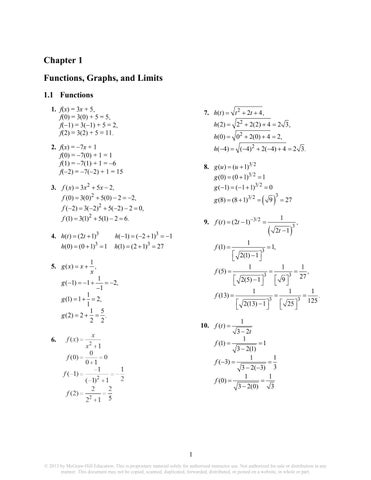
Chapter 1 Functions, Graphs, and Limits 1.1 Functions 1. f(x) = 3x + 5, f(0) = 3(0) + 5 = 5, f(−1) = 3(−1) + 5 = 2, f(2) = 3(2) + 5 = 11.
7. h(t ) =
2. f(x) = −7x + 1 f(0) = −7(0) + 1 = 1 f(1) = −7(1) + 1 = −6 f(−2) = −7(−2) + 1 = 15
h(2)=
22 + 2(2) + 4= 2 3,
h(0)=
02 + 2(0) + 4= 2,
h(−4) =
(−4) 2 + 2(−4) + 4 = 2 3.
) (u + 1)3 2 8. g (u= g (0) = (0 + 1)3 2 = 1 g (−1) = (−1 + 1)3 2 = 0
3. f ( x) = 3 x 2 + 5 x − 2,
( ) =27
f (0) =3(0) 2 + 5(0) − 2 =−2,
g (8) = (8 + 1)3 2 = 9
f (−2) = 3(−2) 2 + 5(−2) − 2 = 0, f (1) 2 6. = 3(1) 2 + 5(1) −=
4. h(t ) =(2t + 1)3 h(0) =(0 + 1)3 =1
3
1
9. f (t ) = (2t − 1) −3/2 =
(
h(−1) =(−2 + 1)3 =−1 h(1) =(2 + 1)3 =27
= f (1)
1 5. g ( x)= x + , x g (−1) =−1 +
t 2 + 2t + 4,
2t − 1
)
3
,
1 = 1, 3 2(1) − 1
1 1 1 = = , 3 3 27 2(5) − 1 9 1 1 1 = f (13) = = . 3 3 125 2(13) − 1 25 = f (5)
1 =−2, −1
1 g (1) =1 + = 2, 1 1 5 g (2) = 2 + = . 2 2
1 3 − 2t 1 f (1) = 1 = 3 − 2(1) 1 1 f (−3) = = 3 − 2(−3) 3 1 1 f (0) = = 3 − 2(0) 3
10. f (t ) =
6.
1 © 2013 by McGraw-Hill Education. This is proprietary material solely for authorized instructor use. Not authorized for sale or distribution in any manner. This document may not be copied, scanned, duplicated, forwarded, distributed, or posted on a website, in whole or part.
2
Chapter 1. Functions, Graphs, and Limits 11. f ( x) = x − x − 2 , f (1) = 1 − 1 − 2 = 1 − −1 = 1 − 1 = 0, f (2) = 2 − 2 − 2 = 2 − 0 = 2, f (3) = 3 − 3 − 2 = 3 − 1 = 3 − 2 = 2. 12. g ( x)= 4 + x g (−2) = 4 + −2 = 6 g (0) =4 + 0 =4 g (2) =4 + 2 =6 −2 x + 4 if 13. h( x) = 2 if x + 1
x ≤1 x >1
h(3) = (3)2 += 1 10 h(1) =−2(1) + 4 =2 h(0) =−2(0) + 4 =4 h(−3) =−2(−3) + 4 = 10 3 if t < −5 14. f (t ) = t + 1 if −5 ≤ t ≤ 5 if t >5 t f(−6) = 3 f(−5) = −5 + 1 = −4 f (16) = = 16 4
15. g ( x) =
x 1 + x2
Since 1 + x 2 ≠ 0 for any real number, the domain is the set of all real numbers. 16. Since x 2 − 1 = 0 for x = ±1 , f(x) is defined only for x ≠ ±1 and the domain does not consist of the real numbers. 17. f (t= ) 1− t Since negative numbers do not have real square roots, the domain is all real numbers such that 1 − t ≥ 0, or t ≤ 1. Therefore, the domain is not the set of all real numbers. 18. The square root function only makes sense for non-negative numbers. Since
of h= (t ) t 2 + 1 consists of all real numbers. x2 + 5 x+2 Since the denominator cannot be 0, the domain consists of all real numbers such that x ≠ −2.
19. g ( x) =
20. f ( x) = x3 − 3 x 2 + 2 x + 5 The domain consists of all real numbers. 21. f = ( x) 2x + 6 Since negative numbers do not have real square roots, the domain is all real numbers such that 2x + 6 ≥ 0, or x ≥ −3. t +1 22. f (t ) = 2 t −t −2 t 2 − t − 2 = (t − 2)(t + 1) ≠ 0 if t ≠ −1 and t ≠ 2.
23. f (t ) =
t+2
9 − t2 Since negative numbers do not have real square roots and denominators cannot be zero, the domain is the set of all real
numbers such that 9 − t 2 > 0, namely −3 < t < 3. 24. h= (s)
s 2 − 4 is defined only if
s 2 − 4 ≥ 0 or equivalently ( s − 2)( s + 2) ≥ 0 . This occurs when the factors ( s − 2) and ( s + 2) are zero or have the same sign. This happens when s ≥ 2 or s ≤ −2 and these values of s form the domain of h. 25. f (u ) = 3u 2 + 2u − 6 and g(x) = x + 2, so f ( g (= x)) f ( x + 2) = 3( x + 2) 2 + 2( x + 2) − 6 = 3 x 2 + 14 x + 10.
t 2 + 1 ≥ 0 for all real numbers t the domain
© 2013 by McGraw-Hill Education. This is proprietary material solely for authorized instructor use. Not authorized for sale or distribution in any manner. This document may not be copied, scanned, duplicated, forwarded, distributed, or posted on a website, in whole or part.
Chapter 1. Functions, Graphs, and Limits 26. f (u= ) u2 + 4 f ( x − 1) = ( x − 1) 2 + 4 = x 2 − 2 x + 5
27. f (u ) =(u − 1)3 + 2u 2 and g(x = x + 1, so f ( g (= x)) f ( x + 1) = [( x + 1) − 1]3 + 2( x + 1) 2 = x3 + 2 x 2 + 4 x + 2.
3
34. For f ( x= ) 2x + 3 , f ( x + h) − f ( x) (2( x + h) + 3) − (2 x + 3) = h h 2 x + 2h + 3 − 2 x − 3 = h 2h = h =2
28. f (= u ) (2u + 10) 2
[ 2( x − 5) + 10]2
f ( x − 5)=
= (2 x − 10 + 10) 2 = 4 x 2 29. f (u ) =
1 u2
and g(x) = x − 1, so
f ( g ( x))= f ( x − 1)=
30. f (u ) =
1 ( x − 1) 2
.
1 u
1 f ( x 2 + x − 2) =2 x + x−2
31. f (u= )
u + 1 and g ( x= ) x 2 − 1, so
f ( g= ( x)) f ( x 2 − 1) =
( x 2 − 1) + 1 = x2 = x.
1 1 2 32. f (u ) u= = , f x − 1 ( x − 1) 2
33. f(x) = 4 − 5x f ( x + h) − f ( x) 4 − 5( x + h) − (4 − 5 x) = h h 4 − 5 x − 5h − 4 + 5 x −5h = = −5 h h
35. f ( x= ) 4 x − x2 f ( x + h) − f ( x ) h 4( x + h) − ( x + h) 2 − (4 x − x 2 ) = h 4 x + 4h − ( x 2 + 2 xh + h 2 ) − 4 x + x 2 = h 2 4 x + 4h − x − 2 xh − h 2 − 4 x + x 2 = h 2 4h − 2 xh − h = h h(4 − 2 x − h) = h =4 − 2 x − h 36. f ( x) = x 2 f ( x + h) − f ( x ) ( x + h) 2 − x 2 = h h 2 x + 2 xh + h 2 − x 2 = h h(2 x + h) = h = 2x + h
© 2013 by McGraw-Hill Education. This is proprietary material solely for authorized instructor use. Not authorized for sale or distribution in any manner. This document may not be copied, scanned, duplicated, forwarded, distributed, or posted on a website, in whole or part.
4
Chapter 1. Functions, Graphs, and Limits
x x +1 f ( x + h) − f ( x ) h x+h − x ( x + h ) +1 x +1 = h x+h − x ( x + h + 1)( x + 1) = x + h +1 x +1 ⋅ ( x + h + 1)( x + 1) h ( x + h)( x + 1) − x( x + h + 1) = h( x + 1)( x + h + 1)
37. f ( x) =
x = 4 x2 0 4 x2 − x = 0 x(4 x − 1) = 1 x 0,= x = 4 Since squaring both sides can introduce extraneous solutions, one needs to check these values.
x 2 + hx + x + h − x 2 − xh − x h( x + 1)( x + h + 1) h = h( x + 1)( x + h + 1) 1 = ( x + 1)( x + h + 1) =
38. f ( x) =
1 x
f ( x + h) − f ( x ) = h
1 −1 x + h x ⋅ x ( x + h)
h x ( x + h) x − ( x + h) = hx( x + h) x−x−h = hx( x + h) −h = hx( x + h) −1 = x ( x + h)
39. f ( g ( x)) = f (1 − 3 x) = 1 − 3 x g ( f ( x)) = g
( x )= 1 − 3 x
To solve 1 − 3 x =− 1 3 x , square both sides, so 1 − 3 x =− 1 6 x + 9x −3 x = −6 x + 9 x 6 x = 12 x x = 2x Squaring both sides again,
Also check remaining value to see if it is in the domain of f and g functions. Since f(0) and g(0) are both defined, f(g(x)) = g(f(x)) when x = 0. 40. f ( x) = x 2 + 1, g ( x) = 1− x
f ( g ( x)) =(1 − x)2 + 1 = x 2 − 2 x + 2 and 1 − ( x 2 + 1) g ( f ( x)) = = − x2 So f ( g ( x)) = g ( f ( x)) means x 2 − 2 x + 2 =− x 2 2 x2 − 2 x + 2 = 0 0 x2 − x + 1 = but, by the quadratic formula, this last equation has no solutions.
( )
x +3 x + 3 2 x −2 + 3 41. = = f ( g ( x)) f= x x +3 − 1 x−2 x −2
2x + 3 ( f ( x)) g = g= x −1
2 x +3 + 3 x −1 = 2 x +3 − 2 x −1
x
Answer will be all real numbers for which f and g are defined. So, f(g(x)) = g(f(x)) for all real numbers except x = 1 and x = 2.
© 2013 by McGraw-Hill Education. This is proprietary material solely for authorized instructor use. Not authorized for sale or distribution in any manner. This document may not be copied, scanned, duplicated, forwarded, distributed, or posted on a website, in whole or part.
Chapter 1. Functions, Graphs, and Limits 1 2+ x , = 4− x 4− x
42. f ( g= ( x))
( 2+ x )
4 − 1x 4 x − 1 = 2 + 1x 2 x + 1
( x)) g ( f=
so f ( g ( x)) = g ( f ( x)) means 2 + x 4x −1 . = 4 − x 2x + 1 Clearing denominators, multiplying, and collecting terms gives (2 + x)(2 x + 1) = (4 x − 1)(4 − x)
2 x + 5 x + 2 =−4 x + 17 x − 4 2
2
6 x 2 − 12 x + = 6 6( x 2 − 2 x + 1) = 6( x − 1) 2 =0 The last equation has solution x = 1 which is in the domains of f ( g ( x)) and g ( f ( x)) . Thus f ( g ( x)) = g ( f ( x)) only for x = 1 . 43. f ( x) = 2 x 2 − 3 x + 1, f ( x − 2) = 2( x − 2) − 3( x − 2) + 1 2
= 2 x 2 − 11x + 15.
44. f ( x= ) x2 + 5 f ( x + 1) = ( x + 1) 2 + 5 = x 2 + 2 x + 6
45. f ( x) =( x + 1) − 3 x , 5
= x5 − 3 x 2 + 6 x − 3.
46. f (= x) (2 x − 6) 2
[ 2( x + 3) − 6]2
= (2 x + 6 − 6) 2 = 4x
x −1 , x ( x + 1) − 1 x f (= x + 1) = . x +1 x +1
49. f ( x) =
50. f ( x= ) 2 x − 20 f ( x 2 − 2 x + 9)= 2( x 2 − 2 x + 9) − 20 = 2 x 2 − 4 x + 18 − 20 = 2 x2 − 4 x − 2
51. f ( x) = ( x − 1) 2 + 2( x − 1) + 3 can be rewritten as g(h(x)) with g (u ) = u 2 + 2u + 3 and h(x) = x − 1. 52. f ( x) = ( x5 − 3 x 2 + 12)3
g (u ) = u 3 h( x) =x5 − 3 x 2 + 12 1
53. f ( x) =
can be rewritten as g(h(x)) x +1 1 with g (u ) = and h( x= ) x 2 + 1. u 2
3 x − 5 can be written as g [ h( x) ]
( x) 54. f =
with g (u= )
u and h( x= ) 3x − 5.
2
f ( x − 1) = [( x − 1) + 1]5 − 3( x − 1) 2
f ( x + 3)=
5
2
4 can be rewritten as 2− x 4 g(h(x)) with g (= u ) 3 u + and u h(x) = 2 − x.
55. f ( x) =
56. f ( x) =
3
2− x +
x+4−
1 ( x + 4)
3
. g (u ) =
u−
1 u3
h( x)= x + 4
47. f ( x) = x , f ( x 2 + 3 x − 1)=
x 2 + 3 x − 1.
2 x 1 1 2 3 f = (3) + 1 = + 2 x x x x x
) 3x + 48. f ( x=
© 2013 by McGraw-Hill Education. This is proprietary material solely for authorized instructor use. Not authorized for sale or distribution in any manner. This document may not be copied, scanned, duplicated, forwarded, distributed, or posted on a website, in whole or part.